Introduction: Beyond Compliance to Strategic Wealth Growth
Advanced tax planning techniques are sophisticated strategies that go beyond yearly tax preparation to legally minimize your tax bill and keep more of your money.
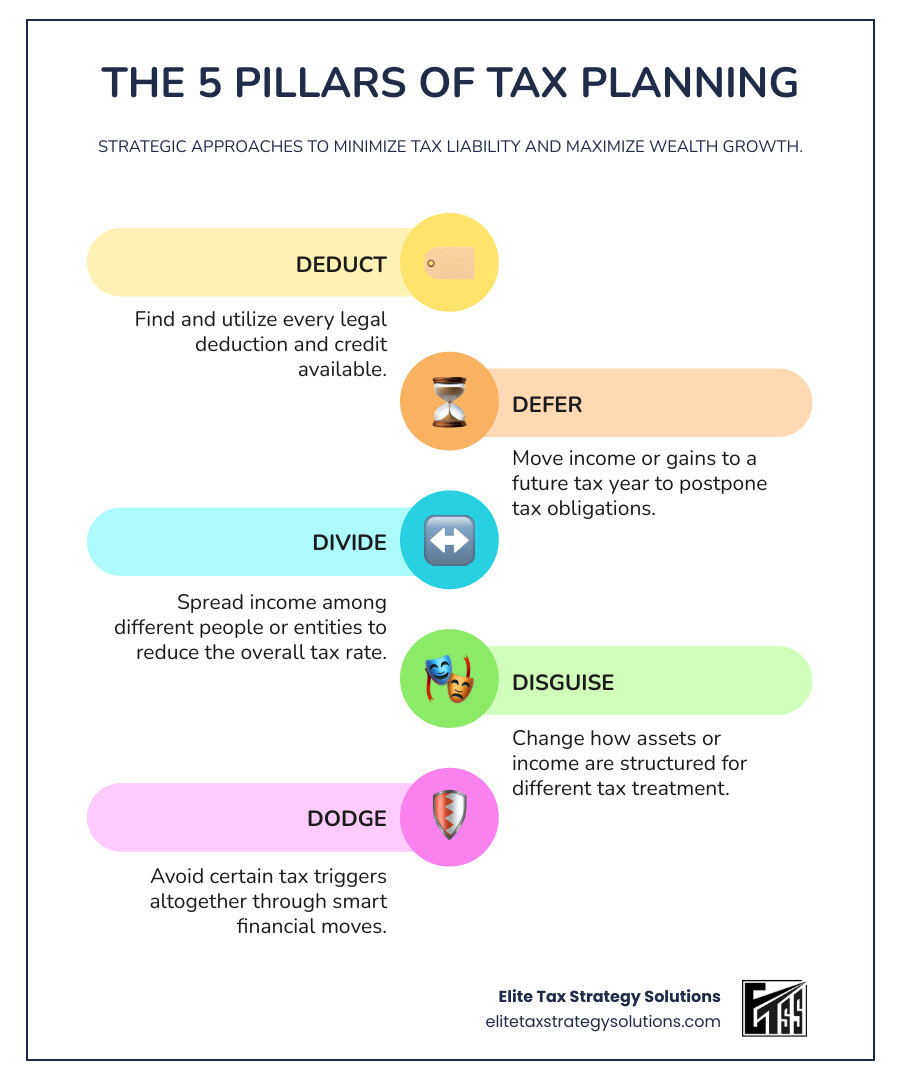
Here’s what advanced tax planning generally involves:
- Deducting: Finding and using every legal deduction and credit.
- Deferring: Moving income or gains to a future tax year.
- Dividing: Spreading income among different people or entities to reduce the overall tax rate.
- Disguising: Changing how assets or income are structured so they are taxed differently.
- Dodging: Avoiding certain tax triggers altogether through smart financial moves.
Why is this important? Complex, ever-changing tax laws can take a large chunk of earnings, especially for businesses and high-income individuals. With over three million tax filers now running their own businesses—a number that’s growing fast—the need for smart tax strategies is greater than ever.
Consider the real savings: one tech company saved $300,000 with the R&D tax credit, and a California investor saved $400,000 through special stock exclusions. These examples show the power of understanding and using advanced tax planning techniques.
I’m David Fritch. With over 40 years of experience owning law and CPA firms and as a former investment advisor, I specialize in innovative advanced tax planning techniques. I help high-income earners and small business owners steer complex tax laws with over 100 custom tax-saving strategies.
In this guide, we’ll explore specific strategies for both businesses and high-income earners. We’ll also cover crucial wealth transfer methods. Let’s dive in.
Common advanced tax planning techniques vocab:
Advanced Tax Planning Techniques for Business Owners

For business owners, smart advanced tax planning techniques can turn the tax burden from a roadblock into a strategic advantage for growth and profitability. Many owners, focused on daily operations, miss huge tax-saving opportunities. Strategic Business Tax Planning is about legally keeping more of what you earn, not just paying what you owe.
Optimizing Your Business with Strategic Entity Structuring
Choosing the right business structure is foundational. Get it wrong, and you’ll pay for it in unnecessary taxes. Get it right, and you’ll save thousands while protecting your assets.
Sole proprietorships are simple, with income on your personal return, but you face unlimited personal liability.
Partnerships allow profits and losses to pass through to partners’ personal returns, avoiding double taxation.
Limited Liability Companies (LLCs) offer liability protection like a corporation with the tax benefits of a partnership, protecting personal assets without double taxation.
S-Corporations allow owners to take a reasonable salary, while additional profits can be distributed without self-employment taxes, saving thousands on Social Security and Medicare.
C-Corporations face double taxation but offer best flexibility for businesses that need to reinvest profits or raise capital.
Here’s a quick comparison to help you see the differences:
| Entity Type | Tax Treatment | Key Benefits | Best For |
|---|---|---|---|
| Sole Proprietorship | All income on personal return, plus self-employment tax | Simple setup and filing | Very small businesses with low liability risk |
| Partnership | Pass-through to partners’ returns | No double taxation, flexible profit sharing | Businesses with multiple owners |
| S-Corporation | Pass-through, but salary subject to payroll taxes | Potential self-employment tax savings | Profitable businesses with active owners |
| C-Corporation | Corporate tax plus shareholder tax on dividends | Growth flexibility, employee benefits | Businesses planning rapid growth or outside investment |
The right choice depends on your specific situation. For deeper insights on S-Corps specifically, check out our guide on Tax Planning for S Corporations. Understanding The Tax Implications of Different Business Entities helps you make an informed decision that could save you tens of thousands over time.
Open uping Savings with Tax Credits and Incentives
Here’s where advanced tax planning techniques really shine. Tax credits are dollar-for-dollar reductions in what you owe. Find a $10,000 credit? That’s $10,000 less you pay in taxes.
The Research and Development (R&D) tax credit is a widely underused credit. Qualifying activities are broad—not just lab work. If you’re improving products, processes, or software, you might qualify. The key is documenting your efforts. The IRS provides detailed guidance in More on the Research Credit from the IRS.
Cost segregation studies allow commercial real estate owners to accelerate depreciation on building components (like carpeting and fixtures) instead of using a 39-year schedule, providing substantial upfront tax savings.
The Work Opportunity Tax Credit (WOTC) provides tax credits up to $9,600 per hire for employing individuals from groups facing employment barriers.
Our approach to Deduction Optimization ensures we catch every credit and incentive your business qualifies for. Most business owners leave money on the table simply because they don’t know these opportunities exist.
Navigating International Waters: Transfer Pricing Essentials
If your business operates across borders, transfer pricing is crucial. This ensures that transactions between your company’s entities in different countries are priced fairly.
The Arm’s Length Principle is your guide, requiring you to price intercompany transactions as if they were between unrelated parties. If your U.S. company sells to your Canadian subsidiary, the price should be what you’d charge any other Canadian customer.
Why does this matter? Improper pricing risks double taxation and hefty penalties for profit shifting avoidance. Tax authorities worldwide are cracking down on artificial arrangements designed to move profits to low-tax jurisdictions. The OECD Transfer Pricing Guidelines provide the international framework most countries follow.
Global tax compliance isn’t just about following rules; it’s about protecting your business. Our Corporate Tax Strategy services help ensure your international operations are structured properly from day one.
Tax-Smart Strategies for High-Income Earners

High-income earners face higher tax brackets and additional taxes like the Net Investment Income Tax (NIIT). The good news is that proven advanced tax planning techniques can help you keep more of what you earn. The key is focusing on your after-tax returns, not just your gross income. Our High Net Worth Tax Planning approach is designed specifically for people in your situation.
Mastering Tax-Efficient Investing and Asset Allocation
Smart investing for high earners means understanding how taxes impact returns and fighting back strategically.
Start with tax-advantaged accounts. Roth IRAs offer tax-free growth and withdrawals, while traditional 401(k)s provide an immediate tax deduction.
Health Savings Accounts (HSAs) offer a triple tax advantage: deductible contributions, tax-free growth, and tax-free withdrawals for medical expenses. After 65, funds can be used for any purpose.
Tax-loss harvesting involves selling losing investments to offset capital gains. You can deduct up to $3,000 in excess losses against ordinary income annually, with the rest carrying forward.
Timing matters. Holding assets for more than a year qualifies you for lower long-term capital gains rates, which can mean paying 20% instead of 37% on investment profits.
Municipal bonds offer interest that is typically exempt from federal income tax, making them highly attractive for those in top tax brackets. The SEC guidance on municipal bonds provides valuable information for making informed decisions.
For a comprehensive look at these strategies, check out our guide on Tax-Efficient Investments.
Leveraging Advanced Tax Planning Techniques for Personal Income
Beyond smart investing, several sophisticated strategies can dramatically reduce your personal tax burden.
Income deferral is powerful if you expect to be in a lower tax bracket next year. Deferring bonuses or sales can save thousands. Our detailed guide on How to Defer Income to Next Year walks through the specific techniques.
Deduction bunching involves concentrating itemized deductions (like charitable gifts) into a single year to exceed the standard deduction, then taking the standard deduction in the alternate year to maximize your total benefit.
Qualified Small Business Stock (QSBS) is a game-changer. Section 1202 of the tax code offers a generous tax break. If you hold qualified small business stock for over five years, you may exclude up to 100% of the gains from federal income tax. The California investor who saved $400,000 used this exclusion when selling startup shares.
The QSBS exclusion can be worth millions, with a maximum exclusion of the greater of $10 million or 10 times your basis in the stock. For an investor who put $100,000 into a startup that later sold for $10 million, the entire $9.9 million gain could be federally tax-free.
These strategies are part of what we consider the 5 Outstanding Tax Strategies for High-Income Earners. The key is implementing them as part of a coordinated plan.
Securing Your Legacy: Advanced Wealth Transfer and Estate Planning

Passing on your hard-earned wealth to loved ones can be challenged by estate and wealth transfer taxes. Advanced tax planning techniques are essential to secure your legacy and keep more money within your family.
At Elite Tax Strategy Solutions, our Tax and Wealth Planning services focus on making sure your assets are safe, your wishes are honored, and future tax bills are minimized.
Using Trusts to Preserve Assets and Minimize Taxes
Trusts are flexible estate planning tools that hold your assets, allowing you to control their distribution while often providing significant tax benefits.
Assets placed in an irrevocable trust generally leave your taxable estate, reducing future estate taxes and protecting assets from creditors. An Intentionally Defective Grantor Trust (IDGT) removes assets from your estate for tax purposes, but you continue to pay the income tax, allowing the trust assets to grow tax-free for your beneficiaries.
A Spousal Lifetime Access Trust (SLAT), set up by one spouse for the other, removes assets from the grantor’s estate while allowing the beneficiary spouse access to the funds, balancing tax savings with flexibility. A Qualified Personal Residence Trust (QPRT) lets you transfer your home into a trust, removing its value from your estate, while you continue to live in it for a set period.
Charitable Remainder Trusts (CRTs) are ideal for highly appreciated assets. You donate an asset to the trust, which sells it tax-free. The trust then pays you an income stream for a set term, with the remainder going to a charity you choose. You get an immediate tax deduction, avoid capital gains tax, receive an income, and support a cause you care about. The IRS has helpful IRS information on Charitable Remainder Trusts if you want to dive deeper.
A Grantor Retained Annuity Trust (GRAT) allows you to transfer appreciating assets out of your estate with little to no gift tax. If the assets grow faster than the IRS-assumed rate, the excess growth passes to your beneficiaries tax-free. Using these trusts is a key part of smart Tax-Efficient Estate Planning.
Strategic Gifting and Philanthropic Strategies
Giving back can be one of the smartest advanced tax planning techniques out there, allowing you to support causes you believe in while lowering your tax bill.
The annual gift tax exclusion lets you give up to $18,000 (for 2024) to any number of individuals each year, tax-free, reducing your taxable estate over time.
The generous lifetime gift and estate tax exemption (over $13 million per person in 2024) allows for larger tax-free gifts. A creative strategy is “upstream gifting,” where you gift an appreciated asset to an older relative. Upon their passing, the asset receives a “step-up in basis,” potentially eliminating capital gains tax for the next generation.
If you’re 70 ½ or older, Qualified Charitable Distributions (QCDs) allow you to donate up to $100,000 annually directly from your IRA to charity, tax-free. This donation can satisfy your Required Minimum Distribution (RMD) without being counted as taxable income. The IRS has More on QCDs from the IRS if you want to learn more.
Finally, instead of cash, consider gifting appreciated securities held for over a year. You can deduct the full market value and avoid paying capital gains tax on the appreciation. This is a powerful strategy for Tax Liability Reduction.
Frequently Asked Questions about Tax Optimization
We know that advanced tax planning techniques can feel overwhelming. Here are straightforward answers to the most common questions we hear.
What is the main goal of advanced tax planning?
The main goal is to legally minimizing your tax liability, which in turn maximizes the wealth you can preserve and grow. For businesses, saved tax dollars can be reinvested into growth. For individuals, it means building a more secure financial future. It’s about proactive financial management and forward-thinking Strategic Tax Planning rather than reacting at tax time.
What are the 5 pillars of tax planning?
While the ‘five D’s’ (Deduct, Defer, Divide, Disguise, Dodge) provide a framework, our practical pillars for Proactive Tax Planning include:
- Bunching deductions: Grouping deductible expenses into one year to exceed the standard deduction.
- Strategic charitable contributions: Donating appreciated assets instead of cash to maximize tax benefits.
- Understanding contribution limits: Maxing out contributions to accounts like 401(k)s, IRAs, and HSAs.
- Timing of income and expenses: Deferring income or accelerating expenses to lower your tax burden in a given year.
- Utilizing tax-advantaged accounts: Using retirement, health, and education savings accounts to shelter money from taxes.
How can I reduce my taxable income?
There are many legitimate ways to reduce your taxable income as part of a plan to How to Minimize Taxes:
- Retirement contributions: Maximize contributions to traditional 401(k)s, IRAs, SEP-IRAs, or Solo 401(k)s.
- Maximizing deductions: Diligently track and claim all eligible business and personal deductions.
- Tax credits: Take advantage of credits like the R&D credit, which reduce your tax bill dollar-for-dollar.
- Tax-loss harvesting: Sell losing investments to offset capital gains.
- Income deferral: Shift income into a future year when you may be in a lower tax bracket.
- Qualified Business Income (QBI) deduction: If eligible, this can deduct up to 20% of your business income.
Conclusion: Partnering for Proactive Financial Success
We’ve explored a range of advanced tax planning techniques, from business structuring to wealth transfer. The common thread is that proactive planning is the key to financial empowerment. Waiting until tax season is reactive; strategic, year-round planning yields far better results.
The tax landscape is a complex, ever-changing maze. What worked last year may not be optimal this year, which is why professional guidance is essential to maximize your financial potential. At Elite Tax Strategy Solutions, we reject cookie-cutter solutions. Whether you’re in Jasper, Indiana, or a major suburb, we create a personalized plan based on your unique goals.
Our holistic approach examines your entire financial ecosystem, considering how today’s decisions impact your long-term goals, retirement, and legacy. This allows us to implement synergistic strategies for compounding benefits. Having a trusted partner means staying current on regulatory changes, identifying hidden opportunities, and ensuring compliance while optimizing your tax position.
The significant savings achieved by the investor and tech company mentioned earlier weren’t lucky breaks; they were the result of expert guidance. Your success story could be next. The cost of inaction often far exceeds the investment in professional planning. Let us help you keep more of what you’ve worked so hard to earn.
Take control of your financial future with our comprehensive financial planning services.