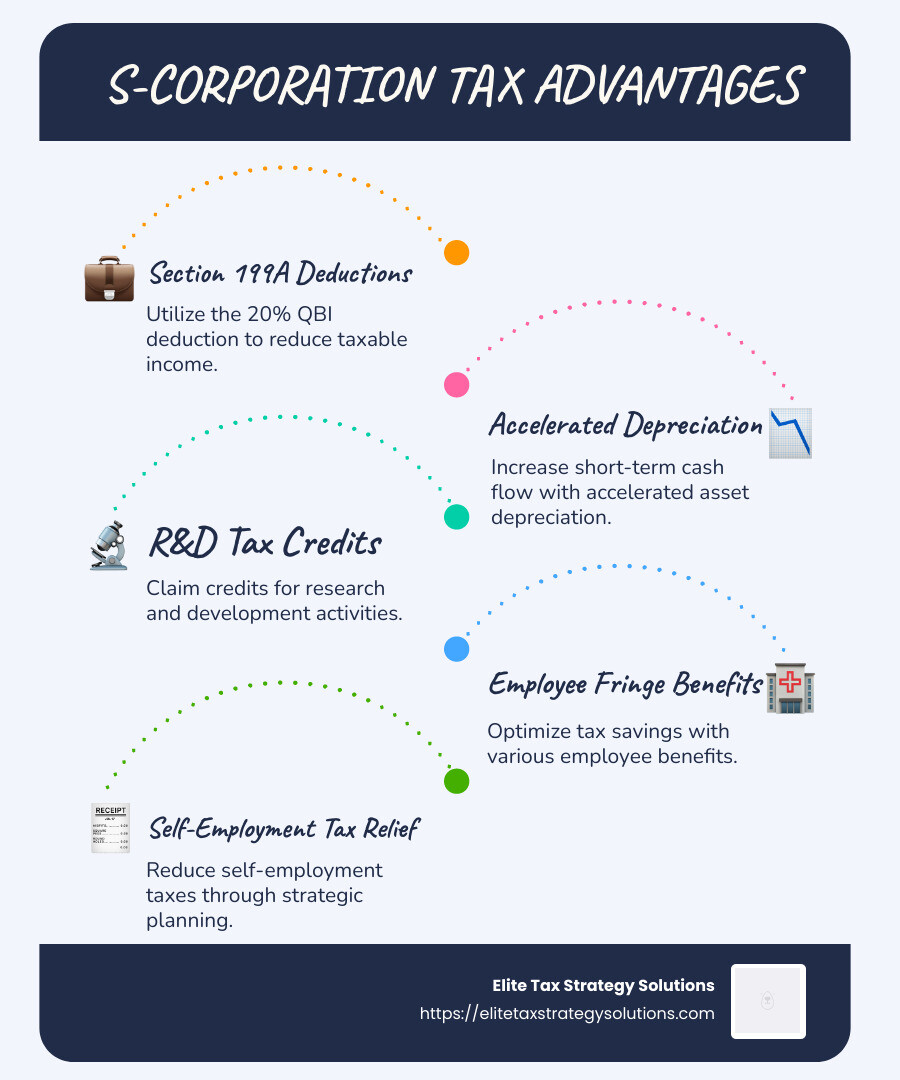
Tax planning for S-corporations can lead to significant financial advantages for small business owners and high-income earners. If you’re looking for ways to reduce taxable income and improve your company’s financial efficiency, understanding these strategies is key:
- Leveraging Section 199A deductions
- Employing accelerated depreciation
- Maximizing research and development tax credits
- Optimizing employee fringe benefits
Navigating the complexities of S-corporation taxation can feel overwhelming, but the potential rewards make the effort worthwhile. S-corporations benefit from pass-through taxation, avoiding the double taxation faced by C-corporations. This means profits pass directly to shareholders’ personal tax returns, leading to substantial tax savings and simplified income reporting.
My name is David Fritch, and with over 40 years of experience in tax planning for S-corporations, I’ve guided numerous business owners through these complexities to maximize their savings and financial growth. Let’s dig deeper into S-corporation tax advantages.
Find more about tax planning for S-corporations:
– business tax planning strategies
– high net worth tax strategies
– tax planning for high salaried employees
Understanding S-Corporation Taxation
Navigating the complexities of S-corporation taxation can feel overwhelming, but the potential rewards make the effort worthwhile. S-corporations benefit from pass-through taxation, avoiding the double taxation faced by C-corporations. This means profits pass directly to shareholders’ personal tax returns, leading to substantial tax savings and simplified income reporting.
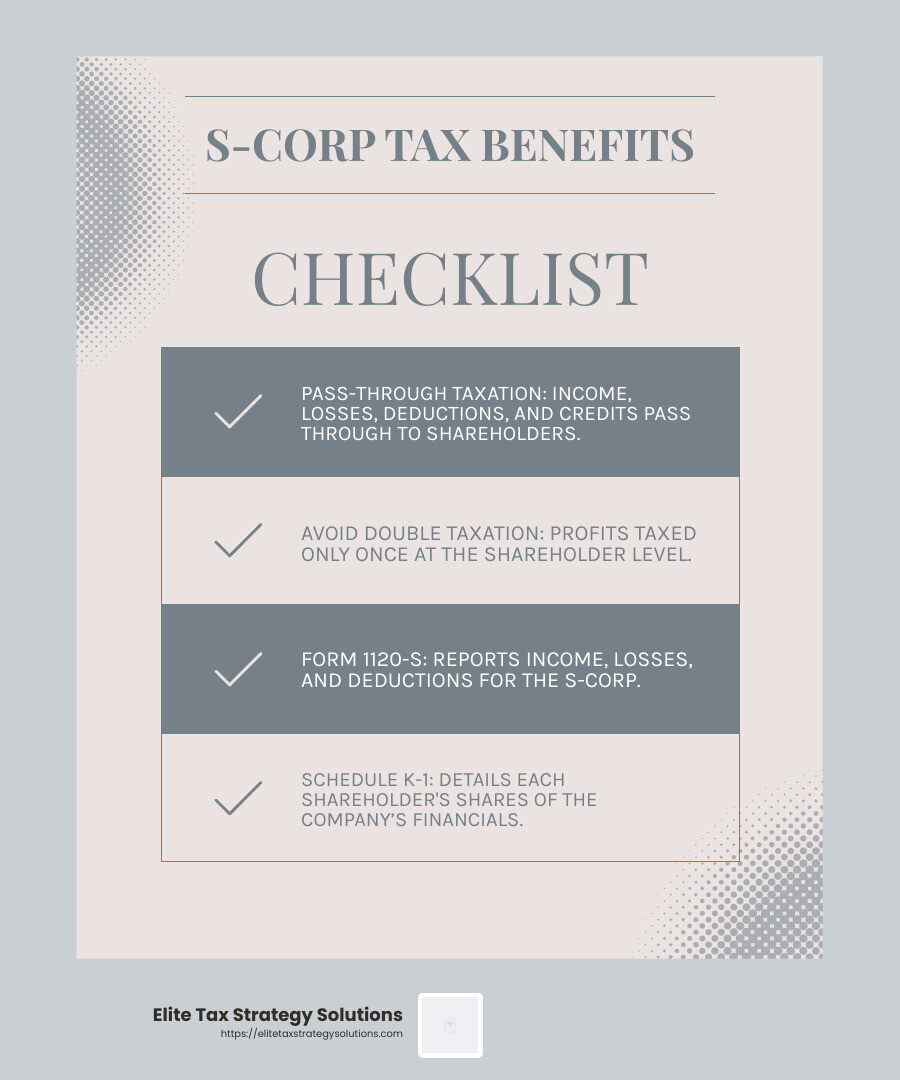
Pass-Through Taxation
One of the biggest perks of an S-corporation is its pass-through entity status. Instead of the corporation paying taxes, the income, losses, deductions, and credits flow through to individual shareholders. This means that each shareholder reports their share of the S-corp’s financial activities on their personal tax returns. For example, if your S-corp earns $100,000 in profit and you own 50% of the shares, you’ll report $50,000 on your personal tax return.
Why is this beneficial?
– Avoids Double Taxation: Unlike C-corporations, S-corporations don’t pay corporate income tax. Profits are only taxed once on the personal level.
– Simplified Reporting: Shareholders can report business income and expenses directly, making it easier to manage taxes.
Avoiding Double Taxation
A significant advantage of the S-corp structure is the avoidance of double taxation. In a C-corporation, profits are taxed at the corporate level first, and then again when dividends are paid to shareholders. However, with an S-corp, profits are only taxed once at the shareholder level. This can result in substantial tax savings.
Example:
– A C-corp makes $100,000 in profit and pays 21% corporate tax = $21,000.
– If the remaining $79,000 is distributed as dividends, shareholders pay tax again, potentially at a rate of 20%.
– In contrast, an S-corp with the same $100,000 profit passes this directly to shareholders, who pay only their personal income tax rate.
Key IRS Forms
To maintain compliance with the IRS, S-corporations must file specific forms:
-
Form 1120-S: This is the U.S. Income Tax Return for an S Corporation. It reports the corporation’s income, losses, deductions, and credits. Filing Form 1120-S is crucial for documenting the corporation’s financial activities and ensuring proper tax reporting.
-
Schedule K-1 (Form 1065): Each shareholder receives a Schedule K-1, which details their share of the corporation’s income, deductions, and credits. Shareholders must include this information on their personal tax returns.
Compliance Tip:
Working with a tax professional can help ensure these forms are filled out correctly and submitted on time. Proper compliance not only avoids penalties but also maximizes potential tax benefits.
In summary, understanding and leveraging the unique taxation structure of S-corporations can lead to significant tax savings and streamlined financial reporting. By taking advantage of pass-through taxation and avoiding double taxation, S-corporation owners can optimize their tax strategy and improve their business’s financial health.
Next, we’ll explore the tax advantages of S-corporations, including how pass-through status and other benefits can further improve your tax planning strategy.
Tax Advantages of S-Corporations
S-corporations offer several tax advantages that can significantly reduce your tax burden and improve your financial strategy. Let’s explore these benefits.
Pass-Through Status
One of the primary benefits of an S-corporation is its pass-through status. This means that business income, deductions, credits, and losses are passed directly to the shareholders, bypassing corporate-level taxation.
Key Benefits:
– No Double Taxation: Unlike C-corporations, S-corporations do not pay corporate income tax. Instead, profits are only taxed at the shareholder level.
– Simplified Tax Reporting: Shareholders report their share of the corporation’s financial activities on their personal tax returns, making tax filing more straightforward.
Employee Income Advantage
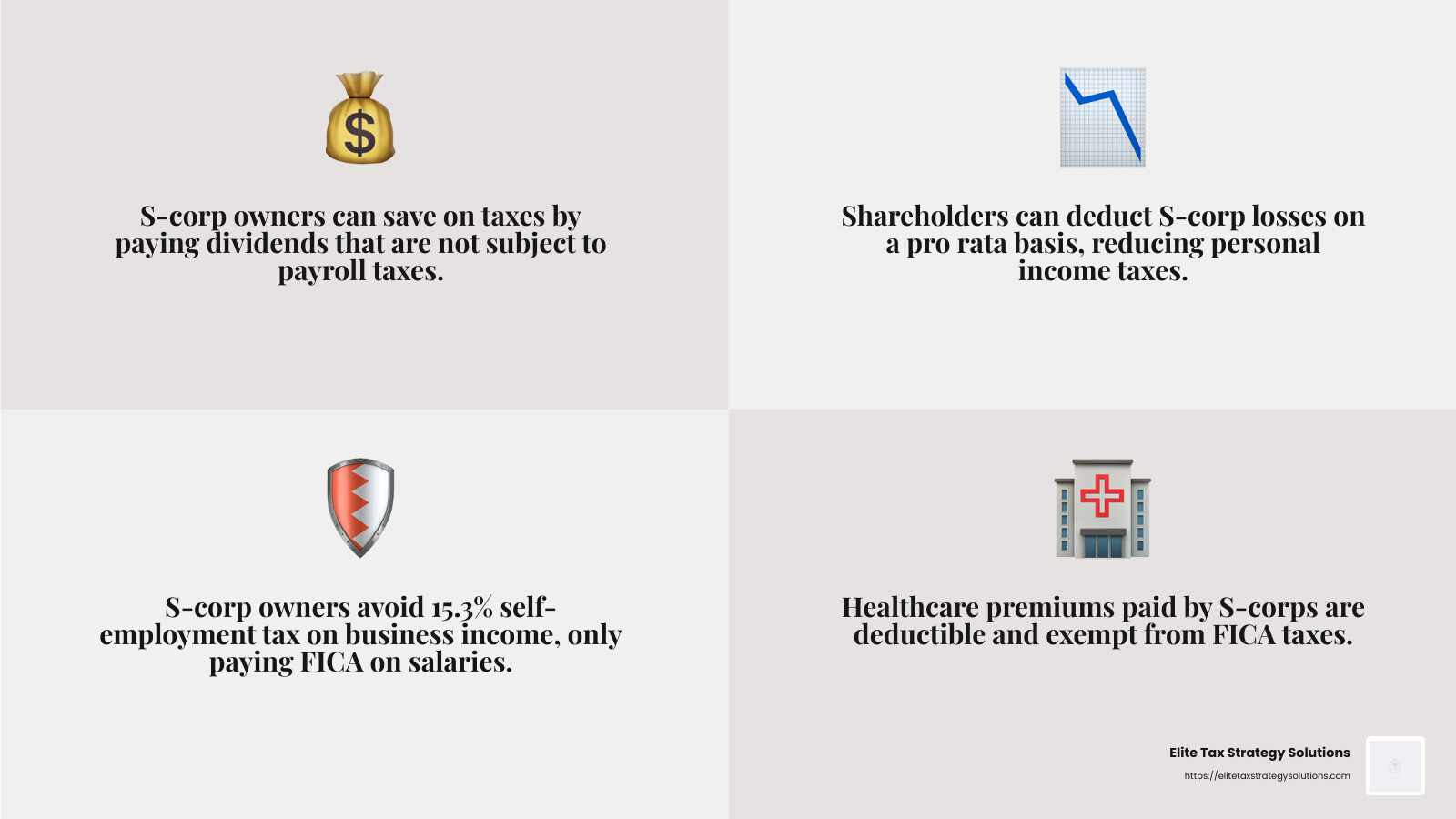
S-corporation owners must pay themselves a reasonable salary. This salary is subject to payroll taxes, but any additional income can be distributed as dividends, which are not subject to self-employment taxes.
Example:
– An S-corp owner pays themselves a $60,000 salary and takes $40,000 in dividends.
– The salary is subject to payroll taxes, but the dividends are not, resulting in significant tax savings.
Tip: Ensure the salary is “reasonable” according to industry standards to avoid IRS scrutiny.
Loss Deductions
If an S-corporation incurs a loss, it can pass this loss on to shareholders on a pro rata basis. These losses can then be deducted from other income on the shareholder’s personal tax return, reducing overall taxable income.
Example:
– If your S-corp has a $20,000 loss and you own 50%, you can deduct $10,000 from your personal income.
Self-Employment Tax Relief
S-corporation owners do not have to pay the 15.3% self-employment tax on their share of the business income. Instead, FICA taxes (Medicare and Social Security) are only applied to the salary portion.
Additional Benefit:
– Contributions to a shareholder/employee’s retirement plan are also tax-exempt, further reducing taxable income.
Healthcare Insurance
S-corporations can provide significant tax savings on healthcare costs. Healthcare premiums paid by the S-corp for its owners can be expensed as wages, making them deductible and exempt from FICA taxes.
Example:
– If your S-corp pays $5,000 in healthcare premiums, this amount can be deducted as a business expense, reducing taxable income.
In summary, the tax advantages of S-corporations—pass-through status, employee income advantage, loss deductions, self-employment tax relief, and healthcare insurance deductions—can lead to substantial tax savings and streamlined financial management.
Next, we’ll explore strategies to further reduce your S-corporation’s taxes, including itemizing deductions and leveraging home office expenses.
Strategies to Reduce Taxes for S-Corporations
Reducing taxes for your S-corporation involves smart planning and strategic moves. Here are some effective strategies to consider.
Itemize Business Deductions
Itemizing deductions can significantly lower your taxable income. Here are some key areas to focus on:
- Vehicle Expenses: If you use your vehicle for business purposes, you can deduct expenses like gas, repairs, and insurance. Keep a detailed log of business mileage to substantiate these deductions.
- Charitable Donations: Donations made by the S-corp to qualified charities can be deducted, lowering your taxable income.
- Real-Estate Taxes: If your S-corp owns property, the real estate taxes paid are fully deductible.
- Marketing Costs: Money spent on advertising and marketing is fully deductible and helps grow your business.
- Salaries and Wages: Employee salaries and wages, including your own, are deductible. This also includes bonuses and other compensation.
- Travel Expenses: Business travel expenses, such as airfare, lodging, and meals, are deductible. Ensure you keep detailed records.
- Professional Fees: Fees paid for legal, accounting, and other professional services are deductible.
Home Office Deduction
If you use part of your home for business, you can take advantage of the home office deduction.
- Exclusive Use: The space must be used only for business purposes. A home office that doubles as a guest room won’t qualify.
- Proportional Expenses: You can deduct expenses like rent, utilities, and repairs based on the proportion of your home used for business. For example, if your home office is 10% of your home’s total square footage, then 10% of these expenses can be deducted.
- IRS Compliance: Keep detailed records of all expenses and use a methodical approach to calculate deductions. Consulting with a tax professional can ensure you maximize your deductions and stay compliant.
Pay Yourself a Reasonable Salary
The IRS requires S-corp owners to pay themselves a reasonable salary before taking distributions.
- Reasonable Compensation: This depends on your role, industry standards, and the size of your business. Pay yourself what you would pay someone else doing the same job.
- 60/40 Rule: A common strategy is the 60/40 rule, where 60% of your total compensation is salary and 40% is distributions. This helps balance payroll taxes against income taxes.
Hire Your Children
Hiring your children can be a smart way to reduce your S-corp’s taxable income.
- Family Business: Ensure the work is age-appropriate and genuinely contributes to your business.
- Tax-Free Threshold: Each child can earn up to $12,000 tax-free under current IRS rules.
- Payroll Taxes: Salaries paid to children are deductible from the business income, lowering overall taxable income.
Deduct State Taxes
Navigating state taxes can significantly impact your S-corp’s tax liabilities.
- SALT Deduction: The State and Local Tax (SALT) cap is set at $10,000, but many states have adopted the Pass-Through Entity Tax (PTET) to circumvent this limit.
- PTET: By opting into PTET, S-corps can treat state taxes as a business expense, potentially reducing taxable income at the federal level.
- State Tax Credit: S-corp owners in eligible states who elect the PTET option also receive a state tax credit on their individual taxes.
Use Tax Credits
Take advantage of available tax credits to reduce your S-corp’s tax liability.
- Research and Development (R&D) Credits: If your business engages in R&D, you may qualify for significant tax credits.
- Retirement Plan Startup Costs: There are credits available for starting retirement plans for your employees.
- Electric Vehicle Credit: If your business uses electric vehicles, you may qualify for credits.
- Empowerment Zone Employment Credit: If your business operates in certain areas, you may qualify for employment credits.
Qualified Business Income (QBI) Deduction
Eligible S-corps can take the QBI deduction (Section 199A), which can amount to as much as 20% of a business’s total taxable income.
- Net Business Income: The IRS defines QBI as the net amount of business income, gains, losses, and deductions.
- Specified Service Trade or Business: To be eligible, a business must be in a specified service trade or business, such as a lawyer, doctor, or consultant.
By implementing these strategies, you can optimize your S-corp’s financial health and minimize your tax burden. Next, we’ll dig into advanced tax planning techniques to further improve your S-corp’s benefits.
Advanced Tax Planning Techniques
Minimizing Taxes Through Salary Adjustments
One of the most effective ways to reduce your S-corp’s tax burden is through salary adjustments. The IRS requires S-corp owners to pay themselves a reasonable salary before taking distributions.
- Reasonable Compensation: This means paying yourself what you would pay someone else for doing the same job. Look at industry standards and the size of your business to determine this amount.
- 60/40 Rule: A common strategy is to allocate 60% of your total compensation as salary and 40% as distributions. This helps balance payroll taxes against income taxes.
Maximizing Deductible Expenses
Business Deductions are another powerful tool for reducing taxable income. Here are some key areas where you can maximize deductions:
- Vehicle Expenses: If you use your vehicle for business, you can deduct expenses like gas, repairs, and insurance. Just make sure to document the business use portion.
- Real Estate Taxes: If your S-corp owns property, the real estate taxes paid are fully deductible.
- Marketing Costs: Money spent on advertising and marketing is fully deductible and can also help grow your business.
- Employee Benefits: Health insurance, retirement plans, and education assistance are deductible expenses that can also improve employee retention.
Leveraging Home Office Deductions
If you use part of your home for business, you can take advantage of the home office deduction.
- Exclusive Use: The space must be used only for business purposes. A home office that doubles as a guest room won’t qualify.
- Proportional Expenses: You can deduct expenses like rent, utilities, and repairs based on the proportion of your home used for business. For example, if your home office is 10% of your home’s total square footage, then 10% of these expenses can be deducted.
- IRS Compliance: Keep detailed records of all expenses and use a methodical approach to calculate deductions. Consulting with a tax professional can ensure you maximize your deductions and stay compliant.
Employing Family Members to Reduce Taxes
Hiring your children or other family members can be a smart way to reduce your S-corp’s taxable income.
- Child Employment: Ensure the work is age-appropriate and genuinely contributes to your business.
- Tax-Free Threshold: Each child can earn up to $12,000 tax-free under current IRS rules.
- Salary Benefits: Salaries paid to children are deductible from the business income, lowering overall taxable income.
Utilizing State-Specific Tax Benefits
State tax laws can significantly impact your S-corp’s tax liabilities.
- SALT Cap: The State and Local Tax (SALT) cap is set at $10,000, but many states have adopted the Pass-Through Entity Tax (PTET) to circumvent this limit.
- PTET Strategies: By opting into PTET, S-corps can treat state taxes as a business expense, potentially reducing taxable income at the federal level.
- Local Credits: Check for any state-specific credits that could reduce your tax burden further.
Exploring Tax Credits and Incentives
Tax credits are a direct way to reduce your tax liability. Here are some credits that can be particularly beneficial for S-corps:
- R&D Credits: If your business engages in research and development, you may qualify for significant tax credits.
- Retirement Plan Costs: There are credits available for starting retirement plans for your employees.
- Healthcare Premiums: Under certain conditions, S-corps can deduct the cost of health insurance premiums, reducing taxable income.
Implementing these advanced tax planning techniques can help your S-corp leverage both federal and state tax laws to your advantage, potentially saving significant amounts on your tax bills. Next, we’ll dig into frequently asked questions about S-corp tax strategies.
Frequently Asked Questions about S-Corp Tax Strategies
How can I ensure my salary meets the IRS’s “reasonable compensation” standard?
Ensuring your salary meets the IRS’s “reasonable compensation” standard is crucial to avoid audits and penalties.
-
Research Industry Standards: Look at what others in similar roles and industries are paid. Websites like the Bureau of Labor Statistics can provide this data.
-
Reflect on Role and Responsibilities: Consider the scope and impact of your duties within the company. Your salary should reflect your role’s importance.
-
Consult with Professionals: A tax advisor or financial consultant can offer personalized guidance based on your specific situation and ensure you meet IRS requirements.
What are the best practices for documenting home office deductions?
To take advantage of home office deductions without risking IRS scrutiny, follow these best practices:
-
Exclusive Use: Ensure the space is used only for business purposes. This area must not be used for any personal activities.
-
Keep Detailed Records: Maintain receipts and records of all expenses related to your home office, including utilities, insurance, and internet costs.
-
Calculate the Proportionate Use: Deduct expenses based on the percentage of your home used for business. Measure your workspace and divide by the total area of your home to get this percentage.
How do specific state tax laws affect my S-Corp’s tax strategy?
State tax laws can significantly impact your S-Corp’s tax strategy due to variations in tax rates, deductions, and credits. Here’s what you need to consider:
-
Understand Local SALT Laws: Be aware of state and local tax (SALT) deductions and how they cap at $10,000. This can affect how much you can deduct on your federal tax return.
-
Explore State-Specific Credits: Some states offer unique tax credits for small businesses and S-Corps that can reduce your liability.
-
Consult State Tax Experts: Since state laws vary widely, it’s wise to work with a tax professional who specializes in your state’s specific tax landscape.
By staying informed and proactive, you can steer these complexities effectively.
Next, we’ll dig into advanced tax planning techniques to help your S-corp leverage both federal and state tax laws to your advantage.
Conclusion
At Elite Tax Strategy Solutions, we understand that every S-Corp’s financial landscape is unique. That’s why our approach to tax planning for S-corporations is personalized and proactive.
Personalized Financial Solutions
We start by diving deep into your financial situation. Our goal is to identify areas for improvement and craft strategies that align with your business and personal financial goals. Whether it’s optimizing your salary structure, reevaluating deductible expenses, or exploring tax credits, we ensure every move benefits your bottom line.
Proactive Tax Planning
Tax laws are constantly changing, and staying ahead can be challenging. We keep our clients informed about the latest tax law changes and how they can affect your business. By anticipating future changes and planning accordingly, we help you avoid surprises at tax time.
Our proactive strategies include:
– Regular reviews of your business structure to ensure it’s still the best choice for tax purposes.
– Advanced planning for significant business transactions to minimize tax liabilities.
– Utilizing lesser-known deductions and credits that could save you money.
Client Care
At the heart of Elite Tax Strategy Solutions is our commitment to client care. We believe in building lasting relationships based on trust, transparency, and mutual respect. Our team is dedicated to understanding not just your business needs but your personal goals as well.
Our client-first approach means we’re always available to answer your questions, help you understand complex tax issues, and provide guidance on financial decisions. We take care of the details so you can focus on what you do best—running your business.
To learn more about how we can help maximize your S-Corp’s tax benefits, visit our Innovative Tax Planning page.
By partnering with us, you gain a trusted advisor dedicated to ensuring your financial health and long-term success. Let’s work together to steer the intricacies of S-Corp taxation with confidence and ease. Your business deserves no less.