Business tax planning strategies are essential for any entrepreneur looking to improve business success and ensure financial stability. If you’re searching for effective strategies to manage your business taxes, here are the key points:
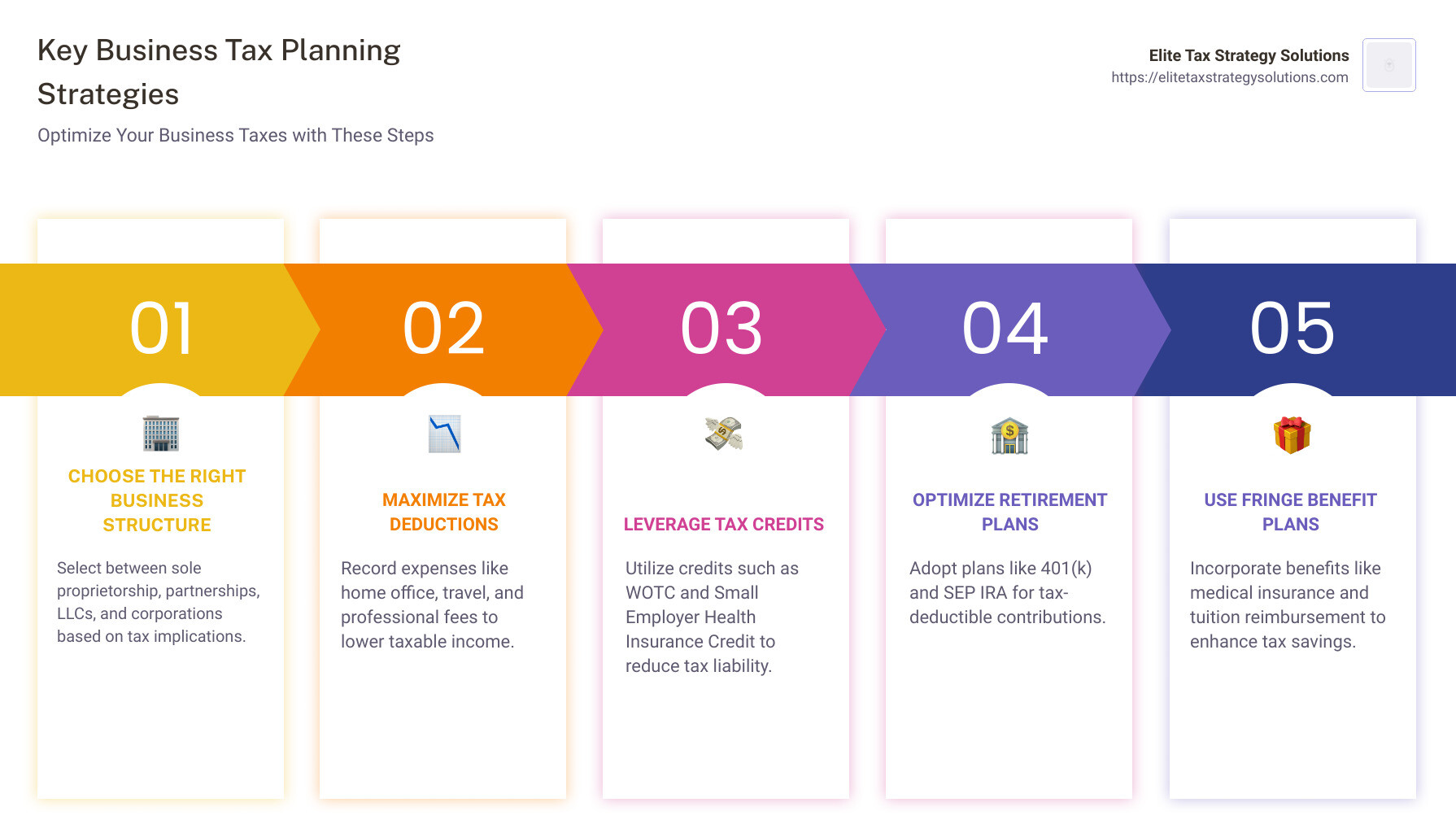
- Choose the Right Business Structure: Different structures like sole proprietorships, partnerships, and LLCs each have distinct tax implications.
- Maximize Tax Deductions: Keep track of expenses like home office deductions, travel, and professional fees to reduce taxable income.
- Leverage Tax Credits: Take advantage of credits like the Work Opportunity Tax Credit (WOTC) and the Small Employer Health Insurance Credit.
Tax planning is more than just an annual task; it’s a strategic approach that can pave the way for long-term financial growth and stability. By staying informed and proactive, small business owners can steer the complexities of tax regulations to save money and ensure compliance.
I’m David Fritch, with 40 years of experience in managing both a law firm and a CPA practice. My expertise in business tax planning strategies has helped numerous small business owners optimize their tax positions and achieve their financial goals.
Next, let’s dig deeper into how choosing the right business structure can significantly impact your tax planning efforts.
Must-know business tax planning strategies terms:
– advanced tax planning strategies
– high net worth tax strategies
– tax advice for high earners
Choose the Right Business Structure
Choosing the right business structure is one of the most important business tax planning strategies. Your structure can affect how much you pay in taxes, the amount of paperwork your business is required to do, the personal liability you face, and your ability to raise money.
Sole Proprietorship
A sole proprietorship is the simplest and most common structure chosen to start a business. This type of business is owned and run by one individual, and there is no legal distinction between the owner and the business.
Tax Implications:
- Business income is reported on your personal tax return using Schedule C (Form 1040).
- You pay self-employment taxes (Social Security and Medicare) via Schedule SE (Form 1040).
- You bear full responsibility for any debts and legal issues.
Partnerships
A partnership involves two or more people who agree to share in the profits or losses of a business. Partnerships are known as pass-through entities.
Tax Implications:
- The business itself doesn’t pay income tax. Instead, profits and losses are passed on to the individual partners.
- Each partner reports their share of the partnership’s income or loss on their personal tax returns.
Limited Liability Company (LLC)
An LLC offers flexibility in how you are taxed. It can be treated as a sole proprietorship, partnership, S corporation, or C corporation for tax purposes, depending on elections made by the LLC and the number of members.
Tax Implications:
- Default Classification: An LLC with one member is treated as a sole proprietorship, and an LLC with multiple members is treated as a partnership.
- S Corporation Election: Allows the business to avoid double taxation, as income is passed through to shareholders who report it on their personal tax returns.
- C Corporation Election: Business profits are taxed at the corporate level, and dividends paid to shareholders are taxed at the individual level.
S Corporation
An S corporation is a special type of corporation that allows profits, and some losses, to be passed directly to the owners’ personal income without ever being subject to corporate tax rates.
Tax Implications:
- Avoids double taxation (corporate tax and personal income tax).
- Shareholders must pay themselves a “reasonable salary” and pay payroll taxes on that salary. Any remaining income can be paid as dividends, which are taxed at a lower rate.
C Corporation
A C corporation is a legal entity that is separate from its owners. It can make a profit, be taxed, and can be held legally liable.
Tax Implications:
- Subject to double taxation: profits are taxed at the corporate level and again at the individual level when dividends are distributed to shareholders.
- Can reinvest earnings back into the business at a lower corporate tax rate, which can be beneficial for long-term growth strategies.
Expert Tip: Ines Zemelman, EA, Founder of TFX, advises that “if you have a stable income stream and earn enough money to pay yourself as an ’employer’ and an ’employee’ in your company, converting a partnership or a sole proprietorship into an S corporation could lower your taxes.”
Choosing the right structure can save you money and headaches down the road. Always consult a tax professional to help you understand the best structure for your specific situation.

Next, let’s explore how you can maximize your tax deductions to reduce taxable income.
Maximize Tax Deductions
Reducing your taxable income through tax deductions is one of the smartest ways to lower your overall tax bill. Here are some key areas where you can maximize your deductions:
Home Office Deductions
If you run your business from home, you might qualify for the home office deduction. This allows you to deduct expenses related to the portion of your home used exclusively for business. There are two methods to calculate this deduction:
- Simplified Method: Deduct $5 per square foot of your home office, up to 300 square feet.
- Actual Expenses Method: Calculate the percentage of your home used for business and deduct that portion of your expenses, like mortgage interest, rent, utilities, and repairs.
Pro Tip: Ensure your home office is used regularly and exclusively for business to qualify for this deduction.
Internet and Phone Expenses
Your internet and phone bills can also be partially deductible if they are used for business purposes. Keep detailed records of your business usage to accurately claim these expenses.
- Internet: Deduct the portion of your internet bill that is used for your business.
- Phone: If you use your personal phone for business, you can deduct the business-related portion of your phone bill.
Travel and Entertainment
Business-related travel and entertainment expenses can add up quickly. Here’s what you can deduct:
- Travel: Expenses like airfare, hotel stays, meals, and car rentals for business trips are deductible.
- Entertainment: While the rules have become stricter, you can still deduct 50% of business meals if they are directly related to your business.
Case Study: A financial advisor in Los Angeles found that deducting actual auto expenses was more beneficial than using the IRS mileage allowance due to the high cost of luxury vehicles and extensive driving.
Education Expenses
Investing in your education can also save you money on taxes. You can deduct expenses for courses, seminars, and workshops that improve your skills related to your business.
- Courses and Seminars: Fees for attending industry-related courses or seminars.
- Books and Materials: Costs for books and materials required for these courses.
Professional Fees
Fees paid to professionals like accountants, lawyers, and consultants can be deducted as business expenses. This includes:
- Tax Preparation Fees: Costs for preparing your business tax returns.
- Legal Fees: Fees for legal advice related to your business operations.
- Consulting Fees: Costs for business consulting services.
Quote: “Maximizing deductions is one of the most important, if not the most important, tax-saving strategy there is,” says Mike Jesowshek, CPA.
By carefully tracking and documenting these expenses, you can significantly reduce your taxable income and keep more money in your pocket.
Next, we’ll explore how to leverage tax credits to further reduce your tax burden.
Leverage Tax Credits
Tax credits are a powerful tool for reducing your tax burden. Unlike deductions, which reduce your taxable income, tax credits reduce the amount of tax you owe directly. Here are some essential business tax planning strategies involving tax credits that every entrepreneur should consider:
Work Opportunity Tax Credit (WOTC)
The Work Opportunity Tax Credit (WOTC) is designed to encourage businesses to hire individuals from specific target groups who have faced significant barriers to employment. These groups include veterans, ex-felons, and individuals receiving certain types of government assistance.
How it works:
– Eligibility: Hire employees from targeted groups.
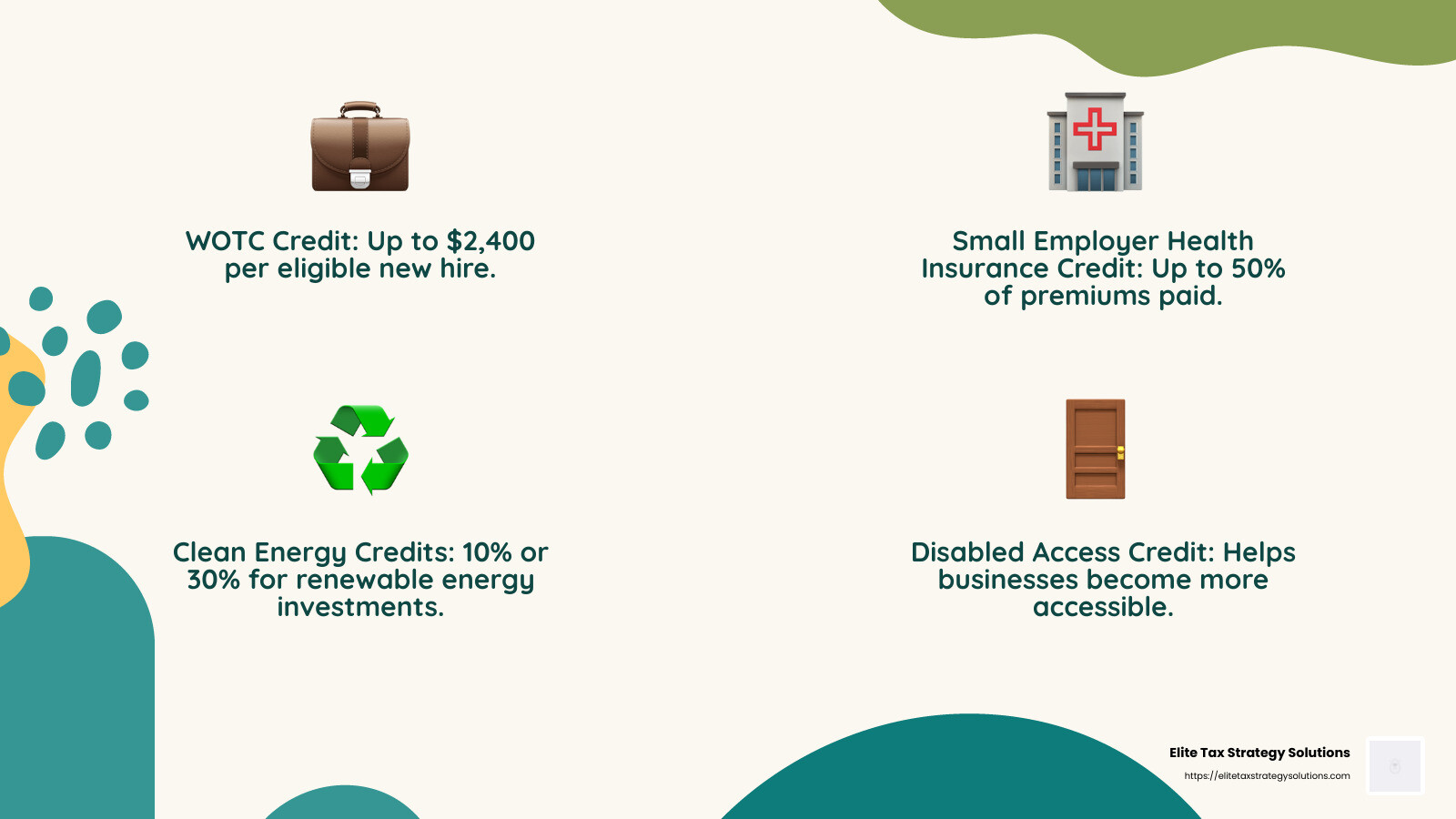
– Credit Amount: Up to $2,400 per eligible new hire.
– Process: Complete Form 8850 and submit it to your state workforce agency within 28 days of the employee’s start date.
Case Study: A small retail business in Indiana hired three veterans and claimed a total of $7,200 in WOTC credits, significantly reducing their tax liability for the year.
Small Employer Health Insurance Credit
Small businesses that provide health insurance to their employees can benefit from the Small Employer Health Insurance Credit. This credit helps offset the cost of premiums and encourages small business owners to offer health insurance.
Requirements:
– Employee Count: Fewer than 25 full-time equivalent employees.
– Average Wages: Less than $62,000 per year per full-time equivalent (adjusted for inflation).
– Insurance: Purchase group health insurance through the Small Business Health Options Program (SHOP) Marketplace.
– Contribution: Pay at least 50% of the cost of employee-only coverage.
Credit Amount: Up to 50% of the premiums paid during the year, claimable for two consecutive tax years.
Pro Tip: This credit can be particularly valuable for new businesses looking to attract and retain top talent by offering competitive benefits.
Clean Energy Credits
Investing in clean energy can not only reduce your environmental footprint but also provide substantial tax savings through various clean energy credits.
Types of Credits:
– Energy Investment Credit: Available for investments in renewable energy property and renewable electricity production facilities.
– Credit Amount: Either 10% or 30% of the basis of energy property placed in service during the tax year.
Example: A manufacturing firm that installed solar panels on its facility claimed a 30% credit on the installation costs, leading to significant tax savings.
Disabled Access Credit
The Disabled Access Credit is designed to help small businesses make their facilities accessible to people with disabilities. This can include modifications like installing ramps or providing accessible restrooms.
Eligibility:
– Revenue: $1 million or less.
– Employees: No more than 30 full-time employees.
Credit Amount: 50% of up to $10,000 in eligible expenses, excluding the first $250.
Quote: “Providing access for disabled individuals not only opens your business to a broader customer base but also offers valuable tax credits,” says Maria Gonzales, a small business consultant.
Employer-Provided Child Care Credit
Employers who support child care for their employees can claim the Employer-Provided Child Care Credit. This credit encourages businesses to help employees with child care needs, which can also improve employee retention and productivity.
Credit Amount: Up to $150,000 for supporting employee child care or child care resource and referral services.
Qualified Expenditures: Costs related to property used for a child care facility, operating costs, and referral services.
Example: A tech startup in California that offered on-site child care facilities claimed a substantial credit, easing their overall tax burden and supporting their employees’ work-life balance.
By leveraging these tax credits, you can significantly reduce your tax liability and reinvest those savings back into your business. Next, we’ll explore how to optimize retirement plans for additional tax benefits.
Optimize Retirement Plans
One of the smartest business tax planning strategies is optimizing retirement plans. These plans not only help secure your future but also offer significant tax benefits. Here are some options to consider:
401(k) Plans
A 401(k) plan is a popular retirement savings plan that allows employees to contribute a portion of their wages to individual accounts. Employers can also make contributions.
Benefits:
– Employee Contributions: Up to $22,500 in 2023, increasing to $23,000 in 2024.
– Catch-Up Contributions: Additional $7,500 for those aged 50 and older.
– Employer Contributions: Tax-deductible and can match employee contributions.
Example: A small business owner contributing $22,500 to their 401(k) could reduce their taxable income by that amount, potentially saving thousands in taxes.
SEP IRA
A Simplified Employee Pension (SEP) IRA is ideal for small businesses and self-employed individuals. It allows for higher contribution limits compared to traditional IRAs.
Benefits:
– Contribution Limits: Up to 25% of compensation or $66,000 in 2023, whichever is less.
– Flexibility: Employers can decide how much to contribute each year.
– Ease of Setup: Less paperwork and administrative costs compared to other plans.
Case Study: A freelance graphic designer earning $100,000 annually could contribute up to $25,000 to a SEP IRA, reducing their taxable income significantly.
SIMPLE IRA
A Savings Incentive Match Plan for Employees (SIMPLE) IRA is another straightforward option for small businesses with 100 or fewer employees.
Benefits:
– Employee Contributions: Up to $15,500 in 2023, with an additional $3,500 for those aged 50 and older.
– Employer Contributions: Match employee contributions up to 3% of their compensation or a 2% fixed contribution.
Pro Tip: SIMPLE IRAs are easier to manage than 401(k) plans, making them a good choice for small businesses looking for a hassle-free retirement plan.
Profit-Sharing Plans
Profit-sharing plans allow employers to share a portion of their profits with employees, providing flexibility in contributions.
Benefits:
– Contribution Limits: Up to 25% of compensation, with a maximum of $66,000 per year.
– Flexibility: Contributions can vary based on the company’s profitability.
– Tax Deductible: Contributions are tax-deductible for the business.
Example: A small business with a profitable year can contribute to a profit-sharing plan, reducing their taxable income while rewarding employees.
Tax-Deductible Contributions
All the above retirement plans offer the advantage of tax-deductible contributions. This means the money you put into these plans can be deducted from your taxable income, reducing your overall tax liability.
Quote: “Maximizing your contributions to a tax-advantaged retirement plan is one of the best ways to lower your tax bill while securing your future,” says a tax advisor at Elite Tax Strategy Solutions.
By optimizing your retirement plans, you can achieve significant tax savings and ensure a comfortable retirement. Next, we’ll explore how to use fringe benefit plans to further reduce your tax liability.
Use Fringe Benefit Plans
Fringe benefit plans are a fantastic way to reduce your business’s tax burden while offering valuable perks to your employees. These benefits can be tax-exempt for your employees and tax-deductible for your business. Here are some fringe benefits you can consider:
Medical Insurance
Offering medical insurance is a win-win for both employers and employees. It’s one of the most common fringe benefits and can significantly reduce your tax liability.
Benefits:
– Tax-Deductible: Premiums paid by the employer are tax-deductible.
– Tax-Exempt: Benefits received by employees are generally tax-exempt.
Example: A small business providing medical insurance can deduct the cost of the premiums, lowering its taxable income.
Group Life Insurance
Group life insurance is another attractive benefit that can help you save on taxes while providing peace of mind to your employees.
Benefits:
– Tax-Deductible: Premiums for coverage up to $50,000 per employee are tax-deductible.
– Tax-Exempt: Coverage up to $50,000 is tax-exempt for employees.
Childcare Assistance
Childcare assistance can be a game-changer for working parents and can also help you save on employment taxes.
Benefits:
– Tax-Deductible: Childcare assistance provided by the employer is tax-deductible.
– Tax-Exempt: Benefits received by employees are generally tax-exempt.
Case Study: A tech startup offering childcare assistance saw increased employee satisfaction and was able to deduct the costs from their taxable income.
Transportation Reimbursements
Transportation reimbursements for commuting expenses can be a valuable benefit for employees and offer tax advantages for your business.
Benefits:
– Tax-Deductible: Reimbursements for transportation costs are tax-deductible.
– Tax-Exempt: Employees can receive up to $300 per month for transportation expenses tax-free.
Fact: According to the IRS, transportation benefits can include transit passes, parking, and even bicycle commuting expenses.
Employee Meals
Providing meals to employees can boost morale and productivity, and it comes with tax benefits.
Benefits:
– Tax-Deductible: Meals provided for the convenience of the employer are tax-deductible.
– Tax-Exempt: Meals provided on the business premises are generally tax-exempt for employees.
Pro Tip: Regularly scheduled employee meals can be 100% deductible if they are for the convenience of the employer, such as during meetings.
Tuition Reimbursement
Tuition reimbursement can help employees further their education and skills, benefiting both the employee and the company.
Benefits:
– Tax-Deductible: Up to $5,250 per employee per year is tax-deductible for the employer.
– Tax-Exempt: Employees can receive up to $5,250 in educational assistance tax-free.
Example: A small business reimbursing an employee for a $5,000 course can deduct this amount from its taxable income, while the employee doesn’t have to report it as income.
By utilizing these business tax planning strategies, you can offer valuable benefits to your employees while significantly reducing your tax liability. Next, we’ll discuss how to defer or accelerate income to optimize your tax situation.
Defer or Accelerate Income
Understanding when to defer or accelerate income can be a game-changer for optimizing your tax situation. It all depends on your accounting method and your tax bracket.
Cash-Based Accounting
In cash-based accounting, transactions are recorded when cash changes hands. This method offers flexibility in managing when you recognize income and expenses.
Benefits:
– Defer Income: If you expect to be in a lower tax bracket next year, you can delay invoicing clients until the new year.
– Accelerate Deductions: Pay expenses before the year ends to maximize deductions.
Example: A freelance photographer can delay sending invoices for December shoots until January, thus deferring income to the next tax year.
Accrual-Based Accounting
Accrual-based accounting records transactions when they occur, not when cash is received or paid. This method is more rigid but provides a clearer picture of your financial health.
Challenges:
– Defer Income: More challenging because income is recorded when services are rendered or products delivered.
– Adjust Service Timing: To defer income, you might need to adjust when you provide services or deliver goods.
Fact: If you render services in December but don’t get paid until January, the income is still recorded in December with accrual accounting.
Lower Tax Bracket
If you anticipate being in a lower tax bracket next year, deferring income can save you money.
Strategies:
– Delay Invoices: Hold off on invoicing until the new year.
– Postpone Sales: Delay selling assets that would result in capital gains.
Case Study: A small business owner delayed invoicing for a large project until January, saving thousands in taxes by deferring income to a year when they expected lower earnings.
Higher Tax Bracket
If you expect to be in a higher tax bracket next year, it might make sense to accelerate income into the current year.
Strategies:
– Early Invoices: Send out invoices before the year ends.
– Complete Sales: Finalize sales of assets before the new tax year.
Tip: By recognizing income early, you can take advantage of lower tax rates now.
Practical Tips
- Review Contracts: Ensure your contracts allow flexibility in billing and payment terms.
- Consult a Tax Advisor: A professional can help you decide the best approach based on your specific situation.
By strategically choosing to defer or accelerate income, you can significantly impact your tax liability. Next, we’ll explore how equipment and real estate purchases can offer substantial tax benefits.
Equipment and Real Estate Purchases
Buying equipment and real estate can offer substantial tax benefits. Let’s explore three key strategies: Section 179 Deduction, bonus depreciation, and green energy tax credits.
Section 179 Deduction
Section 179 allows businesses to deduct the full purchase price of qualifying equipment and software bought or financed during the tax year. This deduction is designed to encourage small businesses to invest in themselves by buying equipment.
Key Points:
– Deduction Limit: For 2023, the maximum deduction is $1,160,000.
– Phase-Out Threshold: Starts at $2,890,000 and completely phases out at $4,050,000.
– Eligible Equipment: Includes machinery, office equipment, and certain improvements to nonresidential real property.
Example: A graphic design firm buys new computers worth $50,000. They can deduct the entire $50,000 under Section 179, reducing their taxable income for the year.
Bonus Depreciation
Bonus depreciation allows businesses to deduct a large percentage of the cost of eligible assets the first year they are put into service. This can be used in conjunction with the Section 179 deduction.
Key Points:
– Current Rate: 80% for assets placed in service in 2023.
– Eligible Property: Applies to new and used property.
– Phase-Out: The rate will drop to 60% in 2024.
Quote: “If you’re on the fence about buying a new piece of equipment, it could make sense to buy it now and get it set up and running before the end of the year in order to get that 80%,” advises financial expert Navani.
Green Energy Tax Credits
The federal Inflation Reduction Act includes nearly $400 billion for clean energy tax credits. These credits are designed to encourage businesses to invest in green technology and energy-efficient improvements.
Key Points:
– Clean Vehicles: Tax credits for buying new or used electric or hybrid vehicles.
– Energy Property: Credits for installing energy-efficient systems like solar panels or wind turbines.
– Restrictions: Specific eligibility criteria apply, so consult with your tax advisor.
Fact: The federal government offers thousands of dollars in tax credits for businesses that invest in clean energy technologies.
Practical Tips
- Timing: Consider your financial year and tax bracket when deciding when to make purchases.
- Documentation: Keep detailed records of all purchases and installations to ensure you can claim these deductions and credits.
- Consult a Tax Advisor: A professional can help you steer the complexities and maximize your benefits.
By leveraging these tax strategies, you can significantly reduce your taxable income and invest in your business’s future. Next, we’ll discuss the advantages of hiring family members and how it can benefit your tax planning.
Hire Family Members
Hiring family members for your business isn’t just a way to keep it in the family; it can also offer significant tax benefits. Here’s how employing your spouse and children can be a smart move.
Spouse
Adding your spouse to the payroll can double your retirement plan contributions. This means you can contribute to two retirement accounts, maximizing your tax-deductible contributions.
Key Benefits:
– Retirement Savings: Double the contributions to retirement plans like a 401(k) or SEP IRA.
– Social Security: Increase your spouse’s future Social Security benefits by reporting their income.
Example: If you own a small business and contribute $19,500 to your 401(k), adding your spouse allows for another $19,500 contribution, doubling your tax savings.
Children
Hiring your children can also offer tax advantages. Children can work tax-free up to the standard deduction limit, assuming you follow IRS income tax thresholds.
Key Benefits:
– Tax-Free Income: Children can earn up to $12,950 (as of 2023) without paying federal income taxes.
– ROTH IRA: You can help them open a ROTH IRA with their earned income, teaching them about saving and investing early.
Fact: Children under 18 working for their parents’ business are exempt from Social Security and Medicare taxes.
Payroll
When you put family members on the payroll, you must follow all standard payroll procedures. This includes issuing W-2 forms and withholding the appropriate taxes.
Key Points:
– Documentation: Maintain proper records and documentation to ensure compliance.
– Fair Compensation: Pay family members a fair wage for the work they perform to avoid IRS scrutiny.
Tip: Consult with a tax advisor to ensure you’re following all IRS guidelines and maximizing your tax benefits.
By employing family members, you can keep your business running smoothly and enjoy substantial tax benefits. Next, we’ll dive into frequently asked questions about business tax planning strategies.
Frequently Asked Questions about Business Tax Planning Strategies
What are the three basic strategies to use in planning for taxes?
When planning for taxes, three fundamental strategies can help reduce your tax liability:
-
Reducing Income: Lowering your adjusted gross income (AGI) can keep you in a lower tax bracket. This might involve contributing to retirement plans or health savings accounts (HSAs).
-
Increasing Deductions: Maximizing deductions can significantly lower taxable income. Common deductions include home office expenses, travel costs, and professional fees. Make sure to keep all receipts and documentation.
-
Taking Advantage of Tax Credits: Tax credits directly reduce the amount of tax you owe. Look for credits like the Work Opportunity Tax Credit (WOTC) or Small Employer Health Insurance Credit.
How do business owners pay less taxes?
Business owners can adopt several strategies to reduce their tax burden:
-
Hire Family Members: Employing your spouse or children can offer tax benefits, such as doubling retirement contributions and providing tax-free income for children.
-
Track Expenses: Keeping meticulous records of all business-related expenses ensures you claim all possible deductions, from office supplies to travel costs.
-
Use Retirement Plans: Contributions to retirement plans like a 401(k) or SEP IRA are tax-deductible, reducing your taxable income.
-
Charitable Deductions: Donations to qualified charities can be deducted from your taxable income. Make sure to keep records of all charitable contributions.
What is a qualified tax planning strategy?
A qualified tax planning strategy involves actions that are:
-
Prudent and Feasible: The strategy must be practical and within the control of management. It should be something the business can realistically implement.
-
Ordinarily Might Not Take: These are actions a business wouldn’t typically take but would consider to avoid losing tax benefits, like preventing a tax credit from expiring.
According to the ASC 740-10-30-19, these strategies should be considered when determining the amount of valuation allowance required. They must meet the more-likely-than-not recognition threshold from a tax law perspective.
By understanding and implementing these business tax planning strategies, entrepreneurs can effectively reduce their tax liabilities and keep more money in their pockets.
Conclusion
At Elite Tax Strategy Solutions, we understand that proactive tax planning is essential for financial stability and success. Our personalized approach to business tax planning strategies ensures that you maximize tax savings while staying compliant with ever-changing tax regulations.
Proactive Tax Planning
Proactive tax planning is not just about reacting to tax season. It’s about year-round strategies that align with your business goals. By staying ahead of tax law changes and implementing custom strategies, you can minimize your tax liabilities and keep more of your hard-earned money.
Financial Stability
Effective tax planning contributes significantly to your business’s financial stability. By maximizing deductions, leveraging tax credits, and optimizing retirement plans, you can reduce your tax burden and reinvest those savings back into your business. This not only improves your cash flow but also sets a strong foundation for long-term growth.
Tax Optimization
Our team of seasoned tax professionals focuses on tax optimization, ensuring that you take advantage of every opportunity within the tax code. Whether it’s through choosing the right business structure, maximizing deductions, or deferring income, we help you steer the complexities of tax planning with ease.
Why Choose Elite Tax Strategy Solutions?
- Expert Guidance: Our experts stay on top of tax law changes to provide you with the most current and effective strategies.
- Personalized Service: We tailor our services to meet your specific needs, ensuring that your tax plan aligns with your overall financial goals.
- Comprehensive Approach: From hiring family members to leveraging fringe benefit plans, we cover all aspects of tax planning to optimize your financial outcomes.
For a deeper dive into how we can help you with innovative tax planning, visit our Innovative Tax Planning page.
By partnering with Elite Tax Strategy Solutions, you can achieve financial stability and peace of mind, knowing that your taxes are optimized and your business is set up for long-term success.