Why Estate Planning Matters for Your Financial Legacy
When you’ve spent a lifetime building wealth, the last thing you want is to see a substantial portion of it vanish to taxes instead of supporting your loved ones. That’s where tax-efficient estate planning comes into play – it’s not just paperwork, but a thoughtful approach to preserving your legacy.
Tax-efficient estate planning is about making intentional decisions today that protect your family’s financial future tomorrow. Think of it as creating a roadmap that guides your assets safely to your heirs while navigating around potential tax obstacles along the way.
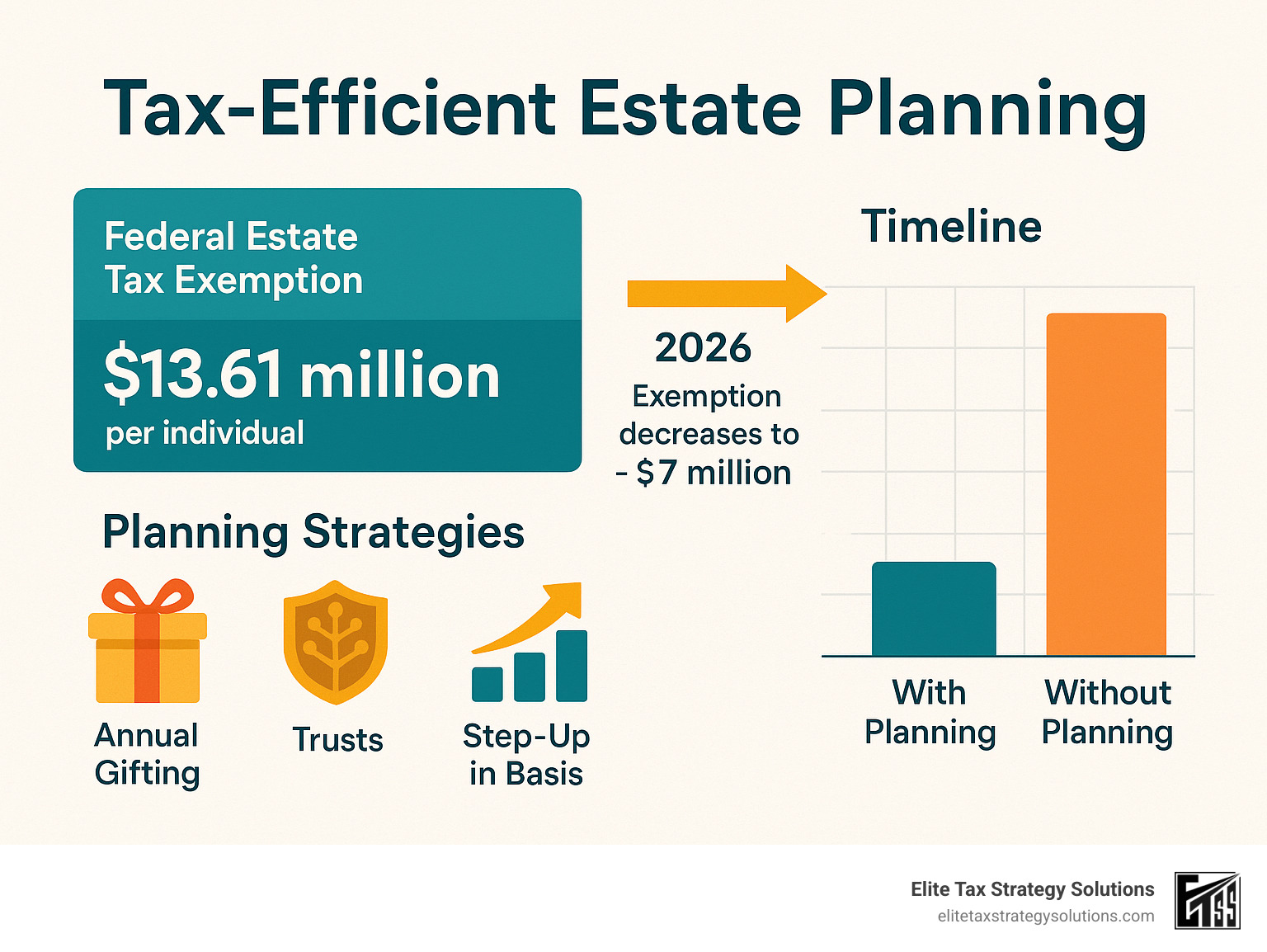
I’ve seen families breathe sighs of relief when they realize how much control they can maintain over their legacy with proper planning. The current federal estate tax exemption of $13.61 million per person (2024) offers a significant planning opportunity, but remember – this window is closing. In 2026, this amount is scheduled to drop to approximately $7 million, bringing many more families into the estate tax conversation.
The stakes are considerable. Without planning, estates exceeding the exemption face a steep 40% federal tax rate. And don’t forget that many states impose their own estate taxes with much lower thresholds – sometimes as low as $1 million.
One of the most powerful tools is the “step-up in basis.” This valuable provision resets the tax basis of inherited assets to their fair market value at death, potentially eliminating capital gains taxes your heirs would otherwise face.
“Estate planning isn’t just about deciding who will inherit your wealth; it’s also about minimizing the tax burden on your heirs and ensuring your assets are passed down efficiently,” as tax planning experts often emphasize.
The annual gift tax exclusion provides another straightforward strategy – you can give $18,000 per recipient in 2024 (increasing to $19,000 in 2025) without touching your lifetime exemption. For families with multiple children and grandchildren, this can transfer significant wealth completely tax-free over time.
I’m David Fritch, and after 40 years as both an attorney and CPA specializing in estate planning, I’ve guided countless families through this journey. The most rewarding part of my work isn’t just the tax savings – it’s the peace of mind clients feel knowing their wishes will be honored and their loved ones protected.
Whether your estate is modest or substantial, proactive planning makes all the difference. The strategies we’ll explore can help ensure that what you’ve built continues to support the people and causes you care about most.
Looking to dive deeper? Explore our resources on advanced tax strategies, financial stability planning, and ways to maximize tax savings.
Understanding Tax-Efficient Estate Planning
Tax-efficient estate planning isn’t just about creating a will and calling it a day. It’s about protecting what you’ve worked so hard to build throughout your lifetime and ensuring it reaches your loved ones with minimal tax impact.
When you think about it, the stakes are incredibly high. Without proper planning, the federal government could claim up to 40% of your estate above the exemption threshold. And here’s the kicker – your family has just nine months after your passing to pay this tax bill, often forcing them to sell assets quickly, sometimes at fire-sale prices.
As David Peterson, Head of Wealth Planning at Fidelity, often tells his clients, “Many people think estate planning is only for wealthy people. They rationalize, ‘I don’t have that much money.'” This common misconception leads many families to miss out on crucial planning opportunities that could save them thousands—or even millions.
The reality is that tax-efficient estate planning matters for most families who’ve accumulated wealth over time, especially business owners, real estate investors, and professionals with substantial retirement accounts. With thoughtful planning, you can dramatically reduce—or sometimes even eliminate—estate taxes while ensuring your legacy goals remain intact.

Why It Matters for 2024-2026
We’re currently in what I like to call a “golden window” for estate planning. The Tax Cuts and Jobs Act (TCJA) of 2017 temporarily doubled the estate tax exemption, but this provision is set to sunset after 2025.
Here’s the timeline we’re working with:
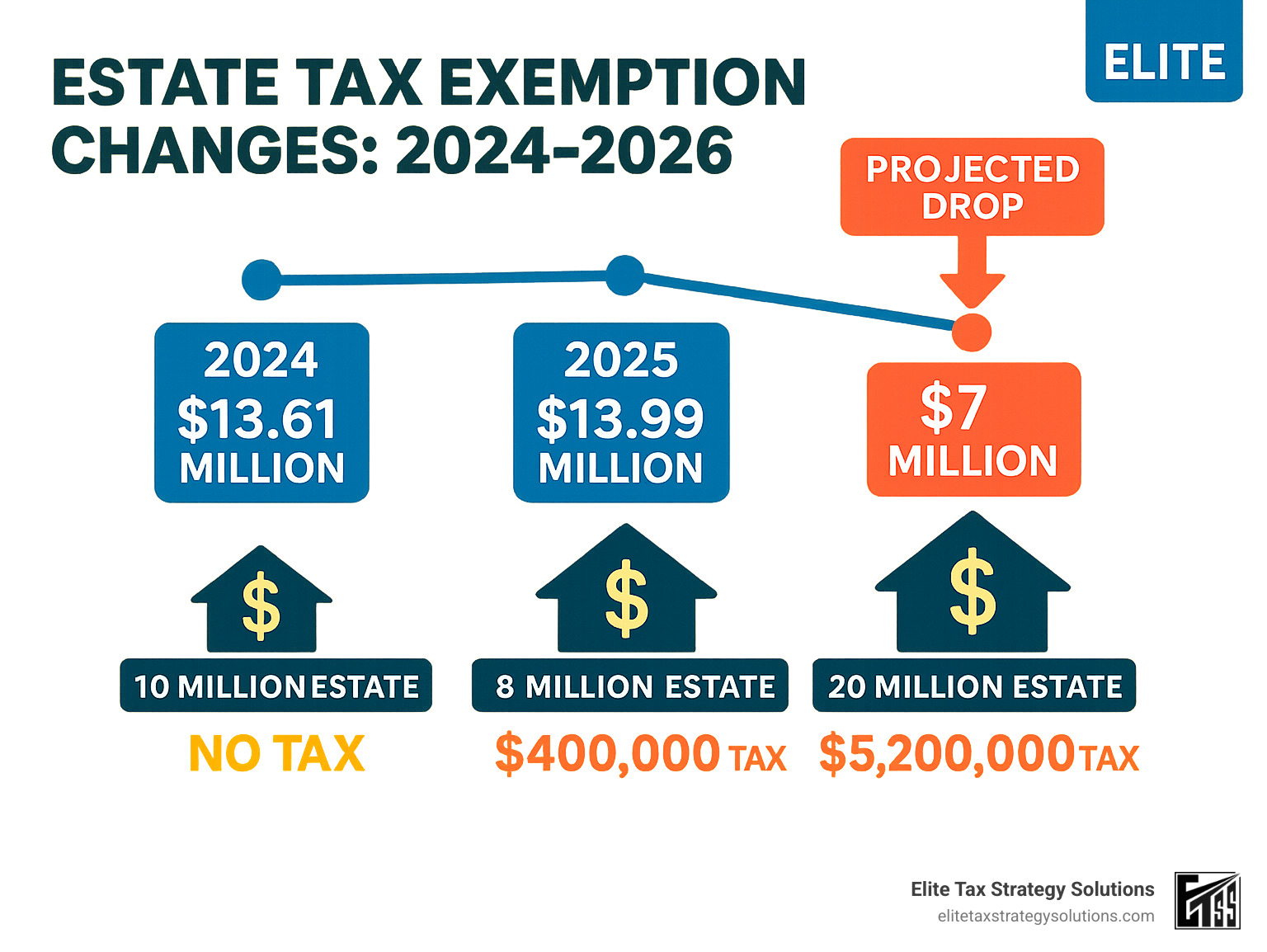
– 2024: $13.61 million individual exemption ($27.22 million for married couples)
– 2025: Expected to increase to about $13.99 million ($27.98 million for couples)
– 2026: Will drop dramatically to approximately $7 million per person (adjusted for inflation)
“People should be aware of what’s going on,” David Peterson warns. This significant reduction means many more families—perhaps yours included—will suddenly face potential estate tax exposure after 2025.
At Elite Tax Strategy Solutions, we’ve seen a noticeable shift in client behavior. Many are accelerating their wealth transfer plans to lock in the current high exemption amounts. The good news? The IRS has confirmed there will be no “clawback” of tax benefits for gifts made during this high-exemption period, even after the limits drop in 2026.
Step-Up in Basis: Invisible but Powerful
One of the most valuable yet frequently overlooked aspects of estate planning is the “step-up in basis” provision. This remarkable tax benefit essentially wipes away unrealized capital gains on inherited assets—like magic, but completely legal!
Here’s how this works in real life:
1. When you buy an asset, you establish a “cost basis” (typically what you paid)
2. Upon your death, your heirs receive those assets with a basis “stepped up” to the fair market value as of your date of death
3. If they sell immediately, they would owe little or no capital gains tax
I remember working with a client named Frank (name changed for privacy). Frank had purchased Apple stock in the 1990s for $10,000. By the time he passed away, that investment had ballooned to $2 million. Had Frank sold the stock during his lifetime, he would have owed capital gains tax on $1.99 million of gain. Instead, his daughter inherited the stock with a stepped-up basis of $2 million. When she sold it a month later, she paid zero capital gains tax. That’s the power of proper planning!
This powerful provision should be carefully woven into your overall Comprehensive Tax Planning. Sometimes, it makes financial sense to gift assets during your lifetime, but in other situations, holding certain assets until death provides greater tax benefits through this step-up provision. It’s all about finding the right balance for your unique situation.
Estate-Tax Rules & Key Threats to Your Legacy
Let’s talk about the elephant in the room – taxes that can take a bite out of your legacy. As someone who’s helped hundreds of families steer these waters, I can tell you that understanding these rules isn’t just for tax nerds (though we appreciate them too!).
When it comes to transferring wealth, you’re potentially facing four different taxes, each with its own quirks and complications:
The federal estate tax hits your assets after you’re gone. The gift tax catches you when you’re generous during life. The generation-skipping transfer tax (GST) adds an extra layer when you try to skip a generation. And then there are those state-level taxes that sneak up on you when you least expect them.
Here’s the good news: the federal estate and gift tax systems work together under a “unified” system with a shared lifetime exemption – currently a whopping $13.61 million per person in 2024. This means you can give away this much during life or at death without triggering federal taxes.
The bad news? Anything above that threshold gets taxed at up to 40%. For someone with a $20 million estate who hasn’t used any exemption, that’s roughly $2.56 million going to Uncle Sam instead of loved ones.
As tax experts at J.P. Morgan Private Bank wisely note, “Estate taxes generally can be minimized—though, for wealthy families, they can rarely be eliminated altogether.”
If you’re married, you get a wonderful benefit – unlimited transfers between spouses (assuming both are U.S. citizens). Plus, couples can effectively double their exemption through “portability,” where the surviving spouse can use any unused exemption from their deceased partner.
For the official details on federal estate tax rules, the Estate Tax page on the IRS website is quite helpful.
State Variations Everyone Forgets
While you might breathe easy thinking you’re under the federal threshold, state taxes can be a rude awakening. More than a dozen states plus D.C. have their own estate or inheritance taxes with much lower exemptions.
Massachusetts and Oregon set their exemptions at just $1 million. New York’s sits around $6.58 million. Washington state comes in at about $2.193 million, while Minnesota offers $3 million.
David Peterson of Fidelity puts it plainly: “People should be aware of what’s going on at the state level.” These lower thresholds mean families who aren’t worried about federal estate tax might still face significant state-level taxes.
At Elite Tax Strategy Solutions, we often help clients with domicile planning – sometimes changing legal residence to states without these taxes. But beware – this isn’t as simple as buying a vacation home in Florida! Tax authorities look for genuine life changes, not just paper moves.
Interaction of the Four Transfer Taxes
The way these taxes play together is where tax-efficient estate planning becomes truly valuable.
Your estate and gift taxes share that $13.61 million lifetime exemption. Every significant gift you make (above the annual exclusion) reduces your remaining estate tax exemption down the road.
The GST tax has the same $13.61 million exemption amount but requires separate allocation decisions. Without proper planning, transfers to grandchildren could face an additional 40% tax – ouch!
State estate and inheritance taxes operate independently from federal taxes. Some states tax the estate itself, while others tax the people receiving inheritances – sometimes based on their relationship to you.
There is a bright spot in all this complexity: the annual gift tax exclusion. In 2024, you can give up to $18,000 per recipient to as many people as you like without using your lifetime exemption or even filing a gift tax return.
For our clients with substantial estates, we create integrated plans addressing all these tax regimes at once – because seeing the whole picture is the only way to truly protect your legacy from unnecessary taxation.
10 Proven Strategies to Minimize Taxes and Maximize Legacy
When clients walk through our doors at Elite Tax Strategy Solutions, they often ask the same question: “How can I make sure more of my money goes to my family instead of the IRS?” The answer lies in tax-efficient estate planning – not a one-size-fits-all approach, but a carefully crafted strategy custom to your unique situation.
We’ve helped hundreds of families protect their wealth using these ten powerful strategies:
Annual gifting programs create a simple yet effective way to transfer wealth gradually. By giving $18,000 per recipient in 2024 (increasing to $19,000 in 2025), you steadily reduce your taxable estate without touching your lifetime exemption.
Using your lifetime exemption before 2026 has become urgent with the looming exemption reduction. Many of our clients are accelerating their wealth transfer plans now, knowing the IRS won’t “claw back” these benefits even after the exemption drops.
Grantor Retained Annuity Trusts (GRATs) allow you to transfer future appreciation with minimal gift tax impact. One client transferred $2 million in pre-IPO stock to a GRAT, resulting in over $8 million passing to her children completely tax-free when the company went public.
Intentionally Defective Grantor Trusts (IDGTs) create a powerful tax advantage – assets move outside your estate while you continue paying the income taxes, essentially making additional tax-free gifts to your beneficiaries.
Spousal Lifetime Access Trusts (SLATs) provide peace of mind by removing assets from your estate while maintaining indirect access through your spouse – perfect for those worried about giving up control of significant assets.
Irrevocable Life Insurance Trusts create tax-free liquidity exactly when your family needs it most – to pay estate taxes without selling cherished family assets like businesses or vacation homes.
Charitable planning tools like Charitable Remainder Trusts let you support causes you care about while generating income and valuable tax deductions. As one client told me, “I never thought I could support my favorite charity AND provide for my grandchildren.”
Donor-Advised Funds offer immediate tax deductions while maintaining your influence over which charities receive grants over time – simpler and less expensive than private foundations.
Family Limited Partnerships can apply legitimate valuation discounts to business and investment assets, significantly reducing transfer tax values while maintaining family control.
529 Plan front-loading allows you to accelerate five years of education funding at once ($90,000 per beneficiary in 2024), removing these assets from your estate while helping the next generation.
These strategies align perfectly with our High Net Worth Tax Strategies approach, always customized to each family’s unique circumstances.
Annual Gift-Tax Exclusion in Action
The beauty of annual gifting lies in its simplicity and power over time. Think of it as slowly moving money from a high-tax bucket to a completely tax-free one – $18,000 at a time in 2024.
For married couples, this strategy becomes even more powerful through “gift-splitting,” allowing $36,000 per recipient this year (increasing to $38,000 in 2025). No forms required if you stay within these limits – though we recommend documenting these gifts in your records.
I recently worked with a family with three children and seven grandchildren. By giving each family member the maximum annual exclusion amount, they’re transferring $360,000 annually without touching their lifetime exemption. Over ten years, that’s $3.6 million removed from their taxable estate, plus all future growth on those assets.
Payments made directly to educational institutions for tuition or to medical providers for healthcare are completely gift-tax free and don’t count toward your annual exclusion. I’ve seen families pay hundreds of thousands in private school and college tuition completely free of gift tax implications.
For gifts exceeding the annual exclusion, you’ll need to file IRS Form 709 (Gift Tax Return), even if no tax is due because you’re using part of your lifetime exemption. We help our clients with this paperwork to ensure everything is properly reported.
Leveraging Lifetime Exemption Before 2026
“Use it or lose it” has become our mantra when discussing the lifetime exemption with clients. With the scheduled reduction in 2026, many families face a critical planning window.
Consider this real-world example: A couple with a $20 million estate recently worked with us to gift $10 million to an irrevocable trust for their children, using a portion of their combined $27.22 million exemption. Had they waited until 2026 when the exemption drops to approximately $14 million combined, they would have faced estate taxes on an additional $3 million at 40% – potentially costing their children $1.2 million in unnecessary taxes.
The IRS has confirmed there will be no “clawback” of tax benefits for gifts made during this high-exemption period, making this strategy particularly compelling. As one client put it, “It’s like the government is offering a limited-time sale on estate taxes.”
At Elite Tax Strategy Solutions, we help families identify which assets make the most sense for lifetime gifting, considering factors like:
- Appreciation potential (high-growth assets often make the best gifts)
- Income tax basis (sometimes the step-up in basis at death is more valuable)
- Family legacy goals (some assets have sentimental value worth keeping)
- Liquidity needs (maintaining sufficient assets for your lifetime needs)
For married couples, we also ensure proper planning for portability of the deceased spouse’s unused exemption, filing the necessary estate tax returns even when no tax is due.
Trust Powerhouse Tools for Tax-Efficient Estate Planning
Trusts aren’t just for the ultra-wealthy – they’re sophisticated tools that can benefit many families in their tax-efficient estate planning. Let me share how three particularly powerful trusts work in real-life situations:
Grantor Retained Annuity Trusts (GRATs) shine when you expect assets to appreciate significantly. One business owner transferred pre-IPO shares to a GRAT just before the company went public. He received back his original investment through annuity payments (based on the pre-IPO valuation), while all the appreciation – over $12 million – passed to his children completely free of gift tax.
The mechanics are straightforward: you transfer assets to the trust, receive annuity payments for a specified term (often 2-10 years), and any growth beyond the IRS-assumed rate (Section 7520 rate) passes to your beneficiaries tax-free. “Zeroed-out” GRATs can virtually eliminate gift tax on the transfer.
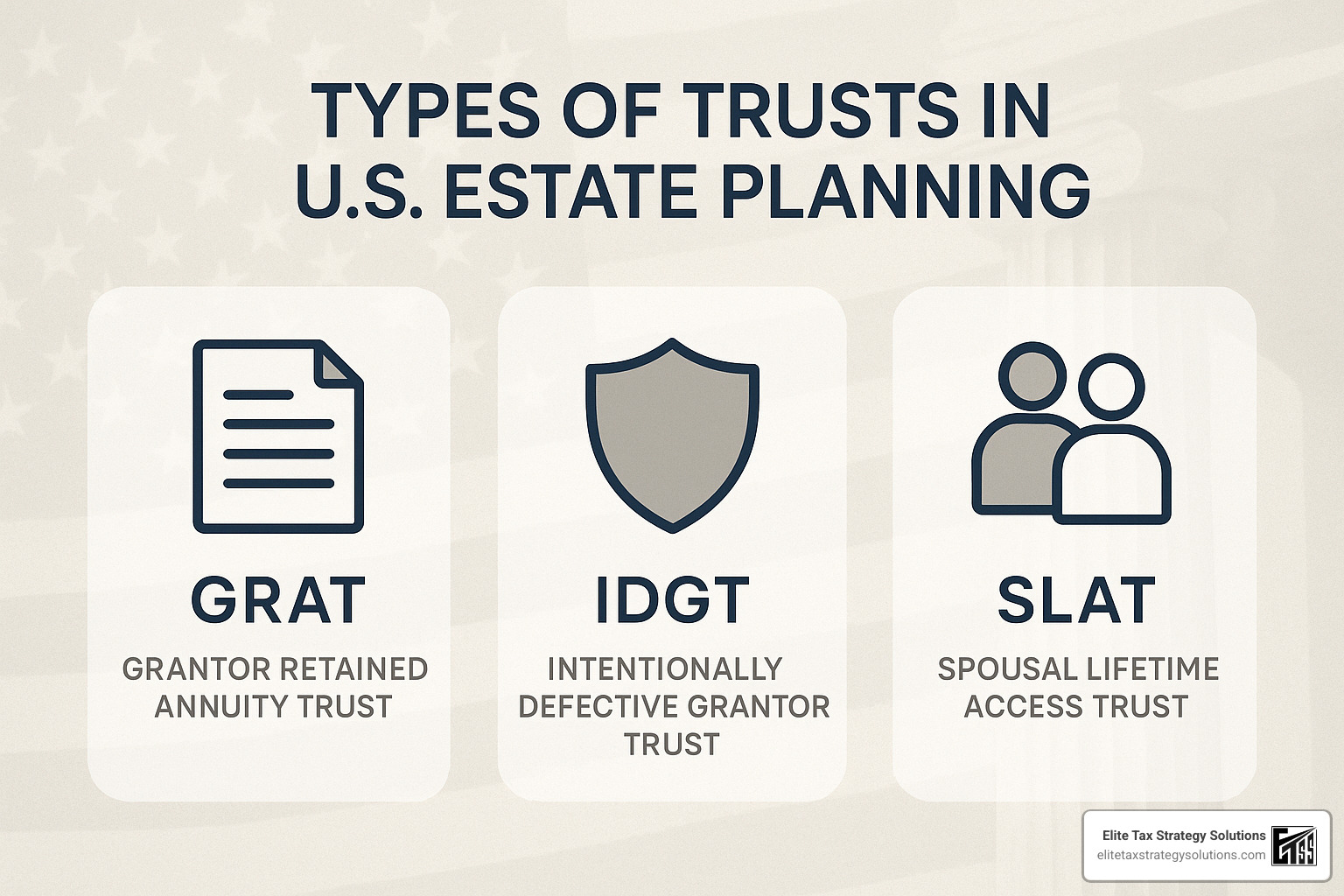
Intentionally Defective Grantor Trusts (IDGTs) create a fascinating tax arbitrage. Assets transferred to the trust leave your estate for estate tax purposes, but you continue paying income taxes on trust income. This allows trust assets to grow tax-free, essentially making additional tax-free gifts to your beneficiaries each time you pay the tax bill.
As one of our attorney partners explained to a client, “You’re essentially burning down your taxable estate with each tax payment while building up the trust outside your estate – it’s like having your cake and eating it too.”
Spousal Lifetime Access Trusts (SLATs) solve the biggest concern many clients have: “What if I need that money someday?” With a SLAT, one spouse creates an irrevocable trust for the benefit of the other spouse and descendants. Assets leave the grantor’s estate but remain indirectly accessible through the beneficiary spouse.
A client recently told me, “The SLAT gave us confidence to make a substantial gift knowing we could still benefit from the assets if our circumstances changed.”
At Elite Tax Strategy Solutions, we carefully design these trust structures to balance tax benefits with practical family considerations, including:
– Asset protection from creditors and divorcing spouses
– Family governance and responsible wealth transfer
– Flexibility to adapt to changing tax laws and family circumstances
– Minimizing administrative complexity and costs
Charitable Plays that Pay
Charitable planning creates a unique win-win: supporting causes you care about while generating significant tax benefits. I’ve seen families transform their tax situations while making a meaningful difference in their communities.
Charitable Remainder Trusts (CRTs) work beautifully for charitably-inclined clients with appreciated assets. One couple transferred $2 million of highly appreciated stock (with a $200,000 basis) to a CRT. They received income for 20 years, avoided immediate capital gains tax on the appreciation, claimed a substantial income tax deduction, and ultimately supported their alma mater – all while removing these assets from their taxable estate.
CRTs provide income to you or your family for a specified term, with the remainder passing to charity. The upfront income tax deduction is based on the present value of the charity’s future interest.
Charitable Lead Trusts (CLTs) work in reverse – providing income to charity for a term of years, with the remainder passing to family with reduced gift/estate tax. These trusts shine in low-interest-rate environments and can be structured as grantor or non-grantor trusts depending on your income tax goals.
Donor-Advised Funds (DAFs) have become increasingly popular for their simplicity and flexibility. As one client shared, “Using a donor-advised fund allowed us to bunch several years of charitable giving into one tax year, helping us itemize deductions while maintaining our regular giving schedule.”
With a DAF, you get an immediate tax deduction for contributions while maintaining advisory rights over charitable distributions over time. They’re particularly valuable for donating appreciated securities, avoiding capital gains taxes while receiving a deduction for the full fair market value.
Charitable contributions are generally deductible up to 50% of adjusted gross income, with a five-year carryforward for excess amounts. We often coordinate charitable planning with other tax strategies to maximize both tax benefits and philanthropic impact.
Life Insurance as a Tax-Payment Backstop
Life insurance plays a unique and powerful role in tax-efficient estate planning, particularly for families with illiquid assets like businesses or real estate. When properly structured, insurance proceeds can provide tax-free liquidity exactly when your family needs it most – to pay estate taxes without forcing fire sales of cherished assets.
“We bought our policy for one reason,” a client recently told me. “We built this business over 40 years and couldn’t bear the thought of our children having to sell it just to pay the tax bill.”
Here’s why life insurance works so well in estate planning:
Second-to-die (survivorship) policies pay out only after both spouses have passed away – precisely when estate taxes typically become due. These policies are usually more cost-effective than individual policies since they insure two lives with one premium.
Irrevocable Life Insurance Trusts (ILITs) hold policy ownership outside your estate, preventing insurance proceeds from being subject to estate tax themselves. Think of it this way: a $5 million policy owned by you becomes a $5 million asset in your estate, potentially creating $2 million in estate taxes. The same policy owned by an ILIT provides $5 million tax-free to your heirs.
Many families use life insurance as a wealth replacement tool when making charitable gifts. One client donated his family vacation property to charity in exchange for lifetime income, then used a portion of that income to fund a life insurance policy providing his children with a tax-free inheritance equal to the property’s value.
While life insurance offers powerful benefits, it does require ongoing premium payments and careful trust administration. At Elite Tax Strategy Solutions, we work with specialized insurance advisors to determine appropriate coverage amounts and policy types based on your projected estate tax liability and liquidity needs.
The peace of mind that comes from knowing your estate plan is fully funded is invaluable. As one client put it, “Knowing the insurance will be there gives us the freedom to enjoy our wealth today rather than worrying about what happens after we’re gone.”
Special Issues: Businesses, Real Estate & Other Illiquid Assets
When it comes to tax-efficient estate planning, family businesses, real estate holdings, and other illiquid assets create unique challenges. These beloved assets often represent the heart of family wealth, but they can cause serious headaches when estate taxes come due.
Think about it – your estate typically has just nine months after death to pay estate taxes. Without proper planning, your heirs might be forced to sell the family business or cherished properties at fire-sale prices just to satisfy the tax bill.
“I’ve seen families devastated when they had to sell a third-generation business because they couldn’t come up with the cash for estate taxes,” shares David, one of our longtime clients. “Don’t let that be your family’s story.”
Fortunately, several specialized strategies can help protect these important assets:
IRC §6166 Installment Payments offers breathing room for qualifying business owners. If your business exceeds 35% of your adjusted gross estate, your heirs can stretch estate tax payments over up to 15 years. They’ll pay only interest for the first 5 years, followed by 10 annual installments. Even better, a special 2% interest rate applies to a portion of the tax – significantly below market rates.
For closely-held businesses, IRC §303 Stock Redemption provides another valuable tool. This provision allows the company to redeem enough stock to cover estate taxes and expenses without treating the redemption as a dividend. Instead, it’s treated as a sale, often resulting in little or no tax if the stock receives a stepped-up basis at death. To qualify, the business must comprise more than 35% of the adjusted gross estate.
Graegin Loans (named after a Tax Court case) offer another creative solution. These are fixed-term loans to estates that cannot be prepaid. When properly structured, the interest becomes deductible as an administration expense, reducing the overall estate tax burden while providing crucial liquidity.
At Elite Tax Strategy Solutions, we’ve helped numerous families develop comprehensive business succession plans that address both management transition and tax-efficient ownership transfer.

Valuation Discounts Done Right
One of the most powerful tools in tax-efficient estate planning for family businesses and investment entities is the strategic use of valuation discounts. These discounts recognize a simple truth: a minority interest in a private company isn’t worth its proportional share of the whole business.
Think about it – would you pay full price for 10% of a business when you can’t control distributions, can’t force a sale, and can’t easily find a buyer for your interest? Of course not! The IRS, somewhat reluctantly, acknowledges this reality.
Two main types of discounts apply in these situations:
A Lack of Control Discount reflects the reality that minority owners can’t make key decisions. They can’t force distributions, can’t liquidate assets, and can’t dictate business strategy. This discount typically ranges from 15% to 40%, with operating businesses generally qualifying for larger discounts than pure investment entities.
A Lack of Marketability Discount recognizes the difficulty in selling interests in private companies. With no ready market and often significant transfer restrictions, finding a buyer can be challenging and time-consuming. This discount typically ranges from 25% to 45%, depending on specific circumstances.
I recently worked with a family who owned a $20 million manufacturing business. By transferring interests to their children through a carefully structured entity, we achieved combined discounts of about 35%. This reduced the taxable gift value to around $13 million – potentially saving millions in estate and gift taxes.
The IRS scrutinizes these transactions carefully, so proper execution is essential. At Elite Tax Strategy Solutions, we ensure entities have legitimate business purposes beyond tax savings, obtain proper appraisals from qualified experts, maintain appropriate entity formalities, and respect suitable holding periods before and after transfers.
Real-Estate Rich, Cash-Poor: What Now?
Real estate often creates a particular dilemma in tax-efficient estate planning. Your properties may be worth millions on paper, but generate limited cash flow. This can spell trouble when estate taxes come due.
“My family almost lost our ranch when my father passed away,” one client told me. “The property was worth a fortune, but we had no way to pay the estate tax bill without selling it. Thankfully, we found solutions before it was too late.”
Several powerful strategies can help real estate-heavy estates:
Special Use Valuation (IRC §2032A) allows family farms and certain businesses to be valued based on their current use rather than “highest and best use.” For example, a farm near expanding suburbs might be worth $10 million as potential development land, but only $3 million as farmland. This provision lets qualifying properties use the lower value, reducing the taxable estate by up to $1.23 million (in 2024, indexed for inflation). The catch? Heirs must continue the business/farming use for 10 years, and qualification requirements are complex.
IRC §1031 Exchange Chains can be particularly powerful for investment real estate. By deferring capital gains through successive 1031 exchanges during life, then holding until death, families can eliminate all deferred gain through the step-up in basis. I’ve seen clients build real estate empires worth millions while deferring gains for decades, only to have all the embedded gain wiped away at death.
Upstream Basis Planning offers another creative approach. This involves gifting low-basis property to older family members (like parents) who have unused exemption amounts. When they pass away, the property receives a step-up in basis, eliminating the built-in gain. The property can then return to the original owner’s family with its new higher basis. To prevent abuse, the older family member must survive at least one year after the gift.
At Elite Tax Strategy Solutions, we help clients evaluate whether to hold real estate until death for basis step-up or gift during life to remove future appreciation from the estate. This decision depends on many factors including age, health, expected appreciation, and the nature of the property itself.
Keeping Your Plan Current: Reviews, Pitfalls & FAQs
Estate planning isn’t something you can just set and forget. Like tending a garden, your tax-efficient estate planning needs regular attention to flourish and protect what you’ve grown over the years.
“Estate planning is not a one-time process,” as many experts in our field emphasize. Life keeps moving, and your plan needs to keep pace. At Elite Tax Strategy Solutions, we’ve seen how critical regular reviews become, especially when triggered by:
- Major tax law changes (like the upcoming 2026 exemption reduction that has many of our clients concerned)
- Family milestones (marriages, births, divorces, or sadly, deaths)
- Significant financial shifts (selling a business, receiving an inheritance)
- Moving to a different state (which can dramatically change your tax situation)
- Changes in your health or that of family members
We recommend looking over your entire estate plan at least every 3-5 years, with more frequent check-ins for specific elements that might need adjustment. Our clients who take advantage of our Tax Planning for High Earners service benefit from these regular reviews built right into their planning calendar.
One thing I’ve noticed over my years in this field: the most successful estate plans involve true teamwork. Your estate attorney, CPA, financial advisor, and insurance specialist all need to communicate regularly, ensuring every aspect of your plan works in harmony. Think of it as an orchestra – all instruments must play from the same sheet music to create something beautiful.

Common Mistakes to Avoid
Even the most thoughtful estate plans can be undermined by simple oversights. Let me share some common pitfalls we help our clients steer around:
Outdated Documents can create serious problems. I recently worked with a family whose parents had created a beautiful trust in the 1990s – but never updated it to reflect new grandchildren or current tax laws. Their documents were like maps to a city that had changed dramatically over the decades.
Improper Asset Titling is another frequent issue. I remember one client who had spent thousands on an elaborate trust structure, but never actually transferred her assets into the trust’s name. As she told me later, “I thought my estate plan was complete after signing the documents, but I hadn’t updated my beneficiary designations or retitled my assets. My advisor at Elite Tax Strategy Solutions caught this before it created problems for my family.”
Poor Communication within families can undermine even the best legal structures. I’ve sat with families where adult children were completely surprised by their parents’ intentions – creating confusion and sometimes hurt feelings that could have been avoided through thoughtful conversations earlier.
DIY Estate Planning approaches often miss crucial details. While online tools can seem convenient, they rarely account for the nuances of your specific situation or state laws. It’s like trying to perform your own dental work – possible, but rarely advisable!
Neglecting International Issues becomes increasingly important in our connected world. Having family members abroad or owning foreign assets requires special consideration to avoid unexpected tax consequences or legal complications.
Roles of Your Advisory Team
Creating and maintaining a truly tax-efficient estate plan takes a village of professionals, each bringing specialized expertise to the table:
Your Estate Planning Attorney crafts the legal framework that will protect your wishes. They create the documents that will speak for you when you no longer can – your will, trusts, powers of attorney, and healthcare directives. They ensure these documents comply with state laws and reflect your unique situation.
A skilled CPA or Tax Professional analyzes how different estate planning strategies impact your tax situation today and in the future. They’ll prepare necessary gift tax returns when you make significant gifts, advise on trust taxation, and help identify opportunities to minimize tax burdens across generations.
Your Financial Advisor helps quantify what you’ll need for your lifetime and what you can comfortably transfer to others. They ensure your investments align with your estate plan and that assets are properly titled to work with your legal documents.
At Elite Tax Strategy Solutions, we often serve as the quarterback of this team, coordinating communication and ensuring everyone works toward your common goals. Our background as both CPAs and financial advisors allows us to bridge the gap between tax considerations and investment strategies.
As one of our clients recently shared, “Having my advisors actually talk to each other has made all the difference. Before working with Elite, I felt like I was the messenger between professionals who spoke different languages.”
Frequently Asked Questions about Tax-Efficient Estate Planning
1. Will the IRS “claw back” gifts made before 2026?
Good news here! The IRS has issued clear regulations confirming there will be no “clawback” of tax benefits for gifts made during our current high-exemption period, even after the exemption drops in 2026. This creates a unique window of opportunity for substantial lifetime gifts that we’re helping many clients take advantage of right now.
2. How does the annual exclusion interact with 529 five-year front-loading?
The 529 college savings plan offers a special feature that many grandparents love – the ability to “front-load” five years of annual exclusion gifts at once. For 2024, that means you can contribute $90,000 per beneficiary ($18,000 × 5) in a single year without using any of your lifetime exemption.
You’ll need to file a gift tax return to elect this special treatment, and you cannot make additional annual exclusion gifts to that same beneficiary during the five-year period. It’s a powerful way to jumpstart education funding while managing gift taxes.
3. What assets should (and shouldn’t) fund an irrevocable trust?
Not all assets are created equal when it comes to irrevocable trusts. Generally, the best candidates include high-growth investments that will appreciate substantially over time, family business interests that may qualify for valuation discounts, and life insurance policies (especially for Irrevocable Life Insurance Trusts).
On the flip side, I usually advise clients against placing certain assets in irrevocable trusts: properties with unrealized losses (better to sell and harvest the tax loss first), highly appreciated assets that would benefit from step-up in basis at death, personal residences (unless using specialized trusts), and assets you might need for living expenses.
Every family’s situation is unique – which is why cookie-cutter approaches rarely work as well as personalized planning with advisors who truly understand your goals and concerns.
Conclusion
Let’s be honest – thinking about estate planning isn’t anyone’s idea of a fun weekend activity. But tax-efficient estate planning might be one of the most important gifts you’ll ever give your family.
With the 2026 exemption reduction looming on the horizon like storm clouds, now is truly a critical moment to make sure your plan is optimized. The difference between acting now and waiting could literally mean millions more dollars for your loved ones rather than the tax collector.
At Elite Tax Strategy Solutions, we see estate planning as much more than just tax minimization. Yes, we’re experts at the technical aspects, but what really drives us is helping you create a meaningful legacy that reflects your unique values and family dynamics.
The most successful estate plans we’ve helped create over the years rest on three essential foundations:
First, a crystal-clear understanding of what matters most to you – perhaps it’s supporting your grandchildren’s education, preserving a family business, or leaving a lasting charitable impact.
Second, thoughtful application of the right tax strategies and tools for your specific situation – because cookie-cutter approaches simply don’t work when it comes to something this important.
And third, a commitment to regular reviews as laws change and life circumstances evolve – because an outdated plan can sometimes be worse than no plan at all.
What sets our approach apart is how we integrate your estate plan with your broader financial and tax strategies. Our clients tell us they appreciate having a team that sees the complete picture rather than working in isolated silos.
I’d like to invite you to schedule a consultation with our team to discuss your specific estate planning needs. We promise no pressure – just a thoughtful conversation about how we might help protect what you’ve worked so hard to build.
For a deeper look at our comprehensive approach to financial planning beyond just estate concerns, you might find our More info about Comprehensive Financial Planning page helpful.
The greatest gift you can leave your family isn’t just financial assets – it’s the peace of mind that comes from knowing you’ve created a thoughtful, tax-efficient plan for their future. And that’s something truly priceless.