Why Strategic Tax Planning Can Save You Thousands
Strategic tax planning is the proactive process of organizing your financial affairs to legally minimize tax liability while maximizing long-term wealth. Unlike basic tax compliance that focuses on filing accurate returns, strategic planning involves year-round decision-making to optimize your tax position.
Key Strategic Tax Planning Services:
– Income splitting through family trusts and spousal accounts
– Tax-advantaged accounts like 401(k)s, HSAs, and RRSPs
– Capital gains timing and tax-loss harvesting strategies
– Charitable giving optimization with donor-advised funds
– Entity structure planning (S-Corp, LLC, C-Corp selection)
– Credits and incentives including R&D, ERC, and industry-specific opportunities
– Estate planning integration with lifetime exemptions and trusts
Research shows that businesses engaging in proactive strategic tax planning can reduce their overall tax liability by up to 20% compared to those focused only on compliance. For high-income earners, the savings can be substantial when combining multiple strategies like maximizing RRSP contributions, utilizing charitable donation credits, and implementing tax-loss harvesting.
I’m David Fritch, and with 40 years of experience owning my own CPA practice and law firm, I’ve helped countless high-income earners and small business owners implement strategic tax planning to maximize their savings while ensuring full compliance. Through Elite Tax Strategy Solutions, I’ve developed over 100 custom tax-saving strategies specifically for individuals earning $200,000 to $2,000,000 annually.
Strategic tax planning helpful reading:
– Tax risk management
– Business expense categories
– Tax filing assistance
Strategic Tax Planning: Core Principles
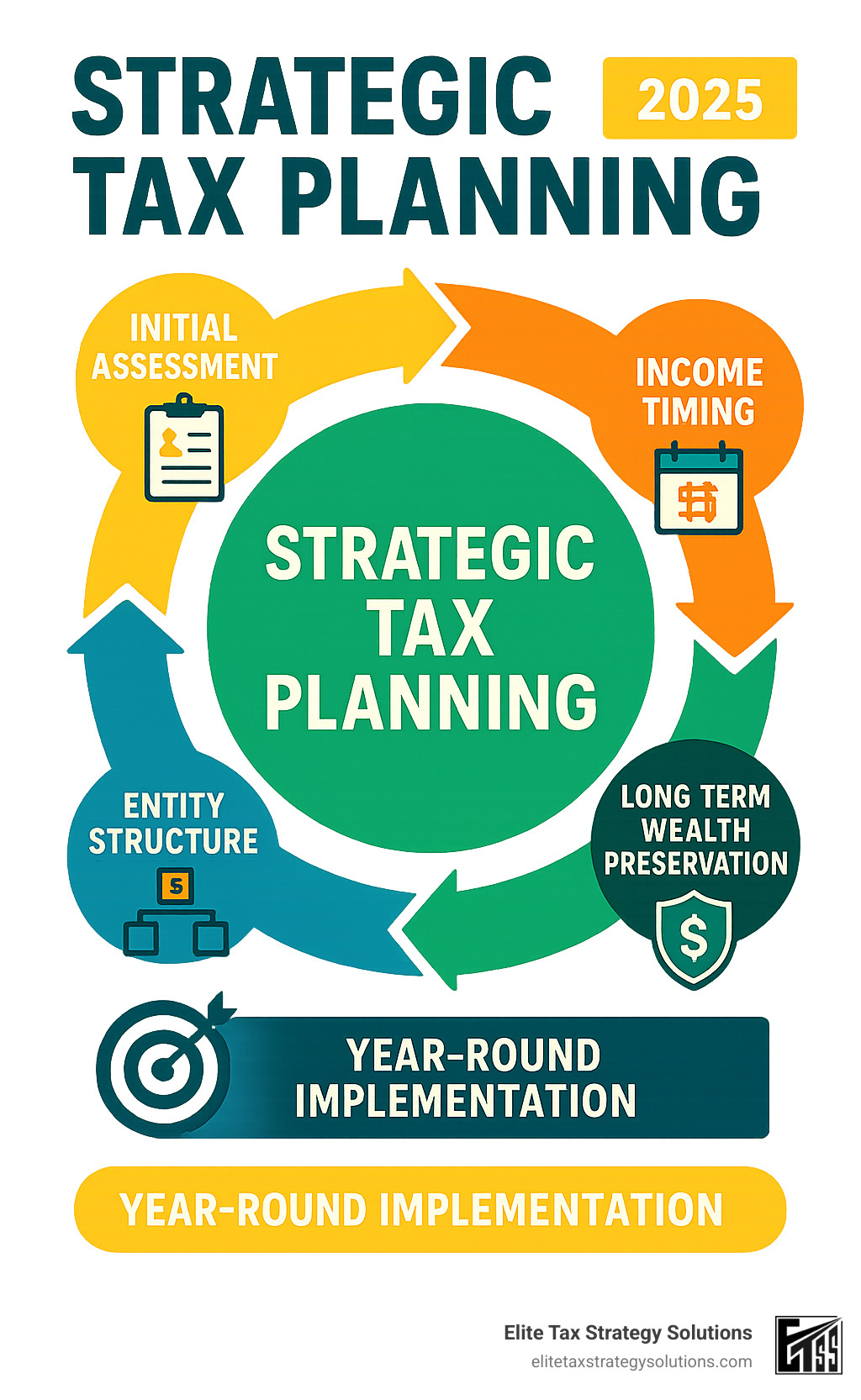
Strategic tax planning is like building a house – you need solid foundations and careful planning at each step. After four decades of helping high-income earners and business owners, I’ve identified five core principles that transform your relationship with taxes from reactive scrambling to proactive wealth building.
The holistic approach examines your complete financial picture, not isolated pieces. We look at how your business income connects with your investment portfolio, how your family situation affects your tax strategies, and how your long-term goals shape today’s decisions.
Proactive versus compliance thinking makes all the difference. Most people wait until tax season to think about taxes. We help you make tax-smart decisions throughout the year, positioning you to take advantage of opportunities before they disappear.
Timing income and expenses strategically can save thousands. If you’ll be in a lower tax bracket next year, we might recommend deferring income or accelerating deductions.
Deduction maximization goes beyond claiming obvious business expenses. We implement sophisticated strategies like charitable donation bunching and donor-advised funds to exceed standard deduction thresholds.
Risk mitigation ensures every strategy comes with proper documentation and compliance protocols. We focus on rock-solid approaches that will stand up to scrutiny.
| Traditional Tax Planning | Strategic Tax Planning |
|---|---|
| Annual compliance focus | Year-round optimization |
| Reactive to tax laws | Proactive planning ahead |
| Single-year perspective | Multi-year strategy |
| Basic deduction claiming | Advanced structure optimization |
| Minimal integration | Holistic financial approach |
How Strategic Tax Planning Differs from Basic Compliance
Most tax preparation is like driving while looking only in the rearview mirror. Strategic tax planning flips this approach completely. Instead of just filing accurate returns, we’re actively shaping your financial decisions before they happen through quarterly reviews and ongoing optimization.
Why Strategic Tax Planning Matters for Individuals and Businesses
Cash flow improvement puts money back in your pocket immediately. Wealth preservation protects what you’ve built through integrated estate planning strategies. Audit readiness provides peace of mind with proper documentation and compliance protocols.
Top 7 Strategic Tax Services for Immediate Savings

These seven services consistently deliver the biggest impact for immediate tax relief. Each one is powerful individually but transformative when combined strategically.
Income Splitting & Family Trusts
Income splitting keeps income in the family while dramatically reducing the tax burden. Spousal RRSP contributions provide immediate tax deductions at the higher rate, but eventual withdrawals are taxed at the lower spouse’s rate. Prescribed-rate loans work well in low-interest environments, shifting investment returns to lower tax brackets. Family trusts offer ultimate flexibility for annual income distribution decisions.
More info about Tax Planning Strategies
Tax-Advantaged Accounts (RRSP, 401(k), HSA)
401(k) plans offer 2024 limits of $23,000 ($30,500 if 50+). Health Savings Accounts provide triple tax advantages with limits of $4,150 individual/$8,300 family. RRSPs average $1,500 in tax refunds. TFSAs provide tax-free growth. The new First Home Savings Accounts combine RRSP-style deductions with TFSA-style withdrawals.
Scientific research on tax-advantaged accounts
Capital Gains Timing & Tax-Loss Harvesting
Tax-loss harvesting strategically sells investments at losses to offset gains. You can deduct up to $3,000 in losses against ordinary income annually. The wash-sale rule requires avoiding substantially identical securities within 30 days.
More info about Advanced Tax Planning Strategies
Charitable Giving Strategies
Donor-advised funds enable “bunching” multiple years of donations in one tax year. Donating appreciated securities provides double benefits – charitable deductions plus avoided capital gains taxes.
Entity Structure Optimization (S-Corp, LLC, C-Corp)
S-Corporation election provides dramatic payroll tax savings through reasonable salary plus distributions. LLCs offer operational flexibility with optional S-Corp tax treatment. The Qualified Business Income deduction provides up to 20% deduction on pass-through income.
Credits & Incentives (R&D, ERC, FICA Tip)
Research and Development credits reward innovation activities. The Employee Retention Credit allowed up to $26,000 per employee. FICA Tip Credit saves food service businesses substantial amounts.
Latest research on international credits
State & Industry-Specific Opportunities
Opportunity Zone investments allow capital gains deferral through qualified funds. Farm property rollovers enable tax-efficient intergenerational transfers. Sales tax nexus planning minimizes multi-state obligations.
Advanced Techniques for Long-Term Wealth & Estate Goals

When you’ve built substantial wealth, strategic tax planning shifts from saving thousands annually to preserving millions over decades.
Retirement Distribution Sequencing
Roth conversion strategies move money from taxable to tax-free buckets when rates are lowest. During low-income years, we convert traditional retirement funds to Roth accounts, paying tax now at lower rates to eliminate future taxes.
Nonqualified Deferred Compensation plans allow high-income executives to defer salary to retirement years with lower tax brackets. The bucket strategy organizes retirement money by time horizon for optimal withdrawal sequencing.
Estate Freezes, Trusts & Lifetime Exemptions
Family Limited Partnerships transfer business interests to children at discounted values while maintaining control. The current lifetime exemption of $12.92 million per person creates massive opportunities before potential 2026 reductions.
Grantor Retained Annuity Trusts transfer asset growth to beneficiaries tax-free. For farming families, intergenerational rollovers defer capital gains on qualified farm property transfers.
Executive Compensation Optimization
Stock option timing requires careful coordination. Incentive Stock Options can qualify for capital gains treatment. Restricted Stock Unit planning manages vesting and sale timing. Deferred bonus structures smooth income across multiple years to avoid higher tax brackets.
More info about Tax Optimization Strategies
Adapting to Changing Tax Laws and Cross-Border Issues
Tax laws never stand still, and neither should your strategic tax planning. Many current tax benefits are scheduled to disappear, making it crucial to act on opportunities before they vanish.
Monitoring Legislative Updates & Phase-Outs
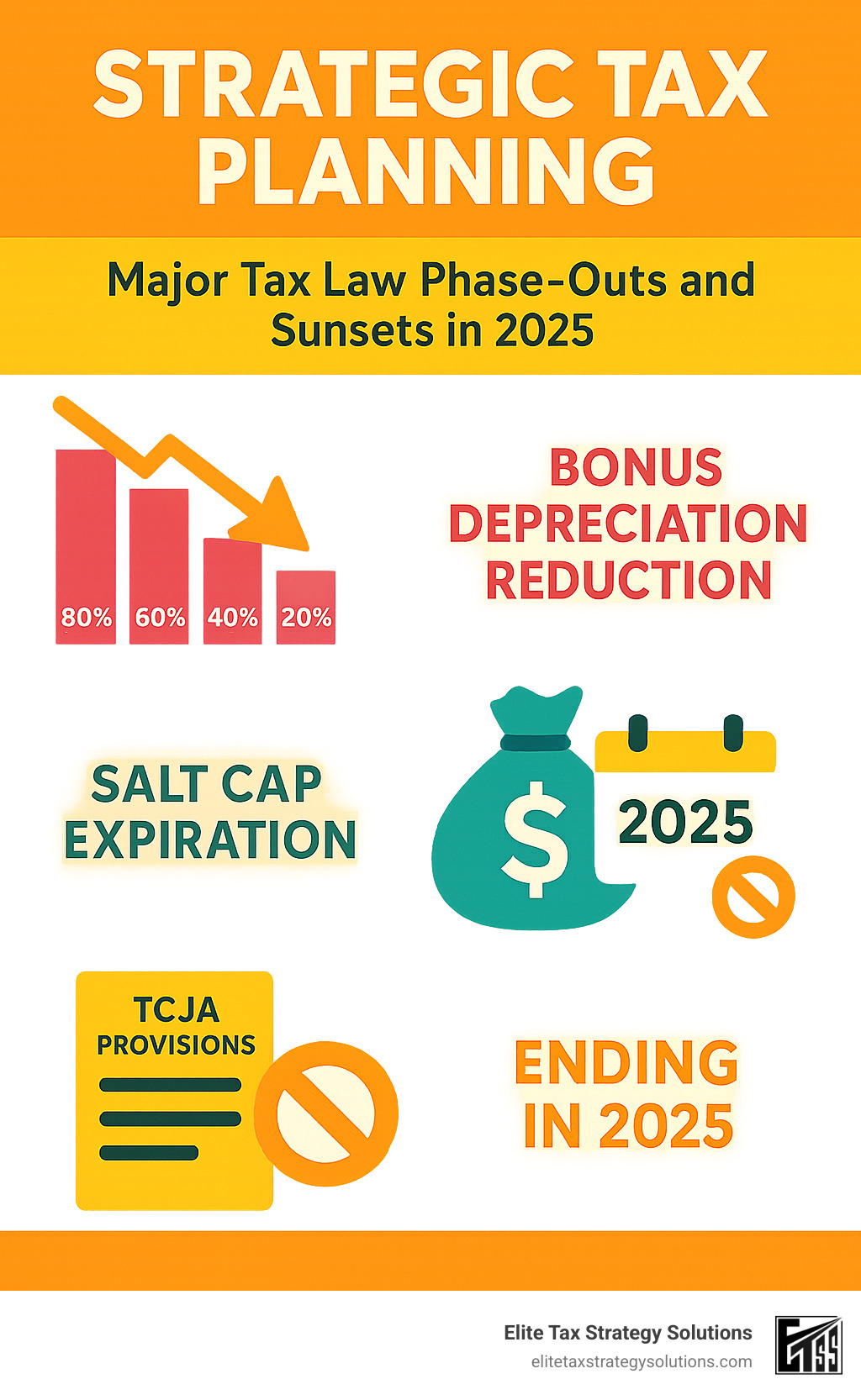
Bonus depreciation is phasing down: 80% in 2023, 60% in 2024, 40% in 2025, 20% in 2026, then eliminated. The SALT deduction cap of $10,000 expires after 2025, potentially restoring full deductibility.
The Tax Cuts and Jobs Act expires at the end of 2025, potentially changing tax rates, standard deductions, and many other provisions.
International Residency & Treaty Planning
OECD Base Erosion rules continue evolving, affecting multinational businesses and international investors. Dual-status planning becomes crucial for people splitting time between countries. Tax treaty benefits can significantly reduce withholding taxes.
Compliance Risks & Mitigation
General Anti-Avoidance Rule compliance requires genuine economic substance beyond tax savings. Penalty protection starts with proper documentation and reasonable basis for every position.
Technology & Professional Support for Seamless Implementation
Technology has transformed strategic tax planning implementation. Digital tools make tax optimization smoother, more accurate, and less stressful.
Digital Record-Keeping & Receipt Capture Apps
The Canada Revenue Agency’s six-year record retention rule requires supporting documents for audits. Receipt capture apps like Kashoo let you photograph receipts instantly, automatically reading details and categorizing expenses. Categorized digital folders organized by tax year make preparation smoother.
Scientific research on receipt digitization
When to Engage Tax Advisors & Legal Counsel
Certified Public Accountants bring deep technical tax knowledge. Tax attorneys become essential for sophisticated estate planning and complex business structures. Multidisciplinary teams coordinate all moving parts.
At Elite Tax Strategy Solutions, I serve as central coordinator with my background as both CPA and attorney, bringing in additional expertise when needed.
More info about Comprehensive Tax Planning
Ongoing Review & Policy Development
Mid-year check-ins catch important changes before they become problems. Key Performance Indicator dashboards show exactly how strategies are performing. Policy manuals document procedures for consistency and training.
Frequently Asked Questions about Strategic Tax Planning
What is the first step in strategic tax planning?
We begin every client relationship with a comprehensive “tax reality check” – examining your previous three years of tax returns to spot patterns and missed opportunities, reviewing current income sources and how they’re taxed, and mapping out your financial goals for the next five to ten years.
This initial assessment typically uncovers immediate savings opportunities worth several thousand dollars before implementing sophisticated long-term strategies.
How often should I review my strategic tax plan?
Strategic tax planning requires ongoing attention, not annual events. We schedule formal quarterly reviews to examine year-to-date numbers and adjust strategies. Between reviews, we stay connected through client portals and quick consultations when life changes occur.
The annual comprehensive review evaluates whether your overall strategy still makes sense and incorporates new tax law changes.
What records should I keep to support my strategic tax strategies?
Digital record-keeping has revolutionized documentation. Apps like Kashoo let you photograph receipts instantly and categorize expenses automatically. Business owners should maintain separate digital folders for different expense types with business purpose notes.
Investment records need special attention for calculating gains and losses. The Canada Revenue Agency requires six years of record retention, but we recommend seven years for safety.
Conclusion
After helping countless clients save thousands through strategic tax planning, I’ve seen how the right approach transforms financial futures. The difference between reactive tax filing and proactive strategic tax planning often amounts to tens of thousands of dollars annually for high-income clients.
At Elite Tax Strategy Solutions, we’ve helped families preserve generational wealth and business owners restructure operations for massive self-employment tax savings. These outcomes result from year-round strategic thinking and proactive implementation.
The most successful clients understand that tax planning is an ongoing process, not an annual event. They recognize that proper documentation and compliance are investments in peace of mind.
Whether you’re earning $200,000 or $2 million annually, strategic tax planning works best when integrated with your overall financial goals. The tax landscape continues evolving rapidly, with major changes coming in 2026 when many current provisions expire.
Your financial future deserves more than basic compliance. It deserves the proactive, comprehensive approach that strategic tax planning provides.
More info about Proactive Tax Planning Opportunities
Ready to find how much you could save through strategic tax planning? Contact Elite Tax Strategy Solutions today to schedule your comprehensive tax strategy consultation. Let’s build a plan that reduces your current tax burden while creating lasting wealth for your family.