Why Customized Tax Planning is Your Financial Game-Changer
Customized tax planning is a strategic approach that analyzes your unique financial situation, goals, and circumstances to create a personalized roadmap for minimizing tax liability while maximizing wealth retention. Unlike traditional tax preparation, which simply files what happened last year, customized tax planning proactively shapes your financial decisions throughout the year.
Here’s what customized tax planning includes:
- Proactive Strategy Development – Year-round planning vs. once-a-year filing
- Personalized Analysis – Custom to your income, business structure, and goals
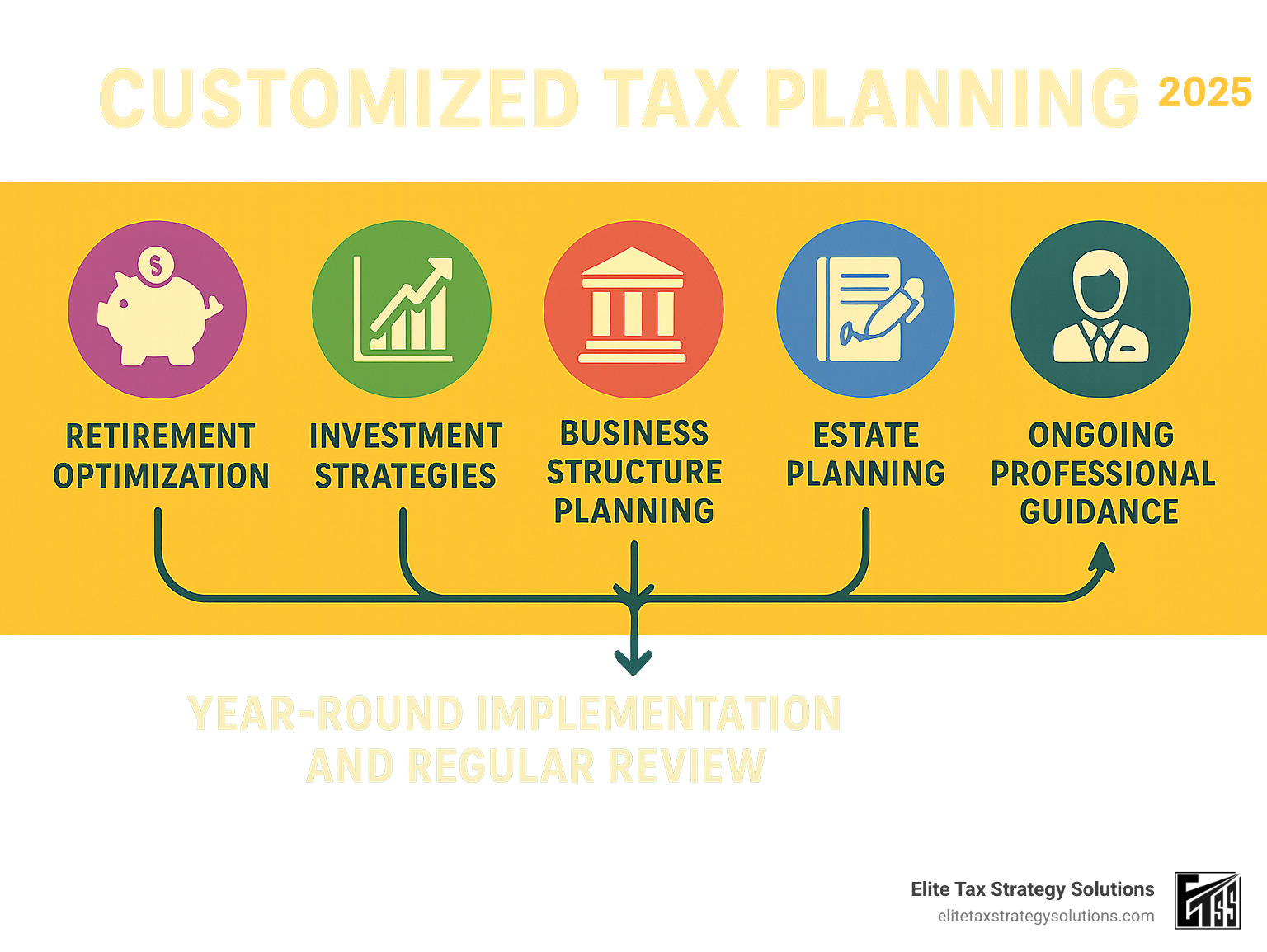
- Multi-Strategy Integration – Combines retirement, investment, estate, and business tax strategies
- Ongoing Optimization – Regular adjustments based on law changes and life events
- Compliance Assurance – Ensures all strategies meet legal requirements
As Judge Learned Hand famously stated: “Anyone may so arrange his affairs that his taxes shall be as low as possible; he is not bound to choose that pattern which will best pay the Treasury.” This principle forms the foundation of strategic tax planning.
For high-income earners and business owners, the stakes are particularly high. The research shows that clients have saved $90,000 in one year through proper tax planning, while others have been able to triple their retirement savings annually. With tax rates potentially increasing and regulations constantly evolving, a reactive approach to taxes can cost you thousands.
The difference is clear: Tax preparation looks backward at what you owe, while customized tax planning looks forward at what you can save.
I’m David Fritch, and with 40 years of experience as both a CPA and attorney, I’ve helped countless high-income professionals and business owners steer complex tax challenges through customized tax planning strategies. My firm, Elite Tax Strategy Solutions, specializes in creating personalized tax optimization plans that have saved clients significant amounts while ensuring full compliance with tax regulations.
Find more about customized tax planning:
What is Customized Tax Planning and How Does It Differ from Filing Taxes?

Picture this: You’re sitting at your kitchen table in March, surrounded by a mountain of receipts, W-2s, and forms you can barely pronounce. Sound familiar? That’s the traditional tax preparation experience – a yearly scramble to document what already happened.
Customized tax planning flips this entire approach on its head. Instead of looking backward at last year’s financial decisions, it’s about looking forward and making smart moves throughout the entire year. Think of it as the difference between driving while staring in the rearview mirror versus having a GPS that shows you the best route ahead.
The beauty of customized tax planning lies in its proactive nature. We’re not just filling out forms – we’re creating a forward-looking strategy that minimizes your tax burden while maximizing your wealth. It’s about making strategic moves in January, June, and October, not just scrambling in April.
This approach integrates seamlessly with your overall wealth management goals. When you know what’s coming, you can make decisions that work in your favor. For instance, timing when to sell investments, maximizing retirement contributions throughout the year, or structuring business expenses to optimize your tax position.
More info about Tax Advisory Services
The Proactive Approach of Strategic Tax Planning
When we dive into customized tax planning, we start with a holistic analysis of your entire financial picture. We’re not just looking at your income – we’re examining your business operations, investment strategy, future income projections, and how all these pieces fit together.
This comprehensive approach means we can align your tax strategy with your personal and financial goals. Whether you’re planning for retirement, growing a business, or building generational wealth, your tax plan becomes part of your overall financial blueprint.
The magic happens when we look at your future income potential and upcoming life changes. Are you expecting a bonus? Planning to sell property? Considering a career change? These aren’t just life events – they’re opportunities to optimize your tax position before they happen.
We also consider your investment strategy and how different types of investments are taxed. This knowledge helps us recommend moves that can significantly reduce your tax liability while supporting your long-term financial goals.
More info about Strategic Tax Planning
The Reactive Nature of Traditional Tax Preparation
Traditional tax preparation is essentially a compliance-focused exercise. It’s about taking historical data from the past year and accurately reporting it to the IRS. While this is absolutely necessary, it’s also completely reactive.
Think of it this way: traditional tax prep is like getting a report card after the school year is over. You can see how you did, but you can’t change your grades. The filing deadlines are fixed, the form completion is based on what already happened, and frankly, most of the opportunities to reduce your tax burden have already passed.
This reactive approach often leads to missed opportunities. Maybe you could have contributed more to retirement accounts, timed the sale of investments differently, or structured business expenses more strategically. But without a proactive plan, these money-saving strategies slip through the cracks.
The focus on historical data means you’re always playing catch-up instead of getting ahead. While tax preparation ensures you meet your legal obligations, it doesn’t help you legally minimize what you owe in the future.
Who Benefits Most from a Custom Tax Strategy?
While everyone can certainly make smarter choices when it comes to their taxes, customized tax planning truly shines and becomes a game-changer for certain individuals and businesses. If your financial life has grown a bit more complex than a simple W-2 paycheck and a few basic deductions, chances are you’re missing out on significant savings without a personalized plan.
Think of it this way: smart tax planning isn’t just an option; it’s a foundational piece for building lasting financial success. It’s like having a custom suit instead of a one-size-fits-all garment—it simply fits better and works harder for you.
So, who exactly finds the most value in our customized tax planning services? Often, it’s folks like high-income earners with substantial salaries, bonuses, or even diverse income streams. We also see tremendous benefit for closely held businesses facing complex operations or big growth plans, and executives navigating stock options or other non-cash compensation. If you’re an investor dealing with capital gains from active trading, or an individual juggling multiple income streams (perhaps you’re a freelancer, consultant, or have rental properties), a custom strategy is key. And of course, professionals diligently planning for retirement can maximize their savings and minimize future tax burdens with a proactive approach.
Want to know more about how we help these groups? Check out our insights on Tax Planning for High Earners.
For High-Net-Worth Individuals and Families
For high-net-worth individuals and families, customized tax planning isn’t just about finding a few extra dollars. It’s about a much bigger picture: preserving and growing your wealth for generations to come. When you’re in a higher tax bracket, those traditional, one-size-fits-all tax methods simply won’t cut it. You need something specifically designed for your unique financial landscape.
That’s where we step in. We focus on strategies like asset protection, carefully structuring your wealth to shield it from heavy taxation and potential liabilities. We dive deep into estate planning, using clever tools like trusts and smart gifting strategies to help minimize the hefty estate tax—which, by the way, can be as high as 40%. For instance, did you know individuals aged 70½ or older can donate up to $100,000 annually from an IRA directly to charity, which can lower your taxable income? It’s a win-win!
We also help optimize your charitable giving, ensuring your generosity makes a real impact while also providing significant tax advantages through options like donor-advised funds. And when it comes to your investment portfolio, we work to optimize it, employing smart, tax-efficient strategies such as tax-loss harvesting to reduce capital gains. It’s all about smooth and efficient generational wealth transfer, making sure your legacy passes on with as little tax erosion as possible.
We know that every high-net-worth individual’s situation is unique, with distinct assets and financial dreams. But almost universally, the goal remains the same: reducing your tax obligations to the absolute minimum legally allowed. And that’s precisely what we help you achieve.
Ready to explore a personalized approach to your wealth? Learn more about Personal Tax Planning.
For Business Owners and Entrepreneurs
For business owners and entrepreneurs, tax planning isn’t just a good idea; it’s a vital ingredient for a truly successful enterprise. Take simple pass-through entities, for example—your business income could be hit with a hefty 15.3% self-employment tax on top of your regular income taxes! This is precisely where making smart, strategic choices about your business structure can make an incredible difference to your bottom line.
We help businesses steer these waters, starting with crucial decisions like your entity structure—should you be an S-Corp or a C-Corp? Choosing the optimal legal structure can dramatically minimize your tax liabilities. For instance, an S-Corporation might help reduce those self-employment taxes by allowing you to pay yourself through payroll, while a C-Corporation offers robust personal liability protection and can be very attractive to investors.
We also devise strategies specifically to reduce that self-employment tax burden. We’ll help you understand and maximize the often-complex Qualified Business Income (QBI) deduction, ensuring you get every penny of this valuable 20% tax break. Plus, we’ll guide you in structuring your employee benefits and retirement plans (like 401(k)s) in the most tax-efficient ways possible. And looking ahead, we can even help you with succession planning, creating a clear roadmap for the future of your business and addressing all the significant tax implications that come with it.
When it comes to business tax planning, it’s truly never too early to start. Ideally, kicking off your tax planning at the start of your fiscal year gives you the most time to put powerful strategies into action. But even if it’s later in the year, don’t worry—it’s always worthwhile to begin optimizing your tax position.
Ready to get your business on the path to greater tax efficiency? Find more about our Small Business Tax Planning Advice.
7 Powerful Strategies for Customized Tax Planning

Now that we understand customized tax planning and who benefits most, let’s explore some powerful strategies. These are actionable steps that can lead to significant tax savings, improve your financial stability, and help you build long-term wealth. It’s about finding every legal deduction, credit, and opportunity to keep more of what you earn.
Here are seven key strategies that form the backbone of effective customized tax planning:
1. Maximizing Tax-Advantaged Retirement Accounts
One of the most straightforward ways to reduce your taxable income is to contribute generously to tax-advantaged retirement accounts. These accounts allow your money to grow tax-deferred or even tax-free, depending on the account type.
- 401(k) Contributions: For 2025, the 401(k) contribution limit is $23,500 for individuals under 50. If you’re 50 or older, you can make an additional $7,500 catch-up contribution, bringing your total to $31,000.
- IRA Contributions: The IRA contribution limit is $7,000 for 2025.
- SEP IRAs and Defined Benefit Plans: For business owners and self-employed individuals, these plans offer even higher contribution limits, allowing for substantial pre-tax deferrals. For instance, Cash Balance Plans can allow deferral of over $100,000 annually, making them a powerful tool for high-income professionals.
By front-loading your retirement savings, you not only build a secure future but also reduce your current taxable income.
For the latest official figures, you can always check the IRS information on retirement plan limits.
2. Implementing Tax-Efficient Investment Strategies
How you invest can significantly impact your tax bill. Smart investment strategies focus on minimizing the tax drag on your portfolio returns.
- Tax-Loss Harvesting: This strategy involves selling investments at a loss to offset capital gains and, potentially, a limited amount of ordinary income (up to $3,000 annually). For example, an investor with $80,000 income and $10,000 long-term capital gains could reduce their tax liability to zero by offsetting gains with $10,000 in capital losses. The excess losses can be carried forward to future years.
- Asset Location: Placing tax-inefficient assets (like high-turnover funds or bonds) in tax-advantaged accounts (like 401(k)s or IRAs) and tax-efficient assets (like index funds or ETFs) in taxable accounts.
- Municipal Bonds: Interest earned on municipal bonds is generally exempt from federal income tax and often state and local taxes if you reside in the issuing state.
- Qualified Opportunity Zones (QOFs): These allow investors to defer, reduce, and potentially eliminate capital gains taxes by reinvesting eligible gains into designated low-income communities.
- Long-Term Capital Gains: Holding investments for more than one year ensures they are taxed at lower long-term capital gains rates, which are significantly less than ordinary income tax rates.
We help you steer investment taxation to ensure your portfolio is working for you, not the taxman. Find out more about our Tax Optimization Strategies.
3. Strategic Charitable Giving
Charitable giving isn’t just about philanthropy; it can also be a powerful tax planning tool, especially for HNWIs.
- Donor-Advised Funds (DAFs): These allow you to make a charitable contribution, receive an immediate tax deduction, and then recommend grants to charities over time.
- Qualified Charitable Distributions (QCDs): If you’re 70½ or older, you can donate up to $100,000 annually directly from your IRA to a qualified charity. This distribution counts towards your Required Minimum Distribution (RMD) but isn’t included in your taxable income.
- Gifting Appreciated Assets: Donating appreciated stocks or other assets held for more than a year allows you to avoid capital gains tax on the appreciation and claim a deduction for the fair market value of the asset.
- Charitable Remainder Trusts (CRTs): These trusts allow you to donate assets to charity, receive an income stream for a set period, and get an immediate tax deduction. The remaining assets go to charity upon your death or the trust’s termination.
These strategies can help you maximize your deductions while supporting causes you care about.
4. Optimizing Your Business Structure
The legal structure of your business has profound tax implications. Choosing the right entity can save you thousands in self-employment taxes and corporate taxes.
- Pass-Through Entities (Sole Proprietorships, Partnerships, S-Corps, LLCs): Income is passed directly to the owners’ personal tax returns. However, certain structures like an S-Corporation can help reduce the 15.3% self-employment tax by allowing owners to take a reasonable salary and distribute remaining profits as non-taxable dividends.
- C Corporations: While C-corps face a flat 21% corporate tax rate on their profits, they offer advantages like complete personal liability protection and can be attractive to investors. However, profits distributed as dividends face “double taxation” (once at the corporate level, once at the shareholder level).
We help you analyze your business’s cash flow, growth projections, and exit strategy to determine the most tax-efficient structure. Dive deeper into Corporate Tax Planning.
5. Advanced Estate and Gift Tax Planning
For those with significant wealth, planning for the transfer of assets to heirs is crucial to minimize estate and gift taxes, which can be as high as 40%.
- Annual Gift Exclusion: For 2025, you can give up to $19,000 per recipient annually without incurring gift tax or affecting your lifetime exclusion amount. This is a simple way to transfer wealth tax-free over time.
- Irrevocable Trusts: These trusts can remove assets from your taxable estate, protecting them from estate taxes and potentially creditors.
- Family Limited Partnerships (FLPs): FLPs allow you to transfer assets to family members at a discounted valuation for gift tax purposes, while you retain control of the underlying assets. This is a sophisticated strategy for high-net-worth individuals, as demonstrated by clients who transferred $10 million of business interests to heirs at a 30% discounted valuation.
Effective estate planning ensures your legacy is preserved as you intend, rather than being significantly eroded by taxes.
6. Leveraging Real Estate Tax Advantages
Real estate investments offer numerous tax benefits that can significantly reduce your overall tax burden.
- 1031 Exchanges: This allows investors to defer capital gains taxes when selling an investment property by reinvesting the proceeds into a “like-kind” property.
- Depreciation: You can deduct the cost of wear and tear on investment properties over time, reducing your taxable income even if the property is appreciating in value.
- Cost Segregation Studies: These studies identify components of a property that can be depreciated over a shorter period, accelerating depreciation deductions and improving cash flow.
- Real Estate Professional Status: For those who qualify, this status allows them to deduct rental property losses against ordinary income, rather than being limited by passive activity loss rules.
Real estate can be a powerful wealth-building tool, and understanding its tax advantages is key. Learn more about Advanced Tax Strategies.
7. Utilizing Health Savings Accounts (HSAs)
Often overlooked, Health Savings Accounts (HSAs) are one of the most powerful tax-advantaged accounts available, offering a triple-tax advantage:
- Pre-tax Contributions: Contributions are made with pre-tax dollars, reducing your taxable income.
- Tax-Free Growth: Your HSA funds grow tax-free.
- Tax-Free Withdrawals: Withdrawals are tax-free when used for qualified medical expenses.
Beyond healthcare, an HSA can serve as an excellent retirement savings vehicle. If you don’t use the funds for medical expenses, after age 65, you can withdraw them for any purpose, taxed as ordinary income (similar to a traditional IRA). This flexibility makes HSAs a versatile tool in a customized tax planning strategy.
Why Your Customized Tax Plan Requires Ongoing Professional Guidance

Think of customized tax planning like tending a garden. You wouldn’t plant flowers in spring and then ignore them until winter, right? The same principle applies to your tax strategy. The financial world doesn’t hit pause while you go about your daily life. Tax laws shift, your income changes, and new opportunities emerge throughout the year.
This is why the most successful tax planning happens with ongoing professional guidance. It’s not about setting it and forgetting it. It’s about having a trusted partner who stays on top of the constantly evolving tax landscape while you focus on what you do best.
The reality is that evolving tax laws create both opportunities and challenges. New legislation can suddenly make certain strategies more valuable or completely obsolete. Meanwhile, life changes like getting married, starting a business, or receiving an inheritance can dramatically alter your tax picture. Economic shifts in markets and interest rates also impact your investment strategies and overall financial health.
Without expert guidance, it’s easy to miss these changes or make costly mistakes. The complexity of our tax system means that compliance alone is a full-time job, let alone optimization.
The Importance of a Proactive and Customized Tax Planning Process
Here’s what separates successful tax planning from the rest: it’s proactive, not reactive. We believe in annual reviews and mid-year adjustments to keep your plan aligned with your goals and current tax laws. This continuous monitoring ensures you’re always positioned to take advantage of new opportunities.
When new legislation passes or your circumstances change, we’re already thinking three steps ahead. We’re adapting to new legislation before it impacts your bottom line. This proactive approach gives you something invaluable: financial peace of mind.
The goal isn’t just to save money this year. It’s to build a sustainable, long-term strategy that grows with you. Every adjustment we make is designed to keep you moving toward your bigger financial picture.
The Role of a Tax Advisor
This is where having the right tax advisor makes all the difference. At Elite Tax Strategy Solutions, we bring expertise that goes far beyond form preparation. We understand the intricate dance between financial planning and tax efficiency, and we use that knowledge to your advantage.
Our objectivity helps you see opportunities you might miss when you’re too close to your own situation. We provide strategy implementation that goes beyond recommendations—we help you execute plans effectively while ensuring all legal requirements are met.
If the IRS ever comes knocking, we provide IRS representation to protect your interests and reduce your stress. But our primary focus is maximizing savings through smart, proactive planning.
The results speak for themselves. One client saved $90,000 in taxes in a single year through our strategic approach. We’ve helped others triple their retirement savings while maintaining full compliance with tax regulations.
Professional guidance transforms customized tax planning from a static document into a dynamic strategy that evolves with your life. It’s about empowering you to make informed decisions that build the financial future you deserve.
For more insights into how this proactive approach can benefit your specific situation, explore our Proactive Tax Planning Opportunities. And remember, you can always check the background of a financial firm on FINRA’s BrokerCheck to verify credentials and ensure you’re working with qualified professionals.
Conclusion
I hope this guide has opened your eyes to how customized tax planning can truly transform your financial life. It’s not just about surviving tax season anymore – it’s about building a strategy that works for you all year long.
Think about it: instead of scrambling every April to gather receipts and hope for the best, you could have a clear roadmap that helps you make smart financial decisions throughout the year. That’s the power of moving from reactive tax preparation to proactive customized tax planning.
We’ve covered a lot of ground together. You’ve learned how customized tax planning looks forward instead of backward, helping you shape your financial future rather than just documenting your past. We’ve explored who benefits most – particularly high-income earners and business owners who have the most to gain from strategic planning.
The seven powerful strategies we discussed aren’t just theory. They’re real tools that can make a significant difference in your tax bill. From maximizing your retirement contributions to implementing smart investment strategies, from charitable giving to optimizing your business structure – each strategy is designed to legally keep more money in your pocket.
But here’s the thing: your financial life isn’t static, and neither should your tax plan be. Tax laws change, life throws curveballs, and the economy shifts. That’s why ongoing professional guidance isn’t just helpful – it’s essential. You need someone in your corner who stays on top of these changes and adjusts your strategy accordingly.
At Elite Tax Strategy Solutions, we believe a customized tax plan is the cornerstone of financial success. Our approach isn’t about quick fixes or one-size-fits-all solutions. It’s about understanding your unique situation and creating a strategy that grows with you.
The long-term value of proper tax planning extends far beyond just saving money. It’s about financial empowerment – having the confidence that comes from knowing you’re making informed decisions. It’s about peace of mind, knowing that you’re not leaving money on the table or making costly mistakes.
Taking a proactive approach to your taxes isn’t just smart – it’s essential for anyone serious about building wealth. The difference between those who thrive financially and those who struggle often comes down to having the right strategy in place.
Don’t let another year pass by wondering if you could be doing better with your taxes. Take control of your financial future today. Let us help you create a sophisticated, forward-thinking tax strategy that protects your wealth and secures your peace of mind.
Explore our comprehensive financial planning services and find how we can help you keep more of what you’ve worked so hard to earn.