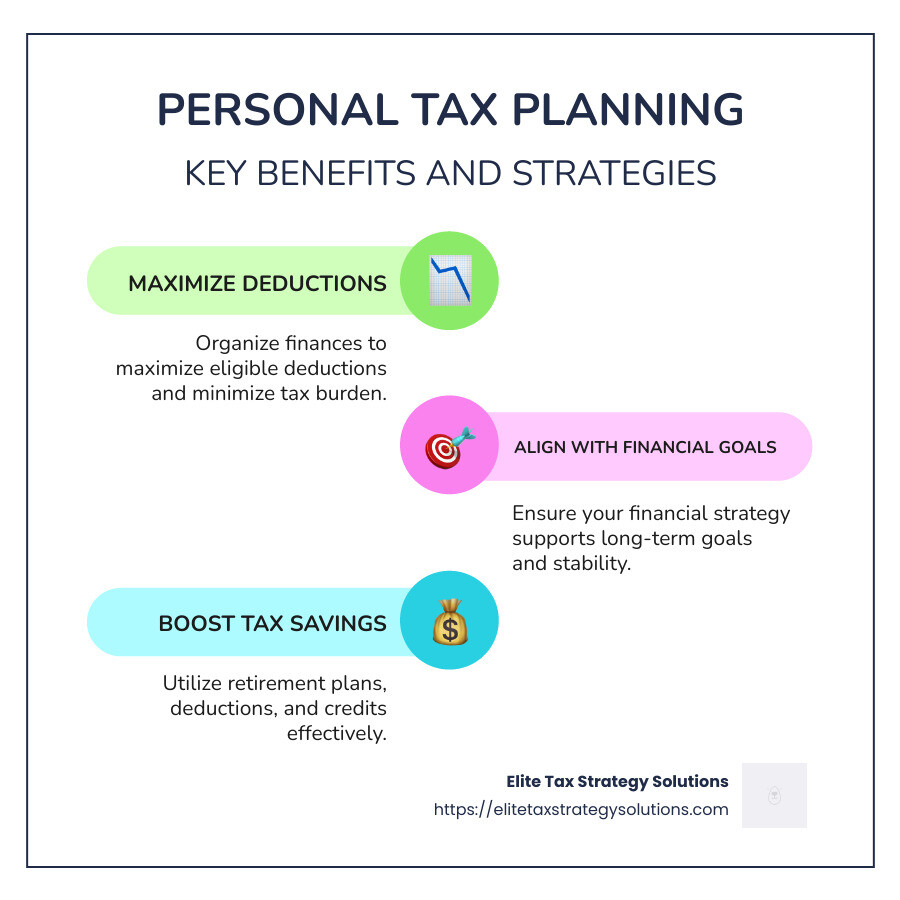
Personal tax planning is more than just a task for tax season—it’s a strategic approach to your financial well-being. At its core, personal tax planning involves organizing your financial life to maximize deductions, alleviate your tax burden, and ensure compliance with ever-changing regulations.
- Importance: Minimizes taxes, maximizes savings
- Financial Strategy: Aligns with long-term goals, improves stability
- Tax Savings: Boosts deductions, reduces liabilities
When we think about managing our finances effectively, personal tax planning plays a pivotal role. It’s about organizing your finances and aligning them with your financial goals. Whether it’s contributing to retirement plans, leveraging tax deductions and credits, or strategically timing your income, the aim is to ensure you’re not paying more tax than necessary.
I’m David Fritch, with 40 years of experience in tax planning and financial management. Having managed my own law firm and CPA practice, I understand first-hand the challenges of financial planning. I’ve dedicated my career to empowering high-income earners and business owners to steer the complexities of taxes. As we dig deeper, I’ll share insights to guide you through personal tax planning effectively.
Essential personal tax planning terms:
– comprehensive financial planning
– deduction optimization
– tax liability reduction
Understanding Personal Tax Planning
Personal tax planning is about making smart decisions with your money to keep more of it in your pocket. It’s like a puzzle where the pieces are your income, expenses, investments, and deductions. When these pieces fit together just right, you pay less in taxes. This is called being tax efficient.
Tax Efficiency
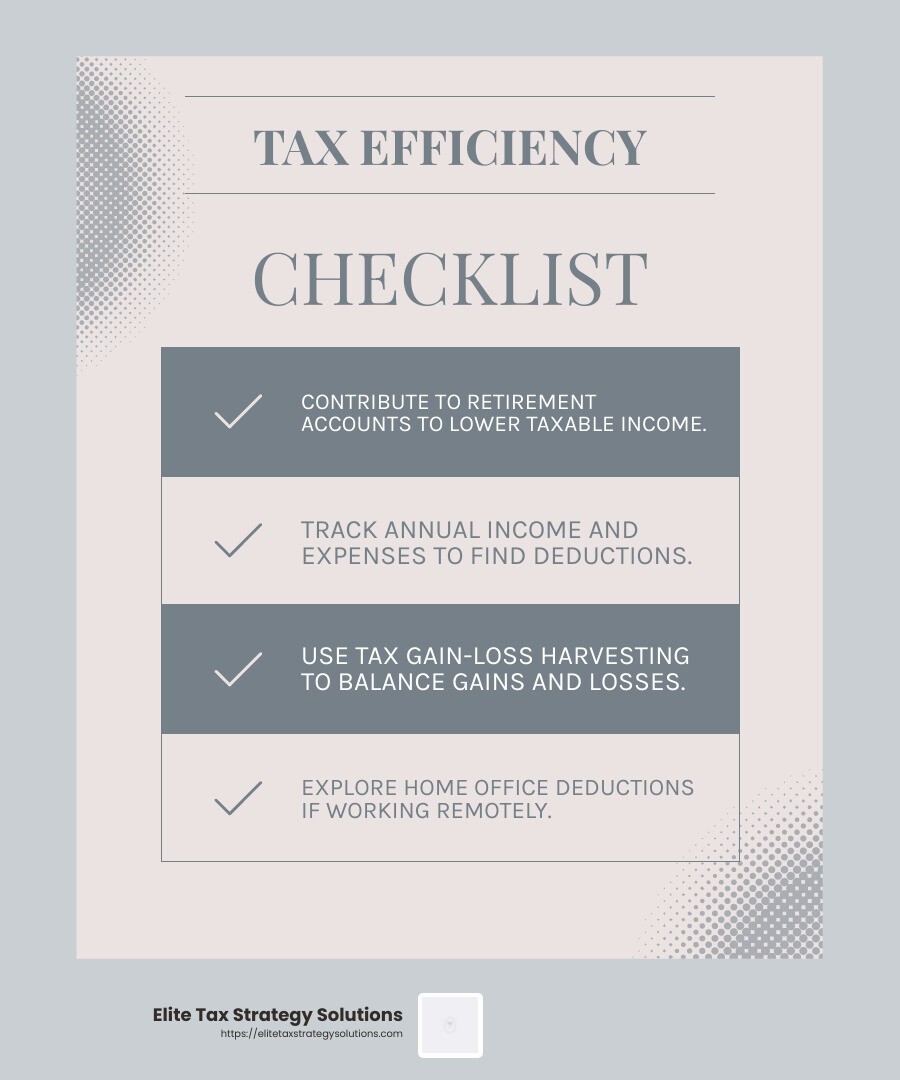
Being tax efficient means arranging your finances in a way that minimizes your tax bill. Think of it as getting the most out of every dollar you earn. For example, contributing to a retirement account like an IRA can lower your taxable income. This means you pay less tax now and let your savings grow over time.
Financial Situation Analysis
To plan your taxes effectively, you need to understand your financial situation. This involves looking at your income, expenses, and any potential deductions or credits. By doing this, you can spot opportunities to save on taxes.
A simple step is to track your spending and income throughout the year. This helps you see where you might have extra deductions or credits. For example, if you work from home, you might be able to deduct some home office expenses.
Tax Liability Reduction
Reducing your tax liability means finding ways to lower the amount of tax you owe. This can be done through careful planning and using available tax breaks.
One popular strategy is tax gain-loss harvesting. This involves selling investments that have lost value to offset gains from other investments. By balancing gains and losses, you can reduce your overall tax bill.
Incorporating these strategies into your personal tax planning can make a big difference. It’s all about understanding your financial picture and making informed decisions that lead to tax savings.
By focusing on tax efficiency, financial situation analysis, and tax liability reduction, you can take control of your finances and work toward a more secure future.
Key Strategies for Personal Tax Planning
When it comes to personal tax planning, three strategies stand out: retirement savings, tax gain-loss harvesting, and income timing. Each plays a crucial role in minimizing your overall tax burden.
Retirement Savings
Saving for retirement is not just about securing your future; it’s also a smart tax move. Contributions to retirement accounts like IRAs and 401(k)s can lower your taxable income. For instance, in 2024, contributing $7,000 to a traditional IRA could reduce your taxable income by that amount. If you’re 50 or older, you can add an extra $1,000 as a catch-up contribution.
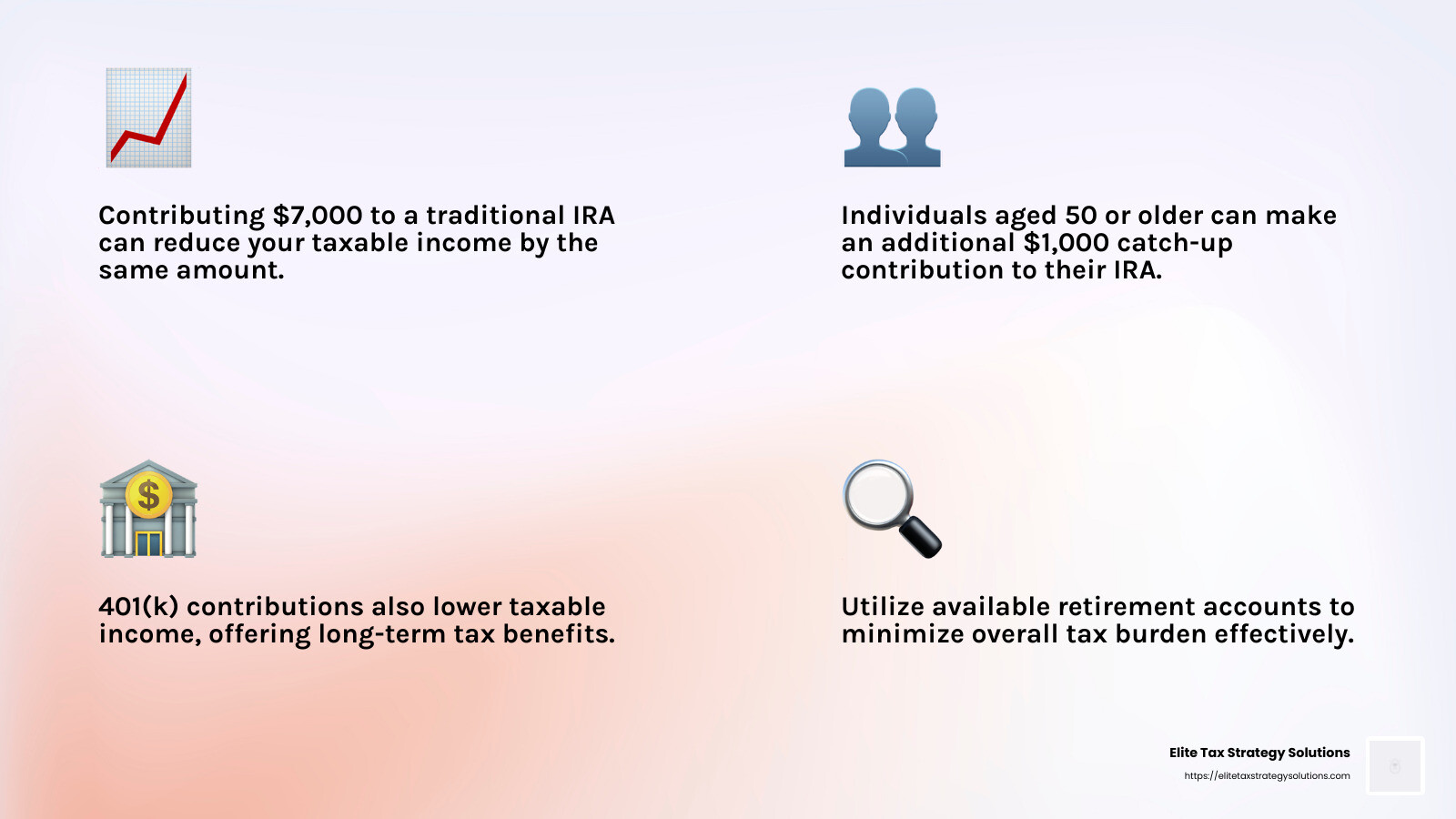
Similarly, for those using a 401(k), the contribution limit is $23,000 in 2024, with an additional $7,500 for those over 50. These contributions grow tax-deferred, meaning you don’t pay taxes on the earnings until you withdraw them. This strategy not only prepares you for retirement but also provides immediate tax benefits.
Tax Gain-Loss Harvesting
Tax gain-loss harvesting is a technique for managing your investment portfolio to minimize taxes. It involves selling investments that have decreased in value to offset the gains from those that have increased. This can help reduce the taxes you owe on capital gains.
For example, if you have a stock that has lost value, selling it can offset the gain from another stock you’ve sold at a profit. The IRS requires that you match long-term losses against long-term gains and short-term losses against short-term gains. This strategy can be particularly beneficial in a volatile market, helping to balance out your tax obligations.
Income Timing
Timing your income can also be a powerful tool in your tax planning arsenal. By strategically timing when you receive income or make certain expenses, you can potentially reduce your tax liability.
For instance, if you expect to be in a lower tax bracket next year, you might defer a bonus or delay selling an investment until then. Conversely, if you anticipate being in a higher tax bracket, you might accelerate income into the current year to take advantage of a lower rate.
These strategies require careful planning and a good understanding of your financial situation. By incorporating retirement savings, tax gain-loss harvesting, and income timing into your personal tax planning, you can effectively manage your tax burden and keep more of your hard-earned money.
Next, we’ll explore how to maximize tax-advantaged accounts to further optimize your tax strategy.
Maximizing Tax-Advantaged Accounts
When it comes to personal tax planning, using tax-advantaged accounts can be a game-changer. These accounts not only help you save for the future but also offer significant tax benefits. Let’s explore how you can make the most of IRA contributions, 401(k) plans, and Roth IRA conversions.
IRA Contributions
Individual Retirement Accounts (IRAs) are a popular choice for those looking to save for retirement while reducing taxable income. For 2024, you can contribute up to $7,000 to a traditional IRA, with an additional $1,000 allowed if you’re 50 or older. These contributions can be deducted from your taxable income, potentially lowering your tax bill.
Consider this: if you earn $75,000 a year and contribute the full $7,000 to your IRA, your taxable income drops to $68,000. This means you pay taxes on a smaller amount, and your contributions grow tax-deferred until you withdraw them in retirement.
401(k) Plans
401(k) plans are another powerful tool in your tax-saving arsenal. These employer-sponsored plans allow you to defer a portion of your paycheck into a retirement account, reducing your taxable income. In 2024, you can contribute up to $23,000, with an extra $7,500 if you’re over 50.
Let’s say you earn $100,000 annually and contribute $23,000 to your 401(k). Your taxable income would then be $77,000. Like IRAs, the money in your 401(k) grows tax-deferred, which means you don’t pay taxes on it until you make withdrawals during retirement.
Roth IRA Conversions
Roth IRAs offer a different tax advantage. Unlike traditional IRAs, contributions to Roth IRAs are made with after-tax dollars, but withdrawals in retirement are tax-free. This can be particularly beneficial if you expect to be in a higher tax bracket in the future.
Converting a traditional IRA or 401(k) to a Roth IRA involves paying taxes on the converted amount, but it can be a smart move for long-term tax planning. By spreading the conversion over several years, you can manage the tax impact and avoid jumping into a higher tax bracket.
Tip: Talk to your tax advisor to determine the best conversion strategy for your situation. Timing and planning are crucial to minimize tax liabilities during the conversion process.
By maximizing contributions to IRAs and 401(k)s and considering Roth IRA conversions, you can take full advantage of these tax-advantaged accounts. These strategies not only help you save for retirement but also optimize your tax situation, keeping more money in your pocket.
Next, we’ll dive into tax planning tips specifically for high-income earners.
Tax Planning Tips for High-Income Earners
High-income earners face unique challenges when it comes to personal tax planning. But with the right strategies, you can significantly reduce your tax liabilities. Let’s explore some key tactics: tax credits, health savings accounts (HSAs), and municipal bonds (munis).
Tax Credits
Tax credits are a powerful way to lower your tax bill because they provide a dollar-for-dollar reduction. Unlike deductions, which lower your taxable income, credits directly reduce the amount of tax you owe.
For high-income earners, some credits may phase out based on income levels. However, explore all available options, such as the Child Tax Credit, the American Opportunity Credit for education expenses, and energy-efficient home improvement credits.
Tip: Work with a tax advisor to identify credits you qualify for and ensure you’re taking full advantage of them.
Health Savings Accounts (HSAs)
HSAs are not just for medical expenses; they are also a smart tax-saving tool. Contributions to an HSA are tax-deductible, and the account grows tax-free. Withdrawals for qualified medical expenses are also tax-free.
For 2024, you can contribute up to $4,150 for self-only coverage and $8,300 for family coverage. If you’re 55 or older, you can contribute an additional $1,000. These contributions reduce your taxable income, providing immediate tax savings.
Example: If you earn $200,000 and contribute the maximum $8,300 to your HSA, your taxable income decreases to $191,700.
Municipal Bonds (Munis)
Investing in municipal bonds can be a great way to earn tax-free interest income. Munis are issued by local governments to fund public projects, and their interest is generally exempt from federal taxes. If you live in the issuing state, you might also avoid state and local taxes.
Did You Know? According to a 2023 report, municipal bonds have a default rate of just 0.08%, making them a low-risk investment option.
While munis typically offer lower interest rates than corporate bonds, their tax-free status can make them more attractive, especially for those in higher tax brackets.
Tip: Consider your overall financial strategy and risk tolerance when investing in munis. They can be a valuable part of a diversified portfolio.
By leveraging tax credits, maximizing HSAs, and investing in municipal bonds, high-income earners can effectively manage and reduce their tax liabilities. These strategies not only help keep more money in your pocket but also align with long-term financial goals.
Next, we’ll tackle some frequently asked questions about personal tax planning to help you steer this complex landscape.
Frequently Asked Questions about Personal Tax Planning
Is tax planning worth it?
Absolutely! Personal tax planning offers significant tax benefits and can lead to substantial financial optimization. By strategically organizing your finances, you can reduce your tax liabilities and keep more money in your pocket. This means more funds for investments, savings, or everyday expenses.
Tax planning isn’t just about saving money today. It’s about setting yourself up for long-term benefits. For example, contributing to tax-advantaged accounts like IRAs or 401(k)s reduces your taxable income now while growing your savings for the future.
What is the difference between tax preparation and tax planning?
Think of tax preparation as a short-term task focused on compliance. It’s about gathering documents, filling out forms, and making sure you meet the IRS requirements. It’s a one-time activity that happens around tax season.
On the other hand, tax planning is a year-long, proactive process. It involves analyzing your financial situation to find ways to legally reduce your tax liability. Tax planning is about making informed decisions today that will benefit you tomorrow. It’s not just about filing your taxes; it’s about optimizing your financial strategy for the future.
How much does a tax planner cost?
The cost of hiring a tax planner can vary widely depending on the complexity of your financial situation and the services you require. On average, you might expect to pay anywhere from $200 to $2,000 or more. For simple tax situations, the cost might be on the lower end. But if you have multiple income sources, investments, or are a high-income earner, the fee could be higher.
Investing in a tax planner can be worthwhile, especially if they help you uncover savings that exceed their fees. Effective tax planning can lead to significant tax savings and contribute to your overall financial health.
By understanding these frequently asked questions, you can better appreciate the value of personal tax planning and make informed decisions that align with your financial goals. Next, we’ll dig into the conclusion, highlighting how Elite Tax Strategy Solutions can help you achieve proactive tax optimization and financial stability.
Conclusion
At Elite Tax Strategy Solutions, we believe that proactive tax optimization is key to achieving long-term financial stability. Our personalized tax planning services are designed to help high earners and closely held businesses steer the complexities of the tax code with ease.
We understand that each client’s financial situation is unique, which is why we offer custom strategies to maximize your tax savings. Our approach goes beyond mere compliance; it integrates tax planning into your overall financial strategy, ensuring that you are well-prepared for any changes in tax laws and regulations.
With our expertise, you can open up the secrets of personal tax planning and take control of your financial future. Whether it’s through maximizing deductions, utilizing tax credits, or planning for retirement, we’ll guide you every step of the way.
Our goal is simple: to help you keep more of your hard-earned money while ensuring your financial goals are met. So, if you’re ready to take a proactive approach to your taxes and achieve financial peace of mind, visit our high-income individual tax planning page to learn more about how we can assist you.
By partnering with Elite Tax Strategy Solutions, you’re not just optimizing your taxes—you’re setting the foundation for a financially secure future.