Why Understanding the Impact of Tax Law Changes Matters More Than Ever
The impact of upcoming tax law changes will soon become more challenging for high-income earners and business owners. Key provisions from the Tax Cuts and Jobs Act (TCJA) expire at the end of 2025, creating a “tax cliff” that could dramatically increase your tax burden.
Key Tax Law Changes Coming in 2026:
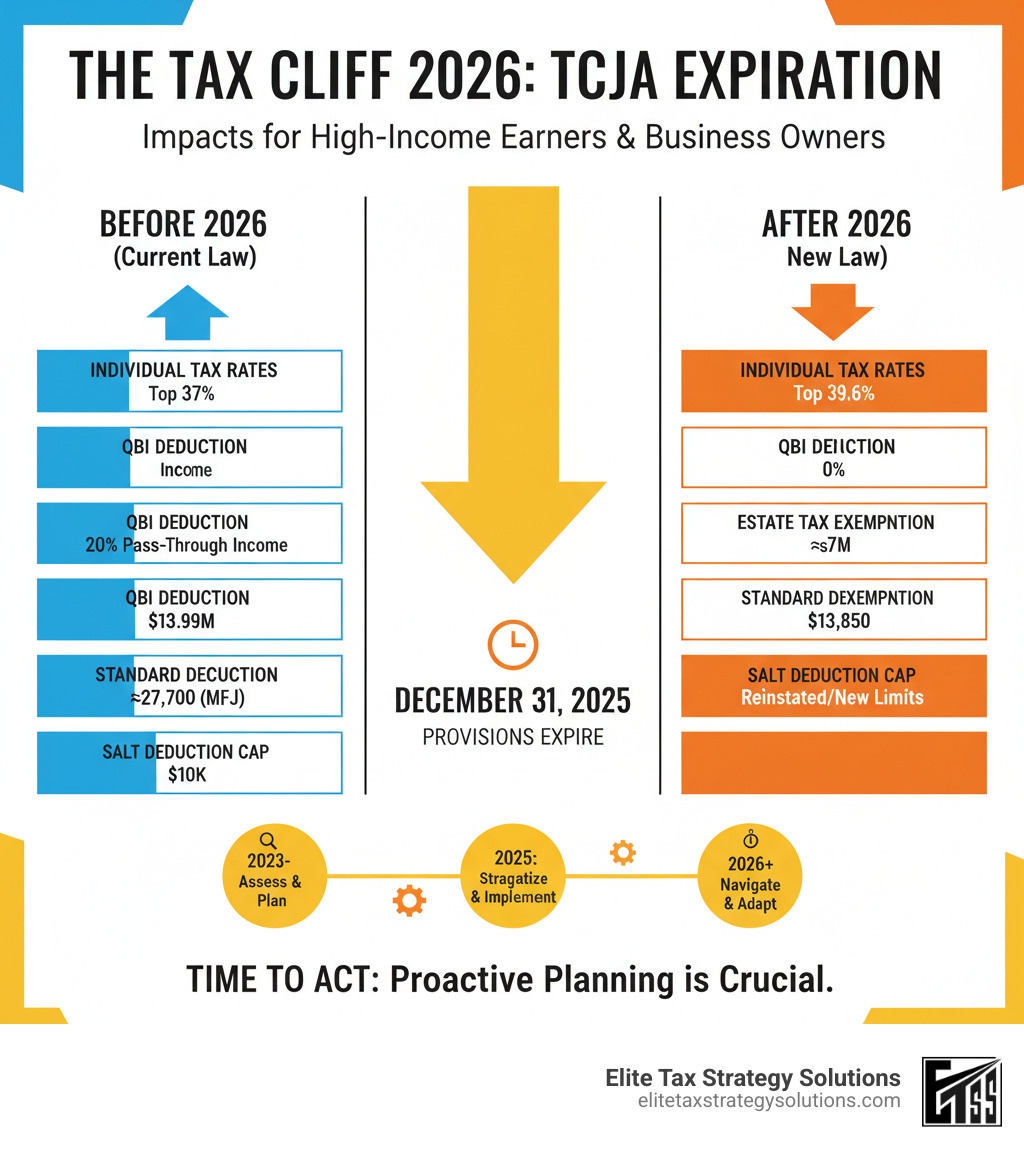
- Individual tax rates increase – Top rate jumps from 37% to 39.6%
- QBI deduction disappears – Loss of 20% deduction for pass-through businesses
- Estate tax exemption halves – Drops from $13.99 million to approximately $7 million
- Standard deduction cuts – Reduced by roughly 50% for most taxpayers
- SALT deduction cap expires – But high earners face new limitations
These changes will impact millions of U.S. taxpayers. For business owners, the loss of the QBI deduction alone could substantially increase effective tax rates. High-net-worth families face a “use it or lose it” scenario with the estate tax exemption.
The ripple effects extend beyond just higher rates. Investment strategies, business structures, and estate plans all need immediate review. Companies may face challenges with R&D deduction changes, while families must steer new rules affecting trust planning and wealth transfer.
I’m David Fritch, and over my 40 years managing tax strategies for high-income clients, I’ve seen how the impact of tax law changes can either devastate or strengthen financial positions depending on preparation. My experience shows that proactive planning before these changes take effect is crucial for maintaining wealth and minimizing tax burdens.
Relevant articles on navigating these changes:
The 2026 “Tax Cliff”: Key TCJA Provisions Set to Expire
Picture this: you’re cruising along a scenic highway when you see a sign that reads “Road Ends Ahead.” That’s essentially what we’re facing with the upcoming changes to federal tax rules. The Tax Cuts and Jobs Act (TCJA) has provided tax relief since 2017, but many key provisions will expire on December 31, 2025.
When Congress passed the TCJA, they set many provisions to expire after eight years as a deliberate sunset clause. As we approach that deadline, we face what tax professionals call the “2026 Tax Cliff.”
Unless Congress acts, we’ll see a dramatic shift back to pre-TCJA tax rules, meaning higher tax rates, fewer deductions, and lower exemptions. The impact will be felt most acutely by high-income earners and business owners who have benefited from these temporary provisions.

Higher Individual Income Tax Rates
When 2026 rolls around, your marginal tax rates are set to jump back to their 2017 levels. The current top rate of 37% will leap to 39.6%, and the entire bracket structure will shift upward.
Instead of the current rates of 10%, 12%, 22%, 24%, 32%, 35%, and 37%, we’ll return to the old system: 10%, 15%, 25%, 28%, 33%, 35%, and 39.6%. These changes will impact middle and upper-middle-class families, not just the wealthy.
For high-income W2 earners, this translates to thousands of additional dollars in tax liability on the same income. A married couple earning $400,000 could see their federal tax bill increase by several thousand dollars annually simply due to rate changes.
This is why we’re passionate about helping clients explore Tax Strategies for High Income W2 Earners before these changes take effect.
The Disappearance of the Qualified Business Income (QBI) Deduction
If you’re a business owner, this next change is significant. The Qualified Business Income (QBI) deduction has been a game-changer, allowing eligible pass-through entities to deduct up to 20% of their qualified business income.
This deduction has provided substantial tax relief for S-corporation owners, partners, and sole proprietors, particularly in professional services and real estate.
Here’s the harsh reality: this 20% deduction is scheduled to vanish completely after 2025. For many business owners, this is their single largest tax benefit. Losing it will effectively increase their tax rates, potentially adding tens of thousands to their annual tax bills.
Consider a consultant with $300,000 in qualified business income. Under current rules, they might deduct $60,000, saving roughly $22,000 in federal taxes. In 2026, that savings disappears.
The clock is ticking, which is why we’ve developed strategies for Maximizing Your Qualified Business Income (QBI) Deduction Before It Expires.
Halving of the Estate and Gift Tax Exemption
For high-net-worth families, this change is both a challenge and an opportunity. The TCJA dramatically increased the lifetime exclusion amount for estate, gift, and generation-skipping transfer taxes. In 2025, you can transfer $13.99 million per person ($27.98 million per married couple) tax-free.
After 2025, this generous exemption will be cut roughly in half to approximately $7 million per individual (adjusted for inflation). This creates a massive “use it or lose it” scenario.
A married couple with a $20 million estate currently faces no federal estate tax. After 2026, they could owe roughly $5.2 million on the same assets. This staggering difference could force the sale of family businesses or other assets.
The opportunity lies in acting now. Families can make large gifts or implement sophisticated estate planning strategies while the higher exemption is available, but these require professional guidance.
Our team specializes in Tax Efficient Estate Planning that maximizes your use of the current exemption while the window remains open.
Changes to Standard and Itemized Deductions
The deduction landscape is also set for a major overhaul. The current standard deduction ($29,200 for married couples, $14,600 for singles) will be cut roughly in half when TCJA provisions expire.
This reduction means many taxpayers will need to itemize again, reversing the TCJA’s simplification efforts. However, there’s a silver lining for some: the $10,000 cap on State and Local Tax (SALT) deductions will disappear, potentially providing relief for those in high-tax states.
However, the return of the Pease limitation will reduce itemized deductions for high-income earners, potentially offsetting some SALT benefits. Additionally, miscellaneous itemized deductions will return, but only to the extent they exceed 2% of your adjusted gross income.
The mortgage interest deduction will also become more generous, potentially covering interest on up to $1 million of acquisition debt and $100,000 of home equity debt.
These interacting changes create a complex web of planning opportunities. Our Deduction Optimization services help you steer these shifting rules to minimize your tax burden.
Understanding the Impact of Tax Law Changes on Different Taxpayers
The approaching 2026 changes won’t affect everyone equally. Your specific situation determines how hard these shifts will hit your finances. The key is understanding where you stand, whether you’re a high-income W2 employee, a business owner, or planning your family’s legacy.

Let’s break down how these changes will affect different taxpayers so you can plan now.
How High-Income Earners Will Be Affected
If you’re a high-income earner, the impact is particularly steep. You’ll be hit from multiple directions, leading to a significant tax bill increase.
Higher marginal rates are just the beginning. The top rate jumps from 37% to 39.6%, which translates to thousands of additional dollars owed for those with substantial income.
It gets more complicated. The Alternative Minimum Tax (AMT) is making a comeback. Under the TCJA, the AMT exemption was raised, but post-2025, lower exemption amounts and earlier phase-out thresholds will catch more people in the AMT web.
The reduction in standard deductions combined with new limitations on itemized deductions creates a “deduction squeeze.” You’ll have fewer ways to reduce your taxable income just as rates are going up.
Capital gains taxes may also increase for high earners, and the return of various phase-out provisions means many tax benefits could start disappearing as your income rises. We’ve developed proven Strategies to Reduce Taxes for High-Income Earners that work in this challenging new environment.
The Impact on Business Owners
Business owners, especially those with pass-through entities, face complex changes. The loss of the 20% QBI deduction alone could substantially increase your effective tax rate.
Research and Development expenses present another challenge. Instead of immediately deducting R&D costs, you may need to amortize them over several years, which can significantly impact cash flow for innovative companies.
The Section 179 expensing limits and bonus depreciation rules are also set to become less favorable. Post-2025, you’ll likely need to depreciate large equipment purchases over time, affecting cash flow and tax planning.
This creates a perfect storm for pass-through business owners: higher individual tax rates on business income, no QBI deduction, and reduced ability to immediately expense business investments.
Many business owners are now reconsidering their entity structure. C-corporations kept their 21% tax rate permanently, making them potentially more attractive. However, this decision involves weighing double taxation against higher pass-through rates.
Our Small Business Tax Saving Strategies can help you steer these structural decisions.
Implications for Families and Estate Planning
Families face a different set of challenges. The child tax credit will likely drop from current levels back to $1,000 per child, with phase-outs starting at much lower income levels.
For wealthy families, the estate tax exemption change is a massive shift. Going from $13.99 million to approximately $7 million per person creates an urgent “use it or lose it” situation for large gifts.
A key change is Revenue Ruling 2023-2, which altered how assets in irrevocable trusts are treated. Previously, beneficiaries often received a “step-up in basis” on inherited trust assets, minimizing capital gains taxes.
Now, if trust assets aren’t in the grantor’s taxable estate, beneficiaries inherit the original cost basis. For example: if a parent transfers a property bought for $300,000 to an irrevocable trust, and it’s worth $500,000 upon their death, the child inherits the original $300,000 basis. A sale would trigger capital gains tax on the $200,000 gain.
This ruling has major implications for trust planning and requires immediate review of existing estate structures. Lower estate tax exemptions and Revenue Ruling 2023-2 make multi-generational planning more complex and critical. Our Multi-Generational Wealth Planning approach helps families steer these interconnected challenges.
Proactive Strategies to Steer the Upcoming Tax Shift
The prospect of a “tax cliff” in 2026 might sound daunting, but it creates a window of opportunity for smart planning. The key is being proactive, not reactive. By understanding the potential impact of these tax changes and acting now, we can help turn these challenges into advantages.

How These Changes Affect Multi-Year Planning
Strategic timing is your best friend. With higher income tax rates looming in 2026, we can use the next year to our advantage through careful multi-year planning.
Income acceleration may seem counterintuitive, but it makes sense if you expect to be in a higher tax bracket after 2025. We might explore accelerating bonuses, exercising stock options, or timing business income.
Roth conversions are particularly powerful now. You convert traditional IRA funds to a Roth IRA, pay taxes at today’s potentially lower rates, and then enjoy tax-free growth and withdrawals forever.
Capital gains harvesting is also attractive. Realizing significant gains in 2025 could save you money compared to waiting until rates potentially increase. Conversely, loss harvesting might be more valuable in 2026, as those losses could offset gains taxed at higher rates.
The beauty of multi-year planning is coordinating these strategies to work together. Our team specializes in identifying these Proactive Tax Planning Opportunities that fit your specific situation.
Re-evaluating Business and Investment Structures
The disappearance of the QBI deduction changes the business structure game. Suddenly, the 21% C-corporation tax rate looks more attractive compared to pass-through entities facing higher individual rates without the 20% deduction.
For pass-through entities, we need to run fresh numbers. Will your S-corp or partnership still be the most tax-efficient choice? A structure that worked beautifully under current law might need adjustment.
Your investment portfolio deserves the same strategic attention. Tax-loss harvesting becomes more valuable when gains face higher tax rates. Asset location – strategically placing investments in the right types of accounts – can save thousands in taxes over time by putting heavily taxed investments in tax-advantaged accounts.
Our Business Tax Advisory services help you steer these critical structural decisions with confidence.
Advanced Estate and Gifting Techniques
The current $13.99 million estate and gift tax exemption is a golden ticket that expires on December 31, 2025. This is a “use it or lose it” opportunity.
Spousal Lifetime Access Trusts (SLATs) offer a neat solution for married couples. One spouse gifts to an irrevocable trust benefiting the other spouse and family. You use your exemption now but maintain potential family access to the assets.
Grantor Retained Annuity Trusts (GRATs) work well for appreciating assets. You transfer assets to the trust, retain annuity payments, and if the assets grow faster than the IRS-assumed rate, the excess passes to beneficiaries gift-tax-free.
Don’t overlook charitable giving strategies. Charitable Remainder Trusts and Charitable Lead Trusts can provide significant tax benefits while supporting causes you care about and reducing your taxable estate.
The annual gift tax exclusion of $18,000 per person ($36,000 for married couples) doesn’t count against your lifetime exemption, making it a simple, effective wealth transfer tool.
Given the complexity and the impact of Revenue Ruling 2023-2, a comprehensive estate plan review is essential. Our High Net Worth Tax Planning experts can help design a robust plan to preserve your wealth.
Frequently Asked Questions about the Impact of Tax Law Changes
Expiring tax provisions and rate increases can be overwhelming. Here are answers to common questions about what’s coming.
What is the single biggest tax change coming in 2026?
The biggest change is the expiration of most individual and small business provisions from the Tax Cuts and Jobs Act (TCJA). This isn’t a small tweak; it’s a complete overhaul.
Three major dominoes are falling at once. First, individual income tax rates are jumping up, with the top rate climbing from 37% to 39.6%. Second, the valuable 20% Qualified Business Income (QBI) deduction for many business owners is gone. And third, the estate tax exemption is slashed in half, dropping from $13.99 million to roughly $7 million per person.
This triple whammy affects millions of taxpayers and fundamentally changes how we approach financial planning.
Will my business taxes go up after 2025?
Almost certainly yes, especially if you’re running a pass-through entity like an S-corp, partnership, or sole proprietorship. The effects on businesses are particularly harsh.
The biggest blow is losing the 20% QBI deduction. If you’ve been enjoying this tax break, its disappearance will directly increase your effective tax rate. For example, a $10,000 annual savings from the QBI deduction means $10,000 more you’ll owe in taxes starting in 2026.
Since pass-through income is taxed at individual rates, you’ll also face those higher individual tax rates. It’s a double hit that could significantly impact your bottom line.
The silver lining? We still have time to plan. That’s why we recommend exploring Business Tax Reduction strategies now, while the rules are more favorable.
How do these changes affect my retirement planning?
Retirement planning is a long game, and the rules are about to change dramatically. The impact on retirement planning requires a strategic shift.
The core issue: if tax rates are going up in 2026, the traditional wisdom of deferring taxes until retirement becomes questionable. Your traditional 401(k) and IRA withdrawals will be taxed at those higher future rates.
This is where Roth conversions become a powerful tool. By paying taxes now at potentially lower 2025 rates, you’re essentially locking in today’s “sale price” on taxes. Every dollar you convert to a Roth IRA today is a dollar that will never be taxed again—not the principal, not the growth.
Roth IRAs also don’t have required minimum distributions, giving you more control over your retirement income. Getting the timing right is key. Comprehensive Tax Efficient Retirement Planning is invaluable, as one size doesn’t fit all when navigating these changes.
Conclusion: Secure Your Financial Future with Proactive Tax Planning
The changes ahead represent a seismic shift that will reshape how you think about money, taxes, and wealth preservation. It’s like standing at a cliff’s edge with the power to build a bridge to safety.
We’ve walked through how higher individual income tax rates, the disappearance of the QBI deduction, and the halving of the estate tax exemption will impact your wallet, your business, and your family’s future. These are real changes with real financial consequences.
In my 40 years of experience, I’ve learned that uncertainty doesn’t have to mean vulnerability. The families and business owners who thrive are those who act decisively with the information they have, rather than waiting for perfect clarity.
The strategies we’ve discussed – from Roth conversions and capital gains harvesting to advanced estate planning – are proven methods that can help you not just manage tax increases, but strengthen your financial position.
At Elite Tax Strategy Solutions, our core belief is that proactive planning beats reactive scrambling every time. We create strategies that work for your unique situation, whether you’re a high-earning professional, a business owner, or someone building generational wealth.
The 2026 tax cliff is coming. You can wait and hope, or you can take control now and turn potential challenges into opportunities. Don’t let this moment pass you by.
Take control of your tax future with high-income individual tax planning and let us help you build that bridge to financial security.