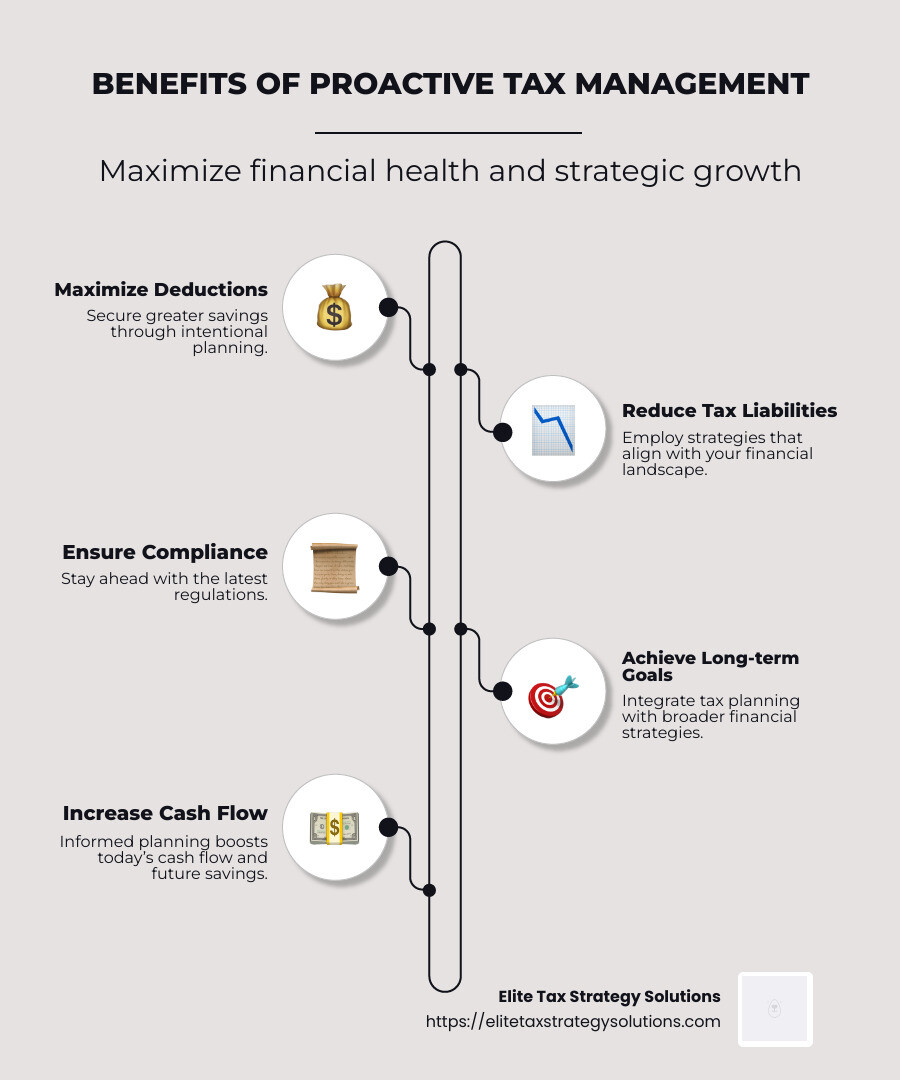
Proactive tax management is not just about evading a hefty bill at the end of the year. It’s a seamless approach to maximizing your income and securing a brighter financial outlook. At its core, this strategy offers a guide through the tax code labyrinth, aiming to improve financial health and strategic growth. Here’s a quick snapshot of the benefits you can expect:
- Maximize deductions and credits: Secure greater savings through intentional planning.
- Reduce tax liabilities: Employ strategies that align with your unique financial landscape.
- Ensure compliance with changing laws: Stay ahead with the latest regulations.
- Achieve long-term financial goals: Integrate tax planning with broader financial strategies.
Every financial decision carries a tax impact. Ignoring taxes in investment or retirement planning could significantly reduce your potential for wealth accumulation. Conversely, informed planning can increase cash flow today and grow long-term savings.
I’m David Fritch, and for over 40 years, I’ve been guiding high-income earners and small business owners through proactive tax management to optimize financial outcomes. Let’s dig deeper into how strategic planning could shape your financial landscape.
Learn more about proactive tax management:
– comprehensive financial planning
– tax audit preparation
– tax planning for businesses
Understanding Proactive Tax Management
Proactive tax management is about planning ahead to make the most of your financial situation. It involves understanding the tax code and using it to your advantage, rather than just reacting to tax bills as they come. This approach can help you find tax-saving opportunities and ensure that your financial strategies are aligned with your long-term goals.
Tax Planning:
Tax planning is a key component of proactive tax management. It’s about analyzing your financial situation to ensure that all elements work together to minimize your tax liability. This means considering the timing of income, the size and timing of purchases, and planning for expenditures.
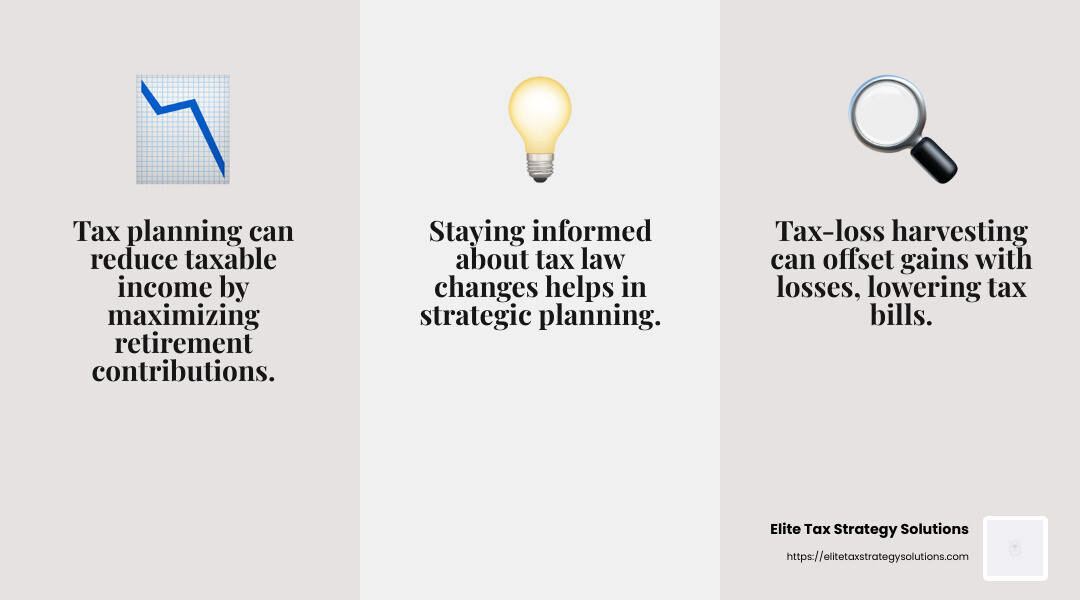
For example, contributing to a retirement plan like a 401(k) or IRA can reduce your taxable income. In 2023, you can contribute up to $22,500 to a 401(k), and this limit will increase to $23,000 in 2024. These contributions grow tax-deferred, meaning you don’t pay taxes on the money until you withdraw it, usually in retirement.
Tax-Saving Opportunities:
There are many opportunities to save on taxes if you plan ahead. For instance, tax-loss harvesting can help you offset capital gains with losses, reducing your overall tax bill. If you have investments that have lost value, you can sell them to realize the loss and then reinvest in a similar asset, maintaining your portfolio’s risk profile.
Another opportunity is using tax-efficient accounts. Placing high-return investments in tax-advantaged accounts can shield them from taxes, while placing lower-return investments in taxable accounts minimizes tax liability.
Proactive Approach:
Being proactive means staying informed about changes in tax laws and adjusting your strategies accordingly. Tax laws change frequently, and what worked last year might not be beneficial this year. Regularly reviewing your tax situation with a professional can help you stay ahead of these changes.
For example, new federal and state tax laws often create opportunities for strategic tax planning. A CPA advisory firm can help identify these opportunities, such as optimizing the sale of real estate or business assets to avoid triggering unnecessary tax events.
By adopting a proactive approach, you can ensure compliance with changing laws, maximize deductions and credits, and reduce overall tax liabilities. This strategic planning not only helps in minimizing taxes but also plays a crucial role in achieving long-term financial goals.
In the next section, we’ll explore key strategies for proactive tax planning, including understanding tax brackets, withholding strategies, and more.
Key Strategies for Proactive Tax Planning
When it comes to proactive tax management, understanding and utilizing key strategies can make a significant difference in your financial health. Let’s explore some essential tactics that can help you stay ahead.
Tax Brackets
The U.S. tax system is progressive, meaning the more you earn, the higher your tax rate. There are seven federal income tax brackets, ranging from 10% to 37%. Knowing your tax bracket can help you make informed decisions about your finances and avoid surprises at tax time.
If you’re on the edge of a higher tax bracket, consider strategies to manage your income. For instance, you might defer some income to the next year or increase contributions to retirement accounts to lower your taxable income.
Withholding Strategies
Proper withholding can prevent financial stress during tax season. If you consistently receive a large tax refund, you might be withholding too much from your paycheck. Conversely, if you owe a substantial amount at tax time, you might be withholding too little.
Using the IRS tax withholding estimator can help you find the right balance. Adjust your withholding by submitting a new Form W-4 to your employer if needed. This way, you can potentially increase your take-home pay and allocate funds toward your financial goals throughout the year.
Taxable Income Reduction
Reducing your taxable income is a straightforward way to lower your tax liability. Consider these strategies:
- Contribute to a 401(k): Save pretax dollars and reduce taxable income.
- Maximize Deductions and Credits: Explore options like the earned income tax credit or deductions for student loan interest.
- Contribute to a Health Savings Account (HSA): Contributions are tax-deductible, and withdrawals for medical expenses are tax-free.
Estimated Tax Payments
If you’re self-employed or have significant non-wage income, you might need to make estimated tax payments. These payments help you avoid penalties for underpayment.
Consult with a tax professional to determine if estimated payments are necessary and how much you should pay. This proactive step ensures you stay compliant and avoid unexpected tax bills.
Itemizing vs. Standard Deduction
Deciding between itemizing and taking the standard deduction is crucial. The standard deduction is a fixed amount that reduces your taxable income. Itemizing allows you to deduct specific expenses, like mortgage interest and medical expenses.
Evaluate which option saves you more money. In some cases, itemizing might be beneficial if your deductions exceed the standard deduction.
By understanding and implementing these strategies, you can take control of your tax situation and work towards your financial goals. In the next section, we’ll explore how tax planning can improve your investment returns through techniques like tax-loss harvesting and tax-efficient withdrawal strategies.
Enhancing Investment Returns through Tax Planning
Tax planning isn’t just about saving money on taxes; it’s also about enhancing your investment returns. By using strategies like asset location, tax-loss harvesting, and tax-efficient withdrawal strategies, you can maximize the growth of your investments.
Asset Location
Asset location involves strategically placing different types of investments in accounts that offer the best tax advantages for those assets.
Think of it like this: You want to keep your high-return investments, like stocks, in tax-advantaged accounts such as IRAs or 401(k)s. This way, you defer taxes on the gains they generate. On the other hand, investments with lower returns, like U.S. government bonds, can be held in taxable accounts without incurring significant tax liability.
By aligning your investments with the right accounts, you can reduce your tax burden and potentially boost your overall returns.
Tax-Loss Harvesting
Tax-loss harvesting is a technique where you sell investments at a loss to offset gains you’ve made elsewhere in your portfolio. This can reduce your taxable income and lower your tax bill.
Here’s how it works: If you have a stock that has lost value, you can sell it and use the loss to offset any gains from other investments. If your losses exceed your gains, you can even use up to $3,000 of those losses to offset ordinary income. Plus, any leftover losses can be carried forward to future tax years.
This strategy is particularly useful in volatile markets, where price fluctuations are common. By carefully selecting which investments to sell, you can maintain your portfolio’s risk and return profile while enjoying tax benefits.
Tax-Efficient Withdrawal Strategies
When it comes time to withdraw money from your retirement accounts, having a tax-efficient strategy is crucial. This ensures you minimize taxes and maximize the longevity of your savings.
A common approach is to withdraw from taxable accounts first, followed by tax-deferred accounts like traditional IRAs, and finally tax-free accounts like Roth IRAs. This order can help manage your tax bracket each year and delay taxes on your retirement savings for as long as possible.
By planning your withdrawals carefully, you can make your money last longer and keep more of it for yourself.
These strategies show how proactive tax management can be a powerful tool in not just reducing your tax liability, but also in growing your wealth. In the next section, we’ll dig into how tax planning can help you build a legacy and secure your financial future through tools like Roth IRAs and estate planning.
Tax Planning for Wealth Accumulation and Legacy
Building wealth and securing your legacy isn’t just about earning more; it’s also about smart tax planning. Let’s explore how tools like Roth IRAs, Roth conversions, tax-efficient accounts, and estate planning can help you achieve these goals.
Roth IRA: A Tax-Free Growth Powerhouse
Starting a Roth IRA early in your career can be a game-changer. Why? Because contributions are made with after-tax dollars, and qualified withdrawals in retirement are tax-free. This means your money grows without the burden of future taxes.
Consider this: If you start contributing to a Roth IRA when your income is relatively low, you maximize your tax-free growth potential. Once your income rises, you might not be eligible to contribute directly due to income limits. So, it’s wise to take advantage of this opportunity while you can.
Roth Conversions: A Strategic Move
If your retirement savings are mostly in pre-tax accounts like traditional IRAs or 401(k)s, consider Roth conversions. This means moving funds from a pre-tax account to a Roth IRA. You’ll pay taxes on the converted amount now, but future withdrawals will be tax-free. This can be particularly beneficial if you’re in a lower tax bracket now than you expect to be in retirement.
Here’s a tip: If you’ve retired and are not yet taking Social Security, this might be a good time to do a Roth conversion. With a lower taxable income, you could convert at a lower tax rate.
Tax-Efficient Accounts: More Than Just Retirement
While retirement accounts like Roth IRAs are crucial, don’t forget about other tax-efficient accounts. For example, 529 college savings plans offer tax-free growth for education expenses, and Health Savings Accounts (HSAs) provide a triple tax advantage for healthcare costs.
These accounts can help you save on taxes now and in the future, providing more funds for your goals.
Estate Planning: Leaving a Legacy
Estate planning isn’t just for the wealthy; it’s for anyone who wants to ensure their assets are passed on efficiently. By integrating tax planning into your estate strategy, you can minimize the taxes your heirs might face.
For instance, gifting strategies allow you to pass on up to $16,000 per year (or $32,000 if married) to each recipient without triggering gift taxes. This can be a tax-savvy way to transfer wealth during your lifetime.
Additionally, using tools like donor-advised funds or naming a charity as a beneficiary of a separate IRA can optimize your charitable giving and reduce tax liabilities for your heirs.
By focusing on these strategies, you can improve your wealth accumulation and ensure your legacy is both impactful and tax-efficient. In the next section, we’ll address some frequently asked questions to further clarify how proactive tax management can benefit you.
Frequently Asked Questions about Proactive Tax Management
What does it mean to be proactive in tax?
Being proactive in tax management means taking deliberate steps to manage your taxes throughout the year, rather than just at tax time. It involves tax planning and a continuous review of your financial situation. This approach helps you identify tax-saving opportunities and adjust strategies as needed. For example, if you expect to be in a higher tax bracket next year, you might consider accelerating some income into the current year to take advantage of a lower rate.
How to cut your 2024 taxes before it’s too late?
To reduce your 2024 taxes, consider these strategies:
-
Deductions: Maximize your deductions by keeping track of all eligible expenses. This can include mortgage interest, medical expenses, and state and local taxes.
-
Charitable Contributions: Donations to qualified charities can be deducted from your taxable income. Consider making contributions before the end of the year to benefit your 2024 taxes.
-
Income Timing: If possible, defer income to the following year or accelerate deductions into the current year. For instance, if you’re self-employed, you might delay invoicing until early next year to defer income.
What are some ways to take a proactive approach to tax planning?
Here are some practical steps for proactive tax planning:
-
Tax Bracket: Understand your current tax bracket and how it might change. This helps you make informed decisions about when to take income or make conversions, like moving funds into a Roth IRA.
-
Withholding Amounts: Review your withholding amounts to ensure you’re not overpaying or underpaying taxes throughout the year. Adjustments can prevent surprises when filing your return.
-
Estimated Payments: If you have income not subject to withholding, like rental income or dividends, make sure to calculate and pay estimated taxes quarterly. This avoids penalties for underpayment.
By adopting these proactive strategies, you can manage your taxes more effectively, potentially saving money and reducing stress. In the next section, we’ll dig deeper into these strategies and how they can be applied to your unique financial situation.
Conclusion
At Elite Tax Strategy Solutions, we believe that personalized tax planning is key to achieving financial stability. Our proactive approach helps you stay ahead of the curve by continuously adapting to changes in tax laws and your personal financial situation.
By focusing on proactive tax management, we help our clients maximize their tax savings and align their strategies with their long-term financial goals. This means more money in your pocket today and greater financial security for the future.
Our team of seasoned professionals works closely with high earners and closely held businesses to develop custom strategies. We understand that each client is unique, and we take pride in delivering solutions that are as individual as you are.
Whether it’s optimizing deductions, leveraging tax-efficient accounts, or planning for retirement and legacy, we’re here to guide you every step of the way. Our goal is to ensure that you not only meet compliance requirements but also seize every opportunity for financial growth.
If you’re ready to take control of your financial future with a partner who understands your needs, contact us today and learn how our personalized tax planning can help you achieve financial stability. Let’s work together to turn your tax challenges into opportunities for success.