Why State and Local Tax Compliance Matters for Your Business
State and local tax compliance is more than just paperwork; it’s a complex, ever-changing landscape that directly impacts your bottom line.
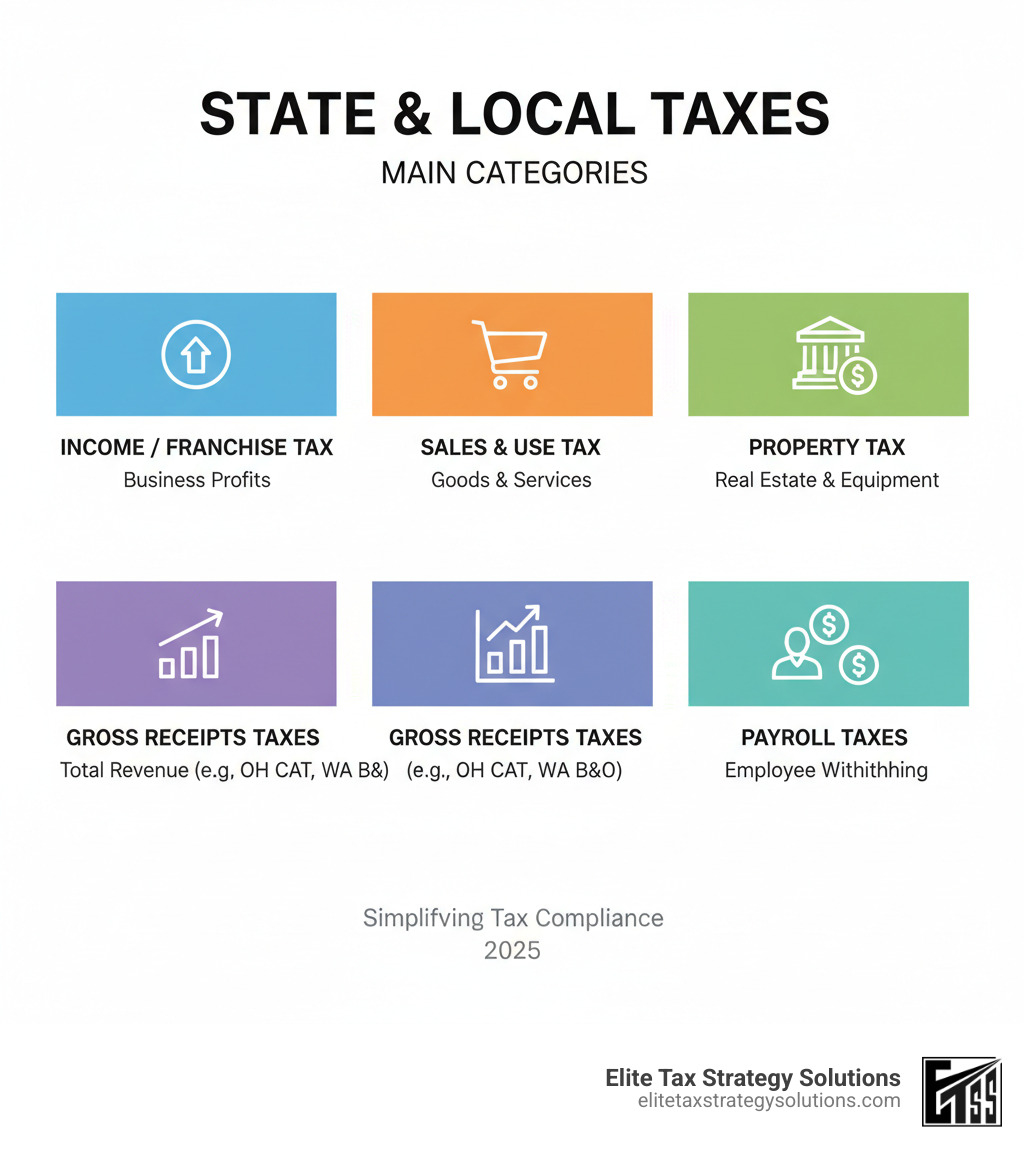
Here’s what state and local tax compliance involves:
- Income & Franchise Tax: Understanding how your business income is taxed across different states
- Sales & Use Tax: Collecting, reporting, and remitting taxes on sales and purchases
- Property Tax: Managing taxes on business property and assets
- Gross Receipts Taxes: Paying taxes based on total revenue in certain states
- Payroll Taxes: Withholding and remitting taxes for employees across multiple jurisdictions
In fiscal year 2023, businesses paid $1.1 trillion in state and local taxes, representing 44.7% of all state and local tax revenue. This is nearly half of all state and local government funding.
The challenge is that tax laws change almost daily due to new legislation, court rulings, and agency interpretations. What was compliant yesterday might not be today. This constant flux creates both risk and opportunity.
While many business owners view state and local taxes as a burden, proactive compliance can become a strategic advantage. The key is understanding the rules, staying ahead of changes, and identifying opportunities to optimize your tax position.
I’m David Fritch. With 40 years of experience, I’ve helped business owners steer complex tax issues, including state and local tax compliance challenges across multiple jurisdictions. Through my work with Elite Tax Strategy Solutions, I’ve seen how proper SALT management transforms compliance from a headache into a competitive advantage.
State and local tax compliance vocabulary:
- multi state sales tax compliance
- personal property tax compliance
- multi state payroll tax compliance
Understanding the Core Components of SALT
Think of state and local tax compliance as a puzzle. Understanding how the pieces fit together is essential for your business’s financial health.
Key Components of State and Local Tax Compliance for Businesses
Here are the main types of state and local taxes affecting your business.
Income and franchise taxes hit your business profits directly. If you operate in multiple states, you must understand apportionment—the method states use to determine what portion of your income they can tax. States typically look at your sales, property, and payroll locations. Get this wrong, and you could overpay or face an audit. Proper Business Tax Compliance starts with getting apportionment right.
Sales and use tax is where many businesses trip up. Sales tax is collected from customers; use tax is owed when you buy something without paying sales tax (like from an out-of-state vendor). The tricky part is that rules on what’s taxable vary by state. Taxability studies are crucial to determine what tax to collect. In fiscal year 2023, businesses collected and remitted $240.6 billion in sales taxes, a 6.4% increase from the prior year. Our Sales and Use Tax Compliance Guide can help.
Property tax isn’t just for buildings. It also covers tangible personal property like manufacturing equipment, computers, and furniture. Each locality has its own valuation methods and assessment schedules, which can be costly for businesses with significant physical assets. In FY23, business property tax collections reached $394.3 billion, a 7.7% increase.
Gross receipts taxes tax your total revenue, not your profit. States like Ohio (Commercial Activities Tax), Washington (Business and Occupation Tax), Oregon (Corporate Activity Tax), and others use this model. For high-volume, low-margin businesses, these taxes can be particularly challenging.
Payroll taxes include state unemployment insurance, income tax withholding, and sometimes local wage taxes. With employees in multiple states, the complexity multiplies. Each state has different withholding tables, deadlines, and reporting requirements. Our Multi-State Payroll Tax Compliance service exists because this gets complicated quickly.
The Federal-State Tax Interaction
Federal and state taxes interact in ways that can significantly impact your tax bill. The SALT deduction is a perfect example. The Tax Cuts and Jobs Act of 2017 capped the federal deduction for state and local taxes at $10,000 per household.
The Joint Committee on Taxation estimated that without the cap, the SALT deduction would have cost the federal government $24.4 billion in 2020 alone. The SALT deduction is a large tax expenditure that primarily benefits higher-income taxpayers in high-tax states.
The $10,000 cap is set to expire after 2025, and this uncertainty makes planning challenging.
Many states created a workaround: Pass-Through Entity (PTE) taxes. Partnerships and S corporations can elect to pay state income tax at the entity level. This payment becomes a federal business deduction—not subject to the $10,000 cap—while owners get credit for the taxes paid at the state level.
Today, 36 states plus New York City offer PTE tax elections. For business owners in high-tax states, this is a valuable tool in Pass-Through Entity Tax Planning. Understanding the interplay between federal and state taxes is key to strategic tax planning.
Navigating Modern Challenges in State and Local Tax Compliance
The world of state and local tax compliance is constantly changing. Landmark court decisions, the digital revolution, and new work models create challenges for businesses.

The Impact of Economic Nexus and Remote Work
The 2018 Supreme Court decision in South Dakota v. Wayfair ended the days of only collecting sales tax where you had a physical presence. This ruling introduced economic nexus for sales tax.
Now, your business can have a sales tax obligation in a state just by reaching certain sales thresholds—typically around $100,000 in sales or 200 transactions—even with no physical presence. Our Remote Seller Nexus Chart breaks down key thresholds and how we can help you comply.
The shift to remote work adds another layer of complexity. An employee working remotely from another state can establish nexus for your business, affecting not just sales tax, but also income tax, payroll tax withholding, and corporate franchise tax.
This “teleworking nexus” means you may need to register for payroll tax withholding in new states. Income tax apportionment also becomes more complicated. Tracking employee locations is a significant compliance challenge. Managing a mobile workforce requires careful attention to each state’s rules, which is why Multi-State Sales Tax Compliance is a critical concern.
Taxation of Digital Assets and Emerging Technologies
Cryptocurrency, NFTs, and other digital assets don’t fit neatly into existing tax frameworks. State guidance on taxing these new assets is inconsistent and evolving. The AICPA has advocated for clearer rules, noting the growing compliance burden. AICPA advocates on Wayfair burden, virtual currency taxation.
Some states now issue specific guidance on digital assets, and a few have even started accepting cryptocurrency for tax payments. The classification of cryptocurrency—as property, currency, or something else—greatly affects its sales, income, and property tax treatment. For businesses in this space, understanding Ecommerce Tax Compliance is essential.
As technology evolves, states will continue to refine their tax approaches. Staying ahead of these changes is a necessary part of maintaining state and local tax compliance.
Special Considerations for Government Interactions
Working with government entities involves unique state and local tax compliance rules. Understanding these special exemptions can save you significant money and prevent headaches.

Federal Government Purchases and Property
A key principle is that the Federal Government is typically immune from state and local taxation on its purchases and property. This immunity stems from constitutional principles.
However, determining if a transaction qualifies for immunity can be complex and may require legal analysis. Executive agencies are encouraged to maximize available tax exemptions. To claim them, you’ll often need specific documentation, most commonly the Standard Form 1094, or U.S. Tax Exemption Form.
Leased equipment is a wrinkle. The company leasing equipment to the government may still owe property or use taxes on it, depending on the jurisdiction. It’s crucial to clarify tax responsibilities in the lease agreement, as immunity doesn’t automatically flow to lessors.
Navigating Government Contractor Obligations
As a government contractor, you are not considered an agent of the government for tax purposes and cannot automatically claim its tax immunity. Many contractors mistakenly assume their material purchases are tax-exempt. Unless a specific state law provides an exemption, you are typically responsible for sales and use tax on materials used to fulfill your contract.
Some states do offer relief. For example, North Carolina allows contractors to claim refunds for sales and use taxes paid on building materials used in government projects. The process requires the government entity to collect certified statements from contractors and file for a refund within specific timeframes.
This highlights the importance of jurisdiction-specific knowledge. Our Sales and Use Tax Compliance Guide covers these state-by-state variations.
To document tax exemptions, you need thorough records, including your contract, purchase orders, and invoices identifying the government sale. You may also need the U.S. Tax Exemption Form (SF 1094), state-specific exemption forms, and shipping documents. Proper documentation protects your bottom line. I’ve seen contractors pay thousands in unnecessary taxes due to poor documentation or not understanding available exemptions.
How to Build a Robust SALT Compliance Strategy
State and local tax compliance is an ongoing strategic priority, not a one-time task. A clear, repeatable process and a proactive mindset separate thriving companies from those struggling with tax surprises. Successful businesses follow a structured compliance cycle, refining it as they go.
A Step-by-Step Compliance Process
Here is a roadmap for your state and local tax compliance.
Step 1: Gather Data. Collect financial information from across your organization. This often requires coordinating with departments beyond accounting, like engineering, legal, and operations.
Step 2: Evaluate & Reconcile Data. Consolidate the data and reconcile it. Compare collected sales tax against accrued use tax to find discrepancies.
Step 3: Populate Returns. With clean data, you can accurately complete your tax forms, keeping in mind that each state has its own reporting quirks.
Step 4: File Returns & Pay Tax. File returns and pay taxes by the deadline. Missing dates leads to expensive penalties.
Step 5: Reconcile Payments. Confirm that the tax authority received and processed your payment to prevent notices and bigger problems.
Step 6: Update Calendar. Maintain a detailed tax calendar with due dates, amounts, and confirmation numbers. This documentation is invaluable.
Step 7: Respond to Notices. When a notice arrives, act quickly. Respond thoroughly within the given window and track the issue to resolution.
Step 8: Repeat & Refine. Use insights from each cycle to refine procedures, adapt to legislative changes, and adjust to operational shifts.
This structured approach is the foundation of effective compliance. Our Sales Tax Filing Services Guide provides more detailed guidance.
Proactive Strategies for State and Local Tax Compliance
This cycle keeps you compliant, but strategic businesses go further, turning state and local tax compliance into an advantage.
Your tax data tells a story. Don’t just use tax data for filing returns. Analyze historical patterns and model scenarios to inform smarter business decisions and find optimization opportunities.
Risk management should be continuous. To avoid surprises, conduct regular nexus reviews, assess taxability, and monitor legislative changes. Our Tax Compliance Risk Management Guide walks through this proactive framework.
Voluntary Disclosure Agreements (VDAs) are your safety valve. If you find past non-compliance, a VDA allows you to come forward, resolve historical liabilities, and often receive penalty waivers and a limited look-back period.
Technology streamlines the heavy lifting. The right systems can automate data gathering and return preparation, reducing errors and freeing your team for strategic analysis.
Professional resources make all the difference. The SALT landscape is too vast to master alone. Organizations like the AICPA and the Council on State Taxation (COST) provide invaluable resources. The State and Local Tax (SALT) Roadmap and Resource Center from AICPA offers comprehensive guidance.
At Elite Tax Strategy Solutions, we act as an extension of your team, using our specialized knowledge to keep you compliant and competitive. Successful businesses view SALT compliance as a strategic function to optimize, not a burden to minimize.
Frequently Asked Questions about SALT Compliance
Here are answers to common questions about state and local tax compliance that keep business owners up at night.
What are the most common SALT compliance errors for businesses?
The complexity of SALT leads to common mistakes. Here’s what I see most often:
Misunderstanding nexus. Many clients are shocked to learn they’ve created a tax presence in an unexpected state. With economic nexus rules and remote work, this is the number one compliance issue today.
Incorrect sales tax collection. This could mean charging the wrong rate due to local taxes or collecting tax incorrectly. The taxability of products and services varies wildly by state, making it easy to get tripped up.
Misclassifying products and services. The taxability of a product or service, like software-as-a-service, can differ dramatically depending on the customer’s location.
Failing to remit collected taxes on time is another common error. States take this seriously, and penalties for late filing or payment add up quickly.
Ignoring use tax obligations is perhaps the most overlooked issue. If an out-of-state vendor doesn’t charge sales tax on a purchase, you likely owe use tax to your home state. Many businesses forget this until an audit.
How does having a remote workforce affect my business’s SALT obligations?
The remote work revolution has created a compliance nightmare for state and local tax compliance. Here’s what happens when employees work from home across state lines.
First, remote employees create nexus in new states. A single remote employee can trigger income, sales, and franchise tax obligations for your business in that state.
This immediately triggers payroll tax withholding requirements. You’ll need to register with that state’s revenue department and begin withholding state income tax.
The administrative burden of tracking employee locations is significant. You need to know where employees are performing work, as even temporary work in another state can create nexus.
Remote workers also complicate income tax apportionment. State formulas for taxing income often rely on payroll location. New remote employees shift these factors, potentially increasing your overall tax burden.
What is a Pass-Through Entity (PTE) tax and how does it help with the SALT cap?
PTE taxes are a legitimate workaround to the federal SALT deduction cap. Here’s how they work.
A Pass-Through Entity tax is a state-level tax paid by the business entity itself (a partnership or S corporation) rather than by the individual owners. Traditionally, income from these entities “passed through” to the owners, who paid the tax personally.
When a business elects to pay this state tax at the entity level, it creates a federal business deduction for the state taxes paid. This is crucial because federal business deductions are unlimited.
This strategy effectively bypasses the individual $10,000 SALT deduction cap for owners. The state tax is deducted before income flows to the owner. This allows the owner to get the benefit of a full deduction for state taxes at the federal level, not just the $10,000 personal limit.
Currently, 36 states plus New York City have enacted a PTE tax. It’s typically an election, and the mechanics vary by state. This is where Pass-Through Entity Tax Planning is essential, as making the right choice depends on your specific situation.
Conclusion
State and local tax compliance is complex, constantly changing, and the stakes are high. But it doesn’t have to keep you up at night. With the right strategy, SALT compliance can transform from a burden into a competitive advantage.
The topics we’ve covered—from core tax types to economic nexus and PTE elections—represent not just requirements, but opportunities for tax optimization.
Proactive SALT management is the key. Implementing robust processes helps you avoid penalties and uncover savings opportunities that reactive businesses miss. The complexity of SALT requires expert guidance. You built your business by focusing on what you do best; let trusted advisors handle the intricacies of multi-state tax law.
At Elite Tax Strategy Solutions, we help high earners and closely held businesses turn tax challenges into strategic wins. Our proactive approach means we actively manage your tax position, identify risks early, and find opportunities that improve your bottom line.
You don’t have to steer the complexities of a remote workforce, government contracts, or changing laws alone.
Let’s work together to transform your tax compliance from a source of stress into a catalyst for growth. Contact us for comprehensive tax support and compliance and find what strategic SALT management can do for your business.