Ecommerce Sales Tax 101: Nexus, Wayfair & Thresholds
Understanding ecommerce tax compliance starts with grasping the fundamental concept of nexus – your connection to a state that creates tax obligations. Before 2018, this was straightforward: you only collected sales tax where you had physical presence. The South Dakota v. Wayfair ruling changed everything.
Why the Wayfair Decision Changed Everything
The Supreme Court’s South Dakota v. Wayfair decision in June 2018 revolutionized ecommerce taxation by establishing economic nexus. This landmark case allowed states to require out-of-state sellers to collect sales tax based on sales volume or transaction count, not just physical presence.
The impact was immediate and massive:
– States gained access to an estimated $30 billion in previously uncollected revenue
– 43 states plus the District of Columbia quickly adopted economic nexus laws
– Online sellers suddenly faced compliance obligations in dozens of states
– The “Wild West” era of tax-free online sales ended
South Dakota’s law required remote sellers to collect tax if they had more than $100,000 in sales or 200 transactions in the state. This became the template most states followed, though thresholds vary.
Understanding Sales Tax Nexus Types
Modern ecommerce tax compliance requires understanding five distinct types of nexus:
Physical Nexus occurs when you have tangible presence in a state:
– Offices, warehouses, or retail locations
– Inventory stored in fulfillment centers (including Amazon FBA)
– Employees working remotely
– Attending trade shows or making sales calls
Economic Nexus is triggered by sales volume or transaction count:
– Most states use $100,000 in sales or 200 transactions annually
– Some states have eliminated transaction counts (Iowa, Louisiana, Maine, Wisconsin)
– California and New York require $500,000 in sales
Marketplace Facilitator Nexus applies when platforms collect tax for you:
– Amazon, eBay, and other marketplaces handle collection
– Nearly every state has marketplace facilitator laws
– You still need to track sales for nexus purposes
Click-Through Nexus involves affiliate marketing relationships:
– Referral fees paid to in-state affiliates
– 15 states have click-through nexus laws
– Often called “Amazon Laws”
Affiliate Nexus covers third-party relationships:
– Drop shipping arrangements
– Marketing affiliates with substantial connections
– 33 states have affiliate nexus provisions
Sales Volume & Transaction Count Thresholds
The $100,000 sales threshold has become the de facto standard, but transaction counts are evolving. Recent changes show states simplifying compliance for smaller sellers:
States That Eliminated Transaction Thresholds (2023-2024):
– Iowa – Sales only threshold
– Louisiana – $100,000 sales only
– Maine – $100,000 sales only
– South Dakota – $100,000 sales only
– Wisconsin – $100,000 sales only
Notable Exceptions:
– California: $500,000 in sales
– New York: $500,000 in sales
– Mississippi: $250,000 in sales
– Texas: $500,000 in sales
This trend toward eliminating transaction counts helps smaller businesses avoid the administrative burden of tracking hundreds of small sales while still capturing significant revenue from larger sellers.
Ecommerce Tax Compliance Roadmap: Registration to Collection
Once you understand your nexus obligations, it’s time to get compliant. Successful ecommerce tax compliance isn’t about scrambling to catch up – it’s about building systems that work from day one.
Think of compliance as building a house. You need a solid foundation (registration), proper wiring (tax calculation systems), and good maintenance (ongoing filing). Skip any step, and you’re asking for trouble down the road.
Registering for Sales Tax Permits
Here’s where many sellers make their first mistake – they wait until they’re already over the nexus threshold to register. Don’t be that seller. You need to register before you make your first taxable sale in any nexus state.
The registration process itself isn’t rocket science, but timing is everything. If you crossed the $100,000 threshold on March 15th, you needed to be registered by March 14th. States don’t care that you didn’t know about the requirement.
Getting your timing right starts with knowing your nexus trigger date. For physical nexus, that’s when you first established presence. For economic nexus, you need to track when you actually cross those sales thresholds, not when you realize you crossed them.
Most states make registration straightforward through their online portals. You’ll need your basic business information, EIN, bank account details, and an estimate of your monthly sales volume. The whole process usually takes about 20 minutes per state, though some states can take up to two weeks to process your application.
Here’s a pro tip: register when you hit 80% of the nexus threshold. This gives you breathing room to set up your systems properly instead of frantically trying to figure everything out after you’re already non-compliant.
If you’re looking at multiple states, consider the Streamlined Sales Tax (SST) program. Twenty-four states participate, and it can simplify registration across member states. You get uniform exemption certificates, simplified tax rates, and sometimes even centralized filing options.
Product & Customer Taxability Rules
This is where ecommerce sales tax compliance gets really complex. The same t-shirt that’s tax-free in Pennsylvania might be taxable in California, unless it costs more than $75, in which case… well, you get the idea.
Product taxability is all over the map. Clothing is exempt in some states, taxed in others, and subject to dollar thresholds in a few. Food gets even weirder – groceries are often exempt, but prepared food is taxable. Digital products vary wildly – some states tax downloaded software, others don’t.
The key is building systems that automatically know what to do. You can’t manually look up tax rules for every sale – that’s a recipe for errors and burnout.
Customer exemptions add another layer of complexity. Businesses buying for resale don’t pay tax, but they need to give you a valid resale certificate. Nonprofit organizations often qualify for exemptions, but the rules vary by state and organization type. Government purchases are usually exempt, but you need proper documentation.
The trick with exemption certificates is getting them before the sale when possible. It’s much harder to chase down paperwork after you’ve already processed the order. Store certificates securely – you’ll need them if you ever get audited.
Marketplace Facilitator Laws & Platform Settings
Here’s some good news in ecommerce tax compliance: marketplace facilitator laws have made life easier for many sellers. When Amazon, eBay, or other platforms collect tax on your behalf, you’re generally off the hook for collection and remittance in those states.
But you still need to understand how these laws work. The platforms handle collection, but you’re still responsible for tracking sales for nexus purposes. And the rules aren’t the same everywhere.
Amazon FBA creates an interesting situation. Amazon collects tax for your marketplace sales, which is great. But your inventory sitting in their warehouses creates physical nexus, which means you might have compliance obligations for sales through other channels.
Each platform handles things differently. eBay requires Managed Payments for tax collection features. Shopify gives you the tools but leaves you to configure everything yourself. The key is understanding what your platform does and doesn’t handle.
One important note: about half the states don’t count marketplace sales toward your nexus thresholds. So even if you’re doing $200,000 in Amazon sales in Texas, you might not have nexus there for your direct sales. But you still need to track everything carefully – for multi-state sales tax compliance, the details matter.
Filing, Remittance & Staying Audit-Ready
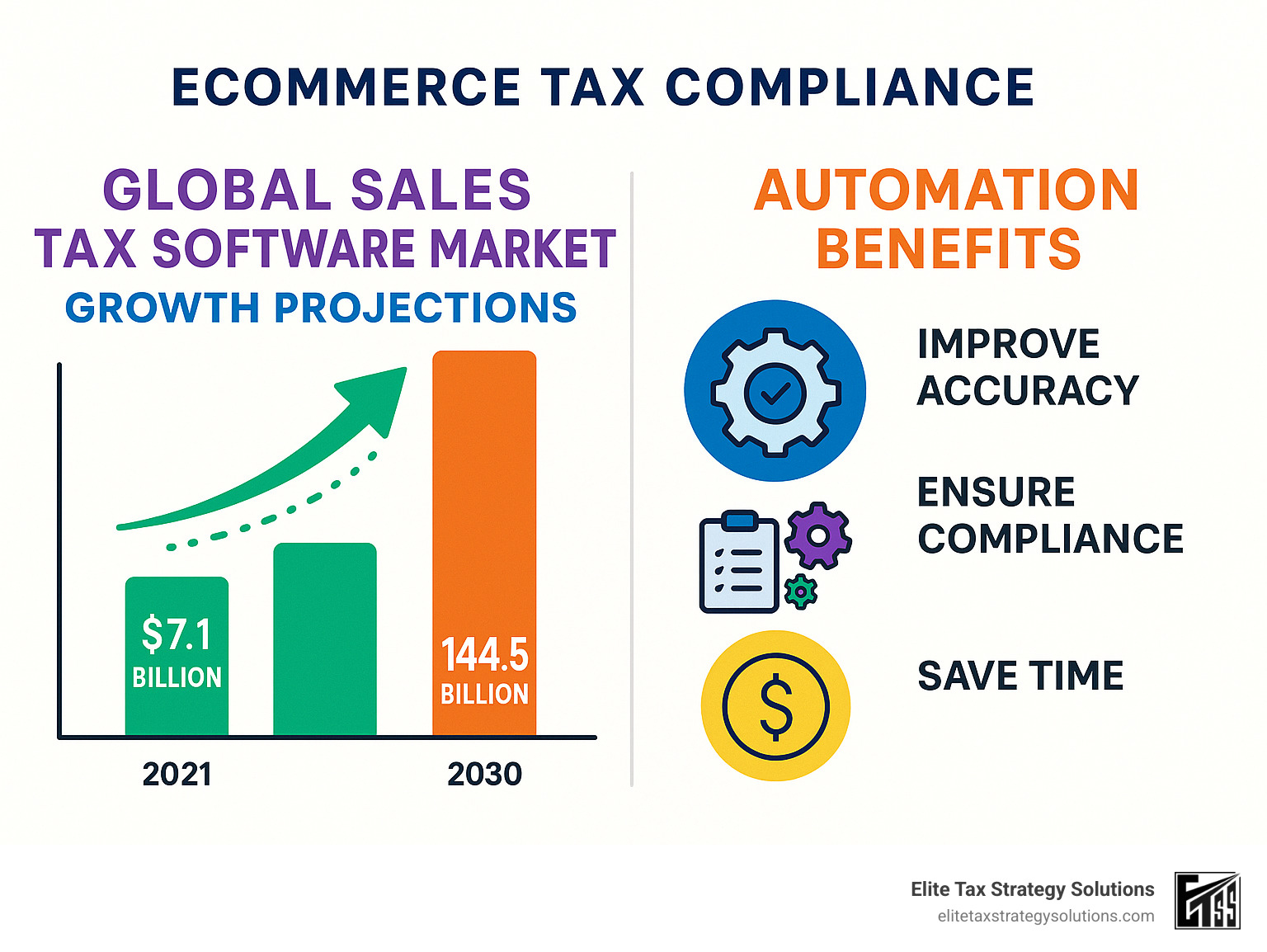
The global sales tax software market is projected to grow from $7.1 billion in 2021 to approximately $14.5 billion by 2030, driven by increasing compliance complexity and audit enforcement. This explosive growth tells us something important: ecommerce tax compliance is getting more complex, not simpler.
The good news? With the right systems and habits, you can stay ahead of the curve and sleep peacefully knowing your business is protected.

Best Practices to Avoid Noncompliance
Think of compliance as building a fortress around your business. Every good practice is another brick in the wall protecting you from penalties, audits, and sleepless nights.
Your record-keeping system is your first line of defense. We’ve seen businesses save thousands in audit penalties simply because they could produce clean, detailed records. You need transaction-level detail for all sales, not just summaries. Store customer exemption certificates where you can find them in minutes, not hours.
Filing discipline separates the pros from the amateurs. Here’s a rule that saves our clients heartache: never miss a filing deadline, even when you owe zero tax. States don’t care if you had no sales – they still want that zero return filed on time. Set up automated calendar reminders because human memory isn’t reliable when you’re juggling multiple states with different deadlines.
Use tax monitoring often gets overlooked until an auditor asks about it. Every time you buy business equipment, software, or services where sales tax wasn’t collected, you likely owe use tax. Keep track of these purchases and pay the tax proactively.
Creating a master tax calendar might sound boring, but it’s your secret weapon. Include all state deadlines, registration renewals, and permit updates. Set up multiple reminder alerts and assign backup personnel who can handle filings if you’re unavailable.
Choosing Sales Tax Software & Automation Tools
Let’s be honest – managing ecommerce tax compliance manually is like trying to juggle flaming torches while riding a unicycle. Our clients using sales tax compliance automation companies report saving 20+ hours monthly on tax administration.
The right software should make your life easier, not more complicated. Look for real-time rate calculation that uses actual geolocation, not just ZIP codes. ZIP codes can cover multiple tax jurisdictions, leading to costly errors. You want automated nexus monitoring across all states because keeping track of changing thresholds manually is a recipe for missed obligations.
Exemption certificate management with renewal alerts can save you from awkward conversations with auditors. When a certificate expires and you keep accepting it, you’re liable for the uncollected tax. Good software tracks expiration dates and reminds you to get updated certificates.
The software should integrate seamlessly with all your sales channels. If you’re selling on Amazon, eBay, Shopify, and your own website, you need one system that captures everything.
Consider the ROI beyond just software costs. Calculate the time you’ll save, the penalties you’ll avoid, and the accuracy improvements you’ll gain. Factor in scalability – will this system grow with your business, or will you need to switch again in two years?
Handling Sales Tax Audits Like a Pro
Here’s something that might surprise you: audit rates have nearly quadrupled since 2021. States are aggressively targeting ecommerce businesses because that’s where the money is. California and Illinois remain audit hot spots, while Wisconsin and Washington are ramping up enforcement.
Understanding audit triggers helps you avoid unwanted attention. Multiple amended returns raise red flags because they suggest you’re struggling with compliance. Large use tax assessments make auditors wonder what else you might have missed.
Your audit defense starts long before any auditor contacts you. Maintain impeccable records from day one because you can’t recreate three years of transaction history under audit pressure. Document all nexus determinations with dates and reasoning. Keep exemption certificates current and easily accessible.
Hot spot states deserve extra attention. California combines aggressive enforcement with complex rules and high penalties. Illinois has intricate local tax requirements that trip up many businesses. Wisconsin significantly increased audit staffing in 2024, while Washington is specifically targeting ecommerce enforcement.
Voluntary disclosure can be your lifeline if you find past compliance issues. This process offers reduced penalty exposure, limited lookback periods, and confidential settlement procedures. Most importantly, it helps you avoid criminal prosecution risk.
The key to audit success is preparation, not panic. When you’ve built solid systems and maintained good records, audits become manageable business processes rather than existential threats.
Beyond the U.S.: Cross-Border Ecommerce Tax Compliance
Taking your online business global? Ecommerce tax compliance suddenly becomes a whole new ballgame. With over 100 countries now requiring foreign businesses to register and collect tax, international expansion can feel overwhelming – but it doesn’t have to be.
The good news is that many countries are adopting simplified systems specifically for ecommerce businesses. The challenge? Every country has its own rules, thresholds, and quirks that can trip up even experienced sellers.
Understanding global tax obligations is absolutely crucial for GST compliance for e-commerce operators, and the landscape changes frequently as governments worldwide scramble to capture revenue from the digital economy boom.
Key VAT/GST Rules for Online Sellers
Europe leads the charge in making cross-border ecommerce taxation manageable. The European Union’s One Stop Shop (OSS) system lets you handle VAT for all 27 member countries through a single registration – a massive improvement over the old system.
Here’s how the EU system works: You only need to worry about VAT once your sales to consumers in other EU countries exceed €10,000 annually. Below that threshold, you charge your home country’s VAT rate. Above it, you charge the customer’s country rate – but file everything through one portal.
VAT rates across the EU range from 17% to 27%, so knowing where your customers are located makes a real difference to your pricing strategy. The Import One Stop Shop handles goods coming from outside the EU, streamlining customs and VAT in one process.
The United Kingdom went its own way after Brexit, creating a separate system with a £135 threshold for low-value goods. If you’re shipping directly to UK consumers, you’ll need VAT registration for most sales.
Canada keeps things relatively simple with a CAD $30,000 threshold for GST registration. But watch out for provincial sales taxes – some provinces layer additional taxes on top of the federal GST.
Australia and New Zealand both operate straightforward GST systems. New Zealand’s 15% rate applies broadly, while Australia has carved out various exemptions. Both countries offer simplified registration processes for foreign businesses.
Dropshipping, SaaS & Emerging Models
Dropshipping creates unique challenges because you’re often not the one physically handling the goods. The key question becomes: are you the retailer or just facilitating the sale? This determination affects where you need to register and collect tax.
When working with suppliers, managing resale certificates becomes critical. You need proper documentation showing you’re buying for resale, not personal use.
SaaS and digital services face a patchwork of rules that would make anyone’s head spin. Some states tax software subscriptions, others don’t. Some care whether your customer is a business or consumer, others treat everyone the same. Origin vs. destination sourcing adds another layer – where you’re located versus where your customer uses the service.
The complexity multiplies with subscription billing. Monthly charges, annual prepayments, upgrades, and cancellations all create different tax scenarios.
Emerging trends are reshaping the landscape faster than ever. Colorado’s $0.27 retail delivery fee for large retailers signals a new frontier in compliance – fees that aren’t technically taxes but function the same way. Other states are watching Colorado’s results closely.
Future of Ecommerce Tax Compliance: AI, E-Invoicing & Real-Time Reporting
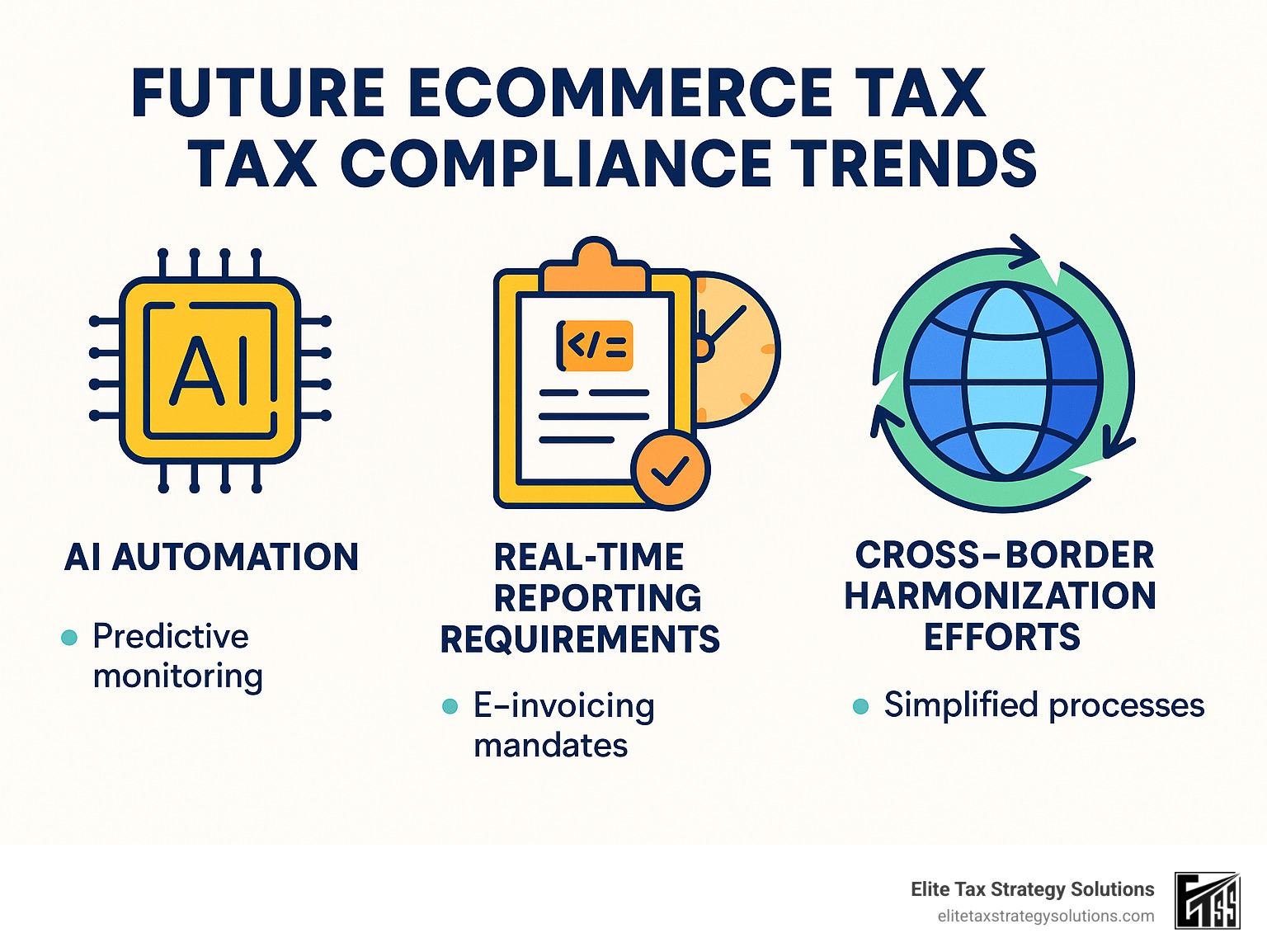
The future of ecommerce tax compliance is arriving faster than most businesses are prepared for. Artificial intelligence and machine learning are already changing how tax systems work, with predictive nexus monitoring and automated product classification becoming standard features.
Real-time rate updates powered by AI mean no more quarterly rate file downloads – your system knows instantly when rates change. Audit risk assessment algorithms can flag potential issues before they become problems.
E-invoicing mandates represent the biggest shift coming down the pipeline. Countries worldwide are moving toward real-time transaction reporting, giving tax authorities immediate visibility into business sales. This reduces audit requirements but demands perfect record-keeping from day one.
The Business Payments Coalition and similar organizations are pushing for standardized systems that work across borders. While we’re not there yet, the trend toward simplification and automation is unmistakable.
Regulatory harmonization is slowly happening, with countries copying successful systems from each other. The EU’s OSS model is being studied worldwide, and simplified registration processes are becoming the norm rather than the exception.
The companies that thrive in this evolving landscape will be those that accept automation early and build compliance into their business processes from the ground up. The alternative – playing catch-up with an ever-expanding web of global tax obligations – gets more expensive and risky every year.
Frequently Asked Questions about Ecommerce Tax Compliance
Let’s tackle the most common questions we hear from online sellers about ecommerce tax compliance. These are the real concerns keeping business owners up at night – and honestly, they’re all completely understandable given how complex this stuff has become.
What triggers sales tax nexus for my online store?
Think of nexus as your “connection” to a state that creates tax obligations. It’s like the state saying, “Hey, you’re doing enough business here that you need to play by our rules.”
Physical nexus is the traditional trigger – and it’s broader than most people realize. Having an office or warehouse counts, but so does storing inventory in Amazon FBA centers. If you have employees working from home in a state, that creates nexus too. Even attending trade shows or making regular sales calls can establish physical presence.
Economic nexus is where things get interesting (and complicated). Most states use the $100,000 in sales or 200 transactions rule annually. But here’s the thing – some states have dropped the transaction count entirely. Iowa, Louisiana, Maine, and Wisconsin now focus solely on sales volume, which actually makes life easier for smaller sellers.
California and New York set their bar higher at $500,000 in sales, while Texas follows the same threshold. The key is tracking your sales by state so you know when you’re approaching these limits.
Don’t forget about marketplace facilitator nexus either. When Amazon or eBay collects tax for you, that’s great – but you still need to watch your total sales numbers for nexus purposes.
Do marketplace facilitator laws mean I never collect tax?
This is probably our most frequently asked question, and the answer is both yes and no (sorry, we know that’s not helpful!).
Marketplace facilitators handle the heavy lifting for sales on their platforms. Amazon, eBay, Etsy, and other major platforms collect and remit tax in states with facilitator laws. That’s fantastic and saves you tons of administrative headache.
But here’s what catches people off guard: you’re still on the hook for direct sales. If you sell through your own website, at craft fairs, or on platforms without facilitator laws, you need to handle tax collection yourself.
Even more confusing? Some states require you to file returns even when the marketplace collected tax for you. And here’s a quirky twist – 21 states don’t count marketplace sales toward economic nexus thresholds. So you might cross the $100,000 threshold with direct sales alone, even if Amazon is handling your marketplace sales.
The bottom line? Marketplace facilitator laws are incredibly helpful, but they don’t eliminate all your tax obligations. You still need to stay on top of your total sales picture.
How can I catch up if I’m already out of compliance?
First, take a deep breath. You’re not alone – tons of online sellers find themselves in this situation. The good news is there are ways to fix it without facing the full wrath of state tax authorities.
Voluntary disclosure agreements (VDAs) are often your best friend here. Think of them as a peace treaty with the state. You come forward voluntarily, and they typically offer some pretty attractive terms in return.
Most VDAs include penalty waivers (sometimes completely eliminated), limited lookback periods of 3-4 years instead of going back indefinitely, and a confidential settlement process. Plus, you get protection from criminal prosecution, which gives most business owners serious peace of mind.
Here’s our recommended game plan: Start with a comprehensive nexus study to identify every state where you have obligations. Then prioritize the high-risk states – those with the biggest tax liabilities or the most aggressive enforcement reputations.
Don’t ignore the problem hoping it goes away – trust us, it won’t. States are getting increasingly sophisticated at tracking down non-compliant sellers. The sooner you address past issues, the better your negotiating position and the lower your ultimate cost.
The key is being proactive rather than reactive. We’ve seen businesses save tens of thousands of dollars by addressing compliance issues early rather than waiting for an audit notice to arrive.
Conclusion
Here’s the truth about ecommerce tax compliance: it’s not going away, and it’s only getting more complex. But here’s the good news – with the right approach, you can turn this challenge into a strategic advantage that protects your business and frees you to focus on what you do best: growing your sales.
The landscape has changed dramatically since Wayfair. What used to be a simple “do I have a store there?” question has evolved into a multi-layered compliance puzzle involving economic nexus thresholds, marketplace facilitator laws, and international VAT obligations. The businesses thriving today aren’t necessarily the ones with the best products – they’re the ones with bulletproof compliance systems.
We’ve seen too many successful ecommerce businesses get blindsided by audit notices, penalty assessments, and compliance gaps they didn’t even know existed. The cost isn’t just financial – it’s the sleepless nights, the time away from growing your business, and the constant worry about what you might have missed.
That’s exactly why Elite Tax Strategy Solutions takes a different approach. We don’t just help you file returns – we build comprehensive compliance systems that grow with your business. Our nexus monitoring catches obligations before they become problems. Our automated systems handle the heavy lifting while you focus on serving customers. And when audits happen (and they do), you’ll have the documentation and professional support to handle them confidently.
The math is simple: the cost of proactive ecommerce tax compliance is a fraction of what you’ll pay in penalties, interest, and emergency remediation if you wait. Plus, you’ll sleep better knowing your business is protected.
Your ecommerce business deserves the same strategic tax planning we provide to high earners and closely held businesses. The complexity might seem overwhelming, but you don’t have to steer it alone.
Ready to transform your tax compliance from a source of stress into a competitive advantage? Learn more about our ecommerce sales tax compliance services and let’s discuss how we can protect your business while you focus on growing it.
The best time to get your ecommerce tax compliance house in order was when you made your first sale. The second-best time is right now – before the next audit notice arrives.