Why Sales and Use Tax Compliance Matters for Your Business
Sales and use tax compliance is a complex and costly obligation for businesses. With over 12,000 U.S. sales tax jurisdictions and ever-changing rules, staying compliant is a major challenge. It involves registering for permits, calculating correct rates, filing returns, and maintaining records for both sales tax (collected from customers) and use tax (paid by buyers when sellers don’t collect).
The financial impact is significant. Businesses with 20-499 employees spend an average of $1,740 per month just on identifying state tax obligations. This tedious and time-consuming task is complicated by economic nexus rules from the Wayfair decision, varying tax rates, and different rules for physical vs. digital goods.
Non-compliance carries serious consequences like penalties and interest. However, with proper planning, businesses can manage this challenge effectively. I’m David Fritch, a CPA and attorney with 40 years of experience. At Elite Tax Strategy Solutions, I help high-income earners and closely held businesses steer sales and use tax compliance and maximize tax savings.
Understanding Your Core Obligation: Nexus and the Wayfair Ruling

Nexus is the legal connection that obligates your business to collect and pay a state’s sales tax. Historically, this was based on physical nexus—having an office, store, warehouse, or employees in a state. Even temporary activities like attending trade shows could trigger this obligation.
However, the Supreme Court’s South Dakota v. Wayfair decision on June 21, 2018, introduced economic nexus. Now, states can require you to collect sales tax based purely on your sales volume there, even without a physical presence. Since nexus rules and thresholds vary by state and change often, staying updated is crucial for Multi-State Sales Tax Compliance.
The Impact of Wayfair on Sales and Use Tax Compliance
The South Dakota v. Wayfair decision revolutionized sales and use tax compliance by establishing economic nexus. Before this ruling, remote sellers without a physical presence in a state could often avoid collecting sales tax. Now, if your business meets certain sales or transaction thresholds, you must collect and remit sales tax, even if your only connection is online.
Most states initially adopted thresholds of $100,000 in sales or 200 separate transactions annually, as seen in North Dakota’s $100,000 sales threshold example. However, these thresholds now vary widely by state, with some dropping the transaction count. This change created a significant challenge for remote sellers, especially e-commerce businesses, turning a local issue into a complex multi-state problem requiring specialized Ecommerce Tax Compliance expertise.
Physical Nexus vs. Economic Nexus
It’s crucial to understand the difference between the two types of nexus.
- Physical Nexus: Triggered by a tangible presence like an office, warehouse, employees, or temporary activities such as trade shows. It’s generally straightforward to identify.
- Economic Nexus: Triggered by exceeding state-specific sales revenue or transaction count thresholds, regardless of physical presence. This requires constant monitoring of sales into every state.
Other forms of nexus also exist, such as affiliate nexus (from in-state partners) and click-through nexus (from commissioned links on in-state websites). Even a temporary presence, like a pop-up shop, can create a year-long physical nexus obligation.
While physical nexus was once the primary concern, economic nexus now adds a layer of complexity, often catching businesses by surprise as they grow. Both types create valid tax obligations, making professional guidance essential for navigating these dual requirements.
A Step-by-Step Guide to Managing Sales and Use Tax Compliance
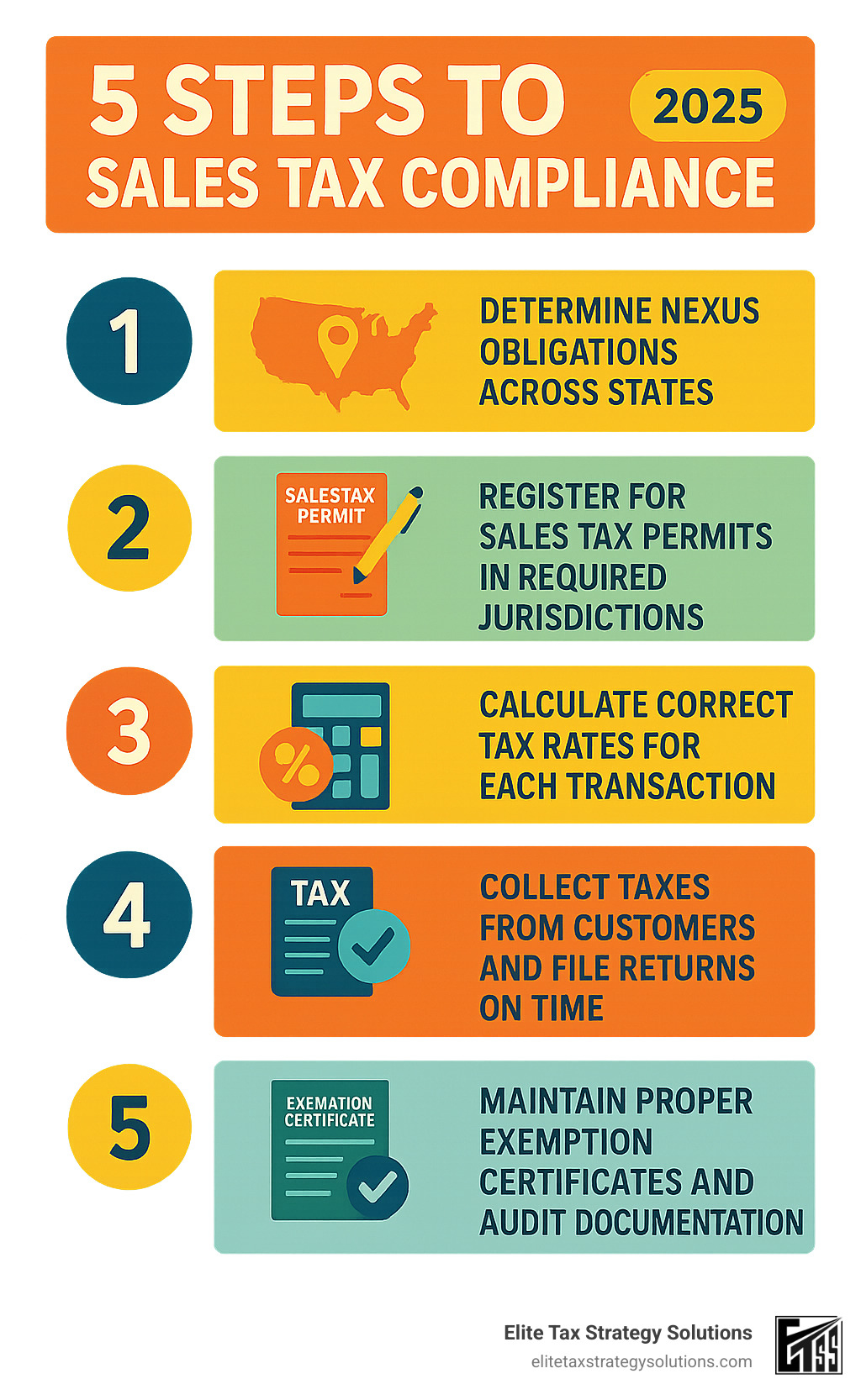
Once you determine where you have nexus, managing sales and use tax compliance involves five core steps: registration, taxability determination, accurate calculation, collection and remittance, and exemption management. The complexity is immense, with over 12,000 tax jurisdictions in the U.S., including states, counties, and cities. So-called “home rule” states add another layer of difficulty by allowing cities to administer their own sales tax. A systematic approach is essential, which is why comprehensive Business Tax Compliance strategies are so valuable.
Best Practices for Sales Tax Registration and Filing
Proper registration is the first step. You cannot legally collect sales tax without a permit in each state where you have nexus. Timely registration is crucial, though some states offer grace periods after you cross nexus thresholds, as shown in Iowa’s guidance.
After registering, states assign a filing frequency (monthly, quarterly, or annually) based on sales volume. Due dates vary by state, and missing them leads to penalties. A common pitfall is failing to file zero returns; even with no sales, a return is often required. Ensure accuracy in filings by reconciling data from all business systems. Most states now require electronic remittance, which is faster and more reliable than mail.
Determining Taxability and Calculating Rates
Determining what is taxable and at what rate is a major challenge. Rules vary significantly by state and product type.
- Tangible Property: Taxability can depend on subtle details, like whether food is sold with utensils.
- Digital Goods & SaaS: The tax treatment of e-books, streaming, and software is inconsistent and evolving across states.
- Professional Services: While often exempt, some states tax specific services.
Sourcing rules add another layer of complexity. Origin-based sourcing (taxed at the seller’s location) is simpler but less common. Most states use destination-based sourcing (taxed at the buyer’s location), which is far more complex for remote sellers. Manually tracking constantly changing rates and rules across thousands of jurisdictions is nearly impossible.
Managing Exemption Certificates for Compliant Sales
Many businesses fail audits due to improper management of exemption certificates. If you make tax-exempt sales (e.g., to resellers or nonprofits), you must have a valid certificate on file. Without it, you are liable for the uncollected tax, plus penalties and interest, even if the customer was legitimately exempt.
Proper certificate management significantly reduces audit risk. Digital management systems are essential, replacing paper files with a centralized, searchable database. These systems can track expirations, send collection reminders, and even use AI to validate certificates. This can save a business up to 416 hours per year, freeing up time to focus on growth instead of paperwork.
Navigating Modern Sales Tax Challenges

Modern sales and use tax compliance includes several new challenges:
- Marketplace Facilitator Laws: Most states now require platforms like Amazon and Etsy to collect and remit sales tax on behalf of their sellers. However, sellers are still responsible for tax on direct sales and may have other reporting requirements.
- Sales Tax Holidays: These temporary tax-free periods create compliance headaches for retailers, who must update systems and track eligible items accurately.
- International Sellers: Businesses based overseas selling to U.S. customers are still subject to economic nexus rules and must comply with state tax laws. Expanding globally also requires understanding systems like GST Compliance for E-commerce Operator.
Sales Tax vs. Value-Added Tax (VAT)
For businesses operating internationally, it’s important to understand the difference between U.S. sales tax and the Value-Added Tax (VAT) used in over 190 countries.
- Sales Tax: A single-stage tax collected by the final seller from the end consumer. It’s usually added to the price at checkout.
- VAT: A multi-stage tax collected at every step of the supply chain. Businesses collect VAT and can also reclaim VAT paid on their own purchases. The tax is typically included in the advertised price.
VAT also generally has a broader scope, applying to most goods and services, whereas U.S. sales tax has more exemptions. Navigating both systems requires distinct strategies, as U.S. compliance methods don’t apply to European VAT Compliance.
The Role of Technology and Expertise in Tax Compliance
Managing sales and use tax compliance manually is nearly impossible today. Automation is key. Businesses using tax software save up to 510 hours annually and can reduce costs by up to $150,000 per year by improving accuracy and efficiency. Automated solutions track rate changes across thousands of jurisdictions in real-time, something no human can do.
The consequences of getting it wrong are severe. Non-compliance leads to heavy penalties and interest, back taxes on uncollected amounts, and disruptive audits. In some cases, it can even result in legal action. Protecting your business’s financial stability requires robust systems, which is why we emphasize professional Tax Management Services.
How Software Simplifies Sales and Use Tax Compliance
Modern tax software revolutionizes sales and use tax compliance with several key features:
- Real-time Calculations: Pinpoints the exact, rooftop-level tax rate for any U.S. address instantly.
- Centralized Records: Keeps all transactions, calculations, and exemption certificates in one secure, audit-ready location.
- Seamless Integration: Connects with major accounting, ERP, and e-commerce systems to automate tax calculations at the point of sale.
- Automated Filing and Remittance: Prepares and files returns, manages payments, and handles complexities like home rule states and zero returns.
- Data Security: Protects your information with high-level encryption and compliance standards.
A robust Tax Compliance Platform turns a complex manual task into a smooth, automated background process.
When to Leverage Professional Tax Advisory Services
While software is powerful, it can’t replace the strategic judgment of a human expert. Professional advisory services are crucial for:
- Complex Nexus Studies: Analyzing your specific business activities to accurately determine your tax footprint across states.
- Historical Liability: Quantifying past-due tax exposure and developing a mitigation strategy, including navigating Voluntary Disclosure Agreements (VDAs) to reduce penalties.
- Proactive Tax Planning: Structuring your operations to legally minimize tax burdens, a key part of our Tax Planning for Businesses service.
- Audit Representation: Defending your business during a sales tax audit to ensure the best possible outcome.
At Elite Tax Strategy Solutions, we provide the expertise to help high earners and closely held businesses steer these challenges, protecting your business and optimizing your tax position.
Frequently Asked Questions about Sales and Use Tax Compliance
Let me address some of the most common questions I hear from business owners about sales and use tax compliance. These are the same concerns that keep many of my clients up at night before we work together to create a clear compliance strategy.
What is the difference between sales tax and use tax?
Sales tax and use tax are two sides of the same coin, designed to tax consumption within a state.
- Sales Tax is collected by the seller from the customer at the point of sale.
- Use Tax is paid directly by the buyer to the state when the seller does not collect sales tax. This often happens with purchases from out-of-state vendors who don’t have nexus in your state. The responsibility to report and pay the tax falls on the consumer or business using the item.
Essentially, if sales tax isn’t paid on a taxable purchase, use tax is due.
How did the South Dakota v. Wayfair Supreme Court case change sales tax?
The South Dakota v. Wayfair decision on June 21, 2018, revolutionized sales tax for remote sellers. Previously, businesses only needed to collect sales tax in states where they had a physical presence (like an office or warehouse).
The Supreme Court’s ruling established economic nexus, allowing states to require tax collection based on a business’s economic activity alone. This means if your business exceeds a state’s specific thresholds (typically $100,000 in sales or 200 transactions annually), you must collect sales tax there, even without a physical presence. This transformed sales and use tax compliance from a local issue to a complex, multi-state challenge for many businesses, especially in e-commerce.
What are the biggest consequences of failing to comply with sales tax laws?
Failing to take sales and use tax compliance seriously can have devastating consequences for a business. The biggest risks include:
- Financial Penalties and Interest: States impose steep penalties (often 10-25% of the unpaid tax) plus compounding interest.
- Back Tax Liability: You will be held responsible for all uncollected taxes from previous years, which must be paid from your business’s funds.
- Disruptive Audits: Non-compliance often triggers time-consuming and costly audits.
- Personal Liability: In many states, owners and officers of closely held businesses can be held personally liable for unpaid sales taxes, putting personal assets at risk.
- License Revocation and Reputational Damage: States can revoke business licenses, and compliance issues can damage your business’s reputation.
The cost of compliance is always far less than the cost of non-compliance.
Conclusion: Achieve Proactive and Strategic Tax Compliance
Sales and use tax compliance is complex, but it’s a manageable challenge that can become a strategic advantage. While competitors struggle with the basics, a proactive approach with the right systems and expert guidance creates financial stability and a competitive edge.
Thriving businesses view tax compliance not as a cost, but as a foundation for growth. This is especially true for high earners and closely held businesses, where business and personal finances are intertwined. Getting compliance right frees you to focus on building your business, while getting it wrong can lead to costly audits and fees.
At Elite Tax Strategy Solutions, we help business owners steer these complexities. Our thorough, proactive, and strategic approach to sales and use tax compliance creates scalable systems that protect your business and maximize tax savings.
Don’t let tax complexity hinder your success. With the right guidance, you can make decisions based on opportunity, not fear. Ready to turn compliance into an advantage? Learn how Outsourcing Sales Tax Compliance can simplify your operations and position your business for long-term success.