Understanding the Business Tax Compliance Landscape
Business tax compliance refers to adhering to all tax laws and regulations by accurately reporting income, expenses, and other financial details to the appropriate tax authorities in a timely manner. It’s the foundation of your business’s legal standing and financial health.
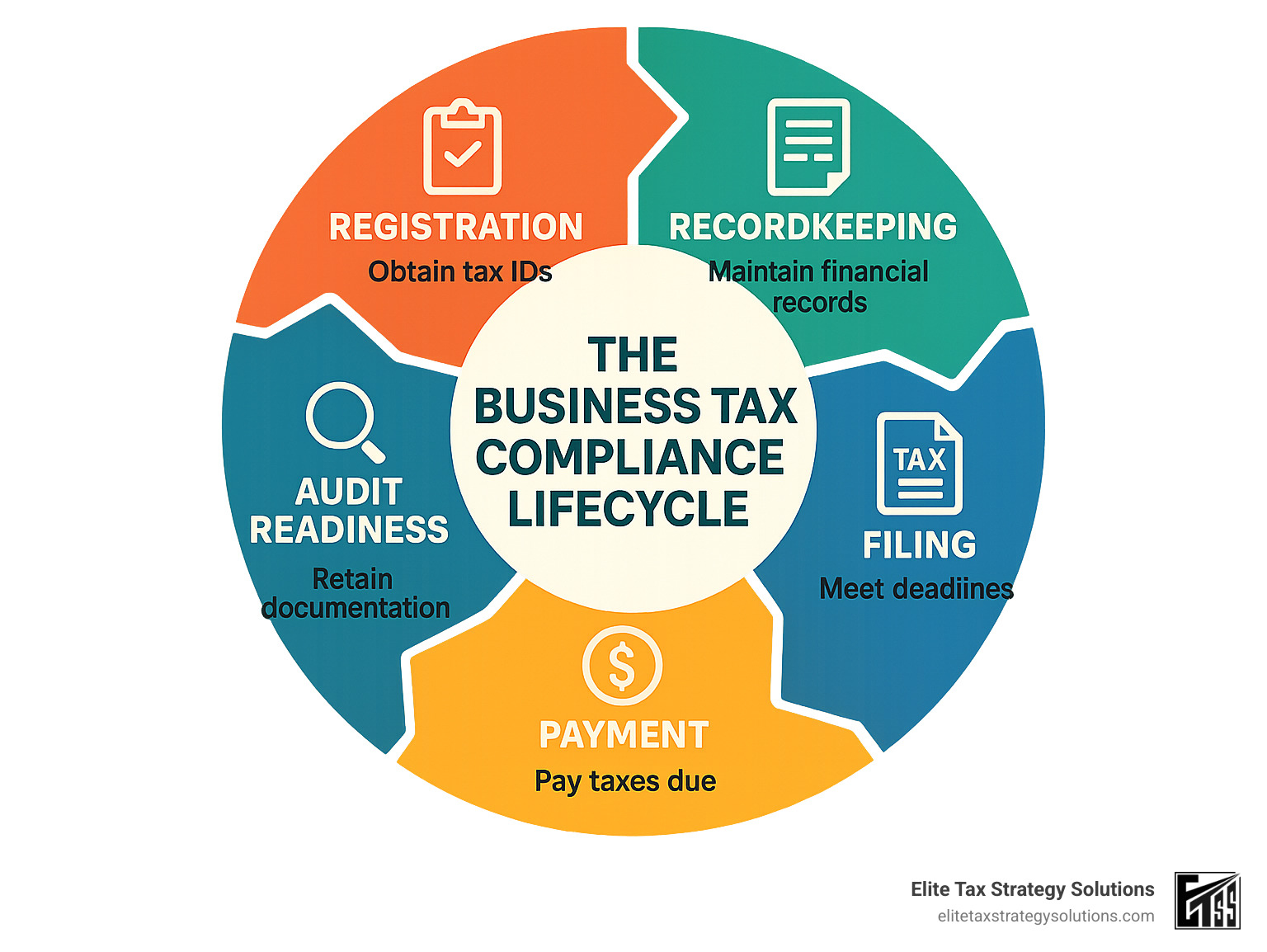
What Business Tax Compliance Includes:
– Tax Registration: Obtaining proper tax IDs (EIN, sales tax permits)
– Accurate Reporting: Maintaining detailed financial records
– Timely Filing: Meeting all federal, state, and local deadlines
– Tax Payments: Remitting all taxes owed on schedule
– Documentation: Keeping proper records for the required retention periods
The IRS estimates the average gross tax gap (taxes owed but not paid) for 2017-2019 was $540 billion per year. With the Inflation Reduction Act providing an additional $79.6 billion in IRS funding, compliance enforcement is increasing, making proper tax management more critical than ever.
Staying compliant isn’t just about avoiding penalties—it’s about maintaining your business reputation, facilitating smooth operations, and creating a foundation for strategic growth. Non-compliance can result in fines, interest charges, audits, and in severe cases, business closure or criminal penalties.
I’m David Fritch, and with 40 years of experience as both a CPA and attorney specializing in business tax compliance, I’ve helped hundreds of small business owners steer the complexities of tax regulations while maximizing their savings. My background working with Arthur Andersen and as a business owner myself gives me unique insight into the challenges entrepreneurs face when balancing growth with compliance obligations.
Business tax compliance helpful reading:
– irs compliance audit
– transfer pricing compliance
– multi state payroll tax compliance
Business Tax Compliance 101: Why Entrepreneurs Can’t Ignore It
I get it. You didn’t start your business because you were itching to fill out tax forms. Your passion is creating amazing products, delighting customers, and watching your company grow—not deciphering IRS jargon. But here’s the truth we need to talk about: business tax compliance isn’t just some optional side quest in your entrepreneurial journey.
The numbers tell a compelling story. In 2021 alone, the IRS collected over $4 trillion in taxes, penalties, interest, and fees. And that tax gap—the difference between what’s owed and what’s actually paid? It’s sitting at a staggering $470 billion annually. With the 2022 Inflation Reduction Act pumping an additional $79.6 billion into IRS funding, we’re entering a new era of increased audits and tighter enforcement.
So why should you—an already time-strapped business owner—care about business tax compliance?
First and foremost, it’s about your financial stability. Unexpected tax bills don’t just appear with a polite knock—they crash through your door like unwelcome guests, often bringing their friends Penalty and Interest along. Proper compliance helps you forecast these obligations, preventing the cash-flow nightmares that keep entrepreneurs up at night.
Your business reputation is on the line too. Tax liens become public record, potentially damaging relationships with customers, vendors, and the financial institutions you might need for growth. In today’s transparent business environment, your tax standing is part of your company’s character.
Let’s not forget your civic duty. The taxes you pay fund essential services that benefit both your business and community. Roads your delivery trucks use, schools that educate your future employees, emergency services that keep your business safe—all supported by tax compliance.

Clean tax records also enable growth. When you’re seeking business loans, courting investors, or positioning for acquisition, your tax compliance history often determines whether doors open or close. It’s like a credit score for your business’s future opportunities.
Perhaps most valuable is the peace of mind that comes with knowing your business meets all tax obligations. As one of our clients recently shared, “I used to lose sleep over tax deadlines. Now I sleep like a baby knowing my compliance is handled.” That’s exactly what we aim to provide at Elite Tax Strategy Solutions—not just technical compliance, but genuine peace of mind that lets you focus on what you do best.
Latest research on IRS tax gap | More info about Business Tax Management
Business Tax Compliance Roles & Responsibilities
When it comes to tax compliance, knowing who’s responsible for what can make the difference between smooth sailing and choppy waters. The accountability structure might be more nuanced than you initially thought.
In larger organizations, a Tax Compliance Officer typically oversees the big picture—developing the overall compliance strategy, ensuring accuracy in tax returns before they’re submitted, enforcing internal policies, investigating any financial reporting discrepancies, and educating team members about their tax obligations.
Meanwhile, a Tax Compliance Manager handles the day-to-day operations—monitoring legislative changes that might affect your business, updating internal policies to reflect current laws, integrating tax strategy into business operations, managing regular compliance activities, and overseeing the preparation and filing of returns.
For smaller businesses, these roles might blend together or be outsourced to professionals. But here’s the critical part—even with external help, you as the business owner retain ultimate responsibility for compliance. You can delegate the tasks, but not the accountability.
Creating an effective governance structure for tax compliance doesn’t have to be complicated. Start with a clear separation of duties—having different people handle tax preparation, review, and payment approval helps prevent both errors and potential fraud. Document your compliance processes and decisions carefully. Schedule regular reviews of your procedures to catch any issues early. Make sure everyone on your team understands how their record-keeping impacts tax compliance. And finally, don’t hesitate to bring in qualified professionals for complex matters.
Business tax compliance might not be what gets you excited about entrepreneurship, but treating it as a fundamental business function rather than an afterthought can save you significant headaches—and dollars—down the road. After all, the best tax strategy isn’t just about minimizing what you pay—it’s about building a sustainable, compliant foundation for your business to thrive.
The Tax Landscape: Income, Sales, Payroll & Beyond
Let’s face it—the world of business tax compliance can feel like navigating a maze blindfolded. But don’t worry! I’m here to shed some light on this complex landscape that every business owner needs to understand.
Think of taxes as the different terrains your business must cross—each with its own rules and challenges. From income tax mountains to sales tax valleys, knowing what lies ahead makes the journey much smoother.
Major Business Tax Categories
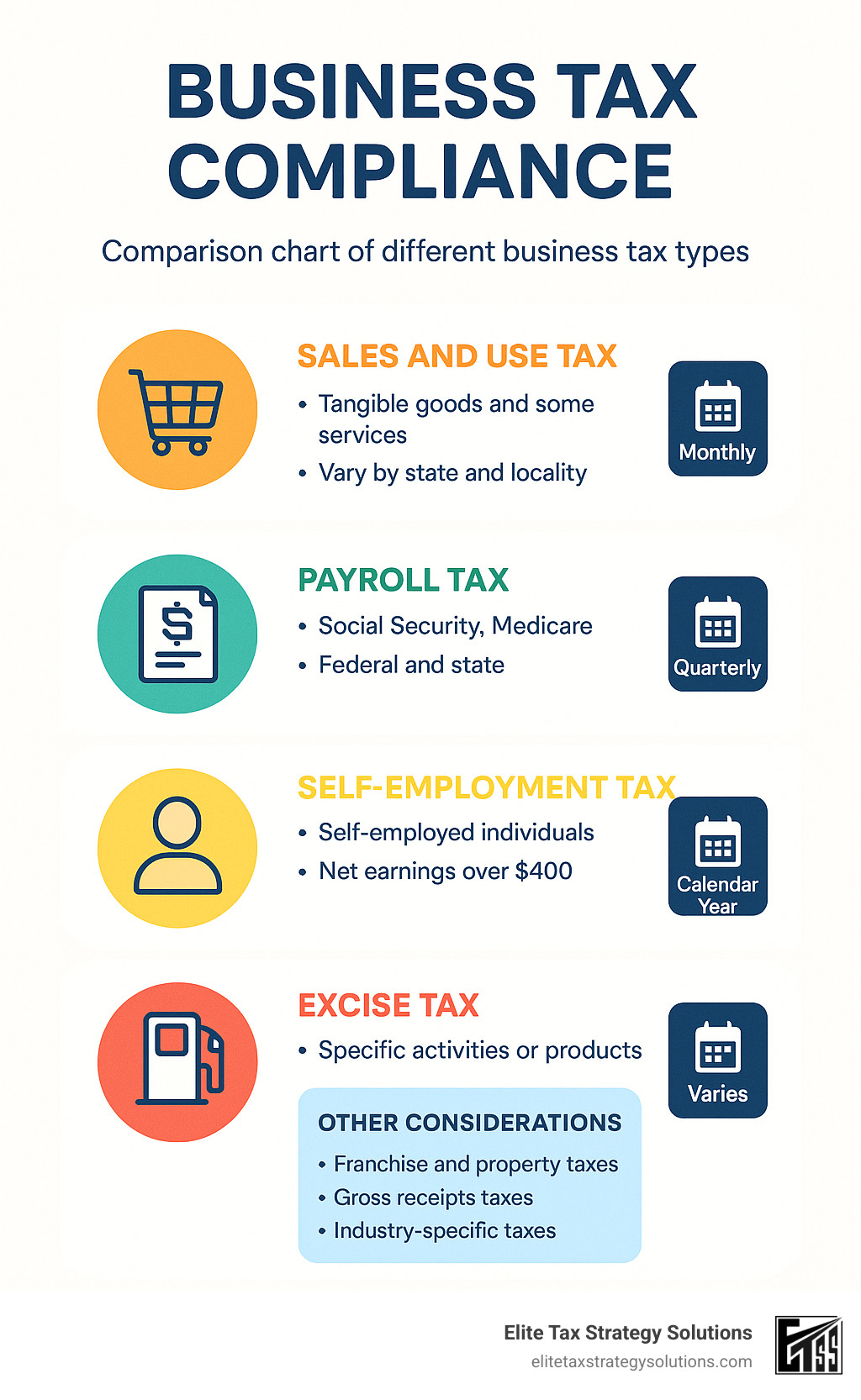
When you’re running a business, income tax is just the tip of the iceberg. Your business tax compliance journey actually spans several different territories.
Income tax affects virtually every business (except partnerships, which file information returns instead). It operates on a pay-as-you-go basis through those quarterly estimated payments we all love so much. Depending on whether you’re a calendar year or fiscal year business, your filing deadlines will vary—but they’re always lurking on the horizon!
Then there’s sales and use tax—perhaps the most geographically diverse tax of all. The rates and rules change dramatically as you cross state and even city lines. You might trigger “nexus” (a fancy word for taxable presence) simply by having physical operations or reaching certain sales thresholds in a state. Most businesses need to file these returns monthly or quarterly, creating a never-ending cycle of compliance.
If you have employees, payroll taxes become your constant companion. Social Security, Medicare, federal income tax withholding—they’re all part of your responsibility as an employer. Don’t forget about FUTA (Federal Unemployment Tax Act) and state unemployment contributions! These typically require quarterly filings on Form 941 and an annual reconciliation on Form 940.
Self-employed? Once your net earnings exceed a mere $400, you’ll need to pay self-employment tax to cover your Social Security and Medicare contributions. This gets reported on Schedule SE along with your personal tax return.
Some businesses also face excise taxes—special taxes on specific products or activities like fuel, tobacco, or operating heavy vehicles. These come with their own unique forms (720, 2290, 730, or 11-C) and filing schedules.
And we can’t forget about state-specific taxes like franchise taxes, gross receipts taxes, property taxes on business assets, and various industry-specific taxes that might apply to your particular business.
The way your business is structured fundamentally shapes your tax obligations. Take a look at this comparison:
| Tax Type | Sole Proprietor | Partnership | LLC | S Corporation | C Corporation |
|---|---|---|---|---|---|
| Income Tax | Personal 1040 | Information Return | Pass-through* | Pass-through | Entity Level |
| Self-Employment | Yes | Partners Individually | Members* | No | No |
| Payroll (w/employees) | Yes | Yes | Yes | Yes | Yes |
| Sales Tax | Yes | Yes | Yes | Yes | Yes |
| Estimated Tax | Quarterly | Partners Individually | Members* | Shareholders | Corporate |
*Depends on LLC tax election
The complexity multiplies exponentially when you operate in multiple states. Suddenly you’re juggling different filing requirements across various jurisdictions, each with its own definition of what constitutes “doing business” in their territory.
Business Tax Compliance Across Structures
Your choice of business structure isn’t just about liability protection—it dramatically impacts your business tax compliance journey.
Sole proprietorships offer the simplest compliance path. Your business income flows directly onto Schedule C of your personal return. While this simplicity is appealing, you’ll pay self-employment tax on everything over $400, and there’s zero separation between your personal and business assets. As one client told me, “I loved the simplicity until I realized I was personally on the hook for everything.”
Partnerships file an annual information return (Form 1065) and distribute Schedule K-1s to partners showing their share of the profits or losses. Each partner then reports this on their personal returns and pays self-employment tax on their portion. Like sole proprietorships, partnerships offer no liability protection—your personal assets remain at risk.
LLCs offer fascinating flexibility in the tax world. Single-member LLCs are typically taxed like sole proprietorships, while multi-member LLCs generally follow partnership taxation. But here’s where it gets interesting—you can elect to be taxed as an S or C corporation instead! This gives you liability protection while maintaining tax flexibility. It’s like having your cake and eating it too.
S corporations provide pass-through taxation (avoiding the double taxation of C corps) while filing a corporate return (Form 1120-S) and issuing K-1s to shareholders. One significant advantage: potential payroll tax savings by taking some income as distributions rather than salary. But beware—the IRS requires owner-employees to take “reasonable compensation” before distributions. Plus, there are strict eligibility requirements, including a 100-shareholder maximum and U.S. citizenship/residency requirements.
C corporations face the most complex compliance requirements. They pay tax at the corporate level, and shareholders pay tax again on dividends (the infamous “double taxation”). However, they offer unlimited growth potential with no restrictions on shareholders.
Here’s something critical every business owner should understand: “piercing the corporate veil.” This legal doctrine can strip away your liability protection if you don’t maintain proper business tax compliance and separation between personal and business affairs. One misstep could literally cost you your personal assets.
As a client who switched from sole proprietor to S corporation status recently shared, “I’m saving over $15,000 annually in self-employment taxes, but I had no idea how important it was to maintain proper payroll compliance to protect that status.”
The tax landscape may seem overwhelming, but with the right map and guide, you can steer it successfully while keeping more of what you earn. That’s where strategic business tax compliance planning makes all the difference.
More info about Tax Compliance for Companies
Your Compliance Roadmap & Best Practices
Let’s face it—business tax compliance can feel like navigating a maze blindfolded. But it doesn’t have to be that way! I’ve helped hundreds of business owners turn tax chaos into calm with this straightforward roadmap:
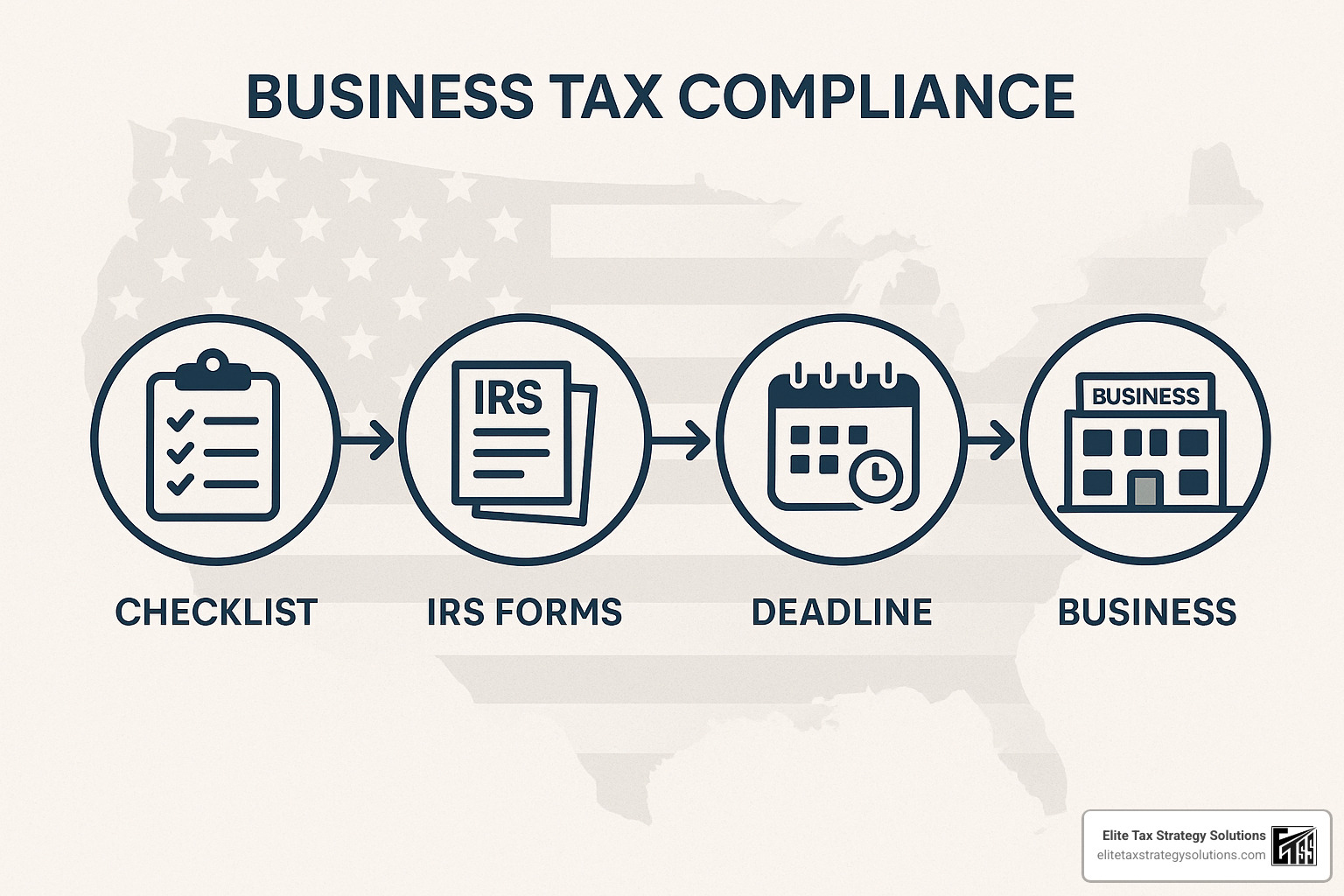
1. Registration & Setup
Think of this as laying the foundation for your business’s tax health. Start by obtaining your federal Employer Identification Number (EIN)—it’s like your business’s Social Security number. Then register for state tax accounts covering income, sales, and withholding taxes.
Don’t forget local business licenses and permits! These seemingly small details can come back to haunt you if overlooked. One of my clients learned this the hard way when a routine inspection revealed they’d been operating without a local business license for three years—resulting in penalties that wiped out a month’s profit.
Setting up a separate business bank account isn’t just good advice—it’s essential for maintaining the “corporate veil” that protects your personal assets. Pair this with a reliable recordkeeping system, and you’ve completed step one!
2. Calendar Critical Deadlines
Tax deadlines wait for no one. Create a tax calendar marking all filing and payment due dates, then set reminders 2-4 weeks before each one. This buffer gives you time to gather documents and resolve any issues.
I recommend noting extended hours of operation for tax departments near deadlines—this small detail has saved many of my clients when last-minute questions arose. While you’re at it, schedule quarterly compliance reviews to catch and correct small issues before they become big problems.
3. Implement Accurate Reporting Processes
Accurate reporting is the heartbeat of business tax compliance. Document all income sources and expense categories carefully. The IRS loves contemporaneous records—meaning you document expenses when they occur, not months later when memory gets fuzzy.
Monthly account reconciliation might not be exciting, but it’s like brushing your teeth—a little regular maintenance prevents painful problems later. Keep personal and business transactions strictly separate, and track the basis in your business property for when you eventually sell or dispose of it.
4. Establish Payment Protocols
Nothing causes more tax headaches than having the paperwork right but coming up short on payment. Set aside tax funds in a separate account—I call this the “sleep well at night” account. Implement electronic payment methods for reliability and the all-important payment trail.
Document all payments with confirmation numbers and review your payment history quarterly. This simple habit has saved countless clients from “but I paid that!” disputes with tax authorities.
5. Leverage Technology
We’re lucky to live in an age where technology can shoulder much of the business tax compliance burden. Cloud-based accounting software gives you real-time financial visibility from anywhere. For more complex requirements, specialized tax compliance software can be a lifesaver.
Document management systems ensure you maintain records for the required retention periods—generally 3-7 years depending on the document type. Set up automated alerts for regulatory changes to stay ahead of shifting requirements.
6. Plan Proactively
The most successful businesses don’t just comply with tax laws—they plan strategically around them. Schedule quarterly tax planning meetings to identify opportunities and address potential issues. Review your entity structure annually as your business evolves.
If you’re expanding, monitor changing nexus requirements that might trigger new tax obligations. And don’t leave money on the table—assess available tax credits and incentives regularly.
The businesses that maintain excellent business tax compliance follow these best practices religiously: They maintain strict separation between business and personal finances. They document everything carefully. They stay current on tax law changes. They reconcile accounts monthly. They maintain constant audit readiness. They consult qualified professionals for complex situations. They train key personnel thoroughly. And they regularly review their entity structure as they grow.
Compliance isn’t just about avoiding problems—it’s about creating a foundation that supports your business growth. As one client told me, “Once we got our compliance house in order, we stopped worrying about tax surprises and started focusing on expansion. Best decision we ever made.”
More info about Tax Compliance for Companies
Keeping Business Tax Compliance on Autopilot
Who has time to manually track every tax obligation? Not successful entrepreneurs! They put business tax compliance on autopilot using smart automation tools.
Cloud accounting platforms like QuickBooks Online or Xero form the backbone of an automated compliance system. These tools capture transactions through automated bank feeds, generate tax-ready reports, and let you document expenses on the go with mobile receipt capture.
For specific tax challenges, specialized software makes all the difference. Avalara AvaTax handles the mind-boggling complexity of sales tax across multiple jurisdictions. Payroll platforms like ADP or Gusto calculate and file payroll taxes automatically. Tax1099 streamlines contractor reporting, while LicenseHQ keeps business licenses current.
Document management systems aren’t just digital filing cabinets—they’re compliance protection. They provide secure storage for tax records, make documents searchable with OCR technology, enforce retention policies, and facilitate secure sharing with your tax professionals.
Don’t forget compliance monitoring tools that alert you to tax law changes, notify you of upcoming deadlines, automate workpapers, and provide electronic signature capabilities.
The difference automation makes is stunning. A retail client of mine used to spend every Monday reconciling weekend sales and calculating tax obligations—nearly 20 hours monthly on compliance tasks alone. After implementing an integrated POS and accounting system with automated sales tax calculations, that time dropped to just 2 hours monthly. “I got my Mondays back,” she told me with a smile.
When implementing automation, start with your biggest compliance headache—often sales tax or payroll. Choose systems that talk to each other without manual intervention. Establish clear processes for handling exceptions. Schedule regular system reviews to ensure everything’s working properly. And always train backup personnel on your automated systems.
Automation doesn’t replace human oversight—it improves it. The winning formula combines efficient technology with professional expertise to keep your business tax compliance rock-solid while freeing you to focus on growing your business.
More info about Monthly Tax Compliance
Audits, Penalties & Staying Ahead
Let’s be honest – the words “tax audit” can make even the most diligent business owner break into a cold sweat. But here’s some good news: understanding what happens during an audit can take much of the fear out of the process. Even with stellar business tax compliance, audits can still happen, and being prepared is your best defense.
Types of Tax Audits
Think of tax audits like medical check-ups – they come in different levels of intensity.
The correspondence audit is the tax world’s equivalent of a quick check-up. It happens entirely through mail, usually focuses on specific issues, and requires you to submit supporting documents. Most business owners can handle these without breaking a sweat.
Office audits kick things up a notch – you’ll need to appear in person at an IRS or state tax office with your records. These dive deeper than correspondence audits and often cover multiple areas of your tax return.
Field audits are the comprehensive physicals of the tax world. Tax authorities come to your business location, which allows them to observe your operations firsthand. These can span multiple days and leave no stone unturned.
When it comes to desk reviews versus field inspections, think of it as the difference between reviewing your business on paper versus seeing it in action. Desk reviews examine your submitted documents remotely, while field inspections involve physical visits to your business. Local tax authorities often work geographically, focusing on specific areas at a time.

Penalties and Their Impact
The IRS and state tax authorities don’t play around when it comes to penalties, and they can add up quickly:
If you fail to file, you’re looking at 5% of unpaid taxes for each month your return is late, up to 25%. Even if you file but don’t pay, there’s still a 0.5% monthly penalty (also maxing out at 25%). Make a significant error? That’s a 20% accuracy-related penalty on the underpayment. And if the IRS determines there was fraud involved, that jumps to a whopping 75% penalty.
But the real impact goes beyond just writing a check. Non-compliance can lead to business license revocation, personal liability (yes, they can come after your personal assets), damaged credit ratings, barriers to government contracts, and increased audit risk for years to come. One client told me, “The penalty hurt my wallet, but the damage to my business reputation hurt even more.”
Record Retention Requirements
Think of good record-keeping as an insurance policy against audit nightmares. The general rule is to keep records for 3 years from your filing date, but there are important exceptions:
Substantially underreported income? Extend that to 6 years.
Employment tax records? Keep those for at least 4 years.
Property records? Hold onto them until 3 years after you’ve disposed of the property.
Unfiled or fraudulent returns? Those records should never leave your possession.
Store everything securely with appropriate backups. If you’re going digital (and you should), make sure your electronic records meet IRS requirements for reliability and accessibility. As one client joked, “My storage unit costs less than what an audit would cost if I couldn’t find my receipts!”
The Appeals Process
Disagreeing with audit findings doesn’t mean you’re out of options. The appeals process follows a clear path:
Start with a request for reconsideration to the auditor’s manager. If that doesn’t resolve things, file a formal appeal through the IRS Office of Appeals or your state’s equivalent. Still not satisfied? Federal disputes can go to Tax Court, while state disputes follow local guidelines.
Timing is everything – the postmark on your appeal documents can make or break your case. And rest assured that your information remains confidential throughout this process, protected under laws like Virginia Code §58.1-3.
Business Tax Compliance Survival Kit
The best defense is a good offense when it comes to business tax compliance. Implement these internal controls to avoid audit triggers: regularly reconcile reported income with bank deposits, treat similar expenses consistently, document unusual transactions, review prior year adjustments, and verify worker classifications.
Your document management system should include a secure portal for sharing sensitive documents, standardized naming conventions, reliable backup systems, chain of custody documentation for physical records, and a designated person responsible for records management.
When problems do arise, you have options. Voluntary disclosure programs allow you to proactively address past non-compliance. Penalty abatement requests can provide relief when you have reasonable cause. Installment agreements help you manage tax liabilities over time, and in certain circumstances, an Offer in Compromise might let you settle tax debt for less than the full amount. For complex disputes, professional representation is worth every penny.
I’ll never forget the manufacturing client who came to us facing a $180,000 assessment. Through careful documentation and appropriate appeals, we reduced it to just $12,000. Their secret? Having solid systems in place before the audit notice ever arrived.
More info about Tax Compliance Audit
Frequently Asked Questions about Business Tax Compliance
What records should I keep and for how long?
Let’s face it—nobody starts a business dreaming about record retention policies. But those boxes of receipts and digital files might just save your business someday.
Think of your business records as your financial story. When the IRS or state tax authority comes knocking (and they might!), you’ll need to tell that story clearly and completely. The documents that matter most include your income proof (those invoices that hopefully keep flowing in), expense documentation (all those receipts you’ve been collecting), asset records (that equipment you purchased), employment paperwork, tax returns, and your foundational business documents.
Here’s where many business owners get tripped up—knowing how long to hang onto all this paperwork. The standard “3-year rule” works for basic situations, but life and business are rarely basic. If you’ve underreported income by more than 25% (intentionally or not), that timeline stretches to six years. Claimed losses from worthless securities or bad debts? Keep those records for seven years.
Some records deserve permanent homes in your filing system. Anything related to business assets should stick around until three years after you’ve sold or disposed of the item. Your employment tax records need at least four years of safekeeping from their due date. And if you’ve got unfiled returns or any hint of fraudulent filings in your past? Those records should never see the shredder.
As one client told me after easily surviving an audit: “Those extra file boxes I kept against your advice? Best insurance policy I never had to use until I really needed it.”
When storage space concerns arise, digital storage is relatively inexpensive compared to the potential cost of missing documentation during an audit. If you’re on the fence about keeping something, the safer bet is always retention.
How do federal, state, and local requirements interact?
Navigating business tax compliance across multiple government levels feels a bit like playing 3D chess. Each layer has its own rules, but they’re all connected in sometimes surprising ways.
Federal tax rules sit at the top of this hierarchy. When conflicts exist between federal and state laws, federal wins—it’s that simple. States cannot tax what federal law explicitly protects, and many state tax calculations actually begin with your federal numbers.
The relationship between federal and state taxes isn’t always straightforward, though. Some states automatically conform to federal tax code changes (making your life easier), while others require their legislature to adopt those changes (potentially creating temporary disconnects in how income is calculated). And let’s not forget that five states don’t impose income tax at all—though they certainly make up for it with other business taxes!
Local taxation adds yet another layer of complexity. Your county or city might impose business license taxes (like Virginia’s BPOL tax), property taxes on your business equipment, or special district assessments for local improvements. These local taxes often fly under the radar until you receive an unexpected bill.
The real headache comes from coordination challenges across these different tax authorities. You’ll face different filing deadlines, varying standards for what creates taxable presence (nexus), inconsistent definitions of what’s taxable, and potentially overlapping audit authority.
One restaurant owner I worked with finded this complexity the hard way when a simple catering job in a neighboring county triggered business license requirements, sales tax collection obligations, and even property tax assessment on equipment temporarily brought into the jurisdiction. What should have been a profitable event became a compliance nightmare.
Success in managing these interactions comes down to understanding which tax base applies to each calculation and maintaining clear documentation of how different jurisdictions treat the same transaction. When in doubt, mapping out these relationships with a qualified tax professional can save substantial headaches down the road.
What happens if I miss a filing deadline?
We all miss deadlines occasionally—it’s part of being human. But when it comes to business tax compliance, missed deadlines can be particularly painful.
The immediate impact hits your wallet. Late filing penalties typically run about 5% of unpaid taxes per month (capped at 25%), while late payment penalties add another 0.5% monthly. Then there’s interest, which continues accumulating until you’ve paid in full. Beyond these direct costs, your business might lose its “good standing” status, affecting your ability to secure contracts, obtain financing, or even operate legally in some jurisdictions.
What many business owners don’t realize are the secondary effects that can be even more damaging. Late filings raise red flags that increase your audit risk—tax authorities often give extra scrutiny to businesses that miss deadlines. If you don’t file at all, tax authorities may create a “statutory assessment,” essentially estimating what they think you owe. These estimates almost always exceed what you’d actually owe if you filed properly.
One missed deadline often creates a domino effect of compliance problems. A client once confided, “I missed one quarterly payroll tax filing because I was in the hospital. Before I knew it, that snowballed into $28,000 in penalties and interest.” While we negotiated a reduction based on their previously spotless record, they still paid significantly more than if they’d filed on time.
If you find yourself in this situation, take these steps immediately:
First, file the required returns right away, even if you can’t pay in full. This stops the more severe late filing penalties. Then pay as much as possible to reduce the penalties and interest that continue accruing. If you had a legitimate reason for missing the deadline, request penalty abatement for reasonable cause. Consider an installment agreement for any remaining balance, and most importantly, document what happened and implement systems to prevent recurrence.
Remember my golden rule of tax compliance: Filing with a payment plan is always better than not filing at all. The IRS and state authorities have far more flexibility to work with businesses that file timely returns, even if they can’t immediately pay the full amount due.
Conclusion
Let’s be honest—business tax compliance isn’t exactly the reason you jumped into entrepreneurship. But here’s the thing: when you shift your perspective from seeing it as a necessary evil to recognizing it as a strategic asset, everything changes.
Think about it. The businesses that thrive aren’t just the ones with the best products or marketing—they’re the ones that build rock-solid foundations. And tax compliance is a cornerstone of that foundation.
Key Takeaways:
When you accept proactive compliance, you’re not just avoiding headaches—you’re positioning yourself for success. I’ve seen it with countless clients: those who stay ahead of deadlines and regulatory changes spend less time putting out fires and more time growing their businesses.
Systematic processes make all the difference. One client told me, “Creating reliable systems for recordkeeping felt like a hassle at first, but now it’s like having an insurance policy that pays me back in time and peace of mind.”
The magic really happens when you integrate tax considerations into your business decisions from the start. That new equipment purchase? The timing could mean thousands in tax savings. Hiring that next employee? The structure matters tremendously for your tax position.
Technology has transformed what’s possible with business tax compliance. The tools available today can automate routine tasks that used to consume entire weekends. One client laughed when she realized she’d spent more time choosing a Netflix show than handling her quarterly tax filings after implementing the right systems.
At Elite Tax Strategy Solutions, we’ve witnessed how proper business tax compliance creates breathing room for growth. Our clients who view compliance as a strategic function consistently outperform their competitors who treat it as an afterthought.
As one business owner put it: “I used to see tax compliance as a burden taking me away from ‘real work.’ Now I understand it’s part of my business strategy—and the peace of mind is priceless.”
The tax landscape will continue evolving, with increased enforcement and changing regulations on the horizon. The businesses establishing robust compliance systems today will steer these changes with confidence while others scramble to catch up.
Business tax compliance isn’t just about following rules—it’s about creating a sustainable foundation for your entrepreneurial vision. It’s about sleeping well at night knowing you’re protected. And ultimately, it’s about freedom—the freedom to focus on what you do best.
More info about comprehensive support
Need help changing your business tax compliance from a source of stress to a strategic advantage? At Elite Tax Strategy Solutions, we combine decades of expertise with personalized service to help entrepreneurs like you steer the complexities of tax compliance while maximizing opportunities for savings and growth.
Contact us today for a comprehensive compliance assessment and find how our proactive approach can protect your business while supporting your goals.