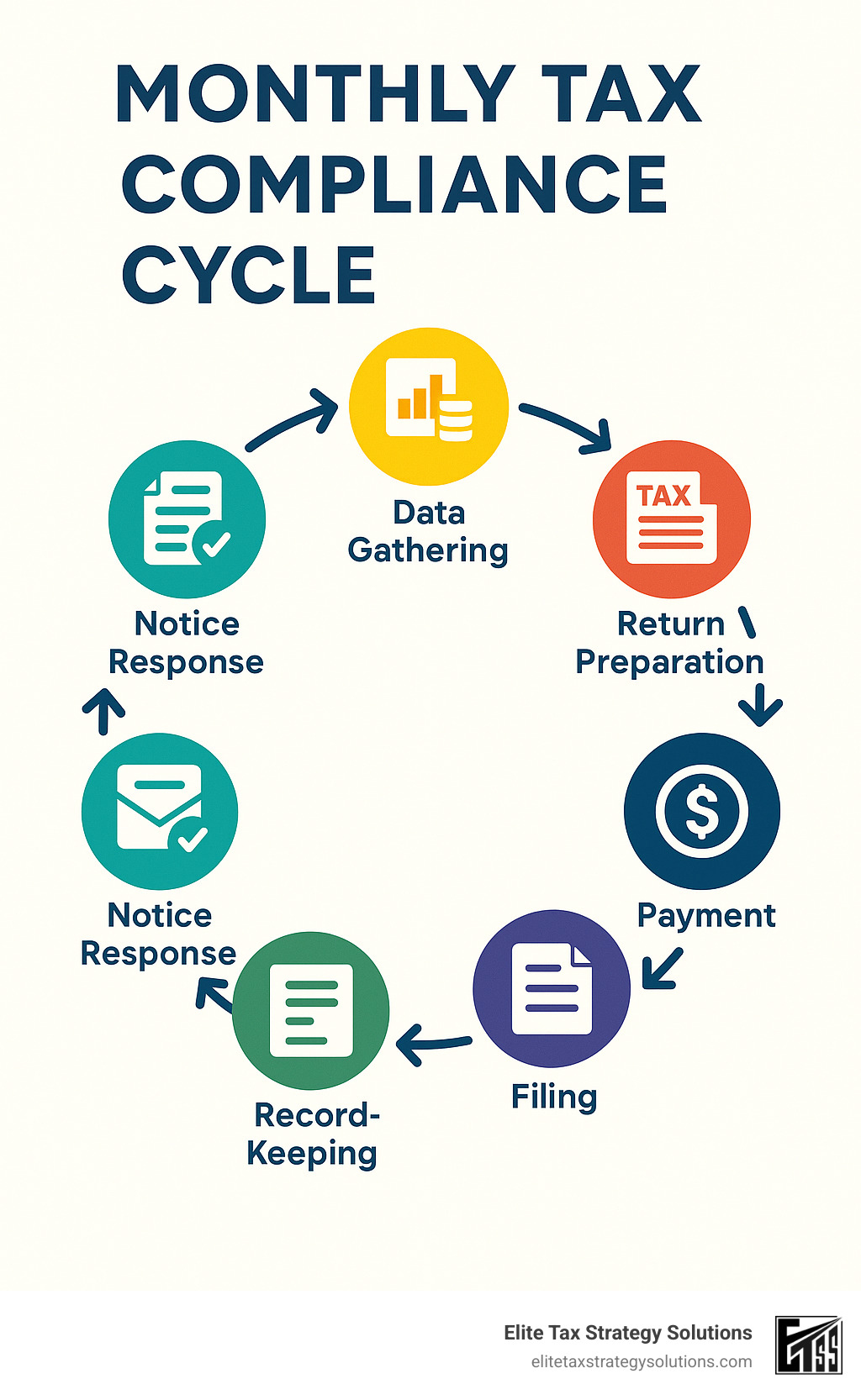
The Monthly Tax Compliance Cycle: Your Roadmap to Peace of Mind
Monthly tax compliance refers to the regular, recurring process of preparing, filing, and paying various tax obligations and statutory returns on a monthly basis. For businesses and high-income individuals, this typically includes:
- GST/Sales Tax Returns: Monthly filing of outward supplies, input tax credits, and tax payments
- TDS/Withholding Tax: Depositing tax deducted at source from payments made to vendors, employees, and contractors
- Payroll Taxes: Remittance of PF (Provident Fund) and ESI (Employee State Insurance) contributions
- Professional Tax: State-specific monthly or quarterly payments
- Labor Law Filings: Various employment-related compliance requirements
Missing these deadlines can result in penalties (typically 1-2% per month), interest charges, increased audit risk, and potential legal consequences.
The monthly tax compliance cycle repeats consistently throughout the year, creating a predictable but demanding rhythm for businesses of all sizes. While large enterprises often have dedicated teams, small business owners frequently struggle to keep up with these obligations alongside running their core operations.
For most businesses, maintaining a comprehensive compliance calendar with reminders at least a week before each deadline is the foundation of effective monthly tax management. This helps prevent the last-minute scramble that often leads to errors and penalties.
I’m David Fritch, a CPA with over 40 years of experience helping small business owners steer the complexities of monthly tax compliance while maximizing their profits and minimizing stress. My background in tax law and accounting has shown me that a systematic approach to monthly tax compliance is essential for business success.
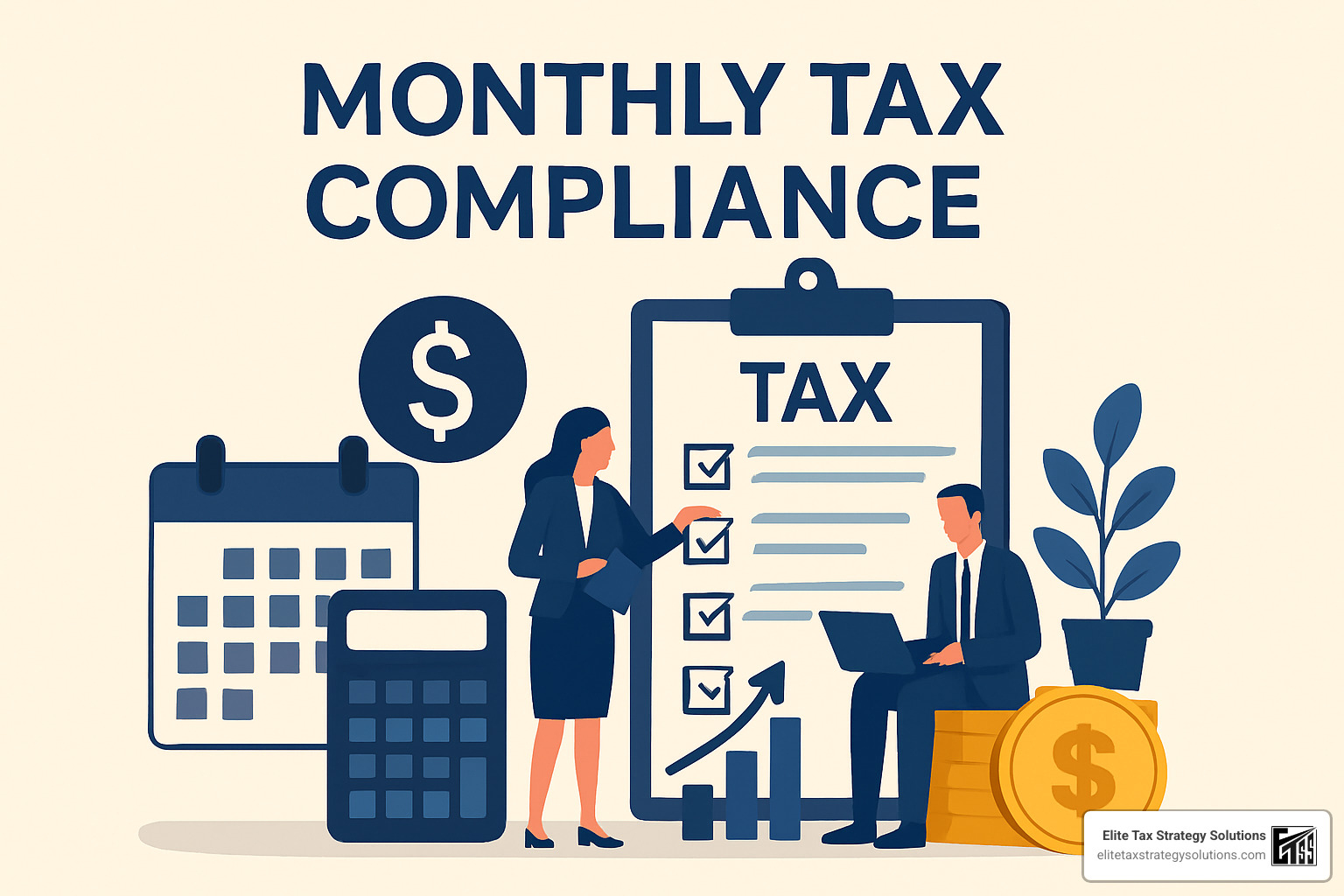
Similar topics to monthly tax compliance:
– tax compliance audit
– accounting and tax compliance
– irs tax compliance
What Is Monthly Tax Compliance & Why It Matters
Picture this: it’s the 7th of the month, and you’re sipping your morning coffee when suddenly you remember—today’s the TDS filing deadline! That moment of panic is all too familiar for business owners juggling multiple responsibilities. This is where monthly tax compliance comes into the picture.
At its heart, monthly tax compliance is simply the rhythm of fulfilling your recurring tax obligations every month. It’s like having a financial heartbeat for your business—regular, predictable, and absolutely essential for keeping everything running smoothly.
When you stay on top of your monthly tax compliance, you’re not just checking boxes. You’re actually building a foundation for business success. Based on our work with clients in Jasper, Indiana and surrounding areas, businesses with strong compliance routines typically save 3-5% of their annual tax liability just by avoiding penalties. That’s money that stays in your pocket!
Beyond the financial benefits, there’s something incredibly freeing about knowing you’re current with all tax authorities. No more Sunday night anxiety wondering if you’ve missed something important. No more digging through old emails trying to piece together what’s due when.
For most businesses, the decision to comply monthly (versus quarterly) comes down to practical considerations. Monthly filing creates a manageable rhythm and prevents the shock of larger accumulated liabilities. It’s like washing dishes after each meal instead of facing a mountain of crusty plates at the end of the week.
Regulatory bodies tend to look more favorably on businesses that maintain consistent compliance records. When your business crosses certain turnover thresholds (typically $1 million in the US or ₹5 crore in India), monthly filing becomes mandatory for many tax types anyway, so developing good habits early pays dividends.
Monthly Tax Compliance for Indian Businesses
The Indian tax landscape has its own unique rhythm when it comes to monthly tax compliance. Whether you run a corner shop in Mumbai or a tech startup in Bangalore, understanding your obligations is crucial.
For most Indian businesses, the monthly calendar revolves around several key filings. GST returns like GSTR-1 for outward supplies and GSTR-3B summary returns form the backbone of the system. TDS deposits must hit government accounts by the 7th of each month, while PF and ESI contributions for employees need to be squared away by the 15th.
Small businesses have a bit of breathing room thanks to the Quarterly Return Monthly Payment (QRMP) scheme. This clever approach lets you file quarterly while still paying monthly, striking a balance between compliance and convenience. It’s particularly helpful for MSMEs that don’t have dedicated accounting teams but still want to maintain good standing with tax authorities.
E-commerce businesses face additional layers of complexity. If you’re running an online marketplace, you’ll need to handle TCS (Tax Collected at Source) compliance under GSTR-8, with filings due by the 10th of each month. This involves collecting tax from sellers on your platform and ensuring it reaches government coffers on time.
Monthly Tax Compliance for Global Operations
When your business crosses borders, monthly tax compliance becomes a multi-dimensional chess game. Each jurisdiction brings its own rules, thresholds, and deadlines to the table.
If you’re selling across multiple U.S. states, you’ll quickly find that each has its own approach to sales tax. Some states might require monthly filing when your annual tax liability exceeds just $100, while others might set the bar at $1,000 or higher. Keeping track of where you have nexus (a fancy word for a tax presence) becomes a project in itself.
For businesses with European operations, Value-Added Tax (VAT) adds another layer to the compliance onion. Monthly VAT returns require careful tracking of both what you’ve collected from customers and what you’ve paid to suppliers. The calculations can get intricate, but staying current prevents potentially costly issues down the road.
International payments introduce withholding tax considerations. When you’re paying foreign vendors, you may need to withhold certain percentages and remit them monthly to tax authorities. The rules vary wildly by country, making this one of the trickier aspects of global monthly tax compliance.
Perhaps most challenging is determining exactly where you have filing obligations in today’s digital economy. Post-Wayfair, many jurisdictions can claim tax authority over your business based solely on economic nexus—meaning you’ve sold enough into their territory to trigger filing requirements, even without a physical presence.
Navigating these complexities doesn’t have to be overwhelming. With the right systems and support, even global monthly tax compliance can become a manageable part of your business operations.
Key Returns, Payments & Deadlines You Can’t Miss
The foundation of effective monthly tax compliance is knowing exactly what’s due and when. Missing these deadlines isn’t just stressful—it can be costly! Let’s walk through the critical monthly obligations that keep your business in good standing with the tax authorities.

Think of your tax calendar as your business’s financial heartbeat. Each month brings a rhythm of filings that, when handled properly, keep your operations running smoothly.
For most businesses, GST or Sales Tax returns typically come due between the 10th and 20th of the following month. These require you to report all sales and purchases, along with the tax you’ve collected and paid. You’ll need to submit these electronically through the appropriate government portal.
TDS or Withholding Tax obligations usually hit earlier—around the 7th of the following month. This is when you must deposit any tax you’ve deducted from payments to vendors, employees, or contractors. Depending on your location, you’ll use forms like 26Q, 24Q, or 27Q to document these transactions.
By the 15th of each month, your employee-related obligations come knocking. Provident Fund (PF) or retirement contributions for all eligible employees need to be submitted. The same deadline typically applies to Employee State Insurance (ESI) or health insurance contributions, particularly for employees below certain wage thresholds.
Professional Tax requirements vary widely by location—some states want monthly payments, others quarterly. This tax on professions and employment is easy to overlook but important to track in your compliance calendar.
While Advance Tax installments are technically quarterly in most places, smart business owners plan for them monthly. Setting aside funds regularly helps avoid the cash flow crunch that comes with large quarterly payments. Failing to make these estimated tax payments can result in interest charges that add up quickly.
Throughout the month, various corporate filings may be due to your local Registry of Companies (ROC). These keep your corporate structure and activities properly documented and maintain your good standing.
For businesses with international operations, Foreign Exchange or FEMA compliance adds another layer of monthly reporting for cross-border transactions.
Don’t forget those state-specific levies! These vary tremendously by location and industry, but they often carry significant penalties if missed. From hospitality taxes to environmental fees, these can be numerous depending on your business type.
For the most up-to-date information specific to your jurisdiction, I recommend checking the latest research on compliance dates.
Monthly Tax Compliance Deadlines at a Glance
To help you keep track of monthly tax compliance, here’s a simple timeline that works for most businesses:
Early month (1st-7th) is typically when TDS/Withholding tax deposits are due, along with Form 27C declarations. Mid-month (8th-15th) brings employee-related payments like PF, ESI, and Professional Tax in many states. The 10th-20th window usually covers your GST/Sales tax returns and VAT obligations. Late month (20th-30th) often includes statistical returns and industry-specific filings, plus it’s your time to prepare for next month’s cycle.
While some jurisdictions offer grace periods, especially for electronic filings, I’ve seen too many clients get burned by relying on these extensions. They can disappear without warning, and often don’t apply to the actual payment deadlines. Better safe than sorry!
Penalties & Interest for Late Filing
The sting of missing monthly tax compliance deadlines can hurt in multiple ways. I’ve seen business owners lose sleep over these consequences—and for good reason.
Monetary penalties for late GST or Sales Tax filings typically run 1-2% per month of the tax due. For TDS or Withholding tax, you might face both flat fees and percentage-based penalties. PF and ESI violations often combine fixed penalties with daily rates that accumulate quickly.
Beyond penalties, interest charges typically run between 12-18% annually in most places. What makes interest particularly painful is that it usually compounds and runs from the original due date. And unlike penalties, which might be waived with a good explanation, interest rarely gets forgiven—even when you have a legitimate reason for the delay.
The legal exposure can be even more concerning. Persistent non-compliance might lead to prosecution, with directors or officers facing personal liability. I’ve seen cases where business licenses and permits were jeopardized by tax delinquencies.
The cash flow impact shouldn’t be underestimated either. Accumulated penalties and interest create financial strain that can snowball quickly. In serious cases, tax authorities might freeze your bank accounts, and tax liens can damage your credit rating.
Perhaps most concerning for many business owners is the increased audit risk. Irregular filing patterns often flag accounts for detailed review. In my experience, late filings typically receive much more scrutiny than timely submissions.
For example, under Section 234E of the Indian Income Tax Act, filing TDS returns late triggers a daily penalty of ₹200 until you file, up to the amount of TDS itself. Most tax jurisdictions worldwide have similar provisions that can add up alarmingly fast.
The good news? With proper planning and systems in place, you can avoid these headaches entirely and keep your monthly tax compliance on track.
Step-by-Step Monthly Tax Compliance Workflow
Let’s face it – monthly tax compliance can feel like a never-ending cycle. But with a well-structured workflow, it becomes much more manageable. After helping hundreds of businesses streamline their compliance processes, I’ve developed this 8-step approach that turns chaos into calm:
1. Gather the Data
Think of this as setting the table before cooking. By the 3rd day of each month, you’ll want to collect all your financial ingredients: sales journals, purchase records, payroll information, bank statements, payment gateway reports, and expense claims.
I always tell my clients that this step determines the quality of everything that follows. Miss a transaction here, and it ripples through your entire compliance process. Take the time to be thorough – your future self will thank you!
2. Evaluate and Reconcile
This is where the detective work happens. Between the 3rd and 5th day of the month, you’ll match your sales records with bank deposits and reconcile purchase invoices with payments.
I remember working with a retail client who finded they were consistently missing online sales in their reconciliation. Once we fixed this gap, their tax filings became much more accurate, and their audit anxiety disappeared. The key is to verify tax rates on transactions and resolve any discrepancies you find right away.
3. Populate Returns
Now it’s time to transfer all that clean, reconciled data into the appropriate tax return formats. Between the 5th and 7th day, you’ll calculate tax liabilities, apply any available credits, and review everything for accuracy.
Pro tip: Always have a second set of eyes on your calculations. Even after decades in this business, I still have a colleague review complex returns. It’s amazing what a fresh perspective can catch!
4. File Returns & Pay Tax
Between the 7th and 20th of the month (depending on specific deadlines), you’ll submit your returns through the designated government portals, generate payment vouchers, and process payments via authorized channels.
Always – and I mean always – keep those confirmation receipts. They’re your proof of compliance and will save you countless headaches if questions arise later.
5. Reconcile Bank/Confirm Payments
Within 1-2 days after payment, verify that the funds actually left your account and match payment confirmations with your filed returns. This step is often overlooked, but it’s crucial for catching payment processing errors before they turn into compliance issues.
6. Update Tax Calendar
Immediately after confirmation, mark completed filings in your compliance tracker and note any upcoming deadlines. This creates a visual roadmap that helps prevent missed filings in the future.
One of my clients uses a color-coded spreadsheet that the whole finance team can access – green for completed tasks, yellow for in-progress, and red for urgent items. It’s simple but remarkably effective.
7. Respond to Notices
Tax authorities send notices – it happens to even the most diligent businesses. The key is monitoring for these communications and addressing any queries promptly (typically within 7-30 days as specified).
Document every interaction with tax authorities. This creates an audit trail that protects you if questions arise about your responsiveness.
8. Continuous Improvement
Before starting the next cycle, take a moment to review what worked and what didn’t. Were there bottlenecks? Did you find any recurring issues? Has tax law changed in ways that affect your process?
This reflection step transforms monthly tax compliance from a repetitive burden into an increasingly efficient process.
For more detailed guidance on perfecting your accounting and tax compliance processes, visit our Accounting and Tax Compliance resource page.
Data Collection & Reconciliation
The foundation of accurate monthly tax compliance is thorough data collection and reconciliation. Think of it as building a house – skip this step, and everything else becomes unstable.
For sales ledgers, categorize transactions by tax rate and jurisdiction. I’ve found that color-coding exempt transactions helps tremendously when it comes time for review. Always reconcile invoices issued against payments received – this simple step catches so many potential errors before they become compliance issues.
When dealing with purchase registers, organization is your best friend. Group purchases by vendor and tax category, and verify input tax credit eligibility for each transaction. One of my clients saved over $12,000 last year simply by improving their system for matching vendor invoices with goods received.
Payroll data requires special attention. Beyond salaries and commissions, you’ll need to track benefits with tax implications and ensure proper classification of contractors versus employees. This area is a common audit trigger, so precision matters.
Bank feeds can transform your reconciliation process. Implementing direct bank feed integration with your accounting software saves hours of manual data entry and reduces errors. When reconciling, focus first on identifying unexplained transactions – they’re usually where the problems hide.
The reconciliation process should feel like detective work. Compare totals across systems, investigate anything that seems off, document your findings, and get appropriate approvals for adjustments. Businesses that accept this approach typically reduce their tax filing errors by over 60% – that’s real peace of mind!
Return Preparation & Filing Portals
Once your data is reconciled, it’s time to prepare and file your returns through the appropriate government portals. Think of these portals as different doorways to compliance – each with its own key and peculiarities.
For GST/Sales Tax, you’ll typically use platforms like GSTN in India or state-specific Department of Revenue portals in the US. Each has its own quirks – GSTN, for example, tends to slow down significantly near filing deadlines. Plan accordingly!
Income Tax and Withholding filings often happen through systems like TRACES (India) or EFTPS (US). These platforms require secure authentication, so keeping your credentials updated is essential.
For Social Security and Retirement contributions, you’ll steer portals like EPFO in India or the Social Security Administration’s systems in the US. These systems tend to be less user-friendly than commercial websites, so patience is your friend.
Labor Law Compliance involves platforms like ESIC in India or various state labor departments in the US. These systems often have strict formatting requirements – one misplaced digit can cause your entire filing to be rejected.
Corporate Filing Portals like MCA-21 (India) or Secretary of State websites (US) handle your company law compliance. These systems typically require digital signatures, so keeping your certificates current is critical.
For businesses with international operations, Foreign Exchange Reporting through platforms like RBI-FIRMS (India) or FinCEN (US) adds another layer to monthly tax compliance.
When preparing returns, consistency is key. Use the latest prescribed formats, verify calculations multiple times, and maintain coherent reporting across related returns. I always tell clients to preserve draft versions with calculation notes – they’re invaluable if questions arise later.
For electronic filing, ensure your digital signature certificates are current and you’re using compatible browsers. Always allow extra time for system slowdowns near deadlines – I’ve seen too many businesses incur penalties simply because they couldn’t get through overloaded government portals on deadline day.
Payment, Confirmation & Recordkeeping
The final phase of the monthly tax compliance cycle is where many businesses drop the ball – but it’s actually where your protection begins. Think of proper recordkeeping as insurance against future headaches.
When generating payment vouchers or challans, double-check every detail – tax codes, assessment years, and amounts. One misplaced digit can send your payment to the wrong account, resulting in compliance issues despite your best intentions. Save digital copies with consistent naming conventions like “GST-Aug2023-Payment” for easy retrieval.
Digital Signature Certification management is often overlooked until it’s too late. Maintain a register of all DSCs with expiration dates and assign backup signatories for emergencies. I once had a client whose compliance officer fell ill right before a major filing deadline – having a backup signer already in place saved them from significant penalties.
Creating standardized MIS reports transforms compliance from a black box into a transparent process. Include filing dates, amounts, and confirmation numbers, and highlight variances from previous periods. These reports aren’t just for record-keeping – they provide valuable business intelligence about your tax patterns over time.
For audit trail maintenance, document the entire compliance process from data gathering to filing. Those screenshots of online submissions that seem tedious to capture? They’re worth their weight in gold during an audit. One client told me they saved over $20,000 in proposed penalties by simply producing confirmation screenshots the auditor didn’t expect them to have.
The best recordkeeping systems combine digital and physical storage with appropriate security measures. Establish minimum retention periods (typically 7-10 years) and conduct periodic audits of your system. According to research referenced by Avalara, businesses with robust documentation systems experience 85% greater efficiency during tax audits compared to those with disorganized records.
In monthly tax compliance, good records aren’t just about satisfying regulators – they’re about protecting your business and giving you peace of mind. A few extra minutes spent on proper documentation today can save hours of stress tomorrow.
Best Practices, Tools & Automation Hacks
Streamlining your monthly tax compliance process can save countless hours and reduce errors significantly. Here are the strategies and tools that our most successful clients implement:
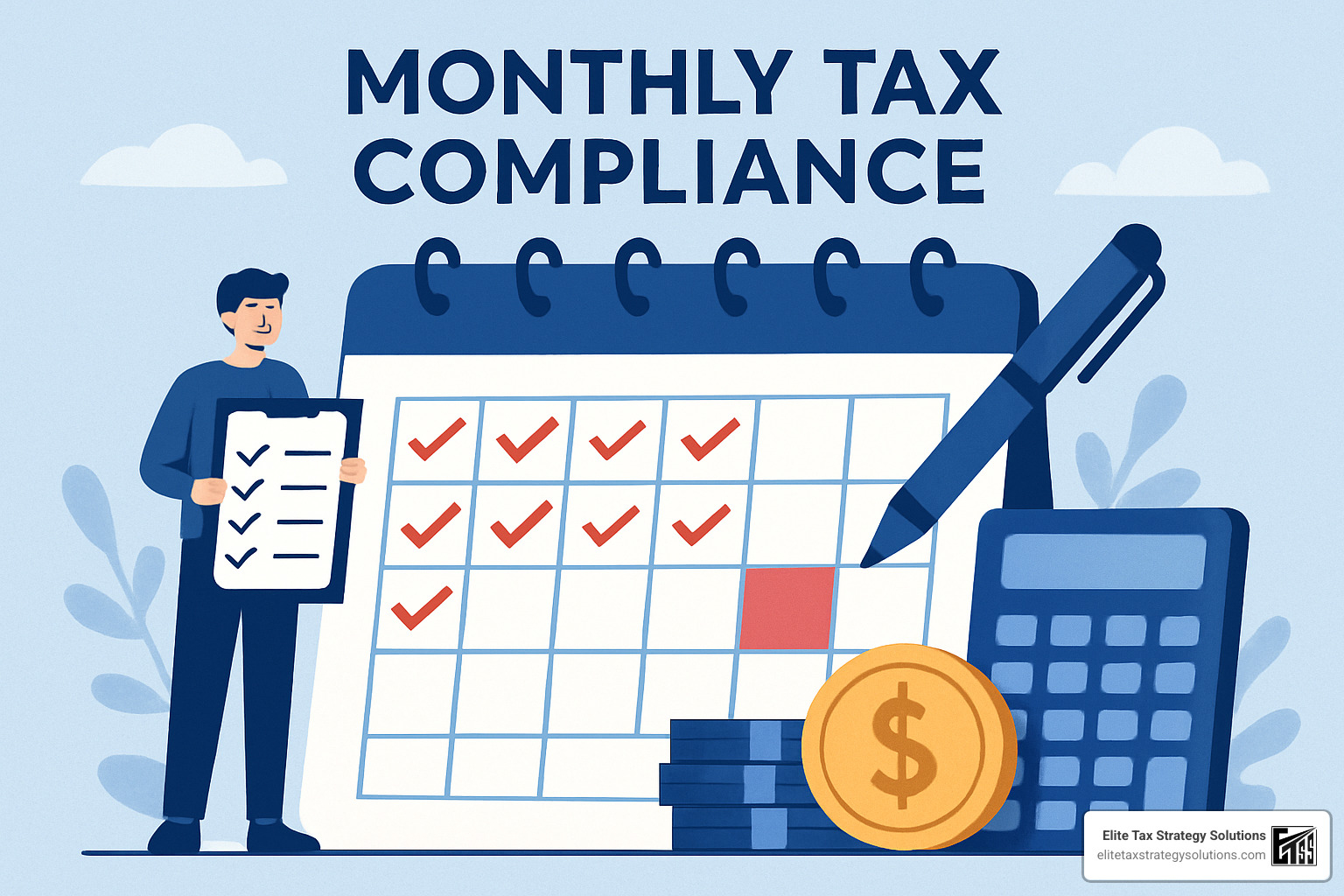
Building an Evergreen Tax Calendar
A comprehensive tax calendar is the backbone of effective monthly tax compliance. Think of it as your roadmap through the complex landscape of tax deadlines.
Start by creating a master calendar using tools you’re already comfortable with—whether that’s Google Sheets, Excel Online, or specialized compliance software. Include every jurisdiction where you have filing obligations and make it visually intuitive with color-coding by tax type. This simple step alone can transform chaos into clarity.
Assign clear ownership for each filing requirement. In my years of practice, I’ve seen too many businesses miss deadlines because everyone thought someone else was handling it! Designate both primary and backup responsible individuals, and create a simple handover protocol for when team members change.
Your reminder system should work the way your brain does—with increasing urgency as deadlines approach. Set up cascading alerts at 7 days, 3 days, and 1 day before each deadline. And don’t rely on just one notification method—combine email, calendar alerts, and even messaging apps to ensure nothing falls through the cracks.
Regular calendar reviews are essential as tax regulations change frequently. Schedule monthly check-ins to keep everything current, and always document where you found each deadline so you can verify accuracy later.
Finally, track completion status in real-time. Record filing references and payment confirmations as they happen. This creates both peace of mind and a valuable audit trail.
For an excellent starting point, check out the American Payroll Association’s compliance calendar, which provides a comprehensive template you can adapt to your needs.
Leveraging Technology for Monthly Tax Compliance
When I talk to business owners in Jasper and surrounding areas, they often tell me that monthly tax compliance feels like a never-ending treadmill. That’s where smart technology comes in—not to replace human judgment, but to eliminate repetitive tasks and reduce errors.
The return on investment for tax automation is compelling. According to data from Avalara, businesses implementing these solutions typically see a 90% increase in tax research efficiency and an 85% reduction in time spent managing returns. Most of my clients achieve positive ROI within 6-12 months of implementation.
Tax calculation engines are game-changers for businesses with complex sales patterns. They automatically apply the correct tax rates based on location and product type, and update seamlessly when rates change. For one of my retail clients, this eliminated about 15 hours of manual work each month.
Data extraction tools have transformed how we handle information flow. Instead of manually entering data from receipts and invoices (a process prone to errors), these tools automatically convert unstructured information into usable formats. The time savings—and stress reduction—can be enormous.
AI-powered reconciliation represents the cutting edge of tax compliance technology. These systems can identify discrepancies between your accounting records and bank statements, suggest matching entries based on patterns, and flag unusual transactions for human review. It’s like having a tireless assistant who never misses a detail.
E-filing platforms connect directly with tax authorities, streamlining the submission process and storing confirmation receipts automatically. This creates both efficiency and an automatic audit trail.
If you’re just starting to explore automation, I recommend beginning with accounting software that includes basic tax compliance features, then adding specialized tools as your needs grow. For more detailed guidance, visit our guide on Sales Tax Compliance Automation Companies.
Internal Controls & Documentation
Strong internal controls are the unsung heroes of reliable monthly tax compliance. They’re the difference between occasional lucky compliance and consistent, dependable results.
Standard Operating Procedures (SOPs) might sound boring, but they’re invaluable when key team members are out sick or leave the company. Document each compliance process step-by-step, including screenshots and examples. Make these living documents—review and update them quarterly or whenever regulations change. I’ve seen businesses reduce their error rates by 50% simply by implementing clear SOPs.
The maker-checker system introduces a crucial second set of eyes to your compliance process. Separate the duties of preparation and review between different team members, and create formal checklists for reviewers to follow. Document review notes and how issues were resolved. This approach catches the vast majority of errors before they become problems with tax authorities.
Your document retention strategy matters more than you might think. Define how long you’ll keep each type of record (generally 7-10 years for tax documents), implement automatic archiving based on document age, and establish secure destruction protocols for expired records. This prevents both the risks of insufficient documentation during an audit and the unnecessary costs of storing everything forever.
Audit readiness isn’t about hoping audits never happen—it’s about being prepared when they do. Create a “first-day package” with commonly requested items, maintain clear cross-references between returns and supporting documentation, and conduct mock audits annually. When an actual audit occurs, you’ll face it with confidence rather than panic.
By implementing these controls, my clients typically reduce compliance-related errors by 70-80% and significantly improve their performance during actual tax audits. More importantly, they sleep better at night knowing their tax house is in order.
Outsourcing vs. In-House: What Works Best?
Deciding whether to handle your monthly tax compliance in-house or outsource it is one of those business crossroads that can significantly impact your peace of mind and bottom line. I’ve worked with hundreds of business owners wrestling with this exact question, and the answer isn’t one-size-fits-all.
Let’s break down what I’ve seen work best for different businesses:
| Factor | In-House | Outsourced | Hybrid/Co-Sourced |
|---|---|---|---|
| Initial Cost | Higher (staffing, training, software) | Lower (fixed monthly fee) | Moderate |
| Ongoing Cost | Variable (depends on complexity) | Predictable (contract-based) | Partially predictable |
| Control | Maximum | Reduced | Balanced |
| Expertise | Limited to staff knowledge | Access to specialists | Best of both worlds |
| Scalability | Challenging during growth | Easily adjustable | Flexible |
| Technology | Requires investment | Included in service | Shared investment |
| Business Focus | Diverted to compliance | Maintained on core activities | Strategic involvement only |
| Risk Management | Internal responsibility | Shared/transferred | Distributed by function |
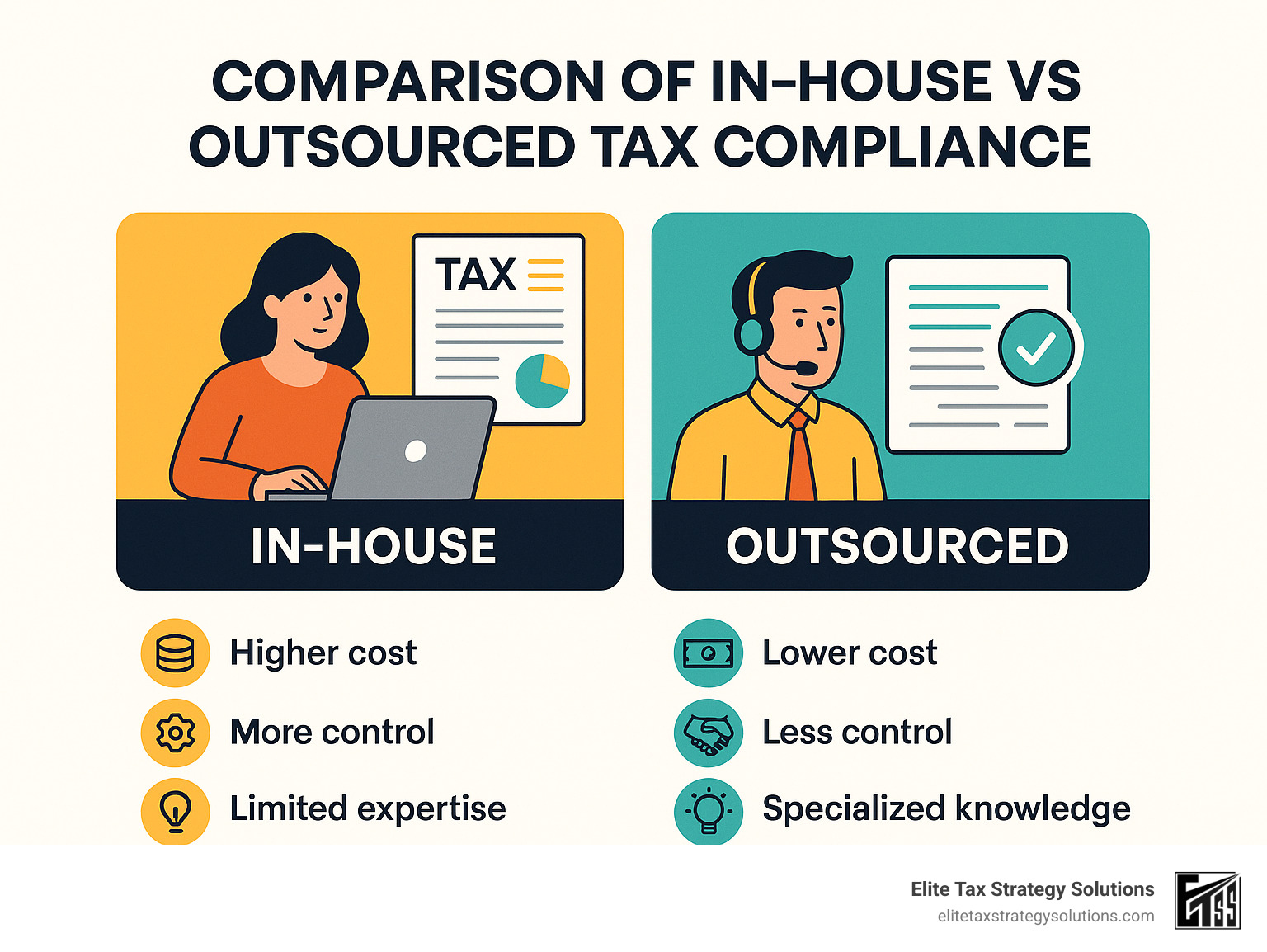
In my experience, your ideal approach depends on several key factors:
Business Size and Complexity makes a huge difference. I’ve seen startups and small businesses thrive when they outsource their monthly tax compliance, freeing up precious time to focus on growth. Mid-sized companies often benefit from a hybrid approach – keeping strategic oversight in-house while outsourcing the heavy lifting. Larger enterprises typically develop specialized internal teams, though even they often outsource specific complex areas.
Growth Trajectory matters too. If you’re scaling rapidly (I’ve worked with businesses that doubled in size within months), outsourcing provides the flexibility to adapt without constant hiring and training cycles. More stable businesses might find investing in in-house capabilities pays off over time.
Your Geographic Footprint can tip the scales. When a Jasper client expanded into three additional states last year, the complexity of multi-state compliance quickly overwhelmed their bookkeeper. Specialized expertise became essential, making outsourcing the clear winner.
Industry-Specific Requirements play a role too. Clients in highly regulated industries like healthcare or financial services often benefit from dedicated internal compliance staff who deeply understand their unique regulatory environment.
For more real-world insights on outsourcing options, check out our guide on Outsourcing Sales Tax Compliance.
Choosing the Right Compliance Partner
If you decide to outsource your monthly tax compliance, finding the right partner isn’t just about price – it’s about finding a relationship that works. Here’s what I advise my clients to look for:
Service Level Agreements (SLAs) form the foundation of a good partnership. Look for clearly defined turnaround times that align with your filing deadlines. Ask about their escalation procedures – what happens when something urgent comes up? Regular service review meetings help keep everything on track and allow for adjustments as your business evolves.
Data Security is non-negotiable. Your tax data is sensitive gold. Ask potential partners about their SOC 1/SOC 2 certification and encryption standards. How do they screen their staff? What happens if there’s a breach? One client told me they chose their provider specifically because of their impressive security protocols, and they’ve never regretted prioritizing this aspect.
Industry Expertise makes all the difference. A partner who already works with businesses in your specific sector brings valuable shortcuts and insights. They’ll understand the unique tax treatments that apply to your industry and business model. Always ask for references from similar clients – a good provider will be happy to share their success stories.
Technology Stack Compatibility might sound technical, but it’s really about smooth daily operations. Can they integrate with your accounting systems? Is their client portal intuitive and useful? Can you get the reports you need? One client saved hours each month simply because their tax partner’s system could automatically import their sales data.
At Elite Tax Strategy Solutions, we specialize in serving high earners and closely held businesses in Jasper, Indiana and suburban areas near major cities, focusing on maximizing tax savings while ensuring complete compliance.
Transition Checklist for Smooth Migration
Whether you’re moving from in-house to outsourced compliance or switching providers, a smooth transition prevents headaches and missed deadlines. Here’s my practical checklist based on dozens of successful transitions:
For Data Handover, be thorough but focused. Compile at least three years of historical returns – this gives your new partner context about your tax history. Provide access to your accounting systems or establish a regular export schedule. Document any special tax treatments or elections you’ve made in the past. And don’t forget to share any ongoing correspondence with tax authorities.
I strongly recommend a Parallel Run period. For 1-2 months, operate both old and new systems simultaneously. This might feel like extra work, but it’s insurance against problems. Compare the outputs, document any discrepancies, and resolve differences before fully cutting over. One client who skipped this step ended up with a missed filing that cost them thousands in penalties.
KPI Tracking helps you confirm you’ve made the right decision. Establish baseline metrics before transition (time spent, error rates, costs), then monitor the same metrics after implementation. Most clients see improvements within 3-6 months, with the full benefits apparent after a year.
A well-executed transition typically takes 60-90 days. Always build in some contingency time for unexpected challenges – tax authorities don’t accept “we were switching providers” as an excuse for missed deadlines!
Frequently Asked Questions about Monthly Tax Compliance
What happens if I miss a single monthly deadline?
We’ve all been there – that sinking feeling when you realize a monthly tax compliance deadline has slipped by. Don’t panic! Here’s what typically happens:
First, you’ll likely face some financial consequences. This usually includes late filing penalties (about 1-2% of the tax due each month) or a fixed daily amount, whichever hits harder. Interest charges will start accumulating from the original due date until you pay up, typically at rates between 12-18% annually.
Beyond the immediate financial hit, your compliance rating with tax authorities may take a dent. Many tax departments maintain these ratings behind the scenes, and they directly influence how often you get selected for audits. You’ll also receive automated notices requiring your response and explanation.
The good news? If this is your first slip-up or you have a legitimate reason, there’s hope. Many tax jurisdictions offer first-time abatement programs, reasonable cause waivers, or voluntary disclosure opportunities that can help reduce or eliminate penalties.
If you’ve missed a deadline, your best course of action is to file immediately, pay all tax and interest due, submit a penalty abatement request with solid documentation explaining your reasonable cause, and most importantly, put safeguards in place to prevent future misses.
The occasional mistake happens to everyone – it’s the pattern of compliance that matters most to tax authorities.
How do compliance requirements differ for startups vs enterprises?
The monthly tax compliance journey looks dramatically different depending on where your business sits on its growth path.
For startups, there’s often a bit more breathing room. You’ll likely qualify for simplified compliance regimes and may have higher thresholds before monthly filing becomes mandatory. Many jurisdictions offer composition schemes with reduced compliance burdens specifically designed for new and small businesses.
The biggest challenge for startups isn’t usually the complexity of requirements but the resource constraints. When you’re wearing multiple hats already, tax compliance often relies on founder knowledge or outsourced support. Most startups use basic tools rather than specialized software, which works fine at lower volumes.
The tricky part comes with growth. You’ll need to carefully monitor when you cross thresholds that trigger new obligations. I’ve seen many growing businesses caught off-guard when their compliance requirements suddenly increase with expansion into new markets or crossing revenue thresholds.
For established enterprises, it’s a different world. You’re subject to comprehensive requirements across all tax types, often with industry-specific additional compliance needs, and face greater scrutiny from tax authorities who know larger businesses have more resources to comply.
Enterprises typically maintain dedicated tax departments, implement specialized compliance software, and develop formalized internal controls with multiple review layers. They also deal with added complexity from multiple business units with varying tax treatments, cross-border operations, and the compliance inheritance that comes with mergers and acquisitions.
The transition point from startup to enterprise compliance typically happens around $5-10 million in annual revenue, when the complexity and risk justify dedicated resources.
Can automation replace human oversight in monthly tax compliance?
As someone who’s watched tax technology evolve over decades, I can tell you that while automation has revolutionized monthly tax compliance, the human element remains irreplaceable.
Some things technology just can’t handle well: interpreting ambiguous tax laws, applying relevant case law to your specific situation, making materiality judgments, or evaluating whether documentation truly meets legal requirements. These all require human judgment developed through years of experience.
Where technology truly shines is in handling the routine, repetitive aspects of compliance. It excels at data extraction and change, ensures calculation accuracy, reliably tracks deadlines and sends notifications, and provides organized document storage and retrieval.
The sweet spot is a thoughtful hybrid approach. Automate the routine, rule-based tasks that computers do better than humans. Use AI for pattern recognition and to flag anomalies that might indicate problems. Reserve your human expertise for review, interpretation, and strategy. Build workflows that escalate exceptions to the right people at the right time.
In our experience, the most effective compliance systems automate about 70-80% of the process while maintaining human oversight for critical decision points and final review.
Will this change in the future? Certainly – automation capabilities improve constantly. But tax laws remain among the most complex, frequently-changing regulations in existence, and they’re written in language that requires human interpretation. For the foreseeable future, the most successful businesses will combine powerful technology with seasoned human judgment.
At Elite Tax Strategy Solutions, we help our clients find that perfect balance between automation efficiency and expert oversight for their monthly tax compliance needs. For more information about comprehensive support, check out our tax support & compliance services.
Conclusion
Let’s face it – monthly tax compliance can feel like a never-ending marathon. But here’s the good news: with thoughtful systems, the right tools, and proper support, it transforms from a monthly headache into a smooth, routine part of running your business.
When you implement the strategies we’ve covered, something interesting happens. Compliance shifts from being a source of stress to becoming a process that actually delivers valuable insights about your business operations and financial health. Many of our clients report that their monthly compliance routine now helps them spot trends and opportunities they previously missed.
Here’s what I’ve seen work best for businesses in my 40+ years of experience:
First, be proactive, not reactive. Create that comprehensive tax calendar we discussed and set your reminders at least a week before deadlines. The peace of mind from knowing what’s coming is worth the setup time.
Second, leverage technology wisely. You don’t need to invest in every fancy tool, but the right automation solutions can dramatically reduce both manual work and those costly human errors. Our clients who implement even basic automation typically cut their compliance time by 30-40%.
Third, document everything carefully. When tax authorities come knocking (and eventually, they will), clear records of all filings, payments, and supporting documentation will be your best defense. Think of good documentation as insurance for your business.
Fourth, consider whether outsourcing makes sense for you. For many businesses, especially those in growth phases, professional compliance support delivers remarkable ROI through both time savings and risk reduction. The question isn’t whether you can afford to outsource – it’s whether you can afford not to.
Finally, stay informed about changing regulations. Tax laws evolve constantly, and your compliance processes need to adapt accordingly. What worked perfectly last year might need adjustment this year.
At Elite Tax Strategy Solutions, we understand the challenges of monthly tax compliance, especially for high earners and closely held businesses. Our approach goes beyond just meeting deadlines – we help you turn compliance into a strategic advantage that supports your overall financial goals.
Whether you’re running a business in Jasper, Indiana, or in suburban areas near major cities, we’re here to help transform tax compliance from a burden into an asset for your business.
Ready to simplify your monthly tax compliance and say goodbye to deadline stress? Visit our tax support & compliance page to learn how we can help, or reach out today for a personalized consultation.