
Why Capital Gains Tax Planning Can Save You Thousands
Capital gains tax planning is essential for keeping more of your investment profits. Without it, you could pay up to 23.8% in federal taxes on your gains, plus state taxes.
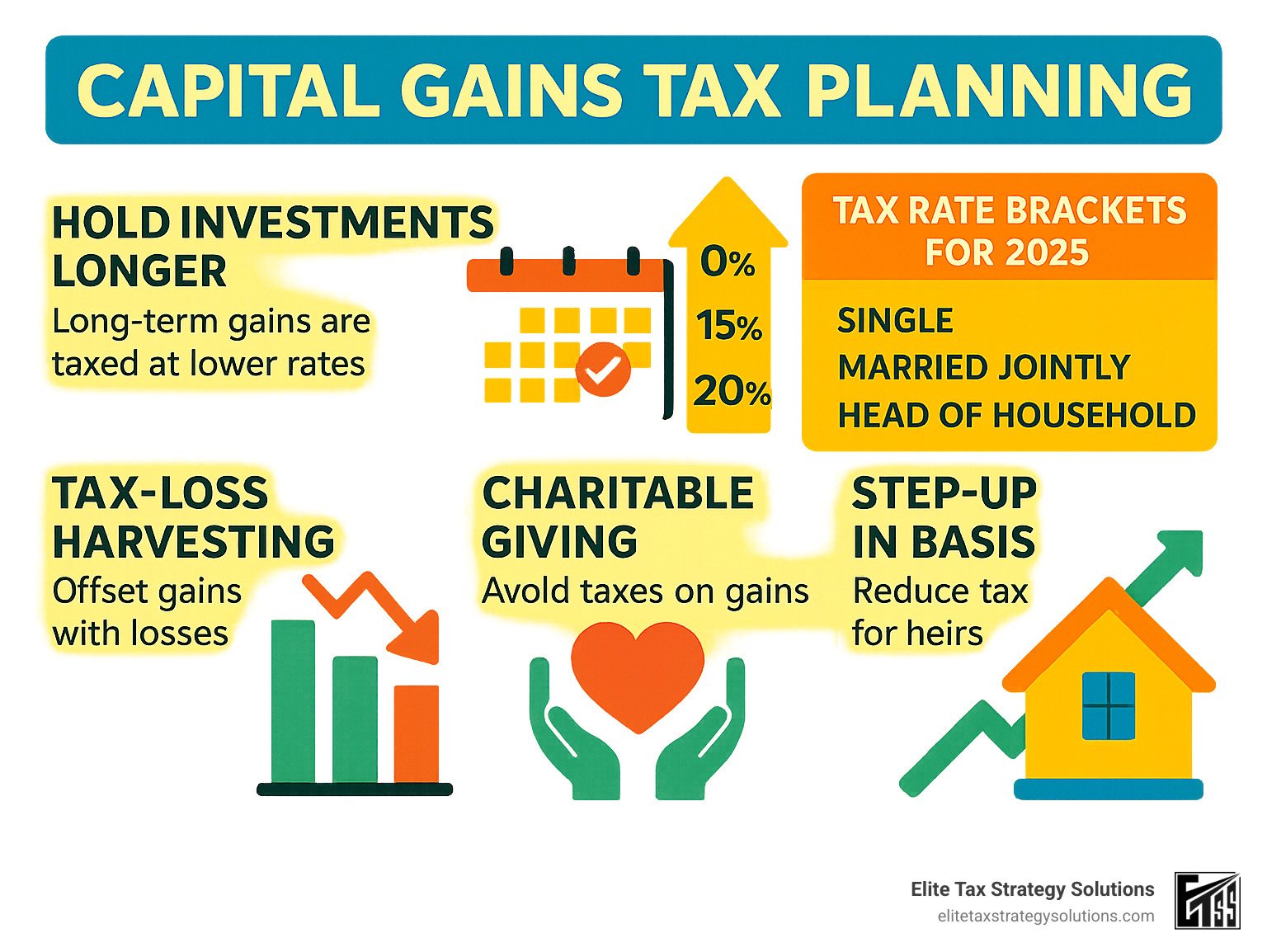
Key strategies to minimize capital gains taxes include:
- Holding investments for over one year to get lower long-term rates (0%, 15%, or 20%).
- Using tax-loss harvesting to offset gains with losses.
- Timing sales strategically to stay in lower tax brackets.
- Donating appreciated assets to charity to avoid taxes on gains.
- Using tax-advantaged accounts like 401(k)s and IRAs.
- Planning for the step-up in basis for heirs by holding assets until death.
The difference is significant. For example, selling a stock one day too early could cost you an extra $9,320 in taxes on a $56,000 gain—a 46% difference between short-term and long-term rates.
Crucially, capital gains “stack” on top of your regular income. This means a small increase in ordinary income can push your capital gains into a higher tax bracket, significantly increasing your tax liability.
I’m David Fritch, and with 40 years of experience as a CPA and attorney, I’ve helped clients save thousands through strategic capital gains tax planning. My firm specializes in advanced tax strategies for high-income earners, and I know how proper planning can dramatically reduce your tax burden.
Basic capital gains tax planning terms:
Understanding the Fundamentals of Capital Gains Tax
When you sell a capital asset—like stocks, real estate, or cryptocurrency—for more than you paid, you have a capital gain. The IRS only taxes realized gains, meaning the profit is taxed only when you sell the asset. An unrealized gain on an asset you still hold is not taxed.
Your cost basis is what you originally paid for the asset, plus adjustments. Your capital gain is the selling price minus your cost basis.
The holding period—how long you owned the asset—is crucial for capital gains tax planning. It determines whether you pay higher ordinary income tax rates or lower long-term capital gains rates. For complete details, the IRS has a guide on capital gains tax explained by the IRS.
How the Holding Period Impacts Your Tax Bill
The one-year rule is central to capital gains tax planning. Hold an asset for one year or less, and your profit is a short-term capital gain, taxed at your ordinary income tax rates (up to 37% federally).
Hold that asset for more than one year, and it becomes a long-term capital gain, which qualifies for preferential tax rates of 0%, 15%, or 20%, depending on your income.
Calculating your holding period starts the day after you acquire the asset and ends on the day you sell it. This is why day trading is so tax-inefficient, as profits are almost always short-term. A buy-and-hold strategy is generally more tax-efficient. The difference is significant: a $50,000 gain could result in an $18,500 short-term tax bill versus just $7,500 in long-term tax. For more strategies, see our guide on tax efficient investments.
The Importance of Cost Basis and Record-Keeping
An accurate cost basis is critical for minimizing your tax. Your basis starts with the purchase price but can be increased by improvements and other qualifying expenses. For example, a $50,000 renovation on a $200,000 rental property creates an adjusted basis of $250,000, reducing your future taxable gain by $50,000.
Inherited assets receive a “step-up in basis” to their fair market value on the date of the original owner’s death, which can eliminate the capital gains tax on all prior appreciation.
Gifted assets, however, typically retain the giver’s original cost basis, meaning you also inherit their potential tax liability.
Stock splits and dividend reinvestment also affect your basis. Reinvested dividends increase your basis, while splits spread it across more shares.
Accurate records are essential. Without proof of purchase dates, prices, and adjustments, you may overpay your taxes. The IRS provides guidance in its publication on investment income and expenses.
2025 Long-Term Capital Gains Tax Rates
Understanding the 2025 long-term capital gains tax rates is crucial for planning. These rates are much lower than ordinary income tax rates, which can be as high as 37%.

The federal government has three main rates for long-term capital gains: 0%, 15%, and 20%. Your rate depends on your taxable income and filing status. The IRS adjusts these income brackets annually for inflation adjustments.
Here are the 2025 brackets:
| Tax Rate | Single Filers (Taxable Income) | Married Filing Jointly (Taxable Income) | Married Filing Separately (Taxable Income) | Head of Household (Taxable Income) |
|---|---|---|---|---|
| 0% | Up to $47,025 | Up to $94,050 | Up to $47,025 | Up to $63,000 |
| 15% | $47,026 to $518,900 | $94,051 to $583,750 | $47,026 to $291,850 | $63,001 to $551,350 |
| 20% | Over $518,901 | Over $583,751 | Over $291,851 | Over $551,351 |
Note: These rates apply to most long-term capital gains. Collectibles are taxed at a maximum of 28%, and unrecaptured Section 1250 gain from real property is taxed at a maximum of 25%.
The 0% bracket allows retirees and those with lower income to potentially pay no federal capital gains tax.
How Capital Gains Stack on Top of Ordinary Income
Your capital gains don’t exist in a vacuum; they stack on top of your ordinary income (salary, business profits, etc.). Your total taxable income is calculated after subtracting the standard deduction or itemized deductions from your Adjusted Gross Income (AGI).
This stacking effect makes tax bracket management critical. For example, a single filer with $40,000 in ordinary income is in the 0% capital gains bracket. If their salary jumps to $50,000, all their capital gains will be taxed at 15%. Understanding your AGI is the cornerstone of our Tax Planning Strategies. You can learn more from the IRS about Understanding your adjusted gross income.
The Net Investment Income Tax (NIIT)
The Net Investment Income Tax is a 3.8% surtax that applies to high-income earners on their investment income.
The NIIT applies when your Modified Adjusted Gross Income (MAGI) exceeds certain NIIT thresholds: $200,000 for single filers, $250,000 for married couples filing jointly, or $125,000 for married filing separately.
These thresholds are not indexed for inflation, meaning more taxpayers are affected over time. If the NIIT applies, your top capital gains rate becomes 23.8% (20% + 3.8%). This jump requires careful planning, which we cover in our services for Tax Planning for High Income Earners.
Core Strategies for Effective Capital Gains Tax Planning
With the fundamentals covered, let’s explore powerful strategies to minimize your capital gains tax. Effective planning is proactive, involving strategic selling and portfolio rebalancing throughout the year.

These techniques can save thousands for any investor with appreciated assets. The key is knowing when and how to implement them. For those ready to take their planning to the next level, our Advanced Tax Strategies can provide more sophisticated approaches.
Strategy 1: Tax-Loss Harvesting to Offset Gains
Tax-loss harvesting turns investment losses into a tax advantage. By selling losing investments, you can realize a loss to offset your capital gains. For example, an $8,000 loss can reduce a $15,000 gain, leaving only $7,000 subject to tax.
If your losses exceed your gains, you can deduct up to $3,000 of the excess against your ordinary income annually. Any additional losses can be carried forward to future years through loss carryforward.
You must adhere to the wash-sale rule: you cannot claim a loss if you buy the same or a “substantially identical” security within 30 days before or after the sale. For a complete guide, see our article on Tax-Loss Harvesting Explained.
Strategy 2: Tax-Gain Harvesting in Low-Income Years
Tax-gain harvesting is an underused strategy that involves selling appreciated assets while you are in the 0% capital gains bracket to realize gains tax-free. This is ideal during low-income years, such as early retirement or career transitions.
By selling and immediately repurchasing the asset, you reset your cost basis to the new, higher price. This reduces the taxable gain on a future sale. For example, if you sell a stock with a $5,000 gain in the 0% bracket and repurchase it, your new basis is $5,000 higher, saving you tax on that amount in the future.
Unlike with losses, there is no wash-sale rule on gains, so you can sell and repurchase immediately. Learn more about implementing Tax-Gain Harvesting Strategies effectively.
Strategy 3: Using Tax-Advantaged Accounts
The simplest strategy is often to use tax-advantaged accounts like 401(k)s, IRAs, HSAs, and 529 plans. These accounts shield your investments from annual capital gains taxes.
Within these accounts, you can buy and sell assets without creating taxable events. They offer either tax-deferred growth (Traditional) or tax-free growth (Roth). Health Savings Accounts (HSAs) are triple tax-advantaged: contributions are deductible, growth is tax-free, and withdrawals for medical expenses are tax-free.
The choice between Roth vs. Traditional accounts depends on whether you expect your tax rate to be higher now or in retirement. 529 plans offer similar tax-free growth for qualified education expenses. Maximizing contributions to these accounts before investing in taxable accounts is a foundational strategy. Explore our Tax-Advantaged Accounts Guide for more details.
Advanced Capital Gains and Estate Planning Strategies
For building generational wealth, advanced capital gains tax planning is essential. It involves creating a comprehensive strategy to protect assets and ensure a smooth intergenerational wealth transfer.

These sophisticated approaches require careful coordination with your estate plan and are powerful legacy-building tools. For comprehensive guidance, explore our Tax Efficient Estate Planning services.
Strategy 4: The ‘Step-Up in Basis’ at Death
The step-up in basis is one of the most powerful estate planning tools. When an heir inherits an asset, its cost basis is “stepped up” to the fair market value at the date of the original owner’s death, potentially eliminating decades of taxable gains.
For example, if you inherit stock worth $500,000 that was originally purchased for $1,000, your new basis is $500,000. If you sell it immediately, you owe zero capital gains tax.
Proper estate planning integration is crucial. A common mistake is avoiding joint tenancy with children on highly appreciated assets, as this can inadvertently eliminate half of the step-up benefit. The gifted portion retains the original low basis, creating a future tax liability.
Strategy 5: Donating Appreciated Assets to Charity
If you are charitably inclined, consider donating appreciated assets (held more than one year) instead of cash. When you donate the asset directly, you avoid capital gains tax on the appreciation. The charity, being tax-exempt, can sell it tax-free, and you can claim a fair market value deduction for its full current value.
This is a win-win: you avoid tax and receive a full deduction. For example, donating a stock worth $50,000 (with a $10,000 cost basis) allows you to avoid tax on the $40,000 gain and claim a $50,000 deduction.
Donor-advised funds offer flexibility, allowing you to contribute assets now and recommend grants later. For those over 70½, Qualified Charitable Distributions (QCDs) allow up to $105,000 to be sent directly from an IRA to charity, satisfying RMDs without being counted as taxable income. Learn more about Ways to Give to Charity.
Strategy 6: Using Trusts for Advanced Capital Gains Tax Planning
Trusts are powerful tools for advanced capital gains tax planning. Grantor trusts allow for asset swapping, where you can exchange low-basis assets in the trust for high-basis assets you own personally. This pulls appreciated assets back into your estate to receive a step-up in basis at death, eliminating the capital gains tax for beneficiaries.
Charitable Remainder Trusts (CRTs) are ideal for supporting a charity while creating an income stream. You transfer appreciated assets to the CRT, which sells them tax-free. The trust then pays you an income for a set term, with the remainder going to charity. A CRT converts a highly appreciated asset into retirement income without a large, immediate tax bill. Find more sophisticated approaches in our guide to Charitable Trust Strategies.
Special Considerations for Property and State Taxes
Real estate brings unique rules to capital gains tax planning. Understanding them, for both a primary residence and investment properties, can save you thousands. Your state of residence at the time of sale can also dramatically impact your final tax bill.

The intersection of federal, state, and property-specific rules creates opportunities that require smart planning. For real estate investors, this is especially critical. Our specialized Tax Planning for Real Estate Investors services address these complex scenarios.
Selling Your Primary Residence
The home sale exclusion is a major tax benefit. If you meet the ownership and use tests—living in the home as your primary residence for at least two of the last five years—you can exclude a large portion of your profit from tax.
The exclusion is $250,000 for single filers and $500,000 for married couples filing jointly. You could make a half-million-dollar profit on your home and owe zero federal capital gains tax.
If your gain exceeds these limits, you can reduce it by increasing your cost basis with home improvements. Major projects like additions, remodels, or new systems can be added to your original purchase price, reducing your taxable gain. Regular maintenance does not count.
Record-keeping for improvements is critical. Keep all receipts and invoices to document your increased basis. A military exemption may extend the five-year test period for servicemembers on qualified extended active duty. For complete details, see the IRS guide on Selling Your Home.
How State Taxes Impact Your Bottom Line
Your state of residence can add significantly to your tax burden, as state tax treatment of capital gains varies widely. Nine states have no income tax and thus no capital gains tax: Alaska, Florida, Nevada, New Hampshire, South Dakota, Tennessee, Texas, Washington, and Wyoming.
In contrast, high-tax states like California can push your combined federal and state long-term capital gains rate over 30%. This creates an opportunity for relocation timing. Moving to a low- or no-tax state before selling a major asset can lead to substantial savings.
However, you must properly establish domicile in the new state, which involves more than just owning property. It requires changing your voter registration, driver’s license, and bank accounts, and proving your intent to reside there permanently. State tax authorities are strict about these rules, so professional advice is recommended for large transactions.
Frequently Asked Questions about Capital Gains Tax Planning
Here are answers to the most common questions about capital gains tax planning.
What is the difference between short-term and long-term capital gains?
A capital gain is long-term if you hold an asset for more than one year, qualifying it for lower tax rates (0%, 15%, or 20%). A short-term gain, from an asset held for one year or less, is taxed at your higher ordinary income tax rate.
Can I use capital losses to reduce my taxes?
Yes. Capital losses first offset capital gains. If your losses exceed your gains, you can deduct up to $3,000 of the excess loss against your ordinary income annually. Any remaining losses can be carried forward to future years to offset future gains. Be mindful of the wash-sale rule, which disallows a loss if you repurchase a substantially identical security within 30 days of the sale.
How can I avoid capital gains tax when I sell my house?
Yes, through the home sale exclusion. If you have owned and used your home as your primary residence for at least two of the last five years, you can exclude up to $250,000 (for single filers) or $500,000 (for married couples) of the gain from tax. You can further reduce any taxable gain by adding the cost of major home improvements to your home’s original cost basis.
Conclusion
Effective capital gains tax planning requires proactive management. From understanding long-term vs. short-term gains to using advanced strategies like trusts and the step-up in basis, the key is making strategic decisions throughout the year, not just at tax time.
Smart planning can save you thousands. It’s about creating a personalized strategy that aligns with your income, timeline, and financial goals. Your long-term financial health depends on keeping more of what you earn. Every strategy we’ve discussed—from tax-loss harvesting to using tax-advantaged accounts—can put real money back in your pocket.
At Elite Tax Strategy Solutions, we’ve seen how proper capital gains tax planning transforms financial futures. We specialize in creating comprehensive strategies for high earners and business owners to maximize tax savings while ensuring compliance.
The money you save on taxes today can be invested to grow, compounding your wealth over time. A comprehensive financial plan that integrates smart capital gains strategies is the foundation for achieving your goals.
Ready to see how much you could be saving? Start your comprehensive financial planning today and let’s create a strategy that’s custom-built for you.