Why S-Corp Tax Planning is Critical for Business Success
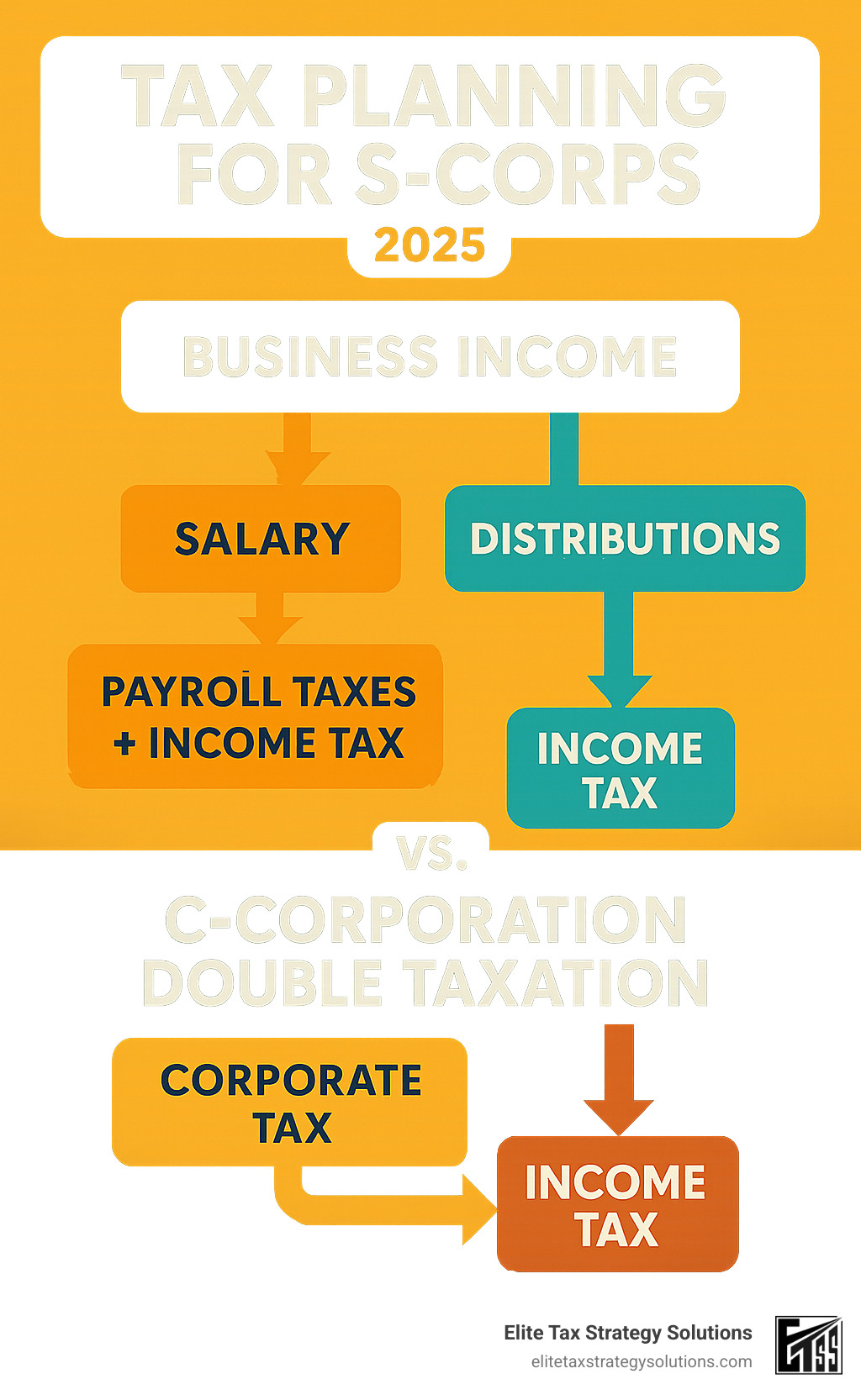
Tax planning for S-corps is essential for the five million-plus small businesses operating under this structure. S-corporations offer a unique opportunity to avoid the double taxation that hits C-corporations while providing substantial self-employment tax relief through a strategic split between salary and distributions.
Key S-Corp Tax Planning Benefits:
- Self-employment tax savings: Avoid the 15.3% FICA tax on distributions.
- Pass-through taxation: Profits are taxed once at the personal level.
- Qualified Business Income deduction: Potential for a 20% deduction under Section 199A.
- Flexible income character: Split income between wages and distributions.
- Business loss deductions: Losses can offset other personal income.
The savings can be significant. A business owner earning $100,000 can save thousands annually in payroll taxes by splitting income between wages and distributions. However, the IRS requires “reasonable compensation,” and getting this wrong can trigger audits and penalties.
This guide reveals 10 proven strategies that successful S-corp owners use to legally minimize their tax burden while staying compliant. From mastering the salary-distribution balance to leveraging advanced techniques, these tactics can transform your tax situation.
I’m David Fritch, and with 40 years of experience helping small business owners optimize their tax strategies through my CPA practice and Elite Tax Strategy Solutions, I’ve seen how proper tax planning for S-corps can save thousands. My focus is helping business owners grow their profits while working less, and smart S-corp tax planning is a powerful tool in that toolkit.
Easy Tax planning for S-corps word list:
The S-Corp Foundation: Understanding Your Tax Landscape
At Elite Tax Strategy Solutions, we call S-corporations the “best of both worlds” because they provide the legal protection of a corporation with the tax perks of a partnership. An S-corp is a corporation that elects a special tax status with the IRS.
The core concept is “pass-through taxation.” Unlike a C-corporation, which faces double taxation (at the corporate and shareholder levels), an S-corp’s income, losses, deductions, and credits flow directly to the owners’ personal tax returns. The business itself usually pays no federal income tax. Instead, shareholders report their share of the profits and losses on their personal tax forms (Form 1040, Schedule K-1) and pay tax at their individual rates.
A critical point for S-corp owners who work in the business is the IRS requirement to pay yourself a “reasonable salary.” This salary is subject to FICA taxes (15.3% for Social Security and Medicare).
The exciting part is that any additional profits taken as distributions are generally free from these FICA taxes. This is the cornerstone of Tax planning for S-corps and can lead to substantial savings.
To establish an S-corp, the corporation must file IRS Form 2553, Election by a Small Business Corporation, signed by all shareholders. Annually, the S-corp files IRS Form 1120-S, U.S. Income Tax Return for an S Corporation. For a deeper dive into our approach, explore our insights on Business Tax Planning.
What are the Primary Tax Advantages of an S-Corp?
The S-corp structure can significantly reduce your total tax bill, especially self-employment tax.
-
Self-Employment Tax Relief: Unlike sole proprietors, where all profits are subject to the 15.3% self-employment tax, only the “reasonable salary” in an S-corp is. The remaining profits, taken as distributions, are not. This single strategy can save thousands. For example, on a $100,000 profit with a $60,000 salary, you save 15.3% on the $40,000 distribution—a $6,120 tax saving.
-
Pass-Through of Losses: If your S-corp has a loss, it can flow through to your personal tax return, potentially lowering your overall taxable income from other sources. This is especially beneficial for new businesses.
-
Qualified Business Income (QBI) Deduction Eligibility: Under Section 199A, many S-corp owners can deduct up to 20% of their qualified business income on their personal tax return, significantly cutting their income tax bill.
-
Flexible Character of Income: The ability to split income between a W-2 salary and FICA-tax-free distributions provides incredible flexibility for strategic Tax planning for S-corps.
Core Strategies for Immediate Tax Reduction

At Elite Tax Strategy Solutions, we believe smart tax planning for S-corps is proactive. It’s about actively working to lower your taxes from the start. These foundational strategies are key to effective Small Business Tax Saving Strategies.
Strategy 1: Master Your Salary and Distributions for Optimal Tax Planning for S-Corps
This is your most impactful tool. The IRS requires S-corp owners who work in their business to be paid “reasonable compensation.” Only this salary is subject to FICA taxes (Social Security and Medicare). Any additional profit taken as a distribution is generally free from these payroll taxes.
Our goal is to find the optimal salary amount. Too low, and the IRS may reclassify distributions as wages, leading to back taxes and penalties. Too high, and you overpay FICA taxes. While some use a 60/40 rule (60% salary, 40% distribution), “reasonable compensation” truly depends on your industry, location, experience, and role.
The IRS provides guidance on reasonable compensation and explains more about paying yourself as an S-Corp owner. We analyze industry data and your specific role to set a salary that is defensible and maximizes your payroll tax savings.
Strategy 2: Maximize Your Deductions on Common Business Expenses
Every dollar spent on “ordinary and necessary” business expenses lowers your taxable income. This includes:
- Vehicle Expenses: Track miles for business use of your car. For 2024, you can deduct a large portion of the cost of qualified vehicles. Heavy vehicles (over 6,000 pounds) may qualify for larger Section 179 deductions.
- Business Travel: Deduct costs for meetings, conferences, or client visits. Business meals are typically 50% deductible.
- Marketing Costs: Expenses for ads, your website, and other promotions are fully deductible.
- Professional Fees: Payments to lawyers, accountants, and tax professionals are a deductible investment in your financial health.
- Health Insurance Premiums: If structured correctly, S-corp-paid health insurance can be a valuable deduction.
For a full look at what you can deduct, check out our insights on Business Deductions and Tax Strategies for Small Business Owners.
Strategy 3: Open up Savings with the Home Office Deduction
If you run your S-corp from home, the home office deduction could save you money by allowing you to write off a portion of your home expenses. To qualify, your office must meet two IRS tests:
- Exclusive Use Test: The space must be used only for business.
- Regular Use Test: You must use the space regularly for your business.
If you qualify, you can deduct a percentage of home expenses like rent, mortgage interest, utilities, and insurance, based on the office’s square footage. The IRS has clear guidance on deducting a corresponding percentage of expenses. You can use the Simplified Method ($5 per square foot, up to $1,500) or the Actual Expense Method, which requires detailed record-keeping but may yield a larger deduction. Accurate records are essential, as poor documentation is the top reason for rejection.
Advanced Tax Planning for S-Corps: Beyond the Basics

Once you’ve mastered the basics, it’s time to lift your strategy. These advanced tax planning for S-corps techniques go beyond simple deductions to build long-term wealth. This is what we at Elite Tax Strategy Solutions call Advanced Tax Planning.
Strategy 4: Keep it in the Family: Tax Benefits of Hiring Relatives
Hiring your children or spouse can create significant tax benefits. The wages you pay them are a business expense, reducing your S-corp’s taxable income. For 2024, each child can earn a substantial amount (around $12,000) without paying federal income tax, effectively shifting income from your high tax bracket to their zero-tax bracket.
If your child is under 18 and your S-corp is wholly owned by you and your spouse, their wages may also be exempt from FICA taxes. Their earnings can then be contributed to a Roth IRA, building tax-free wealth for their future. The key is that the work must be legitimate and the pay reasonable for the services provided. You can also often provide untaxed fringe benefits to family employees.
Strategy 5: Build Wealth with Retirement Plans and Fringe Benefits
Retirement plans are a powerful way for your S-corp to build wealth and cut taxes. As a shareholder-employee, you can make substantial, tax-deductible contributions.
A SEP-IRA is a simple option, allowing you to contribute up to 25% of your W-2 wages, up to an annual limit. For single-owner S-corps, a Solo 401(k) offers even more flexibility. You contribute as both an employee (up to $23,000 for 2024, or $30,000 if 50 or older) and an employer (up to 25% of W-2 wages), with a combined total of up to $69,000 for 2024. These contributions dramatically reduce your taxable income. For high earners, Defined Benefit Plans can allow for even larger contributions.
Beyond retirement, your S-corp can pay for your health insurance premiums if you own more than 2% of the company. When included in your W-2, you can deduct them on your personal return, saving on income taxes. An “accountable plan” for employee reimbursements also ensures they are tax-free to you and deductible for the business.
Strategy 6: Steer State Laws with Smart Tax Planning for S-Corps
State tax laws, particularly the federal $10,000 State and Local Tax (SALT) cap, can be a challenge. However, smart tax planning for S-corps offers a solution. Many states have introduced a Pass-Through Entity Tax (PTET) as a workaround. Currently, 33 states offer this option.
Your S-corp can elect to pay state income tax at the entity level. This payment is then a deductible business expense on your federal return, effectively bypassing the personal $10,000 SALT cap. This allows a full federal deduction for your state income taxes, which can save you thousands. Navigating these state-specific laws is complex, so professional guidance is recommended. You can also look into the best states for S corps for general insights.
Strategy 7: Claim Powerful Tax Credits and the QBI Deduction
Tax credits are more valuable than deductions because they reduce your tax bill dollar-for-dollar.
The Qualified Business Income (QBI) Deduction (Section 199A) allows eligible S-corp owners to deduct up to 20% of their qualified business income on their personal return. For higher-income owners, the deduction is often limited by W-2 wages paid, highlighting the importance of setting an optimal salary.
The Research & Development (R&D) Tax Credit isn’t just for labs. Businesses developing new products, improving processes, or refining techniques may qualify. It’s a direct reduction in your tax bill that many businesses overlook. You can learn more about qualified research expenses.
Other Business Credits are available for activities like hiring certain employees or starting a retirement plan. For example, The Retirement Plan Startup Costs Tax Credit helps offset the costs of setting up a new plan.
Elite-Level Strategies for Maximum Savings

These are the strategies that set apart proactive S-corp owners. They require careful planning and more complex structures, but the rewards can be substantial. This is where we apply our expertise in Corporate Tax Strategy.
Strategy 8: Turn Your Property into a Tax Advantage with Self-Rental Rules
You can rent your personal property (like a building or equipment) to your S-corp to create a tax advantage. The rent paid by your S-corp is a deductible business expense, reducing its taxable income.
On your personal return, this rental income is reported. However, if the property generates a tax loss (due to depreciation, etc.), the self-rental rules may allow you to use that passive loss to offset your active business income from the S-corp. This requires careful structuring and a “grouping election” with the IRS. The IRS scrutinizes these arrangements, so a formal lease and proper documentation are critical. A case like Jadhav v. Commissioner highlights the importance of documentation.
Additionally, the “Augusta Rule” allows you to rent your home to your S-corp for up to 14 days per year for business meetings. The S-corp deducts the rent, and you receive it tax-free. Again, meticulous records are essential.
Strategy 9: Structure for Success by Owning Partnership Interests
This is a sophisticated strategy for S-corp owners with interests in partnerships. Typically, income from a partnership flows to your personal return and is subject to self-employment tax.
However, if your S-corp owns the partnership interest instead of you personally, the income flowing to the S-corp can then be paid out as a distribution, which is not subject to self-employment tax. This converts what would have been self-employment income into FICA-tax-free distributions, saving you 15.3% on that income. This requires careful planning to ensure compliance.
Strategy 10: Legally Deduct Your “Hobby” by Integrating it into Your Business
Do you have a passion project you worry might be classified as a hobby by the IRS? The “hobby loss” rules (Section 183) prevent taxpayers from deducting losses from activities not genuinely engaged in for profit.
With careful tax planning for S-corps, you may be able to integrate a “hobby” into your S-corporation, allowing you to legally deduct its expenses. The key is to demonstrate a clear profit motive and operate the activity in a business-like manner. This involves keeping separate books, having a business plan, and showing efforts to improve profitability. By strategically integrating the activity and maintaining meticulous documentation, you can strengthen your claim that it’s a legitimate business endeavor. You can learn more about aggregating activities to avoid the hobby loss rules.
Frequently Asked Questions about S-Corp Tax Planning
After helping thousands of S-corp owners, I’ve noticed the same questions come up repeatedly. These are the real-world concerns you should be asking about tax planning for S-corps.
How do I determine a “reasonable salary” for myself?
This is a critical question, as getting it wrong can lead to penalties. The IRS defines “reasonable compensation” as what you’d pay someone else for the same job. There’s no magic formula, but we determine a defensible salary by analyzing several factors:
- Industry Standards: We use compensation data to see what other professionals in your field are earning.
- Job Responsibilities: The more roles you fill (CEO, salesperson, bookkeeper), the higher your compensation should be. We document every role to justify the salary.
- Company Performance: A highly profitable company should pay its key drivers a salary that reflects that success.
- Time Commitment: A 60-hour work week justifies a higher salary than part-time involvement.
The key is to land in a defensible range and document the decision-making process. Working with a professional who understands these nuances is crucial.
What are the biggest tax mistakes S-Corp owners make?
I see these preventable mistakes constantly. The most common ones include:
- Paying No Salary: Taking only distributions is a major red flag for the IRS. If you work in the business, you must take a salary.
- Setting Salary Too Low: An unreasonably low salary compared to distributions will likely be reclassified by the IRS, resulting in back taxes, penalties, and interest.
- Poor Record-Keeping: Deductions for home offices, travel, and other expenses are worthless without proper documentation to prove them to the IRS.
- Co-mingling Funds: Using your business account for personal expenses creates tax headaches and can pierce your corporate veil, destroying liability protection. Keep accounts separate.
- Missing Deadlines: Filing Form 2553 late can jeopardize your S-corp status, and missing payroll tax deadlines leads to steep penalties.
Can I deduct health insurance premiums for myself as an S-Corp owner?
Yes, but you must follow a specific process. If you own more than 2% of your S-corp, the premiums cannot be treated as a simple non-taxable fringe benefit.
Here is the correct method:
- The S-corp pays your health insurance premiums directly or reimburses you.
- This amount is included as wages on your Form W-2 for income tax purposes, but it is not subject to FICA (Social Security and Medicare) taxes.
- On your personal tax return (Form 1040), you take the self-employed health insurance deduction. This is an “above-the-line” deduction that reduces your adjusted gross income (AGI).
This process effectively makes the premiums deductible while also saving you the 15.3% FICA tax. Proper setup and payroll handling are essential, which is why professional guidance on tax planning for S-corps is so valuable.
Conclusion: Outsmart the Taxman with Proactive Planning
As we’ve explored, tax planning for S-corps is a year-round strategy that can fundamentally change your financial future. By implementing these tactics, you can lower your tax bill, protect your assets, and accelerate your journey to wealth.
From balancing salary and distributions to leveraging advanced strategies like hiring family or maximizing retirement plans, each step moves you toward greater financial freedom.
The golden rule is documentation. The IRS requires clear, organized records to support your tax positions. Without solid proof, even the smartest strategies can fail. Compliance is not optional; shortcuts lead to penalties and stress.
This is where professional guidance is invaluable. At Elite Tax Strategy Solutions, we are your proactive partner year-round, not just during tax season. Our goal is to optimize your taxes and ensure compliance. With four decades of experience working with high earners and closely held businesses, especially in suburban areas and Jasper, Indiana, we understand your unique challenges.
Don’t leave money on the table or risk a costly audit. Take control of your financial future. We invite you to explore our innovative tax planning services to see how we can help your S-Corp thrive. Let us turn smart tax planning into tangible savings.