
The Smart Way to Keep More of Your Paycheck
Salary tax planning involves strategically managing your income, deductions, and credits to minimize your tax burden while staying compliant with tax laws. If you’re searching for ways to optimize your tax situation as a salaried employee, here’s what you need to know:
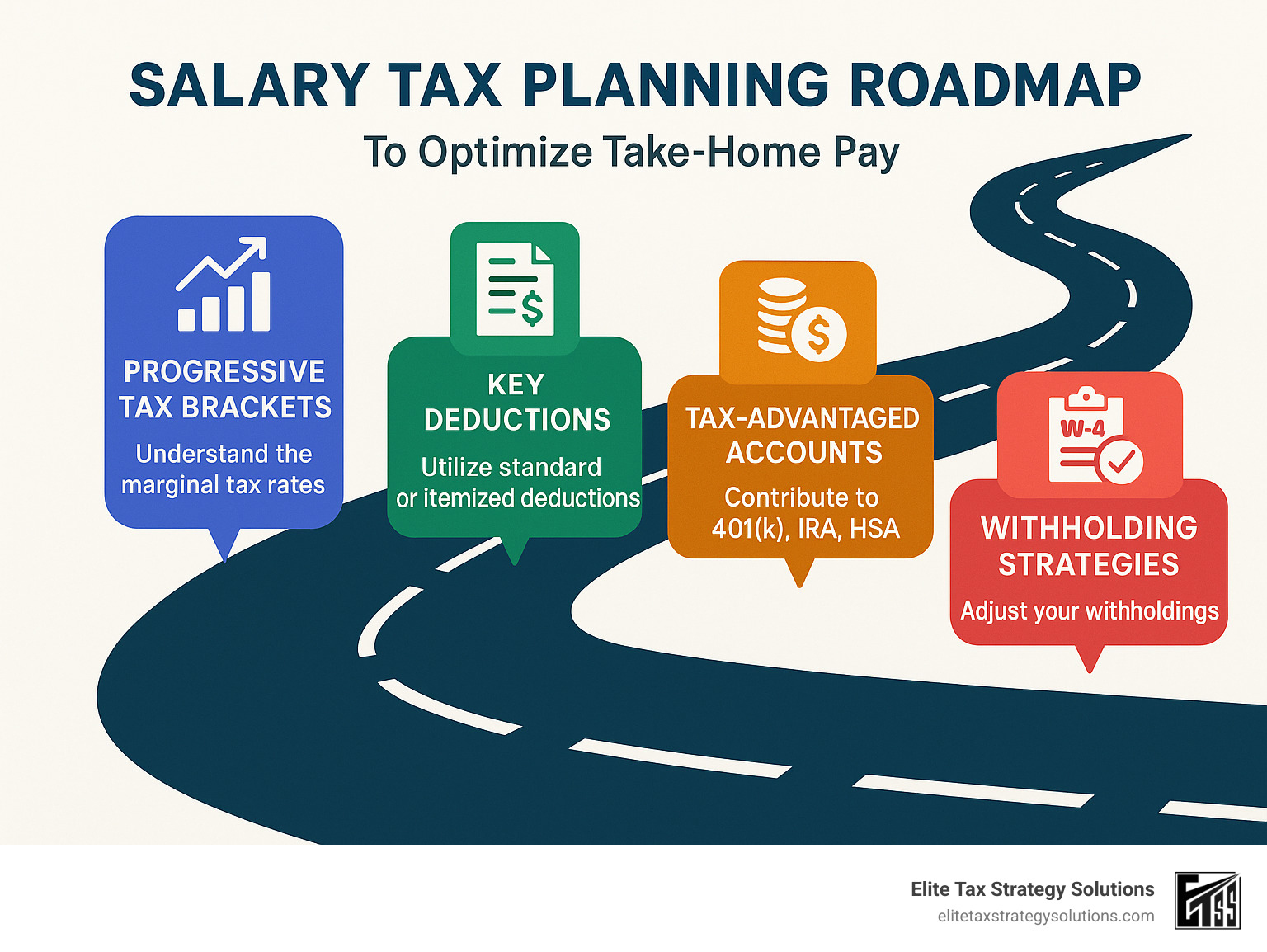
- Understanding tax brackets: The U.S. uses a progressive tax system with rates from 10% to 37%
- Maximizing deductions: Standard deduction ($14,600 single / $29,200 married filing jointly in 2024) vs. itemizing
- Tax-advantaged accounts: 401(k), IRA, HSA contributions reduce taxable income
- Withholding optimization: Adjust your W-4 to avoid large refunds or unexpected tax bills
- Credits vs. deductions: Credits directly reduce taxes owed, while deductions lower taxable income
Did you know that the average salaried employee leaves thousands of dollars on the table each year through missed deductions, credits, and strategic planning opportunities? As a W-2 employee, you may be paying higher taxes than necessary—but with proactive planning you can change that.
The federal personal income tax is the largest source of revenue for the U.S. government, affecting nearly all working Americans. What most people don’t realize is that salary tax planning isn’t just for the ultra-wealthy—it’s a critical financial strategy for anyone who earns a paycheck.
When it comes to reducing your tax burden, timing is everything. Year-end moves are crucial because many deductions and credits phase out after certain thresholds. By understanding how your income is taxed and taking advantage of available strategies, you can significantly reduce what you owe.
I’m David Fritch, a CPA with over 40 years of experience helping clients optimize their salary tax planning strategies to legally minimize tax burdens while maintaining compliance with ever-changing regulations.
For a deeper dive into specific techniques, explore our resources on how to reduce my income tax, the tax planning process, and other tax optimization strategies.
Salary Tax Planning 101: How Your Paycheck Is Really Taxed
Ever looked at your paycheck and wondered where all your money went? You’re not alone. When it comes to salary tax planning, understanding the mechanics behind your paycheck is like finding the secret map to buried treasure – it shows you where your money actually goes and how to keep more of it.
Most of us accept our pay stubs without really digging into the details. But here’s the thing – the U.S. tax system is progressive, which means different slices of your income get taxed at different rates, starting at 10% and potentially climbing to 37% for the highest earners.
If you’re single and earning $50,000 in 2024, your effective tax rate would be about 12.1% – significantly lower than your marginal rate of 22%. This distinction is fundamental to effective salary tax planning.
Beyond federal income tax, your hard-earned dollars also face:
- FICA taxes (Social Security and Medicare) taking 7.65% if you’re an employee
- State income taxes (which vary depending on where you live)
- Local income taxes in some areas
The IRS offers a helpful tax withholding estimator that can save you from nasty surprises at tax time. For deeper insights into proactive approaches, check out our guide to tax planning strategies.
W-2 vs 1099: What That Means for Your Salary
One of the biggest forks in the road for salary tax planning is whether you receive a W-2 or a 1099.
W-2 Employees have it simpler in many ways. Your employer handles withholding taxes from each paycheck and even pays half of your FICA taxes (that’s 7.65% they’re covering for you). Your tax filing is generally more straightforward, though you’ll have fewer business deductions available.
1099 Contractors face a different landscape. No taxes are withheld from your payments, and you’ll pay the full 15.3% FICA tax rate as self-employment tax. The silver lining? You’ll have access to more business deductions and greater planning flexibility.

That FICA tax difference creates a substantial 7.65% gap between W-2 and 1099 workers. For someone earning $100,000, a 1099 contractor pays $7,650 more in FICA taxes before accounting for deductions. However, contractors can deduct half of their self-employment tax on their return.
Salary Tax Planning Checkpoint: Federal Brackets & Standard Deductions
For 2024-2025, knowing your tax brackets is like knowing the rules of the game for effective salary tax planning.
For single filers in 2024, the brackets range from 10% on your first $11,600 of taxable income to 37% on income over $609,351. The standard deduction has increased to $14,600 for singles and $29,200 for married couples filing jointly. Heads of household get $21,900.
Looking ahead to 2025, these numbers tick up slightly with inflation – singles will see a $15,000 standard deduction while married couples filing jointly will enjoy $30,000.
Your filing status significantly impacts your bottom line. Married couples filing jointly often benefit from more favorable tax brackets and higher standard deductions. But it’s not always the best choice, particularly when both spouses earn high incomes.
Fine-Tuning Withholding to Avoid Big Bills
One of the most overlooked aspects of salary tax planning is properly setting up your withholding. Many of us set our W-4 form once when hired and then forget about it – like setting a crockpot and walking away for years.
Your withholding isn’t set in stone. You should revisit it after major life events like marriage or having a child, when starting or stopping a second job, if your spouse’s employment changes, after tax law changes, or mid-year if your financial situation shifts.
If you underwithhold, you might face penalties unless you meet the “safe harbor” requirements. Generally, you’ll avoid penalties if you pay at least 90% of your current year tax liability or 100% of your prior year tax liability (110% if your AGI exceeded $150,000).
Maximizing Take-Home Pay: Deductions, Credits & Accounts
The secret to effective salary tax planning isn’t just understanding how taxes work—it’s knowing how to use the system to your advantage. Think of deductions, credits, and tax-advantaged accounts as three powerful tools that can dramatically boost your take-home pay.
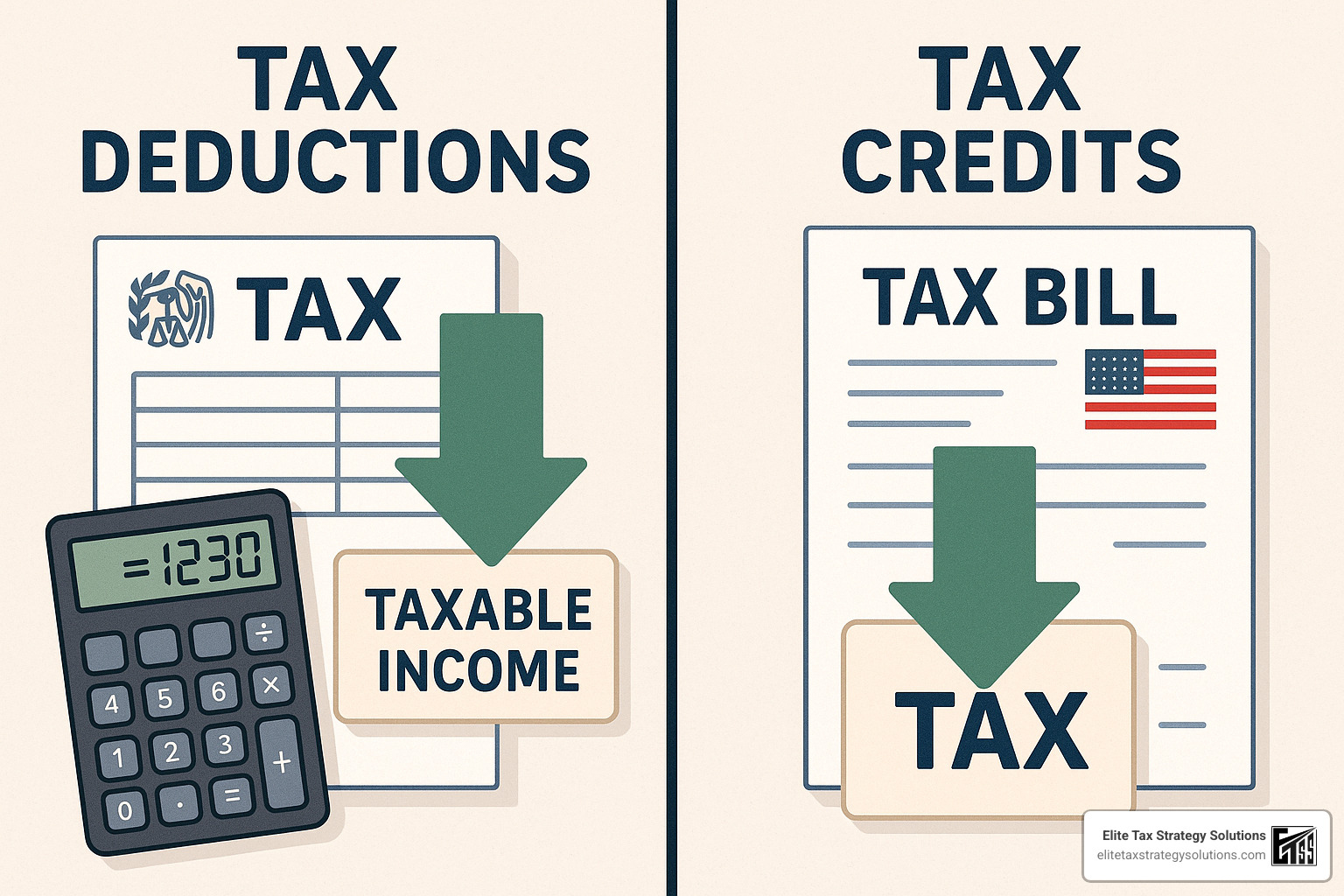
Let’s clear up a common confusion: deductions and credits are not the same thing. A tax deduction reduces the income you’re taxed on. If you’re in the 22% tax bracket, a $1,000 deduction saves you $220. But a tax credit reduces your actual tax bill dollar-for-dollar. That same $1,000 as a credit saves you exactly $1,000, regardless of your tax bracket.
Should You Standardize or Itemize? – Salary Tax Planning Decision Tree
One of the biggest decisions you’ll make each tax season is whether to take the standard deduction or itemize. Since the Tax Cuts and Jobs Act nearly doubled the standard deduction, many taxpayers who previously itemized now find the standard deduction more beneficial.
The math is simple: itemize only if your eligible deductions exceed your standard deduction ($14,600 for singles or $29,200 for married couples filing jointly in 2024). The most common itemized deductions include:
State and local taxes (SALT) are capped at $10,000 annually. Mortgage interest remains deductible, though only for loans up to $750,000 for newer mortgages. Medical expenses can be deducted, but only the portion exceeding 7.5% of your AGI.
One clever strategy is “bunching” your deductions. Rather than making consistent charitable donations every year, consider doubling up in one year to exceed the standard deduction threshold, then taking the standard deduction the following year.
Even if you take the standard deduction, don’t overlook “above-the-line” deductions. These special deductions reduce your adjusted gross income (AGI) regardless of whether you itemize. They include HSA contributions, traditional IRA contributions, and student loan interest.
Retirement, Health & Flex Accounts: Triple Tax Wins
If I could give just one piece of salary tax planning advice, it would be this: max out your tax-advantaged accounts whenever possible.
Your employer’s 401(k) or 403(b) plan allows you to contribute up to $23,000 in 2024 ($30,500 if you’re 50+). These contributions come out pre-tax, immediately reducing your taxable income.
If you have a high-deductible health plan, a Health Savings Account (HSA) offers the “triple tax play”: tax-deductible contributions, tax-free growth, and tax-free withdrawals for qualified medical expenses. In 2024, you can contribute up to $4,150 as an individual or $8,300 for families, with an extra $1,000 if you’re 55 or older.
Unlike Flexible Spending Accounts (FSAs) which typically have “use-it-or-lose-it” rules, HSA funds roll over year after year. Many financial experts recommend treating your HSA as a stealth retirement account.
For more comprehensive strategies on building tax efficiency into your long-term plans, check out our guide to tax-efficient retirement planning.
Charitable & Education Credits You Might Miss
Tax credits are the unsung heroes of salary tax planning. They directly reduce your tax bill, yet many credits go unclaimed simply because taxpayers don’t know they exist.
If you’re paying for college education, don’t miss the American Opportunity Credit, which offers up to $2,500 per eligible student for the first four years of college. What makes this credit especially valuable is that it’s partially refundable.
For graduate school or continuing education, the Lifetime Learning Credit provides up to $2,000 per tax return. While not refundable, it has no limit on the number of years you can claim it.
When it comes to charitable giving, most people know they can deduct donations, but few use the most tax-efficient strategies. You can deduct charitable cash contributions of up to 60% of your adjusted gross income. And if you donate appreciated stocks or other assets you’ve held for more than a year, you get a double benefit: a deduction for the full market value plus avoiding capital gains tax on the appreciation.
For more ways to optimize your deductions, visit our guide on how to optimize tax deductions.
Elite Strategies for High-Income Professionals
High-income professionals face unique challenges in salary tax planning due to phase-outs of deductions and credits, exposure to higher tax brackets, and potential additional taxes like the 3.8% Net Investment Income Tax. However, they also have access to more sophisticated planning strategies.

At Elite Tax Strategy Solutions, we work with high-income professionals in Jasper, Indiana and suburban areas near major cities to implement advanced tax planning strategies that create significant tax savings opportunities.
Income Deferral & Executive Compensation Moves
For executives and high-income professionals, compensation often extends beyond regular salary to include bonuses, stock options, restricted stock units (RSUs), and deferred compensation plans.
Timing can be everything when it comes to bonuses. If you’re expecting a year-end bonus, consider whether it makes more sense to receive it in December or January. If you anticipate being in a lower tax bracket next year, asking your employer to delay payment until January could result in meaningful tax savings.
Equity compensation requires particularly thoughtful planning. When your RSUs vest, they’re typically taxed as ordinary income right away. Many executives adopt a hybrid approach – selling just enough shares to cover the tax bill while holding the rest for potential long-term capital gains treatment.
Nonqualified deferred compensation plans can be a powerful tool in your salary tax planning arsenal. These plans let you postpone receiving a portion of your income until a future date – potentially years when you’ll be in a lower tax bracket. I’ve seen clients save over $50,000 in taxes through careful NQDC planning.
Tax-Loss Harvesting & Asset Location Tactics
Tax-loss harvesting is like finding silver linings in market downturns. When investments decline in value, selling them creates losses that can offset capital gains and up to $3,000 of ordinary income annually. Any unused losses carry forward indefinitely for future years. The IRS allows you to deduct up to $3,000 in losses against ordinary income each year.
The key to successful tax-loss harvesting is immediately reinvesting the proceeds in similar (but not “substantially identical”) investments to maintain your investment strategy while capturing the tax benefit.
Asset location optimization is like giving each investment its perfect home. Think of it as putting tax-inefficient investments (like bonds and REITs) in tax-advantaged accounts where their income is sheltered, while keeping tax-efficient investments (such as index funds and long-term growth stocks) in taxable accounts.
Municipal bonds deserve special mention for high-income professionals. Their interest is generally exempt from federal income tax and often from state and local taxes if the bonds are issued in your state of residence. For someone in the 37% federal bracket, a 3% municipal bond yield translates to a tax-equivalent yield of 4.76%.
Preparing for the 2025 TCJA Sunset
A critical aspect of current salary tax planning is preparing for the scheduled sunset of many Tax Cuts and Jobs Act (TCJA) provisions after 2025. Without congressional action, several key tax benefits will revert to pre-2018 levels.
Think of 2025 as a tax planning deadline. After that, we’re looking at potentially higher tax rates (the top bracket returning to 39.6% from 37%), a significantly reduced standard deduction, the return of personal exemptions, the expiration of the $10,000 SALT deduction cap, and roughly a 50% decrease in the estate tax exemption.
This creates a unique planning window. If you expect to be in a higher bracket after 2025, you might consider accelerating income into 2024-2025. Similarly, it might make sense to defer deductions to 2026 and beyond when they could be more valuable against higher tax rates.
For those with significant estates, making large gifts before the exemption decreases could lock in the current higher limits.
For more specialized strategies custom to high-income individuals, visit our page on tax strategies for high-income individuals.
Frequently Asked Questions about Salary Tax Planning

How do I know if I should change my withholding mid-year?
Life has a funny way of changing when we least expect it. Your tax withholding should change along with it!
If you’ve recently said “I do,” welcomed a little one, or gone through a divorce, it’s definitely time to revisit your W-4 form. The same goes for starting a side hustle or if your spouse has changed employment status.
I’ve seen clients who received $5,000+ tax refunds, essentially giving Uncle Sam an interest-free loan all year. On the flip side, I’ve helped others who were shocked by unexpected tax bills in April because their withholding wasn’t keeping pace with their life changes.
The simplest way to check if you’re on track is to spend about 10 minutes with the IRS Tax Withholding Estimator. This handy tool will help you find that sweet spot – not too much, not too little – just the right amount of withholding for your unique situation.
What records must I keep—and for how long?
For most taxpayers, the magic number is three years from the filing date (or two years from when you paid the tax, if that’s later). This covers the standard IRS statute of limitations for audits. But there are some important exceptions.
If you’ve claimed a loss from worthless securities or bad debt, keep those records for 7 years. Accidentally omitted more than 25% of your income? Those records should stay with you for 6 years. And if you have employees, hang onto those employment tax records for at least 4 years.
For property records, including home improvements, keep everything as long as you own the asset, plus 3-7 years after you sell or dispose of it. Those kitchen renovation receipts might seem unimportant now, but they could save you thousands in capital gains taxes down the road!
I recommend creating a simple filing system with folders for:
- Tax returns and all supporting documents
- Income statements (W-2s, 1099s, etc.)
- Receipts for deductible expenses
- Investment records
- Retirement account contributions
- Home purchase and improvement documentation
When is it time to hire a professional for salary tax planning?
There’s a point where DIY tax preparation becomes more risky than rewarding. Here’s my honest take on when it’s time to bring in the professionals:
When your income crosses that $200,000 threshold, you enter a new tax territory with additional complexities like the Net Investment Income Tax, various phase-outs, and potential AMT exposure.
If you’re juggling multiple income streams – perhaps a day job plus a side business, rental property, or significant investment income – the tax interactions become exponentially more complex.
Major life changes also warrant professional guidance. Whether you’re getting married, having children, buying a home, or relocating to a different state, these transitions create both tax challenges and opportunities.
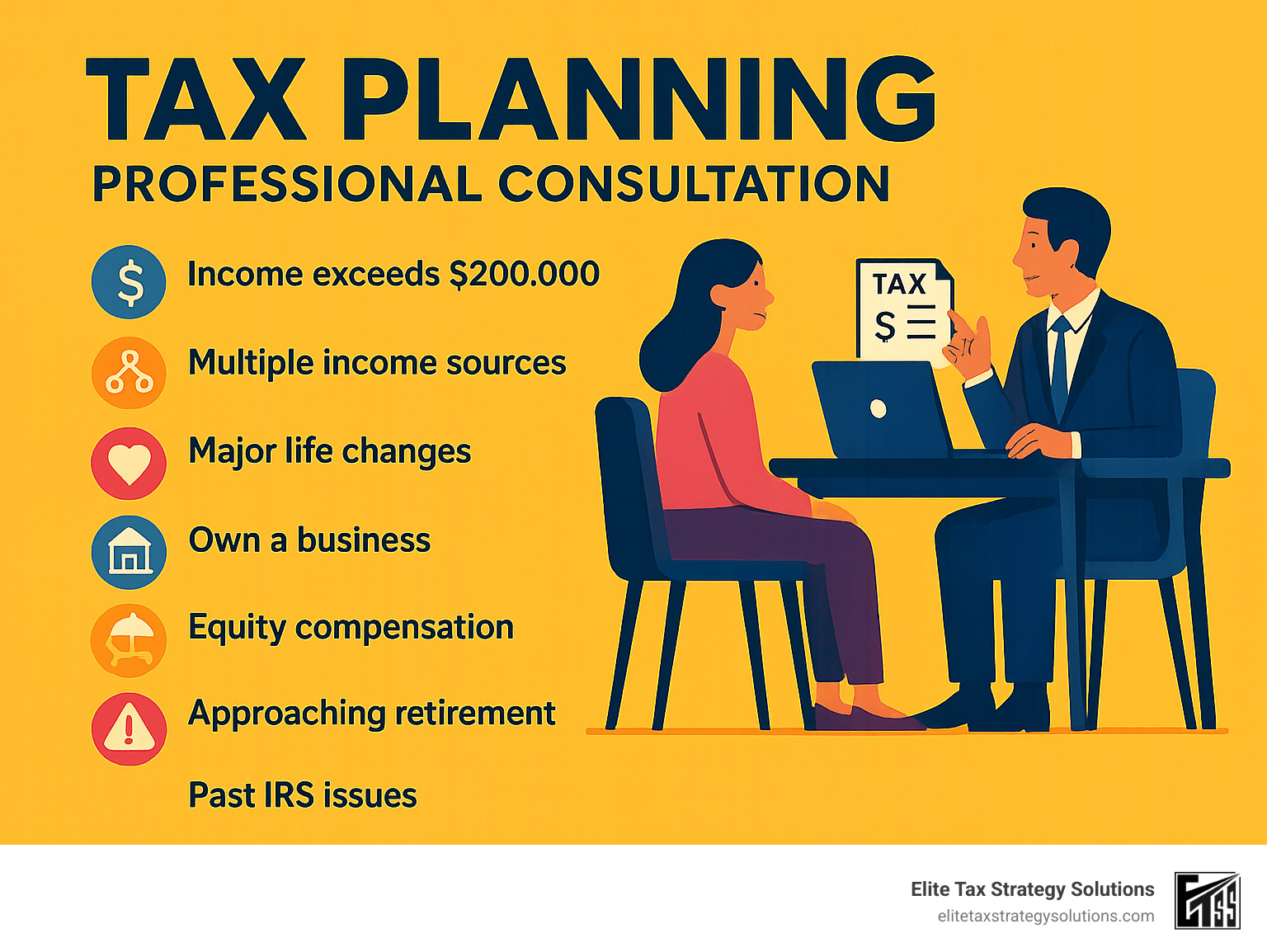
The approach to retirement is another critical time for professional salary tax planning. The 5-10 years before retirement offer unique opportunities to position your assets for tax-efficient withdrawals.
At Elite Tax Strategy Solutions, we focus on making our services an investment rather than an expense. Most of our clients find tax-saving opportunities that far exceed our fees, often by thousands of dollars.
Conclusion
Salary tax planning isn’t something you do once a year when tax season rolls around—it’s more like tending a garden that needs regular attention to truly flourish. Throughout this guide, we’ve walked through the strategies that can help you legally minimize your tax burden and keep more money in your pocket where it belongs.
Think about what we’ve covered together. We’ve explored how our tax system applies different rates to different portions of your income. We’ve looked at the power of tax-advantaged accounts like 401(k)s, IRAs, and HSAs that can dramatically reduce your taxable income while helping you save for important life goals.
We’ve also discussed how fine-tuning your withholding can improve your monthly cash flow without setting you up for an unwelcome surprise at tax time. And importantly, we’ve highlighted how strategic timing of income and deductions based on your current and anticipated future tax brackets can yield significant savings.
One thing you absolutely shouldn’t ignore is preparing for the upcoming TCJA sunset in 2025. This tax law change will affect millions of Americans, and the time to prepare is now, not when the changes take effect.
The tax landscape is constantly shifting beneath our feet. Strategies that work brilliantly today might need adjustments tomorrow as laws change and your personal circumstances evolve. At Elite Tax Strategy Solutions, we make it our business to stay on top of these changes so you don’t have to.
Whether you’re punching a clock in Jasper, Indiana, or you’re a high-powered executive in a suburban enclave, we’re ready to help you steer the complexities of the tax code. We’ll work with you to develop a personalized salary tax planning strategy that aligns with your unique financial situation and goals.
Don’t leave money on the table through missed opportunities. Don’t pay a dollar more than you legally owe. Take control of your tax situation today and start keeping more of what you work so hard to earn.
Ready to see how innovative tax planning can transform your financial picture? Visit our page on innovative tax planning and find what’s possible when you have tax experts in your corner.