Why High-Income Tax Planning Matters in the U.S.
High-income tax strategies are essential for anyone navigating the upper tax brackets. At high income levels, you can face a top federal marginal tax rate of 37%, plus additional state and federal taxes—meaning a significant portion of every additional dollar earned goes to tax.
Although Elite Tax Strategy Solutions is headquartered in Jasper, Indiana, we operate 100% virtually and serve clients nationwide and internationally—including Australian citizens, Australian expatriates living in the United States, and Americans with investments in Australia. Our team frequently collaborates with Australian advisers so that clients with cross-border interests stay compliant with both IRS and Australian Taxation Office (ATO) requirements.
Top U.S. Tax Strategies for High Earners:
- 401(k) and IRA contributions – Maximize pre-tax contributions to lower taxable income.
- Capital gains tax management – Benefit from lower rates for assets held over 12 months.
- Tax-loss harvesting – Offset investment gains with investment losses.
- Trusts – Distribute income to lower-earning family members or for asset protection.
- Income timing – Defer income or bring forward deductions.
- Tax-advantaged investments – Use vehicles like municipal bonds for tax-free income.
The U.S. tax system is progressive, which means the more you earn, the more you pay. For someone earning $500,000, the effective federal tax rate can be substantial. This makes strategic tax planning not just helpful—it’s crucial for wealth building.
As Albert Einstein reportedly said: “The hardest thing to understand in the world is the income tax.” But with the right strategies, you can legally minimize your tax burden while staying fully compliant with Internal Revenue Service (IRS) requirements.
Tax planning is different from tax avoidance. The IRS affirms your right to arrange your financial affairs to keep tax to a minimum. It’s perfectly legal when done correctly.
I’m David Fritch, and I’ve spent 40 years helping high-income earners and business owners optimize their tax strategies through my CPA practice and Elite Tax Strategy Solutions. My expertise in high-income tax strategies has helped clients earning $200,000 to $2,000,000 annually save thousands in unnecessary taxes while building long-term wealth.
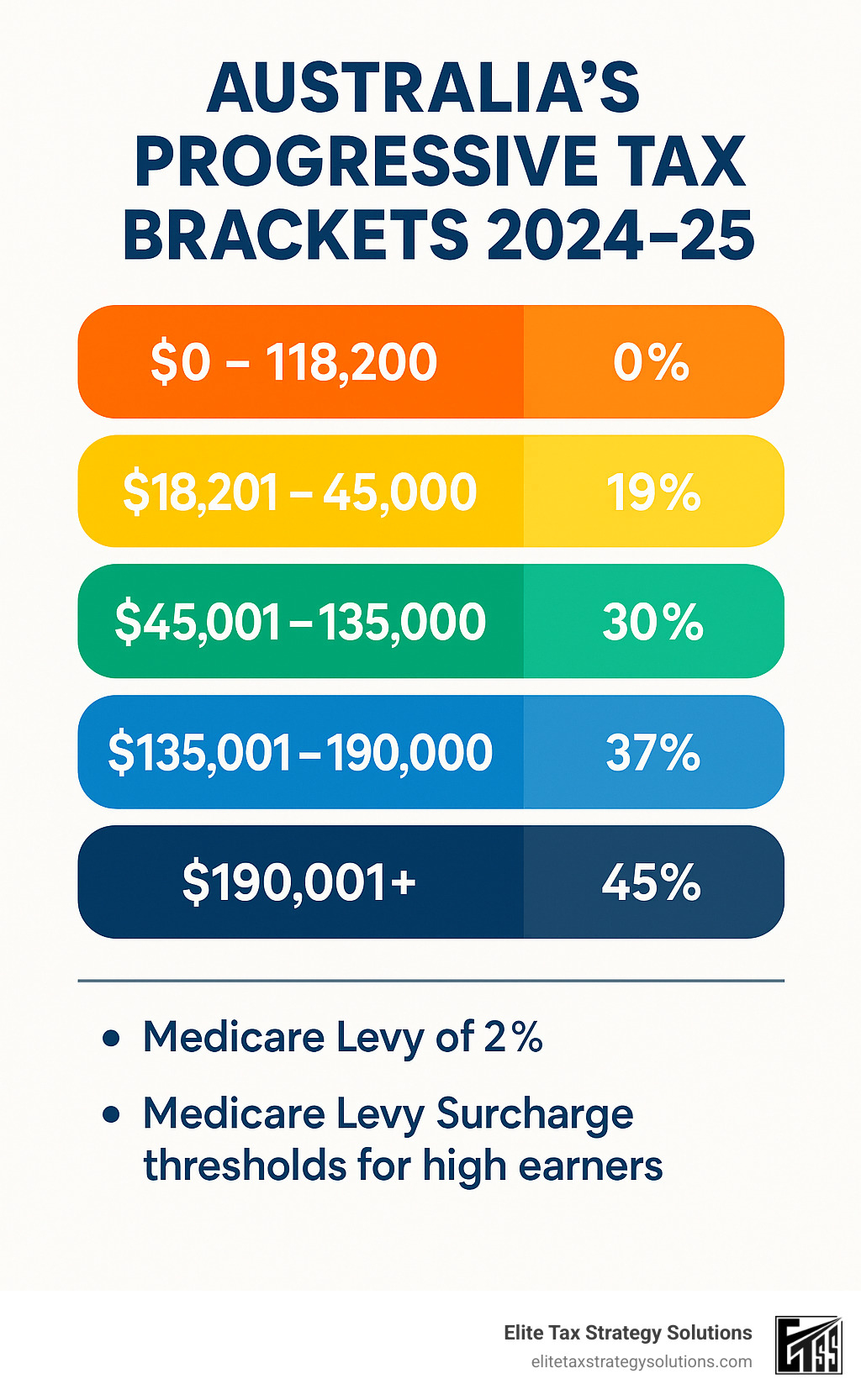
Progressive tax systems, like the one from Australia illustrated below, are common worldwide. In the U.S., the principle is the same: as your income rises, so does your tax rate.
High-income tax strategies terms to know:
- advanced tax planning strategies
- financial planning for high income earners
- wealth management tax planning
Understanding the Playing Field: High-Income Tax in the U.S.

Think of the U.S. tax system like a ladder – the higher you climb, the steeper it gets. The U.S. progressive tax system means that as your income increases, so does the percentage you pay in tax. It’s designed to be fair, but it can feel like a punch to the gut when you see how much disappears from your paycheck.
Here’s the reality: if you’re earning good money in the U.S., you’re probably paying more tax than you need to. Not because you’re doing anything wrong, but because most people don’t understand the rules of the game well enough to play it strategically.
At Elite Tax Strategy Solutions, we’ve spent decades helping clients steer these waters. Our approach isn’t about cutting corners or pushing boundaries – it’s about understanding every legitimate opportunity the tax system offers and making sure you’re not leaving money on the table. That’s where effective High Net Worth Tax Planning becomes invaluable.
The good news? Once you understand how the system works, you can make informed decisions that keep more of your hard-earned money in your pocket, legally and ethically.
Who is a High-Income Earner in the U.S.?
In the United States, if you’re earning over $200,000 as an individual or $250,000 as a married couple, congratulations – you’ve officially joined the high-income earners club. Unfortunately, membership comes with some hefty fees.
At the highest income levels, you’ll pay the top marginal tax rate of 37% on every dollar above the threshold. Add the Medicare tax and the Additional Medicare Tax, and you’re looking at over 39% tax on your highest earnings. That means a substantial portion of every additional dollar you earn goes straight to the Internal Revenue Service.
Let’s put this in perspective. If you earn $500,000 a year, a significant chunk of that income gets taxed at this highest rate. The impact on your take-home pay is substantial, which is exactly why understanding high-income tax strategies isn’t just helpful – it’s essential for building and protecting your wealth.
This isn’t meant to discourage you from earning more (quite the opposite!), but rather to highlight why strategic tax planning becomes increasingly important as your income grows.
Key Levies and Surcharges to Know
Beyond the standard tax rates, high-income earners face additional taxes that can quietly chip away at your wealth. Think of these as the “hidden extras” that many people don’t see coming.
The Net Investment Income Tax (NIIT) is probably the most common surprise. This additional 3.8% tax applies to investment income for individuals with a modified adjusted gross income over $200,000 (or $250,000 for married couples). This tax is levied on top of your regular capital gains and dividend taxes, making tax-efficient investing even more critical. You can find more on the Net Investment Income Tax to understand how it might affect you.
Then there’s the Additional Medicare Tax. If your wages and other compensation exceed the same thresholds ($200,000 for singles, $250,000 for married couples), you’ll pay an extra 0.9% in Medicare tax on the excess earnings.
Finally, the State and Local Tax (SALT) deduction cap is a major factor for high earners. Federal law limits your deduction for state and local taxes—including property, income, and sales taxes—to just $10,000 per household. For those in high-tax states, this cap can significantly increase your federal tax liability.
These items aren’t designed to trick you – they’re legitimate parts of the tax system. But understanding them is crucial for any effective tax planning strategy.
Retirement Accounts & Investments: Your Offensive Line

Think of your investment strategy like a football team’s offensive line – it’s what protects your wealth and creates opportunities to move forward. When you’re earning a high income in the U.S., smart investing isn’t just about growing your money. It’s about keeping more of what you earn while building long-term wealth.
The beauty of high-income tax strategies lies in how they transform your biggest challenge – that hefty tax bill – into your greatest opportunity. Every dollar you can legally redirect from the tax office into wealth-building investments is a dollar that works harder for your future.
At Elite Tax Strategy Solutions, I’ve seen too many high earners miss out on thousands in tax savings simply because they didn’t understand their options. The good news? Once you know the rules of the game, you can play to win. Our Tax Strategies for the High Income Individual are designed specifically for people in your situation.
Leveraging Retirement Accounts for Maximum Tax Benefits
Retirement accounts like 401(k)s and IRAs are hands-down the most powerful tax weapon in your arsenal. It’s like having a secret tunnel that bypasses the tax office’s roadblocks.
Here’s the magic: pre-tax contributions to your traditional 401(k) or IRA reduce your current taxable income. Compare that to your 37% marginal rate, and you’re immediately saving 37 cents on every dollar contributed. The annual cap is $23,000 for a 401(k) in 2024, with an additional $7,500 catch-up contribution for those age 50 and over. The IRS contribution limit info explains exactly how this works.
Contributing via payroll deduction makes this even easier. Simply arrange with your employer to redirect part of your pre-tax salary straight into your 401(k). It’s like giving yourself an instant pay rise by reducing your taxable income today and letting your investments grow tax-deferred until retirement.
While pre-tax contributions are powerful, it’s also important to consider Roth 401(k) and Roth IRA options, which allow for tax-free growth and withdrawals in retirement. A mix of both can be a sophisticated strategy. These strategies form the backbone of our Tax Savings Strategies for High Income Earners.
Smart Strategies to Minimise Capital Gains Tax (CGT)
Capital Gains Tax can feel like a penalty for successful investing, but with the right approach, you can dramatically reduce its impact.
The preferential long-term capital gains rate is your best friend here. Hold any investment for more than 12 months, and you only pay tax on the gain at a much lower rate—typically 15% or 20% for high earners. For someone in the top tax bracket, this effectively cuts your tax rate on the gain from as high as 37% down to 20% (though the 3.8% NIIT may also apply). That’s a massive saving on any significant investment gain.
Tax-loss harvesting is another smart move that many overlook. If you’ve made losses on some investments, you can use these to offset your gains. It’s like the tax system giving you credit for your losses to reduce tax on your wins.
Timing is everything when it comes to realizing gains. Planning a sabbatical? Taking parental leave? These lower-income years are perfect for selling profitable investments, as the gains will be taxed at a lower rate. The IRS guide to capital gains tax covers all the technical details.
Using Investment Deductions and Tax-Advantaged Bonds
Beyond the big-ticket items, there are two more strategies that can significantly boost your tax position.
Deducting investment interest can be a powerful tool. When your investment costs (like margin loan interest) exceed the income it generates, you may be able to deduct that interest expense against your investment income, subject to certain limitations. This effectively reduces the cost of leverage.
Remember though – this is an investment strategy first, tax strategy second. You’re betting that the asset’s growth will more than make up for the costs. It’s not about taking on debt just to save tax; it’s about using the tax system to reduce the cost of building wealth.
Tax-advantaged bonds, like municipal bonds, are the hidden gem of high-income tax planning. Think of them as a way to generate tax-free income. Interest earned on most municipal bonds is exempt from federal income tax, and often state and local tax if you live in the issuing state.
For someone paying a high marginal tax rate, this represents enormous long-term savings. You can learn more about general investment tax considerations at More on investing and tax.
The key to all these strategies is understanding that they work best as part of a coordinated plan, not as isolated tactics. That’s where professional guidance becomes invaluable.
Advanced Structures & Timing: The Playbook for High-Income Tax Strategies

When you’re earning serious money in the U.S., simply putting everything in your own name and hoping for the best is like playing football without a game plan. The real magic of high-income tax strategies happens when you start using advanced structures and perfect timing to your advantage.
Think of it this way: if basic tax strategies are your defensive line, then trusts, companies, and strategic timing are your offensive powerhouse. These aren’t just for the ultra-wealthy anymore – they’re essential tools for anyone serious about keeping more of what they earn. At Elite Tax Strategy Solutions, we’ve seen these strategies transform our clients’ financial futures. Our Advanced Tax Planning services are designed to help you implement these sophisticated approaches with confidence.
How Investment Structures like Trusts and Companies Reduce Tax
Here’s where things get interesting. Instead of having all your investment income taxed at your personal rate of up to nearly 41% (including the NIIT), smart structures can dramatically reduce that burden.
Trusts are like having a financial Swiss Army knife. Certain types of trusts give you incredible flexibility because the trustee can distribute income to beneficiaries. Imagine you have $80,000 in investment income. Instead of you paying over $32,000 in tax (at the top rate), you could distribute that income to adult family members in lower tax brackets. Suddenly, that same income might only attract a fraction of that tax across the family group.
The beauty of income splitting through trusts goes beyond just tax savings. You’re also building wealth across your family unit while protecting assets from potential business or personal liabilities. It’s like having a financial fortress that also happens to be tax-efficient.
C-Corporations offer a different but equally powerful approach. With a flat federal corporate tax rate of 21%, your investment profits can grow much faster than if they were taxed at your personal rate of 37%. This is particularly powerful for building long-term wealth because you can reinvest those profits at the lower tax rate, creating a compounding effect.
The “holding company” strategy combines the best of both worlds. A trust can distribute income to a C-Corporation (the “holding company”), where it’s taxed at the 21% corporate rate. This retained income can then be strategically invested or used for future opportunities, all while staying within the IRS’s rules.
Let’s look at how a $50,000 investment profit might be taxed under different structures:
| Structure | Tax Rate Applied | Tax Paid (Approx.) | Notes |
|---|---|---|---|
| Individual | 37% + 3.8% NIIT | $20,400 | Full personal and investment tax rates apply |
| Trust | Distributed to lower-income beneficiaries | $5,000-$10,000 | Depends on beneficiaries’ tax brackets |
| Holding Company (C-Corp) | 21% corporate rate | $10,500 | Profits retained for reinvestment; dividends may be taxed later |
The difference is staggering – potentially saving over $10,000 in tax on just this one profit. Multiply that across years of investing, and you’re looking at serious wealth preservation.
The Importance of Timing: A core component of high-income tax strategies
In tax planning, timing isn’t just important – it’s everything. The difference between paying tax this year or next year can literally save you thousands of dollars.
Deferring income is one of the most powerful moves in your playbook. If you’re expecting a lower income year ahead (maybe you’re planning a sabbatical or reducing work hours), delaying a bonus or consulting payment can shift that income into a lower tax bracket. This is perfectly legal and can result in substantial savings.
Pre-paying expenses works the opposite way. If you have deductible expenses coming up, paying them before December 31 can bring those deductions into the current year. State tax estimates (up to the SALT cap), mortgage interest, or business expenses can all be strategically timed to maximize your tax benefit.
Bringing forward deductions while deferring income creates a double benefit. You’re reducing this year’s taxable income while potentially having that deferred income taxed at a lower rate next year.
Capital gains timing deserves special mention. If you’re planning to sell investments, the timing can make a huge difference. Selling in a year when your other income is lower, or when you have capital losses to offset gains, can dramatically reduce your CGT liability. Our Proactive Tax Planning approach helps clients map out these timing strategies years in advance.
Strategic Asset Ownership and Estate Planning
Sometimes the simplest strategies are the most effective. While less impactful for federal taxes when filing jointly, strategic asset location between spouses can still be beneficial for state tax or estate planning purposes.
Testamentary trusts are estate planning tools that keep giving long after you’re gone. These are established through your will and offer incredible flexibility and protection for your beneficiaries, shielding assets from creditors and ensuring your wealth is managed according to your wishes.
Minimizing taxes on inherited retirement accounts is crucial for high-income earners with substantial balances. When retirement accounts like 401(k)s or IRAs are passed to non-spouse beneficiaries, they are subject to income tax and must typically be withdrawn within 10 years. Strategic planning around Roth conversions and beneficiary designations can significantly reduce this burden on your loved ones.
The key to all these advanced strategies is getting the structure right from the beginning and then actively managing them over time. It’s not a “set and forget” approach – it requires ongoing attention and professional guidance to ensure you’re always optimizing your position within the legal boundaries.
Take Control of Your Financial Future
As a high-income earner, you’re already ahead of the game financially. But without proper tax planning, you could be leaving tens of thousands of dollars on the table each year. The difference between someone who pays whatever the IRS collects and someone who strategically manages their tax obligations can be enormous over a lifetime of earning.
Think about it this way: if you’re earning $500,000 annually and paying the top 37% federal rate on a significant portion of that income, the tax bill is substantial. But with smart high-income tax strategies, you could potentially redirect significant portions of that income through retirement accounts, investment structures, or timing strategies—keeping more of your hard-earned money working for you instead of the tax office.
Although our headquarters are in Jasper, Indiana, Elite Tax Strategy Solutions supports clients across the U.S. and around the globe, including Australians with U.S. connections and U.S. residents investing in Australia. Because we work virtually, you can access our expertise wherever you live and regardless of time zone.
The strategies we’ve covered aren’t just theoretical concepts—they’re practical tools that thousands of high-income individuals use every day. From maximising your 401(k) contributions to leveraging trusts for income splitting, from timing your capital gains to structuring your investments tax-effectively, each strategy can save you real money.
But here’s the thing: tax planning isn’t a set-and-forget exercise. The tax landscape changes regularly, with new rules, thresholds, and opportunities emerging each year. What worked perfectly last year might need adjustment next year. That’s why having expert guidance isn’t just helpful—it’s essential for protecting and growing your wealth.
At Elite Tax Strategy Solutions, we’ve spent decades helping high-income earners and business owners steer these complexities. We don’t believe in one-size-fits-all solutions because your financial situation is unique. Your income sources, family circumstances, investment goals, and risk tolerance all play a role in determining the best tax strategies for your situation.
Our approach is thoroughly proactive rather than reactive. Instead of scrambling to find deductions at the end of the year, we work with you year-round to implement strategies that align with your long-term financial goals. By taking a comprehensive and innovative approach to tax planning, we ensure you’re not paying more tax than necessary while keeping you fully compliant with all IRS requirements.
The cost of professional tax advice is typically far outweighed by the savings it generates. When you consider that a single well-implemented strategy could save you thousands annually, the investment in expert guidance pays for itself many times over.
Don’t let another financial year pass by paying more tax than you need to. The strategies outlined in this guide provide a powerful foundation, but implementing them correctly requires expertise and ongoing attention. Your financial future deserves that level of care and precision.