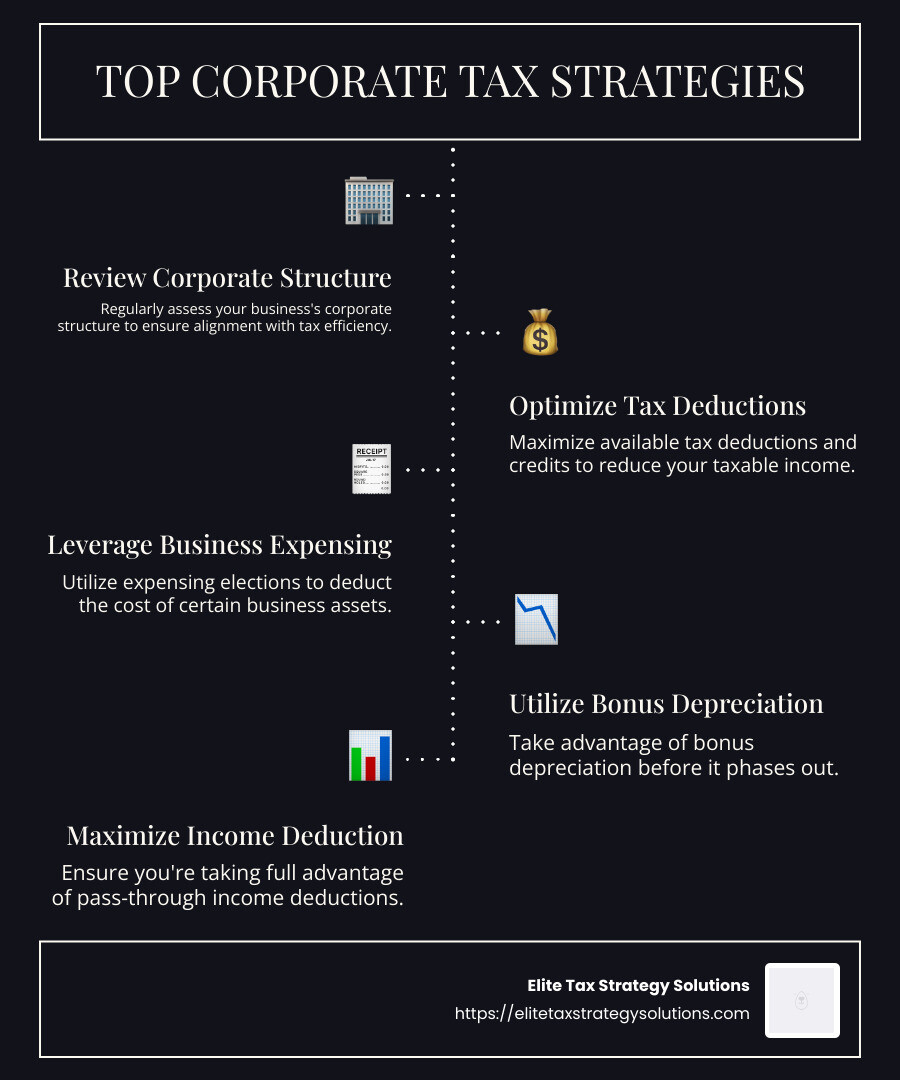
Corporate tax strategies are essential for any business looking to thrive in today’s competitive environment. They are not just about ticking boxes for compliance but proactively seeking opportunities to maximize savings and improve financial stability. Here are some of the key strategies to consider:
- Review your corporate structure regularly.
- Optimize your use of tax deductions and credits.
- Leverage business expensing elections.
- Use bonus depreciation before it phases out.
- Maximize your pass-through business income deduction.
By understanding and implementing these approaches, a business can ensure both regulatory compliance and financial growth.
My name is David Fritch, and with 40 years of experience owning and managing a law firm and CPA practice, I specialize in helping businesses develop effective corporate tax strategies. My focus is on maximizing tax savings and financial optimization, especially for high-income earners and small businesses.
Key terms for corporate tax strategies:
– business tax reduction
– maximize tax savings
– tax savings for businesses
Understanding Corporate Tax Strategies
When it comes to corporate tax strategies, the goal is to minimize tax liabilities while maximizing compliance and benefits. Let’s break down these key elements:
Tax Liabilities
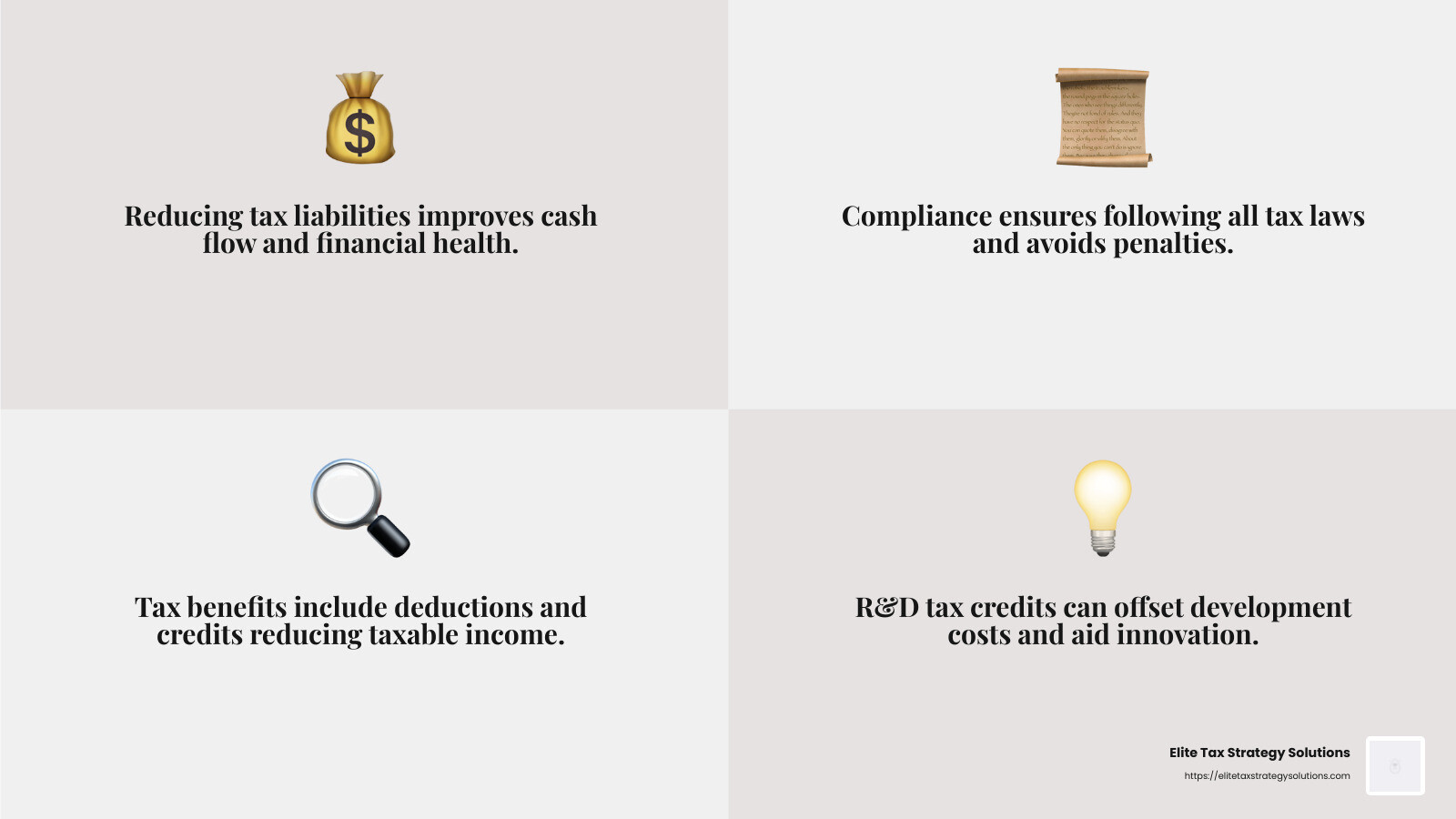
Tax liabilities are the total amount of tax a company owes to the government. These can include federal, state, and local taxes. Reducing tax liabilities is crucial for improving a company’s cash flow and financial health. One effective way to manage these liabilities is by strategically timing income and expenses. For instance, a company might defer revenue recognition to a later tax year to align with lower tax rates or advance expenses to reduce taxable income in the current year.
Compliance
Staying compliant with tax regulations is non-negotiable. Compliance means that a company follows all applicable tax laws and regulations, filing accurate returns on time. Non-compliance can lead to penalties, interest, and even audits. Regularly updating knowledge about tax laws, such as changes in tax credit eligibility or new reporting obligations, is essential for maintaining compliance.
Tax Benefits
Tax benefits come in various forms, such as deductions and credits. These benefits directly reduce the amount of tax owed or the taxable income. For example, deductions for research and development (R&D) expenses are government incentives encouraging innovation. By claiming such deductions, a company can significantly lower its taxable income. Similarly, tax credits, like those for renewable energy investments, directly reduce the tax bill, often providing more substantial savings than deductions.
Case Study: R&D Tax Credits
Consider a tech company investing heavily in developing new software. By claiming R&D tax credits, the company can offset a portion of its development costs, reducing its overall tax liability. This not only improves cash flow but also provides additional funds for further innovation.
In summary, understanding and effectively utilizing corporate tax strategies can lead to substantial savings and ensure compliance. It’s about finding the balance between reducing liabilities and maximizing benefits while staying within the bounds of the law.
This proactive approach to tax planning not only secures financial stability but also positions a company for sustainable growth.
Next, let’s explore how optimizing your business structure can further improve tax efficiency.
Maximize Tax Deductions and Credits
When it comes to minimizing tax liabilities, tax deductions and tax credits play pivotal roles. Both strategies can significantly reduce what a company owes, but they work in different ways.
Tax Deductions
Tax deductions lower your taxable income. Common deductions include operating expenses, employee benefits, and travel costs. For instance, if a business spends on research and development (R&D), it can deduct those expenses. This is a government incentive to foster innovation and growth.
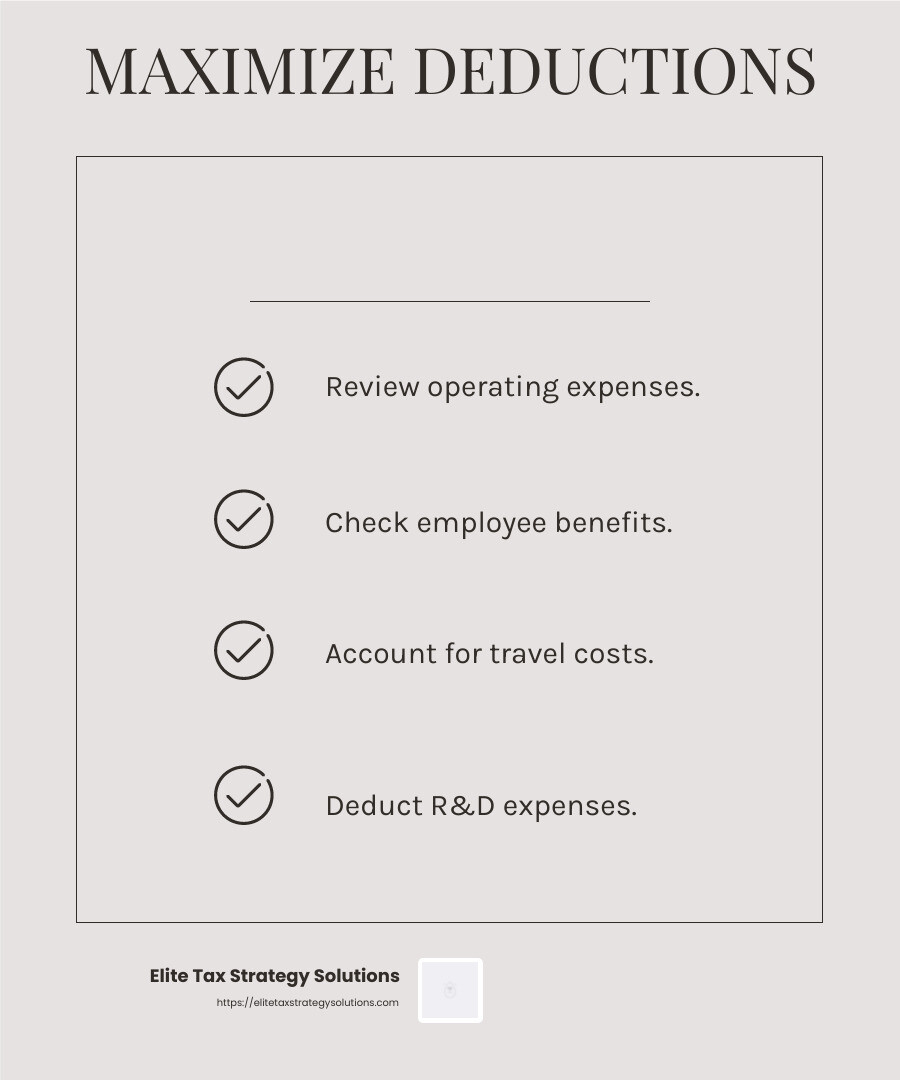
Pro Tip: Regularly review your expenses to ensure you’re capturing all eligible deductions. Missing out on deductions means paying more tax than necessary.
Tax Credits
Tax credits are even more beneficial than deductions because they reduce the tax bill dollar-for-dollar. For example, if a company invests in renewable energy, it might qualify for energy-related tax credits. This directly cuts down the tax amount owed.
Example: A manufacturing company installs solar panels and claims a renewable energy tax credit. This reduces their tax bill, allowing them to reinvest in their operations.
R&D Expenses
R&D tax credits are particularly lucrative. They reward companies for developing new products or improving existing ones. The credit can be used to offset payroll taxes, making it especially valuable for startups or companies not yet profitable.
Case Study: A small biotech firm invests in developing a new drug. By claiming R&D tax credits, they reduce their tax burden, freeing up cash for further research.
Incorporating these strategies into your corporate tax strategies can lead to substantial savings and improve cash flow. It’s not just about cutting costs but reinvesting those savings into the business for growth and innovation.
Next, let’s explore how optimizing your business structure can further improve tax efficiency.
Optimize Business Structure for Tax Efficiency
Choosing the right corporate structure is crucial for minimizing tax liabilities and maximizing savings. Your business structure determines how taxes are filed and what tax benefits you can leverage. Let’s break down the basics.
Corporate Structure
Businesses can be structured in several ways, including sole proprietorships, partnerships, LLCs, S corporations, and C corporations. Each structure has its own tax implications.
- Sole Proprietorships: Simplest form, but owners pay personal income tax on profits.
- Partnerships: Profits pass through to partners, who pay personal taxes.
- LLCs: Offer flexibility; can be taxed as a sole proprietorship, partnership, or corporation.
- S Corporations: Avoid double taxation; profits pass through to shareholders.
- C Corporations: Subject to corporate tax rates but can offer more tax deductions.
Tip: Regularly review your business’s structure to ensure it aligns with your financial goals and tax efficiency.
Tax Status
Your tax status affects how much tax you pay. For instance, C corporations benefit from a flat 21% corporate tax rate. However, they face double taxation—once at the corporate level and again on dividends to shareholders. S corporations and LLCs avoid this by passing income to owners, who then pay personal taxes.
Example: A tech startup elects to be an S corporation to avoid double taxation while benefiting from lower personal tax rates.
Tax Liabilities
Strategically managing tax liabilities involves understanding your structure’s impact on taxes and exploring ways to reduce them. This might include:
- Reinvesting profits to defer gains.
- Claiming deductions and credits specific to your structure.
- Reviewing retirement plan options for tax benefits.
Case Study: A family-owned business shifts from a C corporation to an LLC. This change allows them to pass income directly to owners, reducing their overall tax burden and increasing cash flow.
Aligning your corporate tax strategies with the right business structure not only cuts down on tax costs but also positions your company for growth. It’s essential to consult with a tax advisor to ensure your structure supports your long-term financial goals.
Next, let’s dive into strategic tax planning for international operations and how it can impact your business.
Strategic Tax Planning for International Operations
Navigating international taxes can be tricky, but it’s vital for businesses operating across borders. Let’s explore how global tax implications, international regulations, and BEPS (Base Erosion and Profit Shifting) can affect your business.
Global Tax Implications
When your company operates in multiple countries, understanding global tax rules is crucial. Different countries have different tax systems, and you need to know how these affect your business.
For example, if your company is a tax resident in two countries, you might face double taxation. However, many countries have Double Taxation Agreements (DTAs) that can help you avoid paying taxes twice. These agreements often allow for tax refunds or reliefs before taxes are paid.
Tip: Always check if a DTA exists between the countries you operate in. This can save you a lot of money and hassle.
International Regulations
Staying on top of international tax regulations is a must. Countries are increasingly adopting guidelines from the Organization for Economic Cooperation and Development (OECD) to combat tax evasion. One key initiative is BEPS, which aims to prevent businesses from shifting profits to low-tax jurisdictions.
BEPS Action Plan: This includes measures like:
- Country-by-Country Reporting: Requires companies to report income, taxes, and other economic activity by country.
- Transfer Pricing Documentation: Ensures that transactions between company branches in different countries are priced fairly.
- Limiting Base Erosion: Prevents companies from deducting interest payments that erode the tax base.
Example: A multinational company adjusts its transfer pricing policies to comply with BEPS guidelines, ensuring fair taxation across its global operations.
BEPS and Your Business
BEPS is all about transparency and fairness in international taxation. Companies must ensure they’re compliant with these guidelines to avoid penalties and maintain a good reputation.
Strategy: Invest in technology and data systems to collect and analyze your tax data. This helps you stay compliant with BEPS and other international regulations.
Case Study: A global tech firm implements a new tax software system to track and report its international transactions accurately. This not only ensures compliance but also helps the company identify tax-saving opportunities.
In conclusion, strategic tax planning for international operations requires a keen understanding of global tax implications and compliance with international regulations like BEPS. By staying informed and proactive, your business can minimize tax liabilities and thrive in the global market.
Next, we’ll tackle some frequently asked questions about corporate tax strategies, including how to reduce corporation tax and examples of tax avoidance strategies.
Frequently Asked Questions about Corporate Tax Strategies
How can I reduce corporation tax?
Reducing corporation tax can be achieved through smart business structure and investment planning. By choosing a tax-efficient structure, such as an S corporation, you can avoid double taxation and pass income directly to shareholders. Additionally, maximizing tax deductions and credits, like those for R&D expenses, can lower taxable income.
Investment Planning: Investing in capital assets can provide depreciation deductions, which reduce taxable income. Also, consider timing investments to align with tax relief opportunities, like the Annual Investment Allowance.
Example: A company strategically invests in new machinery, maximizing capital allowances to reduce its tax bill significantly.
What is the meaning of tax strategy?
A tax strategy is a plan to manage tax liabilities and take advantage of tax benefits legally. It involves understanding tax laws and using them to minimize taxes while ensuring compliance.
Tax Avoidance: This is a legal strategy to reduce tax liability through methods like taking advantage of tax credits and deductions. It differs from tax evasion, which is illegal.
Directors’ Loans: These can be a part of tax strategy. If structured correctly, they allow directors to borrow money from their company with minimal tax implications.
Quote: “A well-designed tax strategy aligns with business goals while minimizing the tax burden,” says a tax expert from Elite Tax Strategy Solutions.
Which is an example of a tax avoidance strategy?
An example of a tax avoidance strategy is utilizing shareholders to manage the corporate income tax burden. By distributing profits as dividends, a company can reduce its taxable income. This is especially effective in jurisdictions where dividend tax rates are lower than corporate tax rates.
Corporate Income Tax Burden: By shifting income to shareholders, companies can manage and potentially lower their overall tax obligations.
Case Study: A corporation restructures its dividend policy, allowing shareholders to receive income at a lower tax rate, reducing the company’s overall tax liability.
Understanding these strategies can help businesses effectively manage their taxes, ensuring compliance while maximizing savings.
Conclusion
At Elite Tax Strategy Solutions, we believe in the power of proactive tax optimization. Our approach is not just about compliance with tax laws—though that’s important too. It’s about creating a path to financial stability and growth for high earners and closely held businesses.
Proactive tax optimization means staying ahead of tax changes and planning for the future. We work closely with our clients to understand their unique financial situations and tailor strategies that align with their long-term goals. This includes maximizing tax deductions, utilizing credits, and ensuring every aspect of the business structure is tax-efficient.
Compliance is more than just a checkbox. It’s about building trust and credibility while minimizing risks. Our team ensures that our clients meet all their tax obligations without missing out on opportunities for savings.
By integrating tax planning into broader financial strategies, we help our clients not only save money but also invest in their future. Whether it’s through optimizing business structures, strategic investment planning, or international tax strategies, we aim to provide solutions that foster success.
For those looking to improve their financial planning and achieve sustainable growth, our comprehensive financial planning services are designed to support and guide you every step of the way.
In summary, Elite Tax Strategy Solutions is committed to delivering innovative and effective tax strategies that drive financial success. Let us help you steer the complexities of the tax world with confidence and ease.