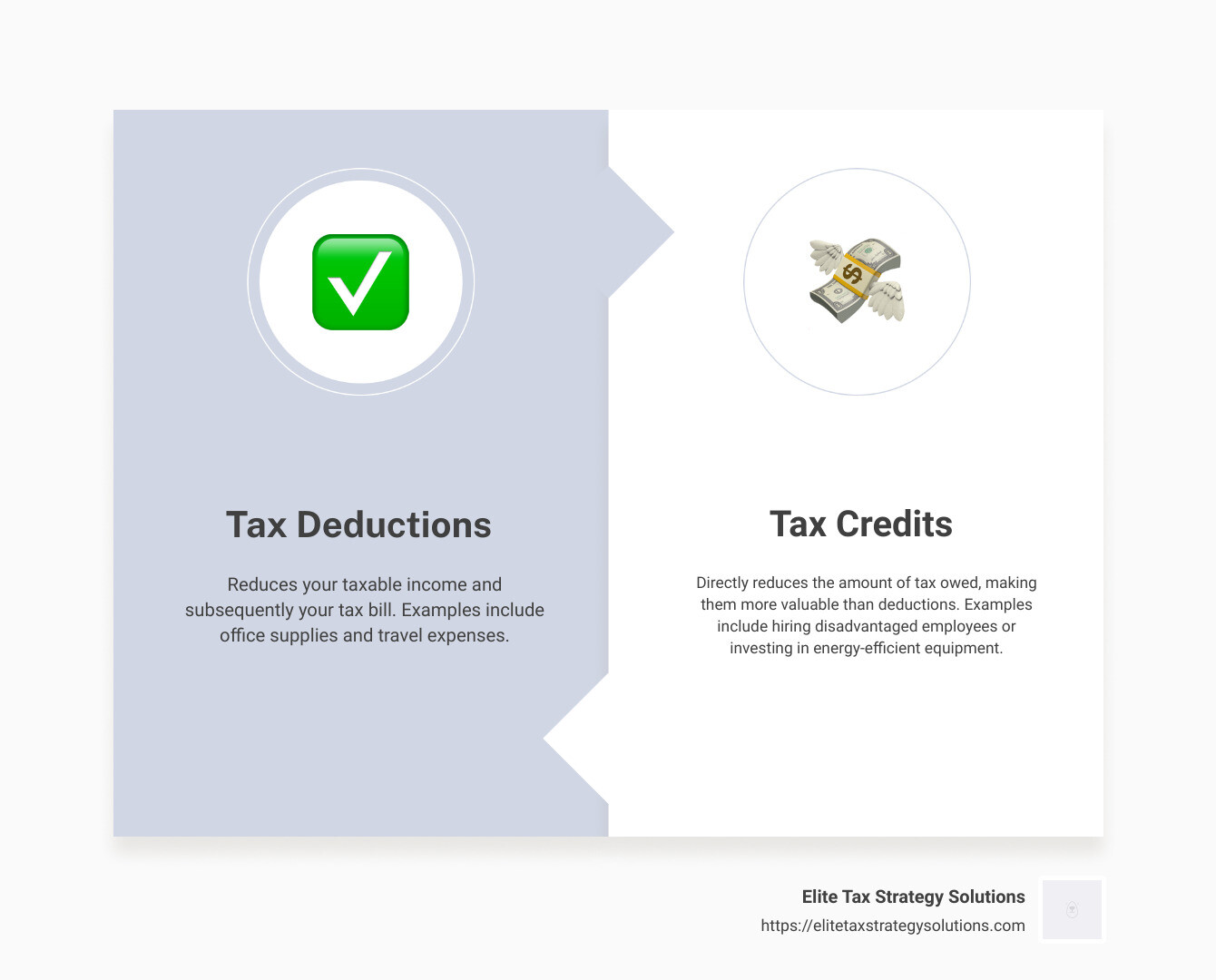
When it comes to tax savings for businesses, understanding deductions and credits can make a significant difference to your bottom line. Here’s a quick rundown:
- Tax Deductions: Lower your taxable income and, as a result, your tax bill.
- Tax Credits: Directly reduce the amount of tax owed; more valuable than deductions.
Tax deductions might include expenses for office supplies or travel, while tax credits could cover hiring disadvantaged employees or investing in energy-efficient equipment. These strategies are especially important for small businesses aiming for financial stability.
The world of tax can often feel overwhelming. However, the right strategies can ease your burden and help maximize your earnings.
I’m David Fritch, and with over 40 years in tax and financial advisory, including time at Arthur Andersen, my expertise at Elite Tax Strategy Solutions lies in turning these complex tax strategies into actionable plans for business success. Join me as we dive deeper into these strategies.
Simple tax savings for businesses word guide:
– business tax reduction
– tax planning for small businesses
– maximize tax savings
Understanding Tax Deductions and Credits
Navigating taxes can be tricky, but understanding the difference between tax deductions and tax credits is crucial for maximizing your tax savings for businesses.
Tax Deductions: Lowering Your Taxable Income
Tax deductions reduce the amount of income that is subject to tax. This means you can lower your taxable income by deducting certain business expenses. Here are some common deductions businesses can claim:
-
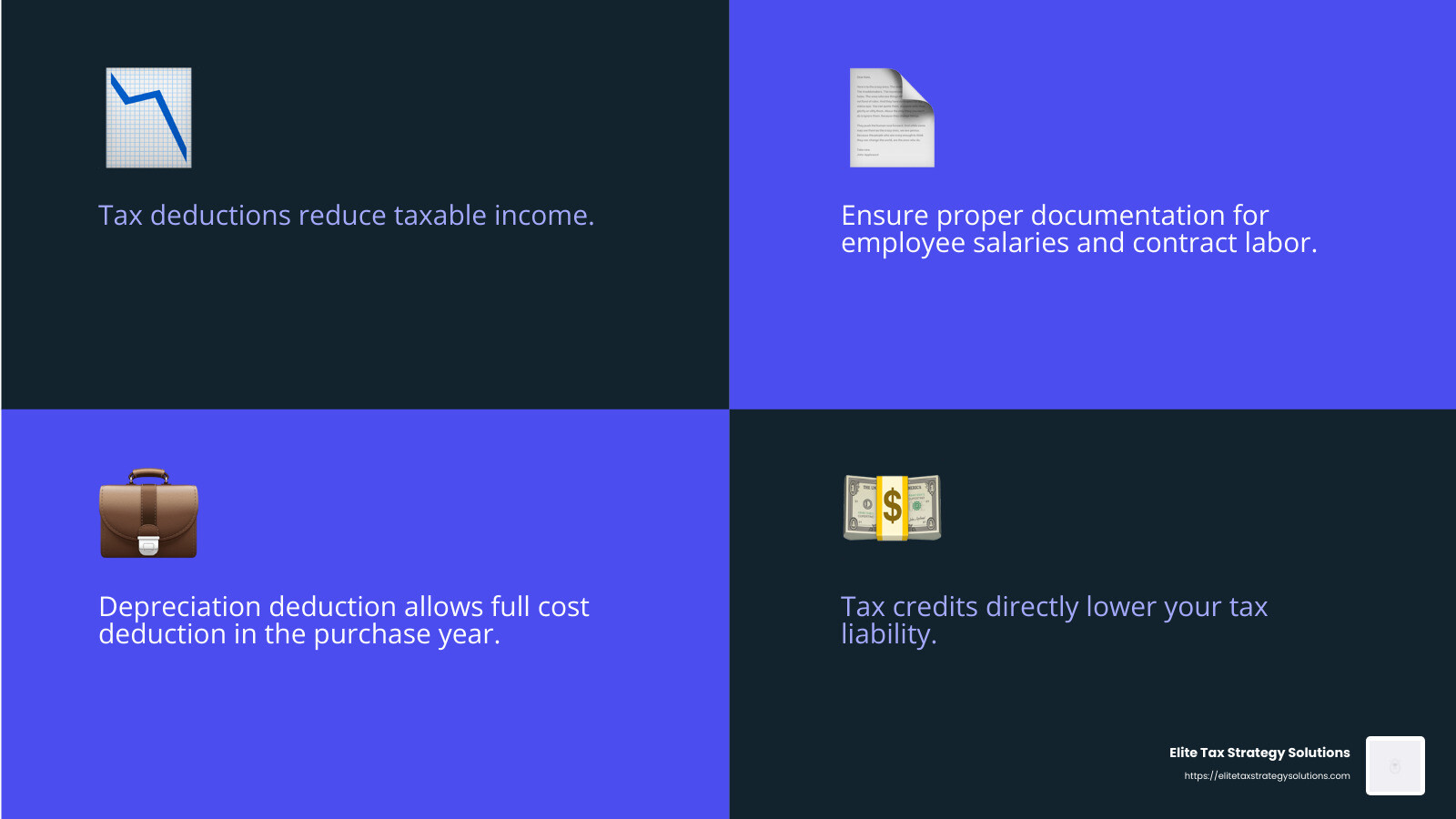
Employee Salaries and Contract Labor: Every dollar you pay to employees or contractors can be deducted, provided you have proper documentation. Collect W-4 forms for employees and W-9 forms for contractors, and issue 1099s at year-end.
-
Retirement Contributions: As a business owner, contributions to retirement accounts like SEP IRAs or Solo 401(k)s are deductible. You can deduct up to $69,000, which can significantly lower your taxable income.
-
Depreciation Deduction (Sec. 179): This allows you to deduct the full cost of tangible assets like equipment or machinery in the year of purchase, rather than spreading it out over several years.
Tax Credits: Directly Reducing Your Tax Bill
Unlike deductions, tax credits directly reduce the amount of tax you owe. Some credits even offer a dollar-for-dollar reduction in your tax bill. Here are some credits businesses might consider:
-
Work Opportunity Tax Credit (WOTC): This credit is available to employers who hire individuals from certain targeted groups facing barriers to employment.
-
Fuel Tax Credit (FTC): Businesses using fuel for specific work-related activities can claim this refundable credit.
-
Small Business Health Care Tax Credit: This benefits small businesses providing health insurance benefits, reducing the cost of offering these essential perks.
The Impact on Your Bottom Line
Utilizing both deductions and credits can lead to substantial tax savings. For example, if a business owner like Joe finds $6,000 in deductible expenses, his tax liability can decrease by over $1,500. This kind of savings can be crucial for reinvesting in the business or improving cash flow.
Understanding and leveraging these tax strategies can significantly impact your business’s financial health. By reducing your taxable income and tax liability, you can keep more money in your pocket, driving growth and stability.
Next, we’ll explore top tax-saving strategies that can further improve your business’s financial performance.
Top Tax-Saving Strategies for Businesses
When it comes to tax savings for businesses, employing smart strategies can make a big difference. Here are some top tactics to consider:
Employ Family Members
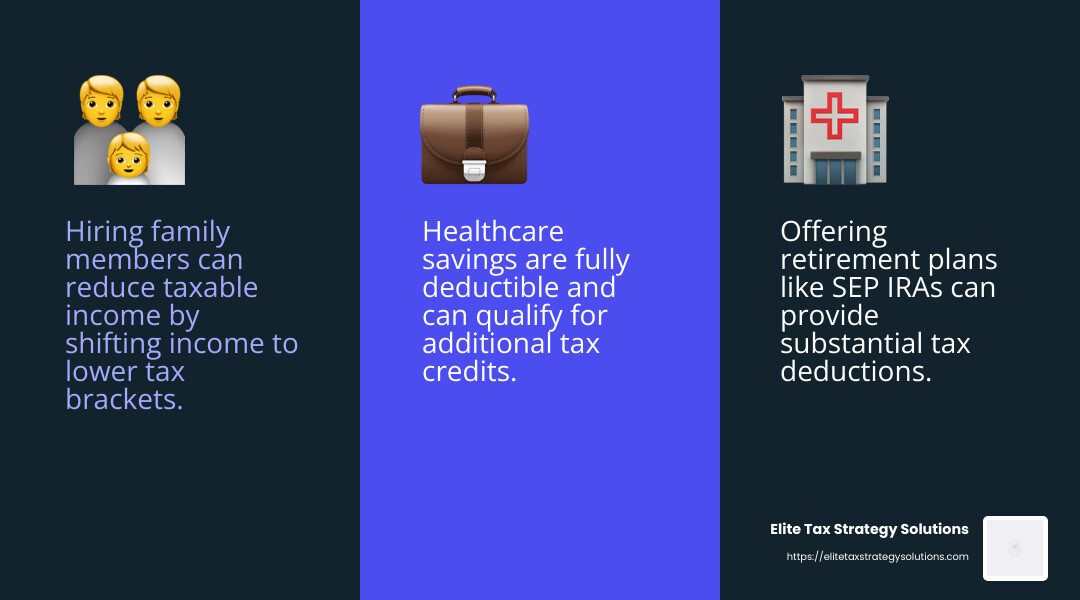
Hiring family members can be a win-win. Not only can you reduce your business’s taxable income, but you can also provide income to your loved ones. For instance, hiring your children can shift income from your higher tax bracket to their lower one. If they earn less than the standard deduction, they may not owe any income tax at all.
However, it’s important to ensure that the work they do is legitimate and properly documented. This strategy can be highly beneficial, especially for sole proprietorships, as it can also reduce payroll taxes like FICA.
Retirement Plans
Offering retirement plans is a great way to attract and retain employees while enjoying tax benefits. Options like SEP IRAs or Solo 401(k)s allow you to contribute as both employer and employee, providing substantial deductions. As of 2024, you can deduct up to $69,000 in contributions, which can significantly lower your taxable income.
Additionally, setting up a retirement plan might qualify your business for tax credits to offset startup costs.
Healthcare Savings
Providing employee benefits, such as health insurance, is not only a great way to keep your team happy but also a smart tax strategy. The costs associated with offering health benefits are fully deductible. Moreover, small businesses may qualify for the Small Business Health Care Tax Credit, which helps reduce the cost of providing these benefits.
Choosing the Right Business Structure
The structure of your business can have a significant impact on your tax obligations. C-Corporations and S-Corporations, for example, can help you avoid self-employment taxes, which can be a substantial saving. However, each structure comes with its own set of requirements and implications, so it’s crucial to weigh the pros and cons with a tax advisor.
Travel Deductions
Traveling for business? You can deduct expenses like airfare, hotels, and meals, as long as they are directly related to business activities. Keep detailed records of your trips to ensure compliance with IRS requirements. A well-planned business trip can lead to substantial tax savings, making it a valuable strategy for businesses of all sizes.
Implementing these strategies can help optimize your business’s tax position, improving your bottom line and freeing up resources for growth. Up next, we’ll dig into maximizing the Qualified Business Income (QBI) Deduction to further improve your financial performance.
Maximizing the Qualified Business Income (QBI) Deduction
One powerful strategy for tax savings for businesses is maximizing the Qualified Business Income (QBI) Deduction. This deduction was introduced as part of the Tax Cuts and Jobs Act and offers significant benefits to eligible businesses.
Understanding the QBI Deduction
The QBI deduction allows certain pass-through entities to deduct up to 20% of their qualified business income. Pass-through entities include sole proprietorships, partnerships, S-corporations, and some LLCs. These businesses report their income on the owner’s personal tax return, rather than at the entity level.
For instance, if your business earns $100,000 in net income, you could potentially reduce your taxable income by $20,000 with the QBI deduction. This can result in substantial tax savings, especially for small business owners.
Who Qualifies?
Not all businesses qualify for the full deduction. The IRS has set income limits and other criteria. For 2024, the income threshold is $191,950 for single filers and $383,900 for joint filers. If your income exceeds these limits, the deduction may be reduced or phased out, depending on the nature of your business.
Certain “specified service” businesses, like those in health, law, or finance, have additional restrictions. However, exceptions exist, and careful planning can help some service businesses still qualify for the deduction.
How to Maximize the Deduction
To make the most of the QBI deduction, consider these tips:
-
Business Structure: Ensure your business is set up as a pass-through entity to qualify.
-
Income Planning: If your income is near the threshold, consider strategies to lower it, such as retirement contributions or deferring income.
-
Seek Professional Advice: A tax professional can help steer complex rules and ensure you’re maximizing the deduction legally.
By effectively leveraging the QBI deduction, you can significantly reduce your taxable income, keeping more money in your business and boosting your bottom line.
Next, we’ll explore essential business expenses that are 100% deductible, further enhancing your tax savings strategy.
Essential Business Expenses That Are 100% Deductible
When it comes to tax savings for businesses, knowing which expenses are fully deductible can make a big difference. Here are some key expenses that you can deduct entirely, helping to lower your taxable income and boost your bottom line.
Office Equipment
Office equipment is a necessary part of running a business, and the good news is that these expenses are 100% deductible. This includes items like:
- Computers and Accessories: Laptops, desktops, monitors, and peripherals.
- Printers and Scanners: Essential for daily operations and document management.
- Office Furniture: Desks, chairs, and filing cabinets.
- Software and Apps: Accounting software, productivity tools, and any other applications needed to run your business.
Keeping thorough records and receipts for these purchases is crucial. This not only helps in claiming deductions but also ensures you’re prepared in case of an audit.
Travel Expenses
Traveling for business can be costly, but many of these expenses are fully deductible. Here’s what you can deduct:
- Airfare and Transportation: Flights, trains, and car rentals for business trips.
- Lodging: Hotels and other accommodations while traveling for business.
- Meals: While typically only 50% deductible, meals provided to employees during travel are an exception and can be fully deducted.
To claim these deductions, ensure you keep detailed records of your travel itinerary, expenses, and the business purpose of each trip.
Client Gifts
Building strong relationships with clients can often involve giving gifts. The IRS allows you to deduct the cost of business gifts, up to $25 per recipient per year. While this may seem modest, it can add up if you have many clients.
For example, if you send holiday gifts to 50 clients, you can deduct up to $1,250. Remember to document each gift’s cost and business relationship to ensure compliance with IRS guidelines.
By understanding and utilizing these fully deductible expenses, you can effectively reduce your business’s taxable income. This not only helps in saving money but also allows you to invest more in growing your business.
Next, we’ll dig into how leveraging tax credits can further support business growth and improve your tax strategy.
Leveraging Tax Credits for Business Growth
Tax credits are a powerful tool for tax savings for businesses. They directly reduce the amount you owe in taxes. Let’s explore some key credits that can support your business growth.
Opportunity Zones
Investing in Opportunity Zones is a great way to boost your business and help communities. These zones are economically distressed areas where new investments, under certain conditions, may be eligible for preferential tax treatment. By investing in these areas, you can defer tax on eligible gains, and potentially reduce your tax liability. This not only aids your business but also contributes to community development.
Electric Vehicles
Switching to electric vehicles (EVs) isn’t just good for the environment; it can also be good for your bottom line. Businesses that purchase EVs may qualify for a tax credit. The amount of the credit varies based on the vehicle’s battery capacity. This credit can help offset the cost of investing in greener transportation options for your business.
Energy-Efficient Homes
If you’re a contractor building or renovating homes, you might qualify for tax credits by focusing on energy efficiency. Eligible contractors can claim up to $5,000 per home for constructing or substantially reconstructing qualified energy-efficient homes. This not only promotes sustainable building practices but also offers a financial incentive for eco-friendly projects.
Work Opportunity Credit
Hiring can be a challenge, but the Work Opportunity Tax Credit (WOTC) can provide financial relief. This credit encourages businesses to hire individuals from certain targeted groups who face employment barriers. By doing so, you can claim a credit for a portion of the wages paid to these employees. This not only supports your hiring efforts but also helps integrate more people into the workforce.
Utilizing these tax credits can significantly impact your business’s financial health. They not only provide immediate tax savings but also promote sustainable and inclusive business practices. By strategically incorporating these credits into your tax planning, you can improve your business growth while contributing positively to society.
Next, we’ll answer some frequently asked questions about tax savings for businesses to further clarify how you can maximize your tax strategy.
Frequently Asked Questions about Tax Savings for Businesses
What are the best tax-saving strategies for small businesses?
Small businesses have several strategies at their disposal to maximize tax savings. One effective approach is to employ family members. Hiring your children, for example, can allow you to shift income to a lower tax bracket, reducing your overall tax liability.
Another strategy is to invest in retirement plans. Small business owners can set up plans like SEP IRAs or Solo 401(k)s, which offer significant tax deductions. These not only help in saving for the future but also reduce taxable income.
Healthcare savings are also vital. Offering health insurance to employees can qualify you for tax credits, and Health Savings Accounts (HSAs) provide tax-free savings for medical expenses.
Choosing the right business structure can significantly impact your taxes. For instance, S-Corporations and C-Corporations can help avoid the self-employment tax, though each comes with different implications. Consulting with a tax professional can help you decide the best structure for your situation.
Finally, don’t overlook travel deductions. Business-related travel expenses, like flights, hotels, and meals, are often deductible, helping to reduce your taxable income.
How can business owners reduce their taxes effectively?
To reduce taxes effectively, business owners should carefully track and document all business expenses. Utilizing software or apps to log expenses can simplify this process and ensure nothing is missed.
Maximizing deductions is crucial. This includes deductions for home office use, vehicle expenses, and depreciation under Section 179, which allows for immediate expensing of equipment and property.
Engaging a knowledgeable CPA or tax advisor can also make a big difference. They can provide insights into tax credits and deductions you might not be aware of, such as the Qualified Business Income (QBI) deduction, which allows eligible businesses to deduct up to 20% of their qualified income.
Proactive tax planning throughout the year, rather than just at tax time, enables you to make strategic decisions that can lead to significant tax savings.
What business expenses are fully deductible?
Several business expenses are fully deductible, meaning they can be subtracted from your gross income to reduce your taxable income. Some of these include:
-
Office supplies and equipment: Items like computers, printers, and office furniture are fully deductible.
-
Travel expenses: Business-related travel costs, including airfare, lodging, and meals, can be fully deducted, provided they are properly documented.
-
Client gifts: While there are limits, small gifts to clients can be fully deductible up to a certain amount per client.
-
Professional fees: Costs for legal and accounting services that are directly related to your business operations are also fully deductible.
Understanding and utilizing these deductions can significantly lower your tax bill and support your business’s financial health.
Let’s explore the conclusion to wrap up our exploration of tax savings strategies and how Elite Tax Strategy Solutions can help you achieve financial stability.
Conclusion
Navigating business taxes can feel like a daunting task, but it doesn’t have to be. At Elite Tax Strategy Solutions, we specialize in turning complex tax codes into clear, actionable strategies custom to your business needs. Our proactive approach means we don’t just wait for tax season; we work with you year-round to maximize your tax savings and improve your financial stability.
Proactive Tax Planning: Our team of seasoned tax professionals is dedicated to keeping you ahead of the curve. We continuously update our strategies to align with the latest tax laws and regulations, ensuring that you benefit from every available deduction and credit. By planning proactively, we help you make informed decisions that can significantly reduce your tax liabilities.
Financial Stability: Our ultimate goal is to bolster your financial health. We understand that every business is unique, and so are its financial challenges. That’s why we offer personalized tax planning services that not only save you money but also align with your long-term financial goals. Whether it’s optimizing your business structure, leveraging tax credits, or maximizing deductions, we’re here to support your journey towards financial success.
Elite Tax Strategy Solutions is more than just a tax service provider; we’re your partners in achieving financial peace of mind. With locations in Jasper, Indiana, and suburban areas near major cities, we’re conveniently positioned to serve a diverse client base. Let us help you open up the full potential of your business through strategic tax planning.
For more information on how we can assist you in your financial planning journey, visit our Comprehensive Financial Planning page. Together, we can build a tax strategy that boosts your bottom line and secures your business’s future.