Why Telecommunications Tax Compliance Demands Expert Attention
Telecommunications tax compliance involves navigating one of the most complex and heavily regulated tax environments in the United States. Here’s what you need to know:
Key Components of Telecom Tax Compliance:
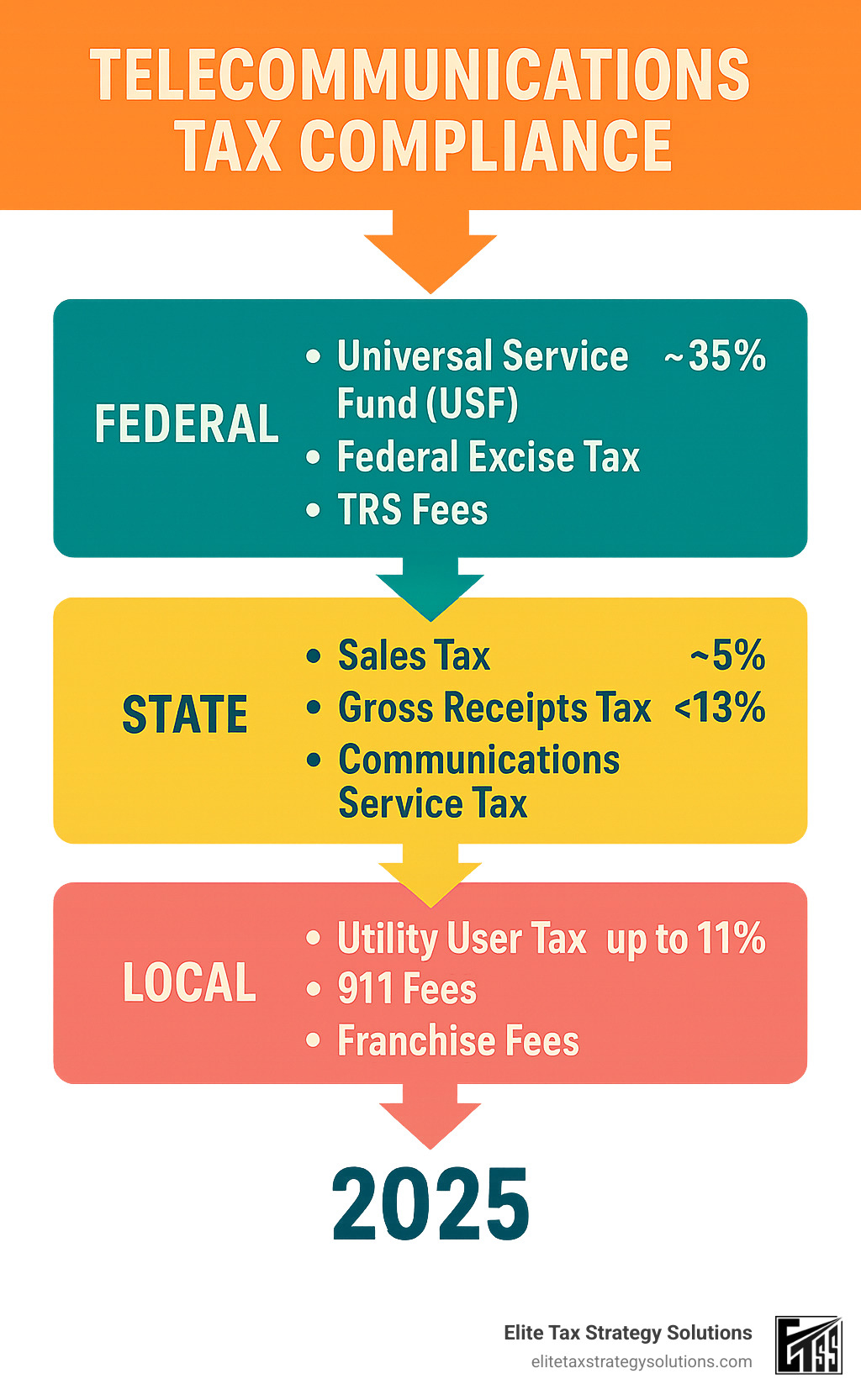
- Federal taxes and fees: Universal Service Fund (USF), Federal Excise Tax, Telecommunications Relay Services
- State and local taxes: Sales tax, gross receipts tax, utility user tax, communications service tax
- Regulatory requirements: Registration with multiple agencies, ongoing reporting, fee remittance
- Compliance challenges: Over 10,000 tax jurisdictions, constantly changing rules, attributional nexus
The telecommunications industry faces a total tax burden that can exceed 30% – making it one of the most heavily taxed industries in America. Unlike other businesses, telecom companies must comply with federal, state, and local tax obligations wherever they have customers, not just where they’re physically located.
This creates what experts call “attributional nexus” – meaning your company may owe taxes in hundreds or even thousands of jurisdictions across the country. Florida’s communications service tax can exceed 13%, while California cities can impose utility user taxes up to 11%. Pennsylvania adds a 5% gross receipts tax specifically on telecom services.
The complexity doesn’t stop there. New technologies like VoIP, streaming services, and cloud-based communications are constantly reshaping what gets taxed and how. States are scrambling to update their tax codes, creating a moving target for compliance.
As David Fritch, with 40 years of experience helping businesses steer complex tax regulations, I’ve seen how telecommunications tax compliance can make or break a company’s profitability. My background includes managing both legal and CPA practices, giving me unique insight into the regulatory challenges telecom businesses face today.
Key terms for telecommunications tax compliance:
Why the Telecom Tax Landscape is Uniquely Complex
Picture this: you’re running a telecommunications company, and you think you’ve got your tax obligations figured out. Then you realize you need to track tax rules across over 10,000 jurisdictions in the United States alone. For large companies with national reach, this balloons to tracking as many as 60,000 state and federal tax revenue jurisdictions across North America.
Each jurisdiction has its own rates, rules, and regulations that seem to change faster than technology itself. What’s compliant today might land you in hot water tomorrow. This isn’t just about keeping up with one state’s sales tax – it’s navigating a constantly shifting maze of federal, state, and local requirements that would make even seasoned tax professionals break out in a cold sweat.
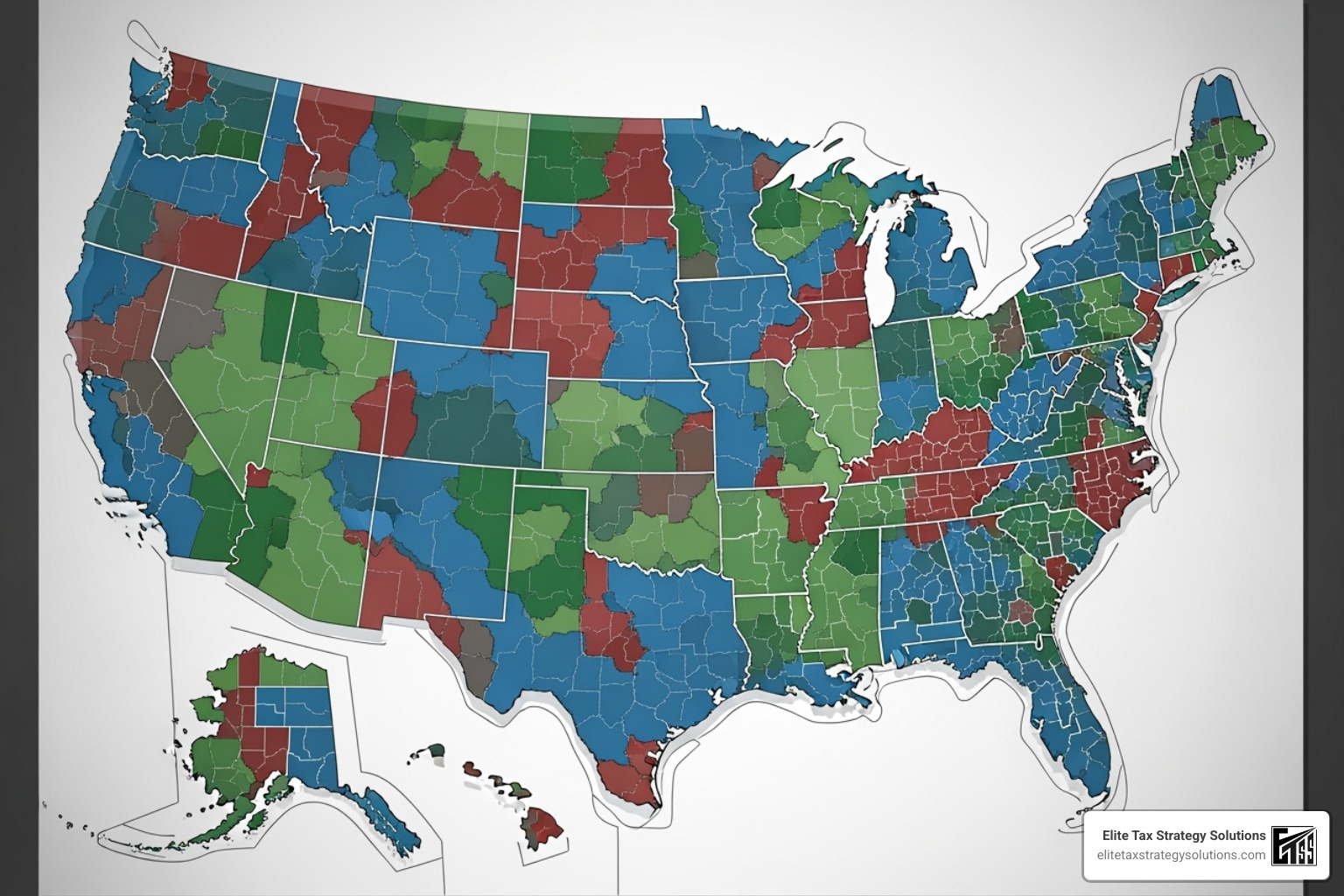
The telecommunications industry faces this jurisdictional complexity unlike any other business sector. While a retail store only worries about taxes where it has physical locations, telecom companies must deal with tax obligations wherever they have customers. This creates a web of compliance requirements that can quickly overwhelm even well-prepared businesses.
For companies operating across state lines, understanding Multi-state Sales Tax Compliance becomes absolutely critical to avoiding costly mistakes and penalties.
The Many Layers of Telecom Taxes and Fees
When we talk about telecommunications tax compliance, we’re dealing with a complex layer cake of obligations. Each layer has its own administrator, rules, and headaches.
At the federal level, you’ll encounter the Federal Excise Tax (FET) on certain long-distance services, though its scope has narrowed over the years. More significant is the Universal Service Fund (USF), administered by USAC. This fund supports telecommunications access in rural and underserved areas, and it’s arguably the single largest tax burden on telecom companies. The contribution factor hovers around 30% of assessable revenue and changes quarterly, making it a constantly moving target.
State-level obligations vary dramatically. Many states impose State Sales & Use Tax on telecommunications services, though defining what counts as a “telecommunications service” differs wildly from state to state. Florida hits companies with a two-part communications service tax that can exceed 13%, while California doesn’t apply state sales tax to telecom services but lets local jurisdictions make up the difference.
Some states prefer Gross Receipts Tax – a tax on total revenue regardless of expenses or profitability. Pennsylvania slaps a 5% gross receipts tax specifically on telecom services, Maryland imposes 2%, and New York can exceed 3% depending on customer location. These function like annual corporate taxes that significantly impact your bottom line.
Local governments add their own flavor with Local Utility User Tax (UUT). California cities and counties can impose UUT rates up to 11%, potentially requiring thousands of individual returns for companies operating nationally. Then there are 911/E911 Fees supporting emergency services, Franchise Fees for using public rights-of-way, and Telecommunications Relay Services (TRS) fees supporting communication services for individuals with disabilities.
What Makes Telecommunications Tax Compliance So Difficult?
The real challenge isn’t just the number of taxes – it’s the unique concepts that make telecom taxation a specialized field.
Attributional nexus is perhaps the most mind-bending concept. Unlike retail businesses that only have nexus where they maintain physical stores, telecom companies are considered to have nexus wherever they serve customers. Why? Because delivering services relies on infrastructure like switches, towers, and fiber optic cables within that state, even if you don’t own them. This means you’re obligated to collect taxes in potentially thousands of jurisdictions where you have users.
Sourcing rules add another layer of complexity. Where exactly is a telecommunications service consumed for tax purposes? Is it where the call starts, where it ends, or where the customer gets billed? For mobile services, the Mobile Telecommunications Sourcing Act generally points to the customer’s “primary place of use.” But for digital services, determining the “situs” where tax applies can be incredibly difficult.
Service classification keeps evolving as technology advances. Traditional voice calls were straightforward, but now we have VoIP, streaming services, Software-as-a-Service, and Internet of Things devices blurring the lines. States are scrambling to expand their tax base to include these new technologies, often with inconsistent definitions across jurisdictions.
Bundled services present their own puzzle. When you offer internet, voice, and streaming in one package, how do you determine what’s taxable? Some jurisdictions might tax the entire bundle if even one component is taxable. Accurately allocating revenue between taxable and non-taxable components requires precision that can make or break compliance.
All of this complexity leads to higher audit risk for telecommunications companies. Tax authorities know the revenue potential and complexity involved, making audits common. The heavier tax burden than other industries – often exceeding 30% – means even small compliance errors can significantly impact profitability.
This intricate web of regulations makes telecommunications tax compliance a critical business function that demands specialized expertise. Companies need strategies that go beyond basic compliance to protect their bottom line. Understanding when you might need a Tax Compliance Audit can help identify potential issues before they become costly problems.
Navigating the Top Challenges in Telecommunications Tax Compliance
Here’s the reality: the telecommunications industry moves at lightning speed, but tax regulations crawl along behind it. What worked for your telecommunications tax compliance strategy last year might leave you exposed today. It’s like trying to hit a moving target while blindfolded.
The biggest headache? Technology keeps evolving faster than lawmakers can write rules for it. One day you’re dealing with traditional phone services, the next you’re trying to figure out how to tax cloud-based communications that didn’t even exist when most tax codes were written.
The Impact of Evolving Technology like VoIP and Cloud Services
Let me clear up a dangerous myth right away: VoIP services are not tax-free just because they travel over the internet. I can’t tell you how many business owners I’ve met who thought their internet-based phone system was somehow exempt from taxes. That’s a costly mistake.
VoIP gets taxed and regulated just like your old landline did. The difference? It’s often harder to figure out where and how much to tax it. States are scrambling to update their rules, and they’re not waiting around for businesses to catch up.

The lines keep getting blurrier between telecommunications and IT services. Is your Software-as-a-Service platform a telecom service? What about your Unified Communications-as-a-Service solution? The answer depends on which state you’re asking – and sometimes even which county within that state.
This creates a nightmare for Digital Tax Compliance. You might think you’re selling cloud storage, but the state thinks you’re providing a communications service. Guess who wins that argument when audit time comes around?
Take Florida’s communications service tax – it can hit you with over 13% on services you might not even realize are taxable. Meanwhile, California doesn’t apply state sales tax to telecom services, but their cities and counties make up for it with utility user taxes that can reach 11%.
Untangling Bundled Services and Sourcing Rules
Picture this: you offer a package deal with internet access, VoIP calling, streaming video, and mobile data. Sounds simple to sell, right? Now try figuring out how to tax it across 50 states with different rules.
This is where telecommunications tax compliance gets really tricky. Some states will tax your entire bundle if even one piece is taxable. Others want you to split out each component and tax them separately. A few states might not tax any of it – but don’t get too excited, because their local jurisdictions probably will.
The real challenge comes with revenue allocation. You need to prove to tax auditors exactly how much of that $100 monthly bundle goes to taxable services versus non-taxable ones. Get it wrong, and you’re either overcharging your customers (making them unhappy) or undercharging taxes (making auditors very interested in your business).
Sourcing rules make things even more complicated. Let’s say you’re providing VoIP service to a company headquartered in Dallas, but their employees work from home across 15 different states. Where do you collect taxes?
The answer usually depends on each user’s “primary place of use” – not just where the company pays the bill. That means tracking individual customer locations, which gets especially messy with mobile services where people move around constantly.
Without accurate location tracking, you’re basically guessing where to apply taxes. That’s not a compliance strategy – that’s playing audit roulette.
The High Cost of Getting it Wrong
The consequences of messing up telecommunications tax compliance aren’t just theoretical scary stories. They’re real, they’re expensive, and they can seriously damage your business.
When tax authorities catch compliance mistakes, they don’t just ask for the missing taxes. They pile on penalties and interest that can quickly turn a small oversight into a major financial crisis. I’ve seen businesses face tax bills that were three times the original amount owed, just because of accumulated penalties.
Audits are incredibly disruptive to your operations. Your team gets pulled away from serving customers to dig through years of records and answer detailed questions. These audits can drag on for months, creating uncertainty and stress throughout your organization.
The financial impact goes beyond just paying back taxes. If you’ve been under-collecting, you might need to raise prices to cover future compliance costs, potentially losing customers to competitors. If you’ve been over-collecting, you face the nightmare of issuing refunds to potentially thousands of customers.
In extreme cases, repeated non-compliance can lead to license revocation. Imagine having your operating licenses pulled because you couldn’t keep up with tax obligations. For closely held businesses, owners can even face personal liability for unpaid taxes.
I’ve worked with companies that finded they hadn’t been filing returns in states where they had attributional nexus. The state didn’t just ask for current taxes – they demanded all back taxes, plus penalties and interest going back years. One small compliance gap turned into a six-figure problem almost overnight.
This is exactly why taking a proactive approach to telecommunications tax compliance isn’t just smart business – it’s essential for protecting your company’s future.
A Strategic Roadmap for Ensuring Compliance
You might be feeling overwhelmed by now – and honestly, that’s completely understandable! The good news is that there’s a clear path through this maze of telecommunications tax compliance. The key lies in combining smart technology with solid processes and, when needed, expert guidance.
Think of it this way: you wouldn’t try to manually calculate payroll for thousands of employees across multiple states, right? The same principle applies here. The sheer volume of tax jurisdictions and constantly changing rules makes manual compliance nearly impossible for most companies.
Leveraging Technology and Automation
Here’s where technology becomes your best friend. Modern tax calculation engines are specifically built to handle the unique challenges of telecommunications tax compliance. These aren’t your basic sales tax calculators – they’re sophisticated systems that understand the difference between a VoIP call and a streaming service, and they know exactly how to tax each one.

Billing system integration is crucial here. Your tax engine needs to talk directly to your billing platform so taxes get calculated automatically as invoices are generated. No more manual lookups or guessing games – the system handles it all in real-time.
The real magic happens with automated reporting and remittance. These systems can track regulatory changes, generate the complex reports you need (like those dreaded USF 499A forms), and even help you submit payments on time. Think of all the hours your team currently spends on manual tax calculations and filings – automation gives you that time back to focus on growing your business.
Reducing manual errors might be the biggest benefit of all. Every time someone manually enters a tax rate or calculates a fee, there’s a chance for mistakes. With thousands of transactions and hundreds of potential filings, those small errors add up fast. Automation eliminates most of these risks, giving you consistency and accuracy across your entire operation.
For companies looking to take this even further, exploring options for Sales Tax Compliance Automation Companies or Outsourcing Sales Tax Compliance can be game-changing decisions.
Essential Steps for Telecommunications Tax Compliance
Let’s break down the practical steps you need to take. This isn’t just theory – these are the concrete actions that will keep you compliant and protect your business.
Start by defining and classifying every single service you offer. This means creating a detailed catalog of every product, service, bundle, and fee on your bills. Each one needs proper tax classification because a VoIP service gets taxed differently than cloud storage, which gets taxed differently than streaming video. Getting this foundation right is critical – mistakes here multiply across your entire customer base.
Conduct a thorough nexus study to understand exactly where you owe taxes. Telecommunications companies face “attributional nexus,” meaning you likely have tax obligations wherever you have customers, not just where your offices are located. This study should identify every federal, state, and local jurisdiction where you need to file returns.
Register with all required authorities before you start providing services in new areas. This includes the obvious ones like state revenue departments, but don’t forget about FCC registration, USAC for USF reporting, and potentially Public Utility Commission registrations depending on your services.
Implement that specialized tax calculation solution we talked about earlier. This system needs to integrate seamlessly with your billing platform and accurately apply taxes based on your service classifications and complex sourcing rules.
Managing exemption certificates is often overlooked but incredibly important. Government agencies, nonprofits, and resellers may be exempt from certain taxes. You need proper documentation to avoid collecting unnecessary taxes or, worse, failing to collect taxes from customers who aren’t actually exempt.
File returns and remit taxes accurately and on time – this is where all your preparation pays off. With proper systems in place, what once took days of manual work becomes a streamlined process. You’ll need to handle federal returns, state sales tax, local utility taxes, gross receipts taxes, and various surcharges, but automation makes this manageable.
The beauty of following this roadmap is that it transforms telecommunications tax compliance from a constant source of stress into a well-oiled part of your business operations. Your team can focus on innovation and customer service instead of drowning in tax paperwork.
For more comprehensive guidance on building these compliance systems, our Business Tax Compliance resources can help you create a framework that works for your specific situation.
Frequently Asked Questions about Telecom Tax Compliance
Over the years, I’ve noticed that telecommunications companies often ask the same questions when they first dive into tax compliance. The complexity can feel overwhelming, but understanding these key areas will help you get your bearings.
What is the Universal Service Fund (USF) and who has to pay it?
Think of the Universal Service Fund (USF) as America’s way of ensuring everyone gets access to basic phone service, no matter where they live. It’s like a shared pot that helps fund telecommunications services in rural areas, schools, libraries, and healthcare facilities.
The Universal Service Administrative Company (USAC) runs the show – they’re an independent, non-profit group that the FCC designated to handle this massive program. Here’s what you need to know about who pays:
If your company provides interstate telecommunications services, you’re likely on the hook for USF contributions. This includes traditional phone companies, wireless carriers, VoIP providers, and even some broadband internet companies. The days of thinking “we’re just internet, so we don’t pay” are long gone.
The contribution factor is where it gets expensive. USAC calculates this quarterly based on your “assessable revenue” from interstate and international telecom services. Right now, that factor hovers around 30% of your assessable revenue – yes, you read that right. It’s one of the biggest single tax burdens in the telecom industry.
There is a small break for tiny companies through the “de minimis” exception, but most active telecom providers will need to file Form 499 and contribute to the fund. Companies get a Form 499 filer ID that shows whether they’re contributing directly or through another carrier.
How do I know where my company has nexus for telecom taxes?
This is where telecommunications tax compliance gets tricky, and honestly, it’s probably not what you’d expect coming from other industries.
The big difference is something called “attributional nexus.” Unlike a retail store that only worries about taxes where it has physical locations, telecom companies have nexus wherever they have customers. Why? Because you’re using infrastructure in that state to deliver your services – even if you don’t own the towers, fiber lines, or switches.
Let’s say you’re based in Jasper, Indiana, but you have customers in suburban Chicago. You’ve got nexus in Illinois because your service relies on infrastructure there to reach those customers. It doesn’t matter if you’ve never set foot in Illinois or if you’re just a small VoIP provider using someone else’s network.
Physical presence still counts, of course. If you have employees, offices, or equipment in a state, that creates nexus the traditional way. But for telecom, customer location is usually the bigger driver.
Economic nexus from the Wayfair decision is also starting to creep into telecommunications. Some states are applying sales thresholds to telecom services, creating nexus even for companies that only sell digitally into their state.
The challenge is that use of third-party infrastructure can create nexus in ways that aren’t always obvious. Even if you’re a small VoIP company that just resells services, you might have nexus in dozens of states based on where your customers are located.
Can I handle telecom tax compliance myself?
I’ll give you the straight answer: probably not, and trying could be expensive.
The DIY risks are real. We’re not talking about a simple sales tax situation here. One mistake in classifying your services or missing a jurisdiction can lead to penalties, interest, and audits that cost far more than getting help upfront. I’ve seen companies try to wing it only to face massive back-tax bills later.
The complexity of the rules is unlike anything else in business taxation. You’re dealing with over 10,000 tax jurisdictions, each with their own rates and definitions of what’s taxable. Federal requirements change quarterly, state rules evolve constantly, and new technologies keep blurring the lines between what’s taxable and what’s not.
You’ll definitely need specialized software – your regular sales tax system won’t cut it. Traditional tax engines designed for selling widgets don’t understand the nuances of telecom services, bundled offerings, or the sourcing rules that apply to your industry.
The value of expert guidance becomes clear when you realize that telecom tax isn’t just about compliance – it’s about strategy. A knowledgeable professional can help you structure your services, optimize your tax position, and avoid the pitfalls that trip up other companies.
Most growing telecom companies find that partnering with specialists actually saves money compared to trying to build internal expertise. The peace of mind alone is worth it when you’re dealing with tax burdens that can exceed 30% of your revenue.
If you’re feeling overwhelmed by all this, you’re not alone. Consider working with a Consultant Tax Compliance specialist who understands the telecom industry’s unique challenges.
Conclusion
The world of telecommunications tax compliance can feel overwhelming – and honestly, it should. With over 10,000 tax jurisdictions, constantly shifting regulations, and tax burdens that can exceed 30% of your revenue, this isn’t a challenge you want to tackle alone.
But here’s the thing: it doesn’t have to be a source of constant stress or financial drain. The companies that thrive in telecommunications are the ones that get ahead of these challenges rather than constantly playing catch-up. They understand that proactive compliance isn’t just about avoiding penalties – it’s about protecting profitability and creating a solid foundation for growth.
Think about it this way: every dollar you overpay in taxes because of poor compliance is a dollar that could have gone toward innovation, expansion, or competitive pricing. Every hour your team spends scrambling to fix compliance issues is time they’re not spending on what really drives your business forward.
The solution lies in taking a strategic approach from day one. This means implementing robust tax automation systems, conducting thorough nexus studies, properly classifying your services, and – perhaps most importantly – partnering with professionals who live and breathe these complexities every day.
At Elite Tax Strategy Solutions, we’ve seen how the right tax strategy can transform a business. Our proactive approach to tax optimization and compliance means you’re not just meeting requirements – you’re strategically managing your entire tax burden. We work with businesses throughout areas like Jasper, Indiana, and suburban communities near major cities, helping them steer complex obligations while maximizing their financial stability.
The telecommunications industry moves fast, and your tax compliance strategy needs to keep up. Don’t let complex regulations become a roadblock to your success.
Steer your complex tax obligations with expert support from Elite Tax Strategy Solutions.