Why Tax Preparer Compliance is Critical for Your Practice and Your Clients
Tax preparer compliance is the set of rules, ethical standards, and professional obligations governing how tax professionals operate. Understanding these requirements is essential to protect your practice and your clients’ interests.
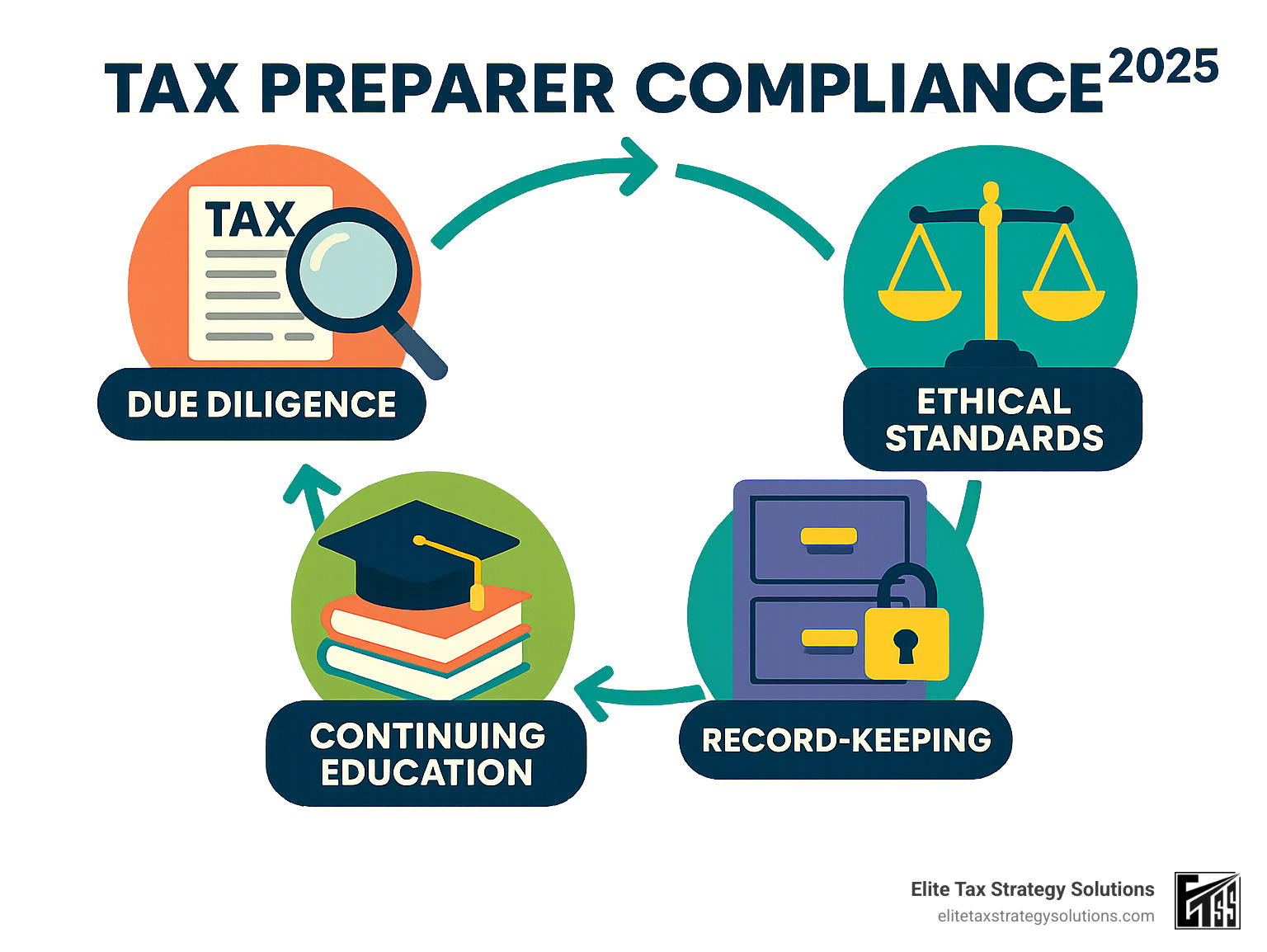
Key Tax Preparer Compliance Requirements:
- Due Diligence: Verify client information and credit eligibility (EITC, CTC, AOTC).
- Credentials: Maintain a valid PTIN and understand your representation rights.
- Ethics: Follow Circular 230 rules for practicing before the IRS.
- Record-Keeping: Implement a Written Information Security Plan (WISP) and retain documents.
- Continuing Education: Stay current on tax law and compliance.
- Penalty Awareness: Know the consequences, from fines to criminal charges.
The stakes are high. The IRS estimated a $26 billion loss from improper refundable credit payments in 2021, making compliance a top priority. Failing to attach Form 8867 can result in penalties of $600 per benefit, up to $2,400 per return. For high-income earners and closely held businesses, compliance failures can be devastating.
I’m David Fritch. With 40 years of experience owning a law firm and CPA practice, I’ve seen how tax preparer compliance failures can destroy careers. My background at Arthur Anderson’s tax department and helping thousands of business owners has shown me the importance of navigating these requirements to maximize tax savings.
Learn more about tax preparer compliance:
The Foundation of Compliance: Circular 230 and Professional Credentials
Understanding the fundamental rules that govern all tax preparers is essential for building a compliant practice.
The Role of Circular 230 and the OPR
The foundation of tax preparer compliance is Treasury Department Circular 230, the mandatory rulebook for practicing before the IRS. It sets the standards of practice for all tax professionals, ensuring ethical behavior, competency, and diligence.
Key obligations under Circular 230 include exercising due diligence, advising clients on potential noncompliance, and providing required information to the IRS. These are mandatory duties.
The Office of Professional Responsibility (OPR) enforces these rules. They investigate violations and can impose serious disciplinary actions, including censure, suspension, or complete disbarment. While the OPR also educates preparers, violations have career-ending consequences.
Understanding Credentials and Representation Rights
While anyone with a PTIN can prepare returns, your credentials determine your representation rights before the IRS. Every paid preparer must have a PTIN, but different credentials offer vastly different powers.
- Unlimited Representation Rights: This is the gold standard, held by professionals who can represent any taxpayer on any tax matter.
- Enrolled Agents (EAs) are federally licensed by the IRS.
- Certified Public Accountants (CPAs) are licensed by state boards.
- Attorneys are licensed by state bar associations.
- Limited Representation Rights: Annual Filing Season Program (AFSP) Participants can only represent clients for returns they prepared and only before certain IRS personnel.
- No Representation Rights: A PTIN alone offers no representation rights for returns prepared after December 31, 2015. You can prepare the return, but you are powerless to help your client if problems arise.
| Credential | Licensing Body | Representation Rights | Typical Continuing Education |
|---|---|---|---|
| Enrolled Agent (EA) | IRS | Unlimited | 72 hours every 3 years |
| Certified Public Accountant (CPA) | State Board of Accountancy | Unlimited | Varies by state (e.g., 80 hours every 2 years) |
| Attorney | State Bar Association | Unlimited | Varies by state |
| Annual Filing Season Program (AFSP) Participant | IRS (voluntary program) | Limited (for returns prepared by them) | 15 hours annually |
| PTIN Holder (without other credentials/AFSP) | IRS (mandatory registration) | None (for returns filed after 12/31/2015) | None required by IRS |
For high-income clients and complex business situations, unlimited representation rights are essential for effective representation during audits or challenges. Clients can verify any preparer’s credentials using the IRS directory of preparers, so transparency about your qualifications is key.
Mastering Due Diligence: The Core of Tax Preparer Compliance

Due diligence is the active, hands-on work required to ensure accuracy and is the essence of day-to-day tax preparer compliance.
Specific Due Diligence Requirements for Tax Credits
The IRS has focused due diligence requirements for credits that are frequently claimed incorrectly: the Earned Income Tax Credit (EITC), Child Tax Credit (CTC/ACTC), American Opportunity Tax Credit (AOTC), and the Head of Household (HOH) filing status.
Form 8867, the Paid Preparer’s Due Diligence Checklist, is a critical roadmap for this process. It guides you through verifying eligibility, such as a child’s relationship and residency for the EITC or a student’s qualifying expenses for the AOTC.
Failing to meet these requirements or attach Form 8867 can result in a penalty of $600 per tax benefit claimed, up to $2,400 per return. Our approach to Tax Audit Preparation integrates thorough due diligence from the start to build a strong, defensible return.
Common Errors and Non-Compliance Hotspots
Understanding common pitfalls is crucial for compliance:
- Failing to attach Form 8867: A simple but costly mistake.
- EITC and HOH Errors: Claiming children who don’t meet relationship/residency tests or manipulating income.
- CTC/ACTC Errors: Overlooking age limits, dependency rules, or residency requirements.
- AOTC Errors: Claiming the credit for ineligible students, non-qualifying expenses, or for more than four years.
- Income/Expense Reporting: Inaccurately reporting income and expenses is a major compliance risk, especially for high earners.
- Poor Documentation: Lacking adequate records for deductions and credits.
- International Compliance: Overlooking International Tax Compliance or FBAR requirements can lead to severe penalties.
Resources to Strengthen Your Due Diligence
Excellent resources are available to strengthen your due diligence:
- The IRS Tax Preparer Toolkit offers due diligence training modules, Schedule C training, videos, and webinars.
- Professional organizations like the National Association of Tax Professionals provide ethical guidelines and educational resources.
Using these resources and pursuing continuing education are key components of a robust Tax Risk Management strategy that protects both your practice and your clients.
The High Stakes: Penalties for Non-Compliance

Failing to meet compliance standards carries serious financial and professional risks.
Understanding Your Core Tax Preparer Compliance Obligations
As tax preparers, we are the first line of defense in tax preparer compliance. We handle most returns claiming key credits, and errors can affect billions in refunds and the tax system’s integrity. The IRS uses a “focused and tiered” approach to compliance, starting with education (like Letter 5025) but escalating to examinations, penalties, and even barring preparers from e-filing for serious or repeated errors.
Our approach to IRS Compliance Audit preparation is proactive, building compliance into every step to mitigate these risks from the outset.
Navigating Penalties for Tax Preparer Compliance Failures
Penalties for compliance failures can be severe, ranging from small fines to career-ending financial and criminal charges. It is critical to understand the potential consequences.
Common Penalties:
- Due Diligence (Form 8867): $600 per tax benefit claimed (up to $2,400 per return) for failing to meet due diligence for credits like EITC or CTC.
- Understatement of Liability: Penalties of $1,000 or 50% of your income from the return for an unreasonable position. This jumps to $5,000 or 75% of your income for willful or reckless conduct.
- Procedural Errors: Fines for not signing a return ($55) or failing to furnish a copy to the client ($50 per occurrence).
Severe Penalties:
- Fraud and False Statements: Criminal charges with fines up to $100,000 for individuals and up to three years in prison.
- Unauthorized Disclosure (IRC § 7216): Civil penalties of $250 per disclosure, plus potential criminal charges and up to one year in prison.
- Aiding and Abetting (IRC § 6701): Penalties of $1,000 per document ($10,000 for corporate returns).
The IRS considers your intent—careless, reckless, or intentional—when determining penalties. Some penalties, particularly for fraud, have no statute of limitations. For a complete list, review the Federal Tax Return Preparer Penalties Quick Reference Chart.
Understanding these risks motivates a serious approach to compliance. For our clients, we also help them understand How to Handle IRS Penalties Strategies to Potentially Avoid Paying when issues arise.
Essential Practices for Staying Compliant
Maintaining tax preparer compliance requires ongoing attention. This section covers the practical, everyday strategies to keep your practice healthy and compliant.
Record-Keeping and Data Security Mandates
Proper record-keeping supports your clients’ returns and protects both of you during an audit. The IRS has clear retention requirements:
- 3 years: The standard rule for most returns.
- 4 years: Required for employment tax records.
- 6 years: For returns with a substantial (more than 25%) understatement of gross income.
- 7 years: For claims involving worthless securities or bad debt deductions.
- Indefinitely: For fraudulent returns or when no return was filed.
Beyond keeping records, you must protect them. Every tax preparer is legally required to create and maintain a Written Information Security Plan (WISP). This plan details how you safeguard client data through physical and digital security measures. IRS Publication 4557 is an excellent guide for developing your WISP. For high-earning clients and businesses, robust data security is a critical component of Business Tax Compliance.
Staying Informed on Evolving Tax Laws
Tax law changes constantly, so staying current is essential for maintaining tax preparer compliance and serving clients effectively.
- Continuing Professional Education (CPE): CPE is the backbone of professional development for CPAs, EAs, and AFSP participants, ensuring you are up-to-date on new laws.
- IRS Resources: The IRS provides direct access to official guidance through publications, the IRS Newswire, and the IRS news for paid preparers page.
- Industry Engagement: Stay informed through industry publications, professional networking, and following proposed regulations. Tracking changes to Circular 230 or Business Tax Regulations allows you to anticipate future requirements.
A commitment to lifelong learning not only meets compliance obligations but also improves your expertise, allowing you to provide better, more proactive advice to your clients.
Frequently Asked Questions about Tax Preparer Compliance
Here are answers to common questions about tax preparer compliance.
What is the single most important regulation for tax preparers?
Treasury Department Circular 230 is the foundational document for all tax professionals. It establishes the mandatory rules, ethical standards, and best practices for anyone practicing before the IRS. Its comprehensive scope covers everything from due diligence to disciplinary procedures. The Office of Professional Responsibility uses Circular 230 as its enforcement tool, and violations can lead to censure or disbarment. Understanding and following it is essential for protecting your practice.
What is the difference between a PTIN and an EFIN?
A Preparer Tax Identification Number (PTIN) is a personal identifier required for anyone who prepares federal tax returns for compensation. It is your individual license to prepare returns.
An Electronic Filing Identification Number (EFIN) is a business identifier that authorizes a firm to e-file returns. It is mandatory for preparers who file 11 or more returns per year.
In short, the PTIN identifies the individual preparer, while the EFIN identifies the authorized e-filing business.
Can I appeal a penalty from the IRS?
Yes, tax preparers have the right to appeal most penalties. The process is formal but manageable. It begins by submitting a formal written protest to the IRS within the specified timeframe. Your case will be reviewed independently by an IRS Appeals Officer. The key to a successful appeal is providing a comprehensive explanation and strong supporting documentation that shows why the penalty should not apply, based on facts, law, or reasonable cause.
Conclusion
Tax preparer compliance is the foundation of a professional practice built on integrity and trust. By mastering Circular 230, due diligence, and record-keeping, we do more than just avoid penalties—we protect our clients, safeguard their financial futures, and build a reputation for excellence.
Mastering these fundamentals allows us to steer complex tax situations with confidence. For high earners and closely held businesses, the stakes are even higher, requiring preparers who excel at compliance, not just meet minimums. Staying ahead of regulatory changes and upholding the highest ethical standards is what builds lasting client relationships and a thriving practice.
At Elite Tax Strategy Solutions, we view tax preparer compliance as the starting point. Our proactive and thorough approach to Tax Support and Compliance ensures every detail is handled with precision. We anticipate tomorrow’s challenges to protect your clients and your professional reputation. When compliance is second nature, your practice is positioned not just to survive, but to thrive.