
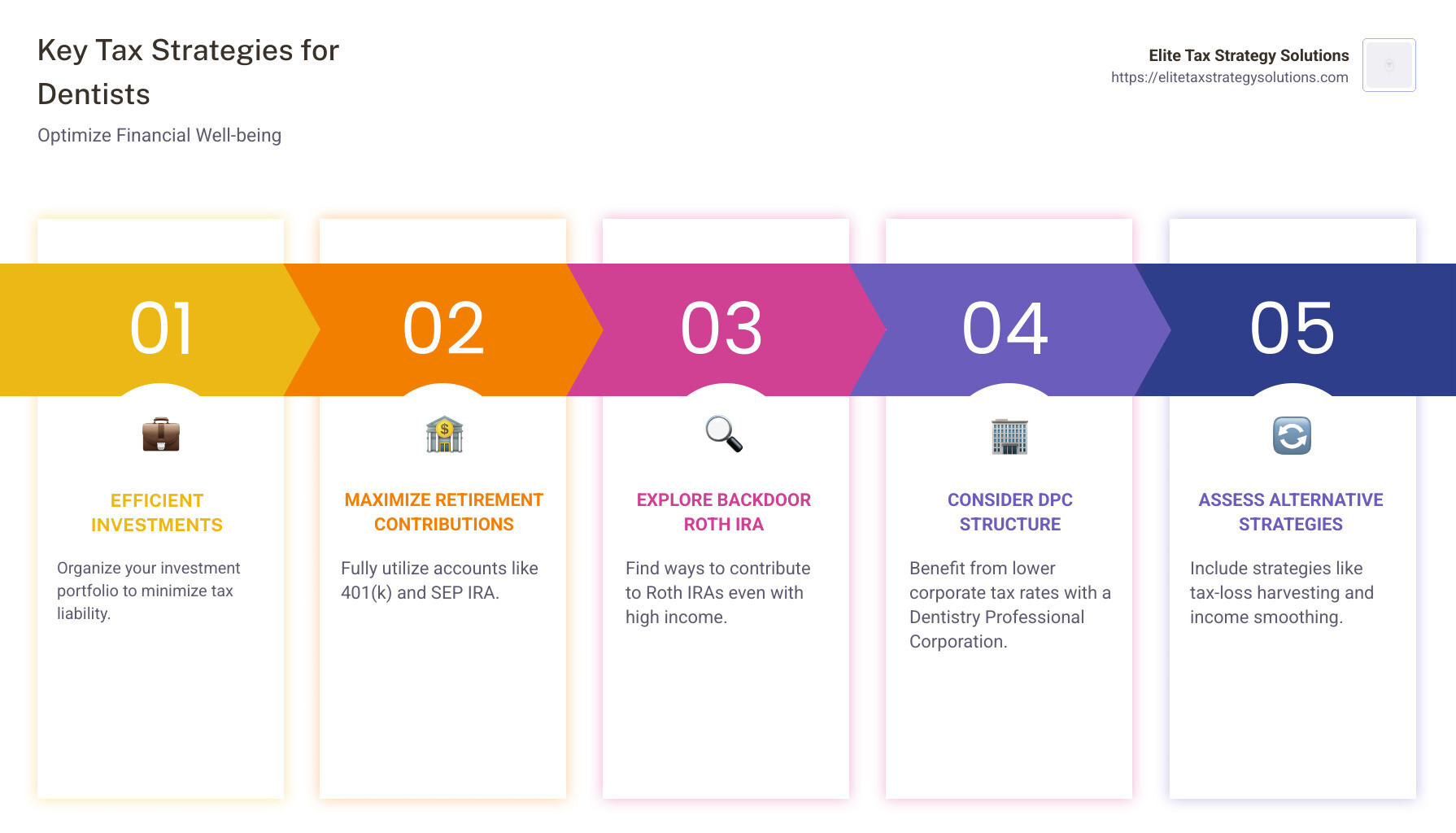
Managing the tax planning for dentists is a critical step towards ensuring financial well-being for those in the dental profession. Dentists often face significant tax burdens due to their high-income level and complex financial situations. By employing effective tax planning strategies, they can significantly reduce these burdens and increase their take-home income. Here are some quick considerations for optimizing tax outcomes:
- Efficient Investments: Organize your investment portfolio to minimize tax liability.
- Maximize Retirement Contributions: Fully use accounts like 401(k), SEP IRA.
- Explore Backdoor Roth IRA Options: Find ways to contribute to Roth IRAs even with high income.
- Consider Dentistry Professional Corporation (DPC): Benefit from lower corporate tax rates.
- Assess Alternative Tax Strategies: Include strategies like tax-loss harvesting and income smoothing.
My name is David Fritch. With over 40 years of experience in tax strategy consultation, including helping small business owners and high-income individuals in tax planning, I specialize in providing custom strategies to optimize tax savings. Transitioning to the detailed strategies improves financial stability, which is crucial for dental professionals.
Basic tax planning for dentists glossary:
- tax planning for consultants
- tax planning for high salaried employees
- business tax planning strategies
Tax Planning for Dentists
When it comes to tax planning for dentists, one of the first things to consider is choosing the right business entity. The structure of your dental practice can significantly impact your tax obligations and financial health. Here’s how:
Entity Selection
Dentists typically choose between an LLC or an S-Corporation for their practice.
-
LLC (Limited Liability Company): Offers flexibility in how you’re taxed, allowing you to choose to be taxed as a sole proprietor, partnership, or corporation. It’s great for shielding personal assets from business liabilities.
-
S-Corporation: Provides liability protection similar to an LLC but also allows you to avoid the double taxation issue common with C-Corporations. Plus, it can help cap self-employment taxes.
Choosing the right entity is crucial. It’s not just about taxes; it’s also about how you manage your business and protect your assets. Always consult with a tax advisor to ensure you’re maximizing benefits and avoiding pitfalls.
Tax Deductions
Dentists have unique opportunities for tax deductions. Here are a few key deductions to consider:
-
Section 179 Deduction: Allows you to deduct the full cost of qualifying equipment and software in the year you purchase it. This is particularly useful when investing in new dental technology.
-
Business Expenses: Proper categorization of major expenses as business expenses can lead to significant tax savings. This includes things like office supplies, utilities, and even some travel expenses if they’re business-related.
-
Dental Insurance Premiums: These can be tax-deductible if they are for procedures to prevent or alleviate dental disease. However, purely cosmetic procedures like teeth whitening are not deductible.
Retirement Plans
Maximizing contributions to retirement plans is another effective strategy for reducing taxable income. Dentists have several options:
-
401(k) Plans: Allows deferral of up to $22,500 in 2023, with an additional catch-up contribution if you’re 50 or older.
-
SEP IRA and SIMPLE IRA: These are great for practice owners who want to contribute a significant portion of their income towards retirement.
-
Health Savings Account (HSA): If you have a high-deductible health plan, consider contributing to an HSA. It offers triple tax advantages: contributions are tax-free, earnings grow tax-free, and withdrawals for qualified medical expenses are tax-free.

Incorporating these strategies into your tax planning can significantly improve your financial stability. By selecting the right business entity, taking full advantage of available tax deductions, and maximizing retirement contributions, dentists can keep more of their hard-earned money and set themselves up for a secure financial future.
Next, we’ll dig into maximizing retirement contributions to further optimize your tax strategy.
Maximize Retirement Contributions
Maximizing retirement contributions is a strategic move for dentists aiming to reduce their taxable income while securing their future. Here’s a closer look at some key options:
401(k) Plans
A 401(k) plan is a popular choice among many professionals, including dentists. It allows you to defer up to $22,500 in 2023, with an additional $7,500 if you’re 50 or older. These contributions not only lower your taxable income now but also grow tax-deferred until retirement.
SEP IRA
For solo practice owners or small dental offices, a SEP IRA offers a flexible option. You can contribute up to 25% of your net earnings, with a maximum of $66,000 in 2023. This plan is excellent for those who wish to save a significant portion of their income for retirement.
SIMPLE IRA
A SIMPLE IRA is suitable for practices with fewer employees. It allows contributions of up to $15,500 in 2023, plus an additional $3,500 for those 50 and older. It’s easy to set up and administer, making it ideal for smaller operations.
Health Savings Account (HSA)
If you have a high-deductible health plan, consider an HSA. It offers triple tax benefits: contributions are pre-tax, earnings grow tax-free, and withdrawals for qualified medical expenses are tax-free. In 2023, you can contribute up to $3,850 for individuals or $7,750 for families, with an extra $1,000 if you’re 55 or older.
Each of these retirement savings options not only helps reduce your taxable income but also builds a robust financial cushion for the future. By taking advantage of these plans, you can optimize your tax strategy and ensure a comfortable retirement.
Leverage Tax-Advantaged Accounts
When it comes to tax planning for dentists, leveraging tax-advantaged accounts can significantly enhance your financial strategy. These accounts not only help you save on taxes but also grow your wealth efficiently. Let’s explore three powerful options: backdoor Roth IRA, 529 plans, and Donor-Advised Funds (DAFs).
Backdoor Roth IRA
High-income dentists often find themselves ineligible for direct Roth IRA contributions due to income limits. The backdoor Roth IRA strategy involves making a non-deductible contribution to a traditional IRA and then converting it to a Roth IRA. Since the contribution is made with after-tax dollars, the conversion is typically tax-free.
This strategy allows you to enjoy tax-free growth and tax-free withdrawals in retirement, making it a valuable tool for dentists aiming to minimize future tax burdens.
529 Plans
A 529 plan is a tax-advantaged savings plan designed to encourage saving for future education costs. Contributions grow tax-free, and withdrawals for qualified education expenses are also tax-free. Many states offer tax deductions or credits for 529 plan contributions, and the funds can be used for a wide range of education-related expenses.
Donor-Advised Funds (DAFs)
For dentists with philanthropic goals, DAFs offer a strategic way to manage charitable giving while enjoying tax benefits. You can contribute to a DAF and receive an immediate tax deduction, then recommend grants to your favorite charities over time, allowing your contributions to grow tax-free in the interim.
This approach not only supports your charitable interests but also provides a flexible way to manage your tax liabilities. By leveraging these tax-advantaged accounts, dentists can strategically plan for the future, whether it’s saving for retirement, funding education, or supporting charitable causes.
Optimize Business Structure
Optimizing your business structure is a key part of effective tax planning for dentists. By choosing the right setup, you can protect your assets, lower your tax burden, and plan for the future. Let’s explore three options: Dentistry Professional Corporations (DPCs), holding corporations, and family trusts.
Dentistry Professional Corporations (DPCs)
A DPC allows you to run your dental practice as a corporation. This structure can offer significant tax advantages and protect your personal assets.
- Lower Taxes: DPCs benefit from a lower corporate tax rate, approximately 12% on the first $500,000 of income. Compare this to personal tax rates, which can be around 50% in many provinces. For example, a DPC earning $350,000 would pay roughly $42,000 in taxes, while an individual might pay nearly $150,000.
- Income Smoothing: If your income varies, a DPC lets you retain income during high-earning years and withdraw it during low-earning years, helping to even out your tax obligations.
However, DPCs come with higher administrative costs and can complicate personal financial matters, like securing personal loans.
Holding Corporations
Holding corporations don’t conduct business activities themselves. Instead, they manage investments and control other companies, including your dental practice.
- Income Splitting: You can distribute income among family shareholders, potentially reducing the overall family tax liability. For instance, adding your spouse as a shareholder might allow you to keep income in lower tax brackets. Be aware of rules like tax on split income (TOSI) and consult with a tax advisor.
Holding corporations share similar disadvantages with DPCs, such as increased complexity and administrative costs.
Family Trusts
Family trusts can be a strategic tool for managing assets and planning for the future. They allow trustees to hold and manage assets for beneficiaries, often family members.
- Wealth Transfer: Family trusts are effective for transferring wealth to future generations while minimizing tax liabilities. They provide flexibility in distributing income among beneficiaries, potentially reducing the overall tax burden.
By choosing the right business structure, dentists can optimize their tax planning, protect their assets, and plan for the future. Next, we’ll address some frequently asked questions about tax planning for dental professionals.
Frequently Asked Questions about Tax Planning for Dentists
Can you write off a dentist on taxes?
Yes, you can deduct certain dental expenses on your taxes. These expenses must be to prevent or alleviate dental disease, like exams, cleanings, and treatments. Cosmetic procedures, like teeth whitening, are not deductible.
To claim these deductions, you need to itemize them on Schedule A of your tax return. Only expenses that exceed 7.5% of your Adjusted Gross Income (AGI) are deductible. So, if your AGI is $100,000, you can only deduct expenses above $7,500.
How much do dentists make a year after taxes?
Dentists’ take-home pay varies widely depending on location, experience, and business structure. According to the ADA, the average dentist earns about $200,000 annually before taxes.
Federal taxes can significantly reduce this income. For instance, a dentist in a high tax bracket might pay up to 35% in federal taxes. State taxes can also impact take-home pay.
Effective tax planning for dentists can help minimize tax liabilities and maximize take-home pay. Dentists can use strategies like contributing to retirement plans and choosing the right business entity to reduce taxable income.
Are dental services taxable?
Dental services are generally considered personal services and are exempt from sales tax in most states. This means patients don’t pay sales tax on procedures like cleanings, fillings, or braces.
However, dentists should be aware of any state-specific rules or exceptions that might apply. Always consult with a tax advisor to ensure compliance with local tax laws.
Understanding these tax nuances helps dentists save money and stay compliant. Next, we’ll explore more about maximizing retirement contributions for dental professionals.
Conclusion
Navigating the complex world of taxes can feel overwhelming, especially for busy dental professionals. But with the right strategies, tax planning for dentists can lead to significant savings and improved financial stability.
At Elite Tax Strategy Solutions, we specialize in providing personalized tax planning services for high earners like dentists. Our proactive approach ensures that you not only comply with tax regulations but also maximize your savings. We understand the unique challenges dentists face, from managing a dental practice to personal financial planning.
By optimizing your business structure and leveraging tax-advantaged accounts, you can reduce your taxable income and keep more of what you earn. Whether you’re considering setting up a family trust or contributing to a backdoor Roth IRA, our team is here to guide you through every step.
Effective tax planning isn’t just about paying less tax today—it’s about securing your financial future. Let us help you achieve peace of mind and stability.
For more information on how we can assist you with innovative tax strategies, visit our service page. Let’s work together to build a brighter financial future for you and your dental practice.