What is Tax Compliance and Why Does It Matter?
A tax compliance accountant is a specialized professional who ensures individuals and businesses meet all their tax obligations by accurately preparing and filing tax returns, maintaining financial records, and staying current with ever-changing tax laws.
What a Tax Compliance Accountant Does:
- Prepares and files federal, state, and local tax returns
- Maintains accurate financial records and documentation
- Ensures compliance with current tax laws and regulations
- Minimizes tax liability through legitimate deductions and credits
- Provides audit support and IRS representation
- Advises clients on tax implications of business decisions
- Monitors changes in tax legislation and their impacts
Tax compliance is about meeting your legal tax responsibilities—filing returns correctly, paying what you owe on time, and following federal, state, and local laws. It’s not just about avoiding penalties. When done right, tax compliance becomes the foundation for your financial health and long-term success.
As the U.S. Bureau of Labor Statistics notes, the accounting field is projected to grow by 5% from 2024 to 2034, with median salaries reaching $81,680 annually. This stable demand reflects how crucial these professionals are to businesses and individuals alike.
For high earners and closely held businesses, tax compliance can feel overwhelming. The rules change constantly. One mistake can trigger an audit, penalties, or worse—damage to your reputation. That’s where a skilled tax compliance accountant becomes invaluable. They don’t just file your returns. They protect your financial stability and help you make smarter decisions.
As David Fritch, with over 40 years of experience owning a CPA practice and law firm, I’ve seen how the right tax compliance accountant can transform a business owner’s financial outlook from reactive stress to proactive confidence. Through Elite Tax Strategy Solutions, we’ve helped countless high-income earners steer complex tax regulations while maximizing their savings.
Tax compliance accountant word roundup:
The Core Role of a Tax Compliance Accountant

A tax compliance accountant is the guardian of financial accuracy, ensuring individuals and businesses—especially high earners and closely held businesses in Jasper, Indiana, and nearby suburban areas—adhere to all federal, state, and local tax laws. Their duties extend far beyond simply filling out forms.
Our role is more than compliance; it’s about mitigating tax risk and proactive advising. We prepare and file tax documents accurately, analyze financial data to find tax savings, and help clients understand the tax implications of their decisions, keeping them in a strong, compliant position.
Key Responsibilities and Daily Duties
The day-to-day work of a tax compliance accountant is dynamic and detailed, covering every aspect of a client’s tax obligations:
-
Tax Return Preparation: We prepare and submit federal, state, and local tax returns (income, payroll, sales, property). This includes complex corporate (Form 1120) or partnership (Form 1065) returns for businesses and detailed individual returns (Form 1040) for high earners, ensuring compliance with Indiana and local regulations.
-
Financial Record Maintenance: We help clients maintain clear, organized financial records. This creates an easily auditable trail, reducing stress and time during potential audits.
-
Tax Law Interpretation: We interpret complex federal, state, and local tax laws, applying them correctly to each client’s unique financial situation.
-
Client Communication: We explain complex tax matters in simple terms, answer questions, and communicate changes in tax law. Building client trust and confidence is paramount.
-
Audit Support: We provide comprehensive audit support if the IRS or state tax authorities inquire. This includes preparing documentation, representing clients, and negotiating to resolve issues.
-
Tax Payment Scheduling: We help clients manage cash flow by strategically scheduling tax payments, ensuring timely estimated payments to avoid penalties, which is vital for those with fluctuating incomes.
-
Identifying Tax Savings: We actively seek legitimate deductions, credits, and tax planning opportunities to minimize tax liability and maximize our clients’ financial health.
-
FBAR Filing: We assist clients with foreign financial interests in filing Foreign Bank Account Reports (FBAR – FinCEN Form 114) and other disclosures like Form 8938, ensuring compliance with international reporting requirements to avoid significant penalties.
Essential Skills for a Successful Tax Compliance Accountant
To excel, a tax compliance accountant needs a robust blend of technical proficiency and interpersonal acumen.
Key Hard Skills for Tax Accountants:
- Auditing Skills: A Franklin University analysis found 58% of tax accountant job postings require auditing skills. This involves examining financial records for accuracy, crucial for preparing returns and defending them in audits.
- GAAP Knowledge: Understanding Generally Accepted Accounting Principles (GAAP) is fundamental for ensuring financial statements are consistent and accurate, providing a reliable basis for tax calculations.
- Tax Software Proficiency: Expertise in tax preparation software (e.g., UltraTax, CCH ProSystem fx), accounting platforms (e.g., QuickBooks), and financial management systems is essential for efficiency and accuracy.
- Data Analysis: Tax accountants analyze financial data to identify trends, errors, and efficiencies. This analytical skill is key to optimizing tax strategies.
- Regulatory Knowledge: A comprehensive, up-to-date understanding of federal, state (Indiana), and local tax laws is non-negotiable.
Key Soft Skills for Tax Accountants:
- Attention to Detail: Small errors can have significant consequences. Our work demands meticulous attention to detail to ensure every number and regulation is applied precisely.
- Communication: We translate complex tax concepts into understandable language. Strong communication is vital for advising clients, collaborating with colleagues, and interacting with tax authorities.
- Time Management: Relentless tax deadlines require effective time management and organizational skills to manage multiple clients and ensure timely, accurate filings.
- Problem-Solving: Each client has unique challenges. We must be adept at identifying issues, researching solutions, and developing creative, compliant strategies.
- Ethical Judgment: Trust is paramount. Maintaining unshakeable ethical standards and sound judgment protects our clients and our reputation.
Common Challenges in Tax Compliance
The life of a tax compliance accountant is rarely dull due to the field’s inherent challenges:
-
Changing Tax Laws: The tax landscape constantly shifts with new legislation and guidance. Staying updated with these ever-changing laws, such as those in the IRS Tax Code, Regulations and Official Guidance, requires continuous learning, especially for high earners and businesses sensitive to legislative changes.
-
Tight Deadlines: Tax compliance has strict deadlines for quarterly and annual filings. Missing them results in penalties and interest. Managing these timelines for multiple clients during peak season demands exceptional organizational skills.
-
Complex Client Situations: High earners and closely held businesses often have intricate finances with multiple investments, income sources, and complex business structures. Navigating these complexities to ensure accurate reporting and optimize their tax position is a significant challenge.
-
Data Management: Collecting, organizing, and verifying large volumes of financial data from various sources can be cumbersome but is critical for accurate tax reporting.
-
International Tax Complexities: Many of our clients in Jasper, Indiana, and suburban areas have international dealings. Navigating complex international tax laws, treaties, and reporting requirements (like FBARs or FATCA) requires specialized knowledge to avoid pitfalls.
Career Path: Becoming and Growing as a Tax Professional

The career path for a tax compliance accountant offers consistent demand and growth. The Thomson Reuters Institute’s 2024 State of Tax Professionals Report highlights talent acquisition as a top priority for employers, reflecting stable demand for tax specialists. This makes it an appealing career for those interested in finance, law, and business.
Becoming a Tax Compliance Accountant: Education and Certifications
The journey to becoming a proficient tax compliance accountant typically begins with a strong educational foundation:
- Bachelor’s Degree: A bachelor’s degree in accounting is the standard entry point, providing foundational knowledge in financial accounting, auditing, and tax principles.
- CPA Certification: The Certified Public Accountant (CPA) license is highly regarded and often essential for career advancement, signifying advanced expertise and professional standards.
- Enrolled Agent (EA): An Enrolled Agent is a tax professional authorized by the IRS to represent taxpayers, demonstrating specialized expertise in tax law.
- Master’s in Taxation: A Master’s in Taxation (M.Tax) or an MBA with a tax concentration provides in-depth knowledge of complex tax laws and strategic planning.
- Relevant Experience: Practical experience through internships or entry-level positions is crucial for building proficiency in tax preparation, analysis, and client interaction.
Specializations and Niches
The field of tax compliance offers various specializations, allowing accountants to focus on areas that align with their interests and client needs:
- Corporate Taxation: Specializing in the tax needs of corporations (C-corps and S-corps), including income tax, payroll tax, and other business filings.
- International Taxation: Dealing with complex cross-border tax issues, international treaties, and foreign reporting requirements for clients with global interests.
- Estate Planning: Assisting with strategies to minimize estate and gift taxes, ensuring efficient wealth transfer through trusts, wills, and charitable giving.
- High-Net-Worth Individuals: Catering to the intricate tax situations of affluent clients, including diversified investments, executive compensation, and complex deductions.
- Flow-through Entities: Focusing on partnerships, LLCs, and S-corporations, which require expertise in Schedule K-1 and associated reporting.
Career Outlook and Salary Expectations
The career outlook for tax compliance accountants remains positive.
- Job Growth Projections: The U.S. Bureau of Labor Statistics projects 5% employment growth for accountants and auditors from 2024-2034, outpacing the average for all occupations.
- Median Salary: Accountants and auditors had a median annual salary of $81,680 in 2024. Payscale reported an average salary of $63,500 per year for tax accountants as of July 2025.
- Senior Accountant Salary: Experience boosts earning potential, with senior tax accountants earning an average of about $81,260 annually.
- Top Earner Potential: The top 10% of accountants and auditors earned more than $141,000 in 2024, highlighting the substantial earning potential for skilled professionals.
Elite Tax Strategy Solutions recognizes the value of these professionals. We ensure our team is well-compensated and continuously trained to deliver top-tier service to our clients in Jasper, Indiana, and suburban areas.
The Strategic Value of Tax Compliance in Business
For high earners and closely held businesses, tax compliance is a strategic imperative for financial health and informed decision-making. A proactive approach transforms compliance from a burden into a powerful tool for growth. It’s not just about following rules; it’s about making them work for you.
How Compliance Avoids Penalties and Legal Trouble
The most immediate benefit of robust tax compliance is avoiding the painful consequences of non-compliance. As the SaasAnt blog notes, failing to meet tax obligations can lead to significant financial penalties or legal action.
-
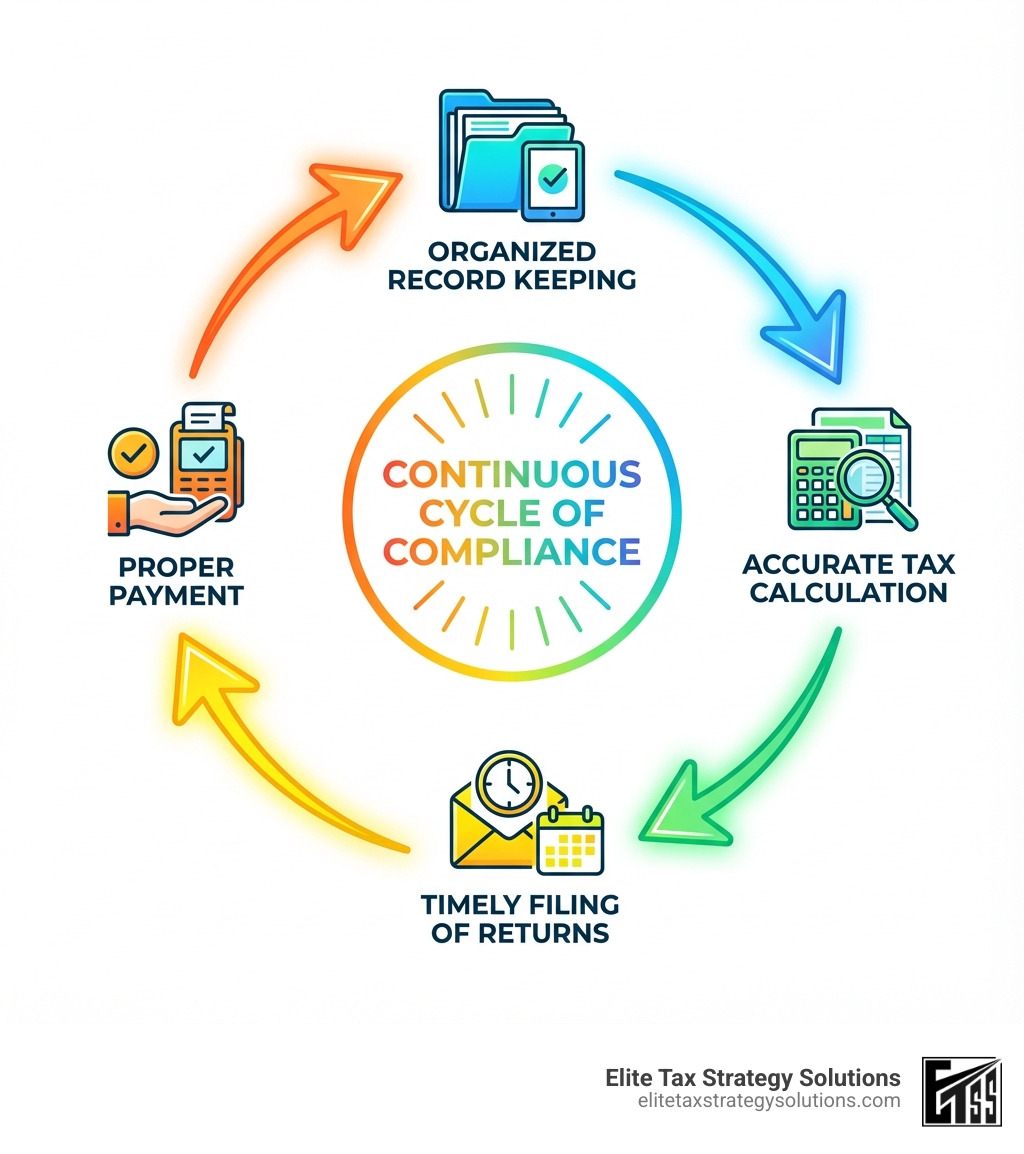
Accurate Filings and Timely Payments: These are the bedrock of penalty avoidance. We ensure all federal, state (Indiana), and local returns are filed correctly and on schedule, preventing penalties and legal issues. A history of timely submissions builds a positive record with the IRS.
-
Avoiding IRS Audits: Consistent, accurate compliance reduces audit likelihood and severity by minimizing red flags. If an audit occurs, our proactive approach ensures we are prepared with all documentation for a smoother resolution. The IRS’s own Tax Compliance Report page highlights how a clean report is invaluable for verifying obligations.
-
Preventing Liens and Levies: Non-compliance can lead to serious enforcement like tax liens or levies, which are financially damaging and tarnish a business’s reputation. Our diligent compliance efforts safeguard clients from these repercussions.
-
Maintaining Good Standing: Consistent tax compliance is crucial for maintaining good standing with state authorities, which is essential for renewing licenses, securing loans, and attracting investors. The real impacts of not being compliant can cause significant reputational and financial damage.
The Role of Technology and Staying Current
Technology has revolutionized tax compliance, making it more efficient and accurate.
-
Tax Software and E-filing: Advanced tax software streamlines filing, reduces errors, and ensures compliance. We leverage these tools for efficient e-filing, which is faster and more secure, as emphasized by the IRS guidance for authorized e-file providers.
-
Data Analytics Tools: We use data analytics to gain deeper insights into client financial data, helping us identify tax savings, spot discrepancies, and model the impact of different tax strategies.
-
AI in Accounting: Emerging AI technologies are beginning to automate routine tasks, improve fraud detection, and improve predictive analysis in tax compliance, allowing us to focus more on strategic advice.
-
Continuous Education and Professional Organizations: Our team at Elite Tax Strategy Solutions engages in continuous professional development, attends seminars, and participates in professional organizations to stay abreast of all tax law changes.
-
IRS Updates: We closely monitor announcements and guidance from the IRS and state tax departments to ensure our strategies reflect the most current requirements.
-
Process Streamlining: Technology allows us to streamline internal processes, from client onboarding to document management, ensuring a seamless experience for our clients.
From Compliance to Strategy: A Proactive Approach
For our clients, our role extends beyond basic compliance. We transform tax reporting from a reactive task into a proactive strategic advantage.
-
Tax Planning: We excel at tax planning. Instead of reacting to past financials, we plan for the future. We analyze goals to develop customized tax strategies that minimize liabilities and maximize wealth, identifying relevant tax credits and deductions for our clients in Indiana and suburban areas.
-
Identifying Credits and Optimizing Tax Structure: We actively identify overlooked federal and state tax credits (e.g., R&D, energy) that can significantly reduce tax burdens. We also advise on optimal business structures (e.g., S-corp vs. LLC) for the most favorable tax treatment.
-
Cash Flow Improvement: Strategic tax planning directly improves cash flow. By forecasting tax obligations and optimizing payment schedules, we help businesses maintain healthy liquidity for reinvestment and growth.
-
Contributing to Financial Strategy: We become part of our clients’ financial strategy teams. Our tax insights inform major business decisions, from investments to succession planning, ensuring every financial move is made with a clear understanding of its tax consequences. Learn about Innovative Tax Planning to see how we achieve this.
Tax Compliance Accountant vs. Other Accounting Roles
While all accounting roles involve numbers and financial data, a tax compliance accountant has a distinct focus compared to other professionals in the field, such as auditors or financial accountants. Each role serves a vital, yet different, purpose in the financial ecosystem.
| Role | Primary Focus | Key Responsibilities | End Goal | Typical Deliverables |
|---|---|---|---|---|
| Tax Compliance Accountant | Adherence to tax laws and optimization of tax liability | Preparing and filing tax returns, tax planning, audit support, interpreting tax regulations, identifying deductions/credits | Minimize tax burden, ensure legal compliance, avoid penalties, contribute to financial strategy | Tax returns (federal, state, local), tax planning reports, audit defense documentation, tax advice |
| Auditor | Verification of financial statements and internal controls | Examining financial records, assessing internal controls, ensuring adherence to GAAP/IFRS, identifying misstatements | Provide an independent opinion on the fairness and accuracy of financial statements, build stakeholder confidence | Audit report, management letter with recommendations for internal control improvements |
| Financial Accountant | Recording, classifying, and summarizing financial transactions | Maintaining general ledger, preparing financial statements (income statement, balance sheet, cash flow), budgeting | Provide accurate and timely financial information for internal and external stakeholders, historical reporting | Financial statements, general ledger, trial balance, financial reports for management |
A tax compliance accountant is primarily forward-looking and compliance-focused, ensuring that all current and future tax obligations are met efficiently and legally. An auditor, in contrast, is primarily backward-looking, verifying the accuracy of past financial records and internal processes. Financial accountants manage the day-to-day financial operations, producing the historical data that both tax accountants and auditors rely upon. While a CPA may perform any of these roles, the specialization of a tax compliance accountant is unique in its deep dive into the changing world of tax law.
Frequently Asked Questions about Tax Compliance Accountants
We often hear similar questions from high earners and closely held businesses as they seek to understand how a tax compliance accountant can best serve their needs. Here are some of the most common inquiries:
What’s the main difference between a tax preparer and a tax compliance accountant?
While both roles involve preparing tax returns, a tax preparer typically focuses on the transactional task of completing and filing returns based on information provided by the client. Their engagement is often seasonal, primarily during tax season. A tax compliance accountant, especially one working with high earners and closely held businesses, takes a much more comprehensive and strategic approach. We offer year-round advisory services, proactive tax planning, detailed financial record maintenance, audit support, and ongoing interpretation of complex tax laws. Our goal isn’t just to file a return, but to manage your overall tax position, minimize liabilities, and ensure long-term financial health. Think of it this way: a tax preparer might help you get through tax season, while a tax compliance accountant helps you strategically steer your taxes throughout the entire year and beyond.
Can a tax compliance accountant help with past-due taxes or IRS audits?
Absolutely. This is one of our critical functions. If you have past-due taxes, unfiled returns, or are facing an IRS or state tax audit, a tax compliance accountant can provide invaluable assistance. We can help you steer the complexities of resolving back taxes, prepare and submit delinquent returns, and explore options like installment agreements or offers in compromise. During an audit, we represent you before the tax authorities, organize and present necessary documentation, clarify discrepancies, and advocate for your best interests. Our expertise in tax law and procedures can significantly alleviate the stress and potential penalties associated with such situations.
Is a CPA certification required to be a tax compliance accountant?
No, a CPA certification is not strictly required to work as a tax compliance accountant. Many skilled professionals hold degrees in accounting or taxation and gain extensive experience without being a CPA. However, the Certified Public Accountant (CPA) license is highly respected and often preferred, especially for roles involving complex advisory services, public accounting, or firm leadership. A CPA designation signifies a higher level of education, rigorous examination, and adherence to strict ethical standards. For high earners and closely held businesses seeking comprehensive tax planning and strategic advice, a CPA-credentialed tax compliance accountant often brings an added layer of expertise and credibility. Other valuable certifications include Enrolled Agent (EA), which specifically authorizes representation before the IRS.
Conclusion: Your Partner in Financial Accuracy and Growth
In the intricate world of finance, the tax compliance accountant truly stands as an unsung hero. We are the architects of financial accuracy, the navigators of complex regulations, and the protectors of your hard-earned wealth. For high earners and closely held businesses in Jasper, Indiana, and suburban areas near major cities, our role is indispensable. We provide the peace of mind that comes from knowing your tax obligations are carefully managed, allowing you to focus on what you do best: growing your business and building your legacy.
At Elite Tax Strategy Solutions, we embody this proactive approach. We don’t just ensure you meet your tax obligations; we leverage every legitimate opportunity to maximize your tax savings and improve your financial stability. Our expertise transforms potential tax headaches into strategic advantages, turning compliance into a powerful tool for growth. When you partner with us, you gain more than just an accountant; you gain a dedicated advisor committed to your long-term success.
Ready to transform your tax compliance from a burden to a benefit? Get professional Tax Support and Compliance with Elite Tax Strategy Solutions.