Why Federal Tax Compliance is Critical for Your Financial Future
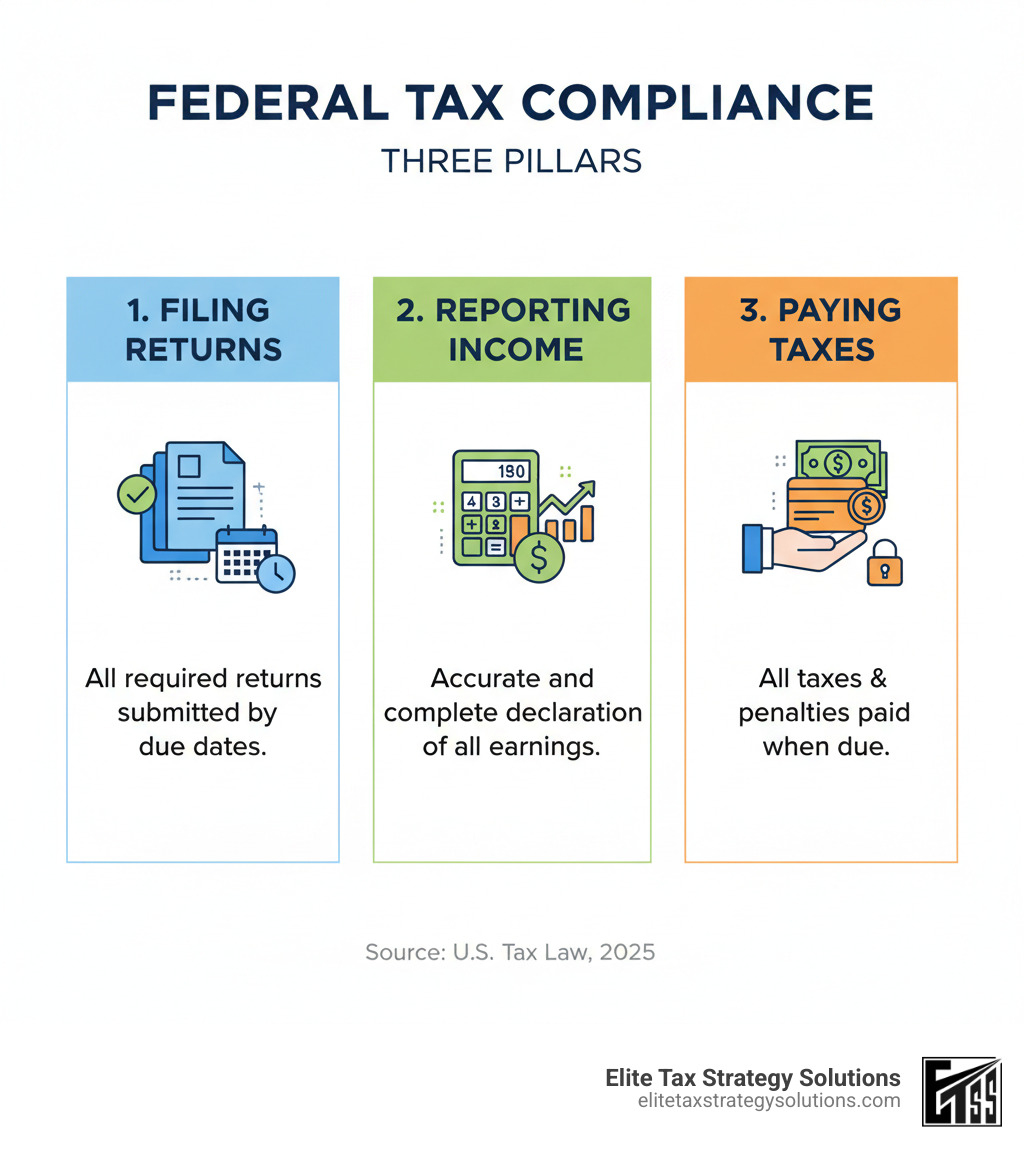
Federal tax compliance means meeting all your legal obligations under U.S. tax law. The IRS defines it simply as filing all required tax returns and paying all required taxes and penalties by their due dates.
Key Federal Tax Compliance Requirements:
- File all required tax returns by their due dates
- Pay all taxes, penalties, and interest when due
- Report all income accurately and completely
- Maintain detailed records to support your filings
- Comply with international reporting requirements (FATCA, FBAR) if applicable
The stakes are high. Americans spend over 7.9 billion hours and $546 billion annually—nearly 2% of GDP—on tax compliance. While individuals average 13 hours for a basic Form 1040, large corporations can spend up to 830 hours on their main tax form.
Non-compliance carries severe consequences:
- Late filing penalties of 5% per month (up to 25%)
- Late payment penalties of 0.5% per month (up to 25%)
- Accuracy-related penalties up to 20% of understated tax
- Interest that compounds daily on unpaid amounts
- Potential criminal prosecution for willful violations
The U.S. tax system relies on voluntary compliance, where taxpayers are expected to fulfill their obligations without direct IRS enforcement. However, compliance is not optional. The IRS estimates a $540 billion annual tax gap between taxes owed and collected, making enforcement a top priority.
I’m David Fritch, and with 40 years of experience as both a CPA and tax attorney, I’ve helped countless high-income earners and business owners steer the complexities of federal tax compliance. Through my firm Elite Tax Strategy Solutions, I’ve seen how proper compliance strategies can protect wealth while poor compliance can devastate financial futures.
Federal tax compliance vocab to learn:
Understanding the Foundations of Federal Tax Compliance

The IRS and U.S. Department of the Treasury manage the complex U.S. tax system. Their mission extends beyond tax collection to developing policies, creating regulations, and negotiating international tax treaties to ensure fairness.
The challenge is the tax gap—the difference between what Americans owe and pay—which sits at a staggering $540 billion annually. This shortfall shows why robust federal tax compliance is so critical. The Treasury Department analyzes these trends in its Tax Policy reports from the Treasury. For business owners, staying current on Business Tax Regulations is essential for avoiding costly mistakes.
What is Federal Tax Compliance?
The IRS definition is simple: “filing all required tax returns by the due date and paying all required taxes and penalties by the due date.”
The term “voluntary compliance” often causes confusion. It doesn’t mean paying taxes is optional. It means you are expected to follow tax laws without direct compulsion from the government. The system trusts you to comply, but there are real consequences for failing to do so.
The Three Types of Tax Regulations
Understanding federal tax compliance means knowing the three main types of tax regulations.
Procedural regulations are the IRS’s “how-to” manual, covering administrative details like filing deadlines, information placement, and audit processes.
Legislative regulations from the Treasury Department carry the full weight of law and are often used to create tax incentives. For example, the Inflation Reduction Act uses tax credits to promote green energy and electric vehicles, turning tax policy into economic policy.
Interpretive regulations clarify complex or unclear tax laws. The IRS issues these as Notices or Revenue Rulings to help taxpayers understand how to apply the law correctly.
Each regulation type is crucial for the structure that makes federal tax compliance possible. Understanding them helps you steer the system more effectively.
The Staggering Cost of Compliance in the U.S.
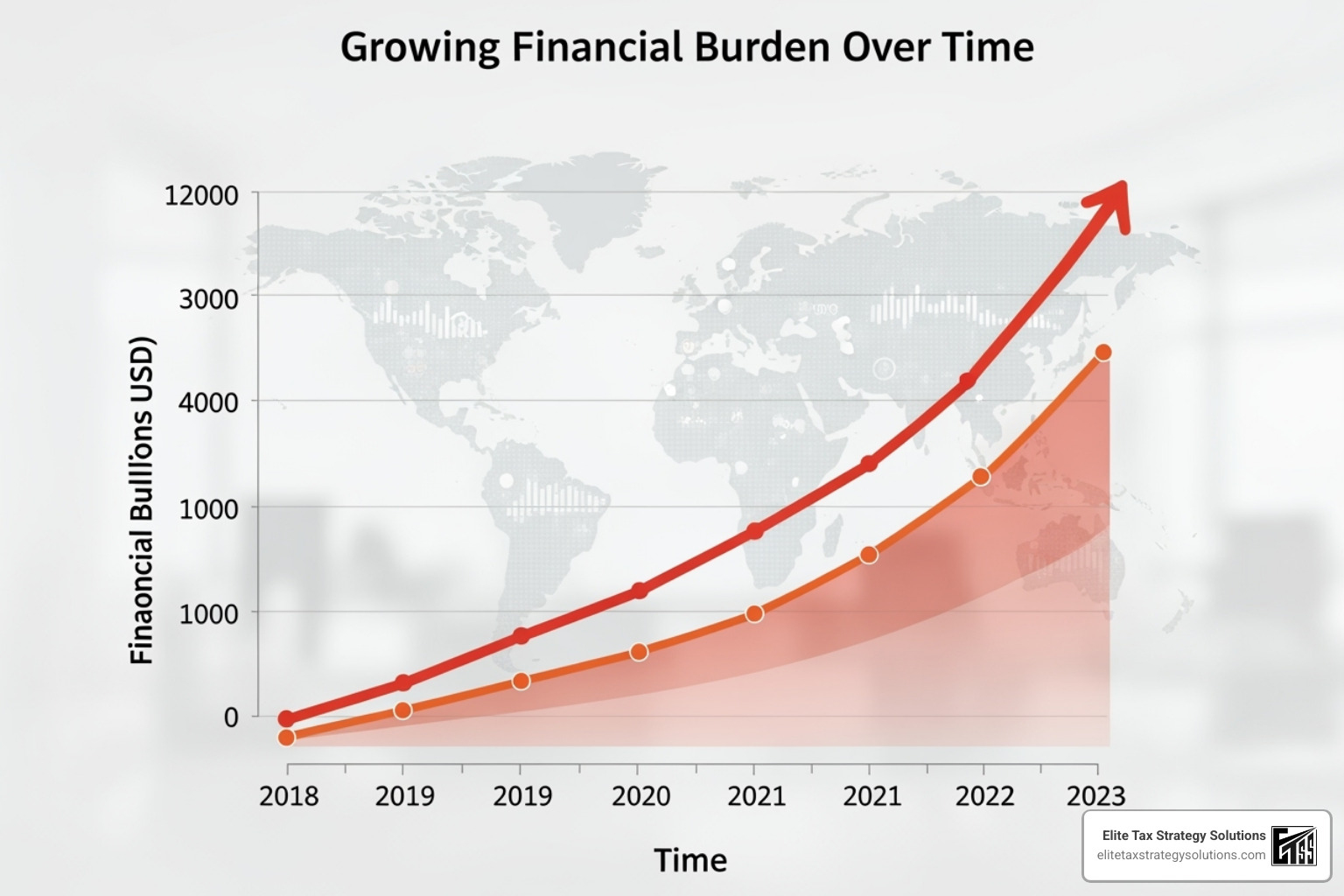
Americans spend a staggering $546 billion annually on tax compliance—not on taxes, but on the costs of preparing returns. This effort consumes 7.9 billion hours each year, equivalent to 3.8 million full-time jobs dedicated solely to tax preparation.
The economic impact is immense, representing nearly 2% of GDP and costing 26 times the IRS’s own annual budget. These costs include $133 billion in out-of-pocket expenses (like software and professional fees) and $413 billion in the value of our time. Every hour spent on taxes has real economic value.
Despite technological advances, the tax code’s complexity means efficiency gains are often offset by new rules. This makes effective Tax Risk Management more important than ever. For a deeper look at these figures, the IRS publishes detailed Taxpayer compliance burden estimates.
Compliance Costs: Individuals vs. Businesses
The burden of federal tax compliance is not shared equally. An individual filing Form 1040 spends about 13 hours on compliance, which can rise to 24 hours if they have business income.
Businesses face a much heavier load. A typical corporate Form 1120 takes 105 hours, while large corporations can spend 830 hours—over 20 full work weeks. Even pass-through entities face significant burdens, with the qualified business income deduction alone adding over $19 billion in compliance costs. Estates and trusts face $20.2 billion in annual compliance costs.
Recent legislation, like the Infrastructure Investment and Jobs Act, added new cryptocurrency reporting requirements, increasing the collective compliance burden by an estimated 1.4 billion hours and $123.7 billion. This highlights the growing importance of understanding 1099 Tax Compliance.
Taxpayer compliance now represents 66% of all time Americans spend on federal paperwork and 72% of all government-wide compliance costs. The growing complexity of tax laws continues to create extraordinary burdens for all taxpayers.
Proving Your Compliance: Reports, Audits, and Checks

Proving federal tax compliance often goes beyond timely filing. Third parties like employers, federal agencies, and banks may require verification of your tax standing.
This is common for federal employment, which requires IRS “suitability tax checks.” Historically inconsistent, these checks are now being standardized by the IRS Human Capital Office’s unified Tax Compliance Check Service. This effort improves consistency in broader IRS Compliance Audit functions.
Tax Compliance Report vs. Tax Transcript
When asked for proof of compliance, you may need a “tax compliance report” or a “tax transcript.” These IRS documents serve different purposes, and understanding the distinction helps you provide the right information without oversharing.
| Criterion | Tax Compliance Report | Tax Transcript |
|---|---|---|
| Purpose | To provide a summary of your tax compliance status to third parties who require verification. | To provide a detailed breakdown of your tax return information for a specific year. |
| Information Included | A summary of your compliance status (compliant, non-compliant, compliance issue), filing information, amount owed, and additional details like late payments or unfiled returns. Less personal/business information. | A comprehensive record of your tax return, including adjusted gross income, taxable income, tax paid, and other specific line items. More sensitive information. |
| Time Period Covered | A longer period, typically covering the last 4-6 years for filing and payment history, and up to 5 years for fraud penalties. | Generally covers a single tax year. |
| Best Use Case | When you need to show your general compliance status to an outside party, such as for a job application or a general business certification. Also, for federal contractors, Letter 6575 is the tax certificate for federal contract awards. | When you need detailed tax history for a specific year, such as for mortgage applications, financial aid, or detailed review by a tax professional. |
You can download a tax compliance report from your IRS online account. Individuals receive Letter 6201, while businesses get Letter 6575 for federal contract awards. Be aware that recent payments can take two weeks to appear, and returns can take four to six weeks to process.
Key Components of a Tax Compliance Report
Your tax compliance report provides a clear snapshot of your status, which the IRS categorizes into three buckets:
Compliant: You have filed all required returns and paid all taxes on time, with no outstanding debt.
Non-Compliant: You have an unfiled tax return or unpaid tax debt that requires immediate action.
Compliance Issue: You have specific problems to address, such as being in an installment agreement, having a history of late filings/payments, a recent civil fraud penalty, or a balance under IRS review.
The report also details filing information (timeliness of returns for the past six years), amount owed (outstanding liabilities for the past four years), and additional information (like civil fraud penalties from the last five years).
If your status is “non-compliant” or “compliance issue,” the report provides a roadmap for what to fix. Addressing these issues quickly is key to avoiding escalating penalties and is a core part of a solid Tax Audit Preparation strategy.
Navigating Common Pitfalls and International Obligations
Even careful taxpayers face federal tax compliance issues. Common mistakes stem from human error (like math mistakes), incomplete information (missing documents), or a lack of understanding of changing tax rules. These small errors can lead to significant IRS penalties, making it crucial to know How to Handle IRS Penalties.
Penalties for Non-Compliance
The IRS uses a range of severe penalties to encourage compliance, regardless of whether a mistake was intentional.
Financial penalties are significant. The late filing penalty is 5% of unpaid taxes per month (up to 25%). The late payment penalty is 0.5% per month (up to 25%). Accuracy-related penalties can add another 20% for substantial understatements.
Interest on unpaid taxes compounds daily, quickly escalating a manageable debt. For serious cases, civil fraud penalties can reach 75% of the underpayment.
In extreme cases of willful tax evasion, you could face legal repercussions including criminal charges, large fines, and prison time.
Your International Federal Tax Compliance Obligations
If you have financial interests abroad, your federal tax compliance obligations become more complex. The U.S. taxes citizens and residents on worldwide income, making international reporting a critical area that demands expert International Tax Compliance services.
The Foreign Account Tax Compliance Act (FATCA) requires reporting foreign financial assets on Form 8938 if they exceed thresholds (often $50,000 for U.S. residents). FATCA also compels foreign financial institutions to report on U.S. account holders to the IRS, with significant penalties for non-compliance.
The Foreign Bank and Financial Accounts (FBAR) report (FinCEN Form 114) is required if your foreign accounts exceed $10,000. Penalties are harsh: up to $10,000 for non-willful violations and for willful violations, the greater of $100,000 or 50% of the account balance, plus potential criminal charges.
Form 5471 affects U.S. persons with interests in certain foreign corporations, particularly Controlled Foreign Corporations (CFCs). This complex form helps the IRS monitor potential tax deferral strategies. Penalties start at $10,000 per return and escalate quickly.
These international requirements are highly technical. Consulting an expert is essential for maintaining proper federal tax compliance.
Best Practices for Maintaining Flawless Compliance
Maintaining impeccable federal tax compliance is about paying exactly what you owe and protecting your financial future. It requires a proactive, strategic approach rather than a last-minute scramble. This comprehensive mindset is the focus of our Tax Management Services. Good compliance habits reduce stress and can reveal opportunities to legitimately lower your tax burden.
Record-Keeping: The Foundation of Compliance
Good records are the foundation of compliance. They are essential for preparing accurate returns, tracking finances, and supporting every item you report. Without proper documentation, you risk missing deductions or facing an uphill battle in an audit.
Documenting income and expenses means keeping everything: W-2s, 1099s, bank statements, receipts, and invoices. The IRS favors contemporaneous records—documentation created when an expense occurs, as this adds credibility to your claims.
The IRS generally accepts both digital and paper records. Digital records are convenient, but ensure they are securely backed up and accessible.
Record retention periods vary. The general rule is three years from your filing date. However, keep records for six years if you underreport income by more than 25%, and for seven years for claims like worthless securities. Keep records indefinitely if you file a fraudulent return or fail to file. Retain property records until the statute of limitations expires for the year of disposal, and keep employment tax records for at least four years.
Meticulous record-keeping is your best defense. Our Small Business Tax Tips provide more targeted strategies.
Staying Updated and Seeking Professional Help
The tax landscape changes constantly, and ignorance is not a valid defense. Recent laws like the Inflation Reduction Act have increased IRS funding for enforcement, while the Infrastructure Investment and Jobs Act added complex cryptocurrency reporting rules. This means more scrutiny and a greater need for vigilance.
To stay informed, follow tax news and consider official sources like IRS e-news subscriptions.
Reputable tax software is useful for simple tax situations. However, software has limits. High-earners, closely held businesses, and those with complex finances (like international investments or multiple income streams) need professional expertise for strategic thinking and judgment.
While software can handle basic filings, it cannot offer personalized strategic planning, proactive tax optimization, or audit protection. That’s where professional guidance becomes invaluable. We specialize in that thorough, proactive approach to maximize tax savings and ensure flawless federal tax compliance, allowing you to focus on building wealth.
Conclusion
Navigating federal tax compliance doesn’t have to be overwhelming. This guide covered the fundamentals, from the definition of compliance to the staggering $546 billion annual cost Americans face. We explored the three types of regulations (procedural, legislative, and interpretive), how to prove compliance with reports and transcripts, and the complexities of international obligations like FATCA and FBAR.
Effective federal tax compliance is more than avoiding penalties; it’s a foundation for financial success. A proactive approach with meticulous records protects your wealth and creates opportunities.
The cost of professional guidance pales in comparison to the potential penalties and sleepless nights that come with non-compliance. More importantly, the right tax strategy can often save you far more than it costs, turning compliance from a burden into a competitive advantage.
At Elite Tax Strategy Solutions, we’ve seen how the right approach to federal tax compliance can transform a business owner’s financial picture. We don’t just help you meet your obligations—we help you optimize them. Our thorough, proactive approach means you can focus on what you do best while we handle the complexities of tax law.
Ready to turn your tax compliance from a source of stress into a strategic advantage? Get expert tax support and compliance services from our team today. Your future self will thank you for making this investment in your financial security and peace of mind.