Why Professional Tax Compliance Matters for Your Business
Professional tax compliance means adhering to all tax laws while legally minimizing your tax burden. For businesses and high-income earners, it involves understanding tax obligations, meeting deadlines, keeping accurate records, and strategic financial planning.
This isn’t just about avoiding IRS trouble; it’s a foundation for long-term financial success. Proper compliance helps you avoid costly penalties, protect your reputation, and focus on growth. More importantly, it open ups tax-saving strategies that reactive filers often miss.
The stakes are high. Non-compliance can lead to significant penalties, such as a Rs. 1,000 penalty for late filing of professional tax returns in Maharashtra or interest of 1.25% per month for late payments. In the U.S., violations can lead to suspension or even disbarment for professionals. Poor compliance creates stress, disrupts operations, and damages business relationships.
However, compliance doesn’t have to be a burden. With the right systems and guidance, you can turn it into a strategic advantage. This guide will help you understand the tax landscape, the rules for tax professionals, and best practices for staying organized.
I’m David Fritch, and for 40 years, my law firm and CPA practice have helped business owners steer complex tax situations, ensuring they meet all obligations while maximizing savings through strategic planning.
Important professional tax compliance terms:
The Landscape of Business and Professional Taxes
Think of the tax system as a multi-layered cake—each layer has its own rules, deadlines, and penalties. For businesses and high earners, understanding this landscape is the foundation of effective professional tax compliance. You’re not just dealing with the IRS; federal, state, and local governments all have different requirements, making strategic planning essential.

Federal Tax Obligations
The IRS oversees federal taxes, with income and payroll taxes being the most significant for businesses.
Income tax is paid on profits. C-corporations have a flat 21% rate, while owners of pass-through entities (S-corps, partnerships, LLCs) and individuals face rates from 10% to 37%. For employees, you must withhold income tax based on their Form W-4 and IRS Publication 15-T, Federal Income Tax Withholding.
Payroll taxes include your contributions as an employer. FICA taxes fund Social Security and Medicare at a combined 15.3% rate (7.65% from the employee, matched by 7.65% from the employer). For 2025, the Social Security wage base increases to $176,100. FUTA (Federal Unemployment Tax Act) is paid on the first $7,000 of an employee’s wages, typically at an effective rate of 0.6% for employers current on state unemployment taxes.
If you’re self-employed, you pay both the employee and employer portions of FICA taxes yourself. Don’t forget excise taxes, which apply to specific goods and services like fuel or tobacco.
State and Local Tax Complexities
State and local taxes add another layer of complexity. Each jurisdiction has its own rules, making professional tax compliance challenging for businesses with multi-state operations.
- State income tax varies widely, from 11.5% in New Jersey to zero in states like Texas and Florida.
- Sales tax rules also differ. Some states tax services, while others don’t. A state-by-state guide to charging sales tax on services is a helpful resource.
- Property taxes are levied by local governments on real estate and vary by location.
- Professional tax registration may be required for individuals in certain professions, along with occupational licenses and fees.
- Multi-state operations can create “nexus” (a significant presence) in several states, triggering tax obligations in each one.
Who is Responsible for Tax Payments?
Understanding tax roles is key to compliance:
- Employers withhold and remit federal and state income taxes, FICA, and pay their share of FICA and FUTA taxes.
- Employees are responsible for their individual tax liability, with taxes typically withheld from their paychecks.
- Self-employed individuals manage their own income and self-employment tax payments, usually through quarterly estimated payments.
- Business owners’ obligations depend on their structure. C-corps pay corporate tax, while profits from pass-through entities flow to the owners’ personal returns. Owners also handle sales and property taxes.
Getting this right requires meticulous records and timely payments. The penalties for errors can be severe, including interest charges, audits, and legal action. With clear systems, compliance becomes manageable.
The Gold Standard: Understanding Professional Tax Compliance Regulations
For professional tax compliance, the IRS has a framework of standards and ethics for tax preparers and representatives. This professional code of conduct protects taxpayers and the integrity of the tax system.
Practice Before the IRS and Circular 230
At the heart of this framework is Treasury Department Circular 230, the rulebook for anyone representing taxpayers before the IRS. It applies mainly to attorneys, CPAs, and enrolled agents (EAs) but also extends to other preparers in the IRS’s Annual Filing Season Program.
Key practitioner duties under Circular 230 include:
- Due Diligence: Exercising thorough care in preparing documents and verifying client information.
- Competency: Possessing the necessary knowledge and skill for the tax matters they handle.
- Ethical Behavior: Avoiding conflicts of interest, charging reasonable fees, and refraining from making false statements.
Violations can lead to serious sanctions, including public censure, suspension or disbarment from practicing before the IRS, and monetary penalties up to the gross income derived from the misconduct.
The Role of the Office of Professional Responsibility (OPR)
The IRS Office of Professional Responsibility and Circular 230 (OPR) enforces these rules. It has exclusive authority to investigate complaints of misconduct from the IRS, taxpayers, or other practitioners. When the OPR confirms violations, it pursues appropriate disciplinary actions, from warnings to disbarment. The OPR also educates practitioners to promote understanding and adherence to the rules.
Consequences of Non-Compliance
For businesses and individuals, failing to meet professional tax compliance obligations has concrete and costly consequences.
- Penalties and Fines: The IRS assesses penalties for filing late, paying late, or underpaying taxes.
- Interest Charges: Interest accrues on unpaid taxes from the original due date until the balance is paid in full.
- Increased Audit Risk: Non-compliance raises red flags, increasing the likelihood of a time-consuming and stressful IRS audit.
- Legal Action: Severe cases, especially involving fraud, can lead to criminal charges and imprisonment.
- Reputational Damage: For businesses, non-compliance can erode trust with clients and partners. For tax professionals, suspension or disbarment is a career-ending event.
Fortunately, these consequences are avoidable with proper systems, knowledgeable guidance, and a commitment to staying compliant.
Strategies for Proactive Compliance and Tax Minimization
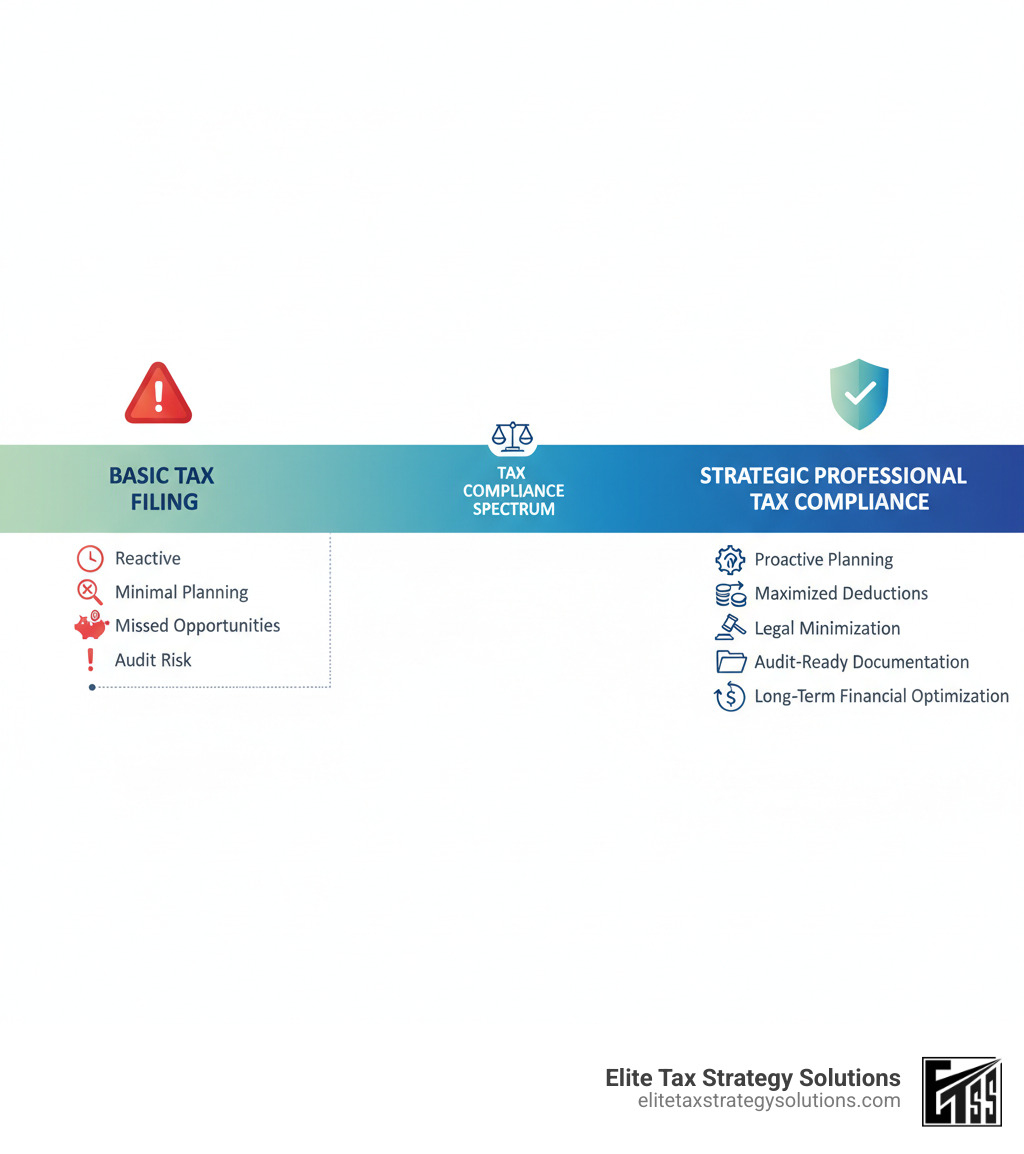
Effective professional tax compliance is a year-round strategic advantage, not an annual chore. The key is shifting from reactive tax preparation (filing for what already happened) to proactive tax planning (strategically minimizing future tax bills).
This forward-looking approach helps businesses and high earners overcome common challenges like changing regulations, disorganized records, and missed deductions.
Building a Compliant Foundation
A solid compliance foundation starts with good habits and smart decisions.
- Meticulous Recordkeeping: Good records are essential for monitoring your business, preparing financial statements, and supporting every item on your tax return. The IRS suggests keeping records for three years, but this extends to seven years for bad debt deductions, six years if you underreport income by over 25%, and indefinitely for fraudulent or unfiled returns. Keep employment tax records for at least four years.
- Choosing the Right Business Structure: Your choice of a C-corp, S-corp, or LLC has significant tax implications. We help clients in Jasper, Indiana, and other suburban areas evaluate these structures to find the best fit.
- Understanding Deadlines: Missing deadlines is a costly mistake. Use a calendar system to track all filing and payment dates.
- Utilizing Accounting Software: Modern software and AI-driven platforms can automate calculations, catch errors, and provide real-time financial insights.
Legal Tax Reduction Strategies
Minimizing your tax liability is about smart, legal planning, not cutting corners.
- Maximizing Deductions: Claim all ordinary and necessary business expenses, including home office deductions (if you meet strict criteria) and asset depreciation.
- Retirement Account Contributions: Contributions to accounts like a 401(k) (up to $23,500 for 2025) reduce your taxable income. Health FSAs (up to $3,300 for 2025) allow you to use pre-tax dollars for medical costs.
- Timing of Income and Expenses: Strategically timing when you recognize income or pay expenses can shift tax liabilities between years to lower your overall burden.
- Tax Credits: Credits reduce your tax bill dollar-for-dollar. Look into the Work Opportunity Tax Credit (WOTC), R&D credits, the 179D deduction for energy-efficient buildings, and the Employer-Provided Child Care Credit.
The Value of a Professional Tax Advisor
Navigating the complex tax code alone is risky. A professional tax advisor translates intricate laws into actionable strategies.
At Elite Tax Strategy Solutions, we develop personalized, proactive strategies. We review financials year-round to identify savings and evaluate your business structure for tax efficiency. We find every legal deduction and credit applicable to you, provide audit representation if needed, and stay updated on law changes to adjust your strategy accordingly. Professional tax compliance isn’t just about avoiding penalties—it’s about keeping more of what you earn.
Future-Proofing Your Tax Strategy: 2024 Updates and Modern Challenges
The tax world is always changing due to new laws, technology, and IRS guidance. For businesses and high earners committed to professional tax compliance, staying ahead of these shifts is crucial.

Key Tax Law Updates for 2024 and Beyond
Staying current on tax law changes is part of our commitment to clients. Here are key updates for 2025 that could affect your strategy:
- The Social Security wage base is rising to $176,100.
- 401(k) contribution limits are increasing to $23,500.
- Health FSA limits are bumping up to $3,300.
- The FICA threshold for household employees is rising to $2,800.
We are also monitoring broader trends, such as expanded digital asset reporting for cryptocurrency, potential corporate tax rate shifts, and evolving international tax frameworks.
Ethical Considerations in the Digital Age
Modern technology has created new ethical challenges for tax professionals. The core ethics for tax practitioners now include digital considerations.
- Technological Competency: Professionals have an ethical duty to understand the tools they use and protect client data from cyber threats.
- Remote Work: The shift to remote work raises questions about jurisdictional licensing and data security in home office environments. Firms need clear policies for handling client information securely.
- Cybersecurity: Reputable firms must have a written information security plan, use encryption, and protect your Personally Identifiable Information.
- Artificial Intelligence: AI can improve efficiency, but it’s a tool, not a replacement for human judgment. A competent professional validates AI-generated results and never inputs sensitive client data into open AI models.
- Social Media: Professionals must maintain confidentiality and avoid giving specific tax advice on public platforms.
Navigating State-Specific Professional Tax Compliance
State-level tax requirements can be overwhelming, especially for businesses operating in multiple states or employing remote workers.
- Regulatory Differences: States have vastly different rules. For example, New York is one of the few states that regulates the tax preparer industry, requiring registration and adherence to state-specific professional responsibility standards.
- Nexus: This concept determines if you have tax obligations in a state. It can be established through physical presence, economic activity, or even online activities, with rules varying by state and tax type.
- Registration and Filing: Many states require business registration, and some levy a professional tax with tight deadlines (often 30 days). Each state has its own forms and filing requirements.
Managing these diverse obligations is where professional guidance is invaluable. At Elite Tax Strategy Solutions, we help clients in Jasper, Indiana, and beyond manage these complexities, ensuring nothing falls through the cracks.
Frequently Asked Questions about Professional Tax Compliance
Tax compliance can be confusing. Here are answers to some of the most common questions I hear from clients.
What is the difference between tax planning and tax preparation?
Understanding this distinction is key to saving money. Tax preparation is reactive; it’s the process of filing returns for a past period. Tax planning is proactive; it’s a forward-looking analysis of your financial situation to legally minimize future tax liabilities.
Think of it as looking through the windshield (planning) instead of the rearview mirror (preparation). At Elite Tax Strategy Solutions, we specialize in tax planning to make the biggest impact for our clients.
What is Circular 230?
Circular 230 is the U.S. Treasury Department’s rulebook for professionals—like attorneys, CPAs, and Enrolled Agents—who practice before the IRS. It outlines their duties, ethical standards, and the sanctions for violations.
This matters because it ensures the professional you hire is held to rigorous standards of competence and integrity. Violations can lead to censure, suspension, or even disbarment, giving you assurance that your advisor is accountable.
How long should I keep tax records?
The short answer is, “it depends.” Here’s a simple guide:
- General Rule: The IRS generally suggests keeping records for three years from the filing date.
- Longer Periods: Keep records for specific situations longer:
- Seven years for claims related to worthless securities or bad debt.
- Six years if you underreport gross income by more than 25%.
- At least four years for employment tax records.
- Indefinitely for records related to property (until you sell it) and for fraudulent or unfiled returns.
My advice: when in doubt, keep it. Digital storage is inexpensive, and having the right documentation when you need it is priceless.
Conclusion
The most important takeaway is this: professional tax compliance is more than just avoiding IRS trouble. It’s a foundation for lasting financial success. It requires a defensive strategy (meeting deadlines, keeping records) and an offensive one (proactive planning to legally minimize your tax burden).
We’ve covered the complex tax landscape, the ethical standards of Circular 230, and practical strategies for staying compliant in the digital age. The rules will always evolve, but with a proactive approach, you can turn change into opportunity.
At Elite Tax Strategy Solutions, this is our specialty. We partner with high earners and closely held businesses in Jasper, Indiana, and suburban areas nationwide to develop personalized strategies that maximize savings and ensure peace of mind. We don’t just file your taxes; we work year-round to optimize your financial position.
You’ve worked hard for your success. Don’t let preventable tax issues hold you back. Get expert tax support and compliance assistance from our team today, and let’s build a tax strategy that works as hard as you do.