
Why Smart Homeowners Optimize Tax Deduction of Home Mortgage
Strategies to optimize tax deduction of home mortgage can save thousands annually, but many homeowners miss these benefits due to complex rules and recent tax law changes.
Quick optimization strategies:
- Compare itemizing vs. standard deduction – Only itemize if total deductions exceed $13,850 (single) or $27,700 (married filing jointly) for 2023.
- Understand the $750,000 limit – The deduction applies to mortgage interest on loans up to $750,000 for homes bought after December 15, 2017.
- Keep detailed records – Save Form 1098 and document all mortgage-related expenses.
- Consider timing strategies – Bundle deductions or prepay January mortgage payments in December.
- Explore other home deductions – Property taxes (up to the $10,000 SALT cap), mortgage points, and home office expenses.
The 2017 Tax Cuts and Jobs Act changed the mortgage interest landscape by nearly doubling the standard deduction. Now, only about 10% of taxpayers benefit from itemizing. For high-income earners and business owners, however, strategic mortgage planning remains a powerful wealth-building tool.
I’m David Fritch, a CPA and tax attorney with 40 years of experience. At Elite Tax Strategy Solutions, I help high-income individuals and small business owners optimize tax deduction of home mortgage benefits and ensure full compliance with ever-changing regulations.
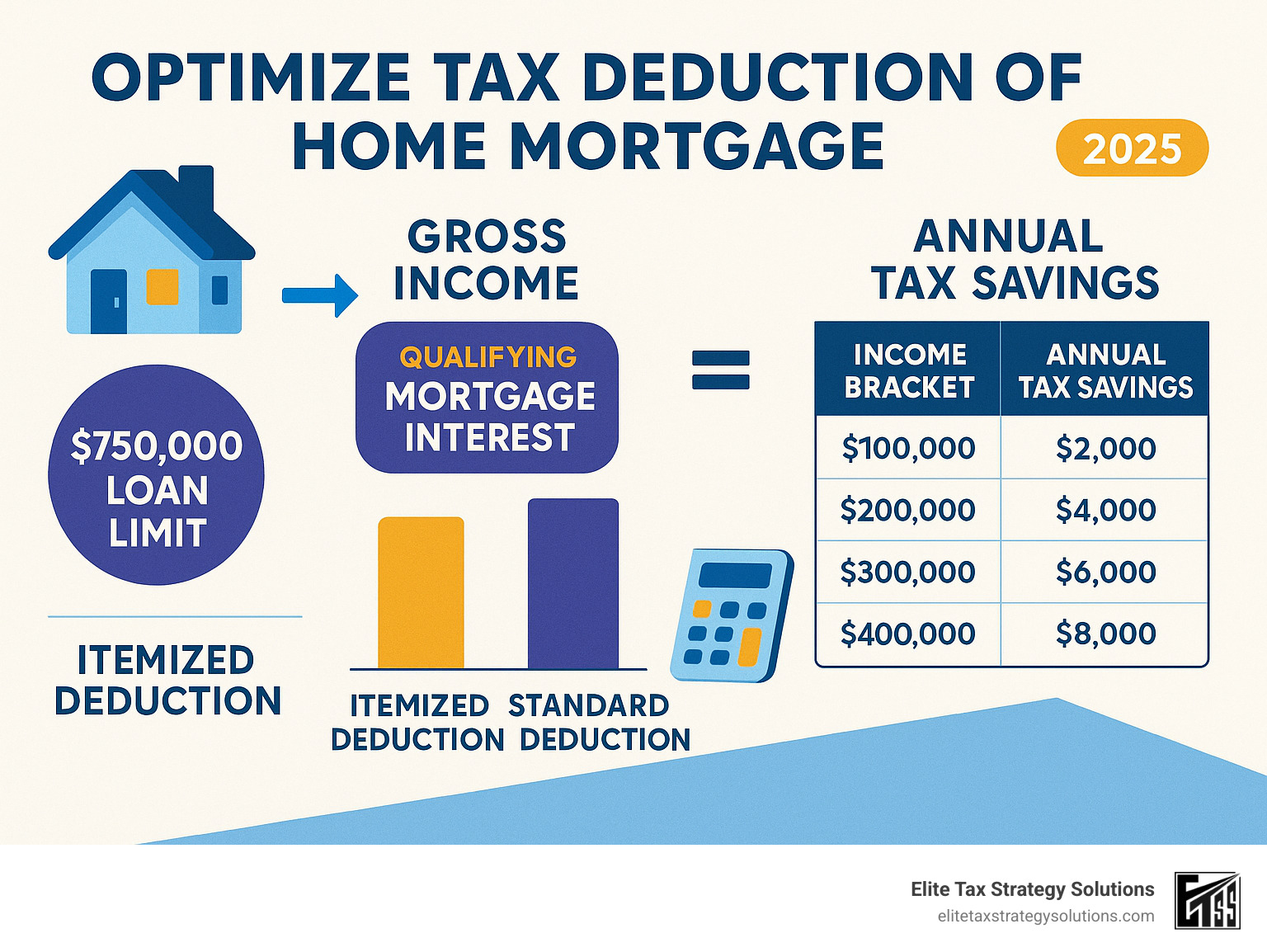
Optimize tax deduction of home mortgage terms at a glance:
Understanding the Home Mortgage Interest Deduction
Your home is often your biggest asset, and the tax code offers a significant tax incentive for homeownership: the home mortgage interest deduction. This allows you to deduct the mortgage interest you pay each year from your taxable income, potentially shrinking your tax bill. While it’s a well-known tax break, the rules have changed, making it crucial to understand the nuances to effectively optimize tax deduction of home mortgage.
The deduction applies to interest paid on a “qualified home,” which includes your primary residence and one second home. The loan must be “secured debt,” meaning the mortgage is tied to the home. For all the technical details, IRS Publication 936 is the go-to source, but we’re here to simplify these complex rules for you.
Who Is Eligible to Claim the Deduction?
To be eligible, you must be the legal homeowner and personally responsible for the mortgage. The loan must be secured by a qualified home, which can be a house, cooperative apartment, houseboat, or mobile home, as long as it has sleeping, cooking, and toilet facilities. For most homeowners in places like Jasper, Indiana, or the suburban areas we serve, their primary residence easily qualifies.
Current Deduction Limits You Need to Know
The Tax Cuts and Jobs Act (TCJA) of 2017 changed the rules. Before TCJA, you could deduct interest on up to $1 million of mortgage debt ($500,000 if married filing separately).
For homes purchased or loans taken out after December 15, 2017, this limit was reduced to $750,000 ($375,000 if married filing separately).
If you took out an $800,000 mortgage in 2019, you can only deduct interest on the first $750,000. However, if you took out that same mortgage in 2016, your debt is “grandfathered,” and you can deduct interest on the full amount. This distinction, based on your mortgage origination date, is critical when we help clients optimize tax deduction of home mortgage.

These limits primarily apply to “acquisition debt”—the money you borrow to buy, build, or substantially improve your home. Understanding these specific limits is a key part of creating proactive tax planning strategies for our high-earning clients.
The First Step: Standard vs. Itemized Deductions
Simply having a mortgage doesn’t guarantee you’ll benefit from the interest deduction. The first step is deciding whether to itemize your deductions or take the standard deduction. This choice is key to being able to optimize tax deduction of home mortgage benefits.
The standard deduction is a fixed amount set by the IRS. For 2023, the amounts are $13,850 for single filers, $27,700 for married filing jointly, and $20,800 for head of household.
Itemizing involves adding up all your eligible expenses, including mortgage interest, state and local taxes (SALT), charitable contributions, and certain medical expenses. To make financial sense, your total itemized deductions must exceed your standard deduction.
Consider this example for a married couple:
| Deduction Category | Amount (Example) |
|---|---|
| Mortgage Interest | $20,000 |
| Property Taxes (SALT Cap) | $10,000 |
| Charitable Contributions | $5,000 |
| Total Itemized Deductions | $35,000 |
| Standard Deduction (MFJ) | $27,700 |
Here, itemizing is the better choice, as their $35,000 in deductions exceeds the $27,700 standard deduction. This difference of $7,300 could save them thousands in taxes. If their total was less than the standard deduction, they would be better off not itemizing.
Why Fewer People Claim the Mortgage Interest Deduction Today
The Tax Cuts and Jobs Act’s biggest impact wasn’t lowering the debt limit; it was doubling the standard deduction. Before 2018, many homeowners could easily surpass the lower standard deduction.
Today, the IRS estimates that only about 10% of taxpayers itemize. This means 90% of homeowners take the standard deduction, making the mortgage interest deduction irrelevant to their tax situation. For many middle-class homeowners, the numbers no longer add up.
However, for high-income earners, those with large mortgages, or taxpayers in high-tax states, the mortgage interest deduction remains a powerful tool. The key is to run the numbers accurately, which is where proactive tax planning becomes essential.
How to Claim and Optimize Tax Deduction of Home Mortgage
If itemizing makes sense for you, claiming the deduction is straightforward. Your lender will send Form 1098, Mortgage Interest Statement, by late January, showing the interest you paid.

You’ll transfer this amount to Schedule A (Form 1040). Tax software simplifies this, but it’s crucial to keep meticulous records, especially if you have multiple mortgages or refinanced during the year.
Key Strategies to Optimize Tax Deduction of Home Mortgage
Beyond the basics, several strategies can help you optimize tax deduction of home mortgage benefits:
- Mortgage points: Points paid on your main home purchase are often fully deductible in the year you paid them. For a refinance, you typically deduct them over the life of the loan.
- Timing your payments: Making your January mortgage payment in December allows you to deduct an extra month’s interest in the current tax year.
- Loan amortization: In the early years of your mortgage, a larger portion of your payment is interest, leading to bigger deductions. This amount decreases over time.
- Extra principal payments: Paying down your mortgage faster saves you interest but also reduces your future tax deductions. This creates a trade-off, especially for high earners.
While a mortgage interest deduction calculator can offer estimates, they don’t capture the nuances of individual situations.
Is It Always the Best Strategy to Optimize Tax Deduction of Home Mortgage?
Maximizing deductions isn’t always the best overall financial strategy. For high-income earners, the savings can be substantial. A $25,000 deduction in the 32% tax bracket means $8,000 in tax savings.
However, paying down debt faster also has benefits. You’ll pay less interest to your lender over the life of the loan. The right choice depends on a comparison of your mortgage rate to potential investment returns and your personal risk tolerance.
Your tax bracket impact is also a major factor, as higher earners see a greater benefit from the deduction. The best approach depends on your complete financial picture, which is why personalized guidance is so valuable.
Beyond Interest: Other Home-Related Tax Deductions
Your home offers tax savings beyond the mortgage interest deduction. Several other valuable opportunities can reduce your tax bill. For more details, see IRS Publication 530.
- Property Taxes: You can deduct state and local property taxes, but the State and Local Tax (SALT) cap limits your total deduction for all state and local taxes to $10,000 per household. This cap is especially challenging for homeowners in high-tax states.
- Home Office Deduction: If you use a portion of your home exclusively and regularly for business, you may qualify. You can deduct a portion of home expenses like utilities and insurance using either a simplified or actual expense method.
- Capital Gains Exclusion: When you sell your primary home, you can exclude up to $250,000 of profit ($500,000 if married filing jointly) from your taxable income. We cover this in more detail in the FAQ.
Are Mortgage Points and HELOC Interest Deductible?
Discount points are prepaid interest. Points paid to get a mortgage for your main home are usually fully deductible in the year paid. If paid on a refinance or for a second home, you must deduct them over the life of the loan.
The rules for Home Equity Lines of Credit (HELOC) and home equity loans changed with the TCJA. Interest is now only deductible if you use the funds to “buy, build, or substantially improve” the home securing the loan. If you use a HELOC to pay off credit card debt or buy a car, the interest is not deductible. This is a critical distinction that often requires professional guidance.
Credits for Home Improvements
Tax credits are more valuable than deductions, as they reduce your tax bill dollar-for-dollar.
- Energy Efficient Improvements: The Inflation Reduction Act of 2022 offers significant credits for eco-friendly upgrades. Qualifying improvements include solar panels, energy-efficient windows and doors, heat pumps, efficient central air conditioning systems, and furnaces. Even home energy audits can qualify.
- Medical Expense Improvements: Modifications to your home for medical care, like wheelchair ramps or accessible bathrooms, may be deductible as medical expenses, subject to AGI limits.
Combining these credits and deductions can significantly impact your tax liability. We help clients identify all eligible improvements to maximize every benefit.
Frequently Asked Questions about Home Mortgage Deductions
Here are answers to common questions we receive from clients looking to optimize tax deduction of home mortgage and other home-related tax benefits.
Can I deduct mortgage interest on a rental property?
Yes, but it’s handled differently. For a rental property, mortgage interest is a business expense deducted on Schedule E (Supplemental Income and Loss), not Schedule A. It reduces your taxable rental income along with other expenses like property taxes and repairs. Be mindful of personal use rules; using the property too much yourself can limit your deductions. Careful record-keeping of rental vs. personal use days is essential.
What happens if I refinance my mortgage?
Refinancing has important tax implications.
- Refinancing Points: Unlike points on an original mortgage, points paid on a refinance must be prorated and deducted over the life of the new loan.
- Cash-Out Refinance: Interest on the original loan balance remains deductible (up to the $750,000 limit). However, interest on the “cash-out” portion is only deductible if you use the funds to “buy, build, or substantially improve” the home. Using the cash for other purposes makes the interest on that portion non-deductible.
Refinancing has tax consequences beyond just the interest rate, requiring careful planning.
How does the capital gains exclusion work when I sell my home?
The capital gains exclusion is a powerful benefit. When you sell your primary residence, you can exclude a large portion of the profit from your taxable income.
- Single filers: Exclude up to $250,000 of capital gains.
- Married filing jointly: Exclude up to $500,000 of capital gains.
To qualify, you must meet both the Ownership Test (owned for at least two of the last five years) and the Use Test (lived in it as your main home for at least two of the last five years). The two years do not need to be continuous. This benefit can significantly reduce the tax burden on one of life’s biggest financial transactions. Any profit above these exclusion amounts is generally subject to capital gains tax.
Conclusion: Building Your Proactive Tax Strategy

Mastering your home’s tax benefits, from the mortgage interest deduction to energy credits, is about building strong long-term financial health. Every smart choice adds up.
At Elite Tax Strategy Solutions, we believe in proactive tax planning—looking ahead to create a smart strategy that grows with you. This is especially true for high-income earners and business owners facing complex tax situations. We offer personalized services to help you maximize savings and build financial stability.
Whether you’re in Jasper, Indiana, or a busy suburb, knowing how to optimize tax deduction of home mortgage is a powerful tool. Don’t let confusing rules prevent you from saving what’s rightfully yours.
We’re ready to help you create a comprehensive tax strategy to open up your home’s tax benefits and secure a more confident financial future.
Develop your high-income tax plan with Elite Tax Strategy Solutions today!