Why High Earners Face Unique Retirement Tax Challenges
High income tax strategies retirement plans are essential because success creates complex tax obligations. As your income grows, so does your tax burden, which can exceed 50% for top earners depending on your state of residence.
The biggest retirement tax challenges for high earners:
- Phase-out limits – Traditional IRA deductions disappear at $123,000+ (married filing jointly)
- Roth IRA restrictions – Direct contributions end at $246,000+ (married filing jointly)
- Higher tax brackets – Top federal rate of 37% plus state taxes
- Required minimum distributions – Forced withdrawals starting at age 73
- Net Investment Income Tax – Additional 3.8% tax on investment income above $250,000
The good news is that strategic planning helps you keep more of what you’ve earned. Smart high earners use advanced strategies like backdoor Roth conversions and tax-efficient withdrawal sequencing to minimize their lifetime tax burden. Tax-efficient retirement planning is not just about saving money; it’s about preserving your lifestyle.
I’m David Fritch. For 40 years, I’ve helped high-income earners and small business owners with complex high income tax strategies retirement plans. I’ve developed over 100 custom tax-saving strategies for individuals earning $200,000 to $2,000,000 annually, helping them optimize retirement planning and minimize taxes.
High income tax strategies retirement plans word guide:
- tax planning strategies for high income earners
- tax diversification strategy high income
- wealth management tax planning
Boost Your Savings: Tax-Advantaged Retirement Accounts for High Earners
For high earners, the first rule of high income tax strategies retirement plans is to maximize contributions to tax-advantaged accounts. These accounts shield your money from taxes, allowing it to grow faster through tax-free or tax-deferred compounding. It’s crucial to capture every opportunity, including employer matches and catch-up contributions.

Maximizing Your 401(k) or 403(b)
Your 401(k) or 403(b) is a core part of your retirement strategy. For 2025, you can contribute up to $23,500. If you’re 50 or older, you can add a $7,500 catch-up contribution, for a total of $31,000. A special catch-up of $11,250 is available for those aged 60 to 63.
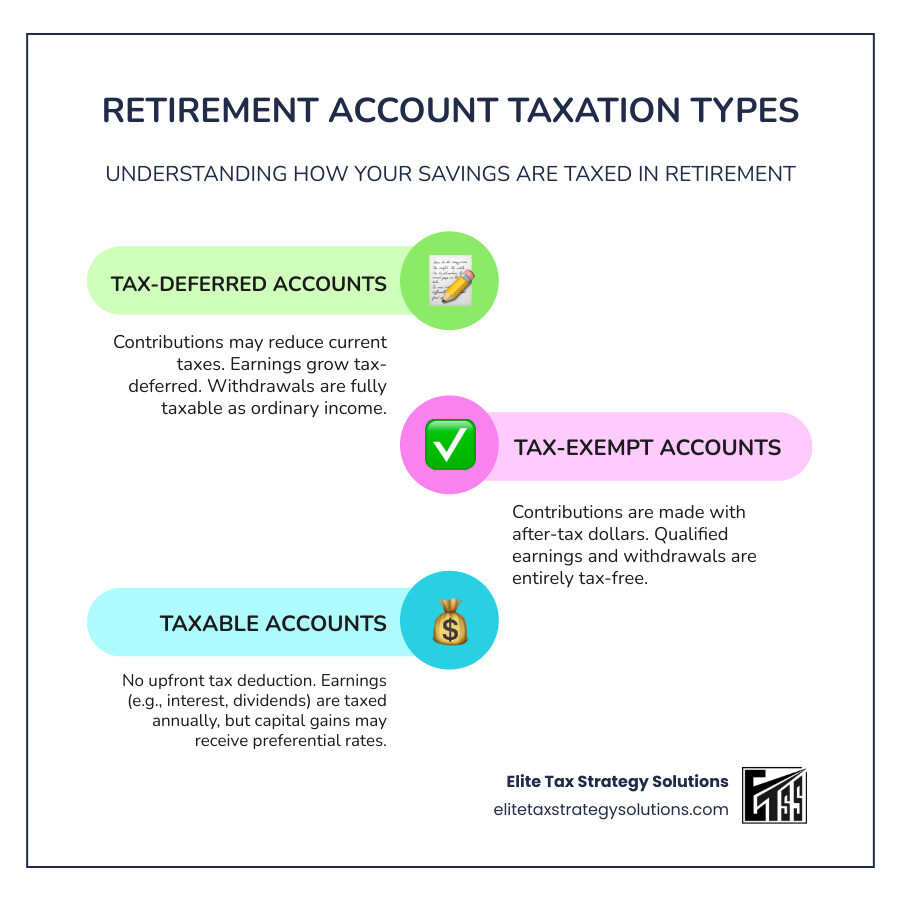
A traditional 401(k) offers an immediate tax deduction, reducing your current taxable income while investments grow tax-deferred. A Roth 401(k), if offered, uses after-tax contributions, but your money grows and can be withdrawn in retirement completely tax-free. This is a powerful option if you expect higher tax rates in the future. We’ll also explore after-tax 401(k) contributions later.
Leveraging Individual Retirement Accounts (IRAs)
IRAs are another crucial retirement tool. For 2025, you can contribute up to $7,000, or $8,000 if you’re 50 or older. However, high earners face restrictions. Traditional IRA deductions phase out for those covered by a workplace plan, starting at $83,000 for single filers and $137,000 for married couples. Roth IRA direct contributions phase out starting at $150,000 for single filers and $236,000 for married couples.
High earners can bypass these limits with the backdoor Roth IRA strategy. You make a non-deductible contribution to a traditional IRA and then immediately convert it to a Roth IRA.
For the latest tax bracket information, check out the IRS 2025 tax bracket information. To dive deeper into IRA strategies, visit our page on Traditional IRAs for High Income Earners.
The Triple-Tax Advantage of a Health Savings Account (HSA)
The Health Savings Account (HSA) is an often-overlooked but powerful retirement tool with a unique triple-tax advantage. Contributions are tax-deductible, growth is tax-free, and withdrawals for qualified medical expenses are tax-free.
To qualify, you need a high-deductible health plan. While many use HSAs for current medical bills, the real power comes from paying those expenses out-of-pocket and letting your HSA investments grow. This creates a tax-free fund for healthcare costs in retirement, making the HSA’s investment potential one of the most underused tools in retirement planning.
For more comprehensive financial planning strategies, check out our guide on financial planning for high income earners.
Comparing Key Retirement Accounts
Here’s how these accounts stack up for your high income tax strategies retirement plans:
| Account Type | Contribution Limit (2025) | Tax Deduction | How it Grows | Taxation on Withdrawal | Best For |
|---|---|---|---|---|---|
| Traditional 401(k) | $23,500 ($31,000 if 50+) | Yes, up front | Tax-deferred | Taxable | Reducing current taxes; maximizing employer match |
| Roth 401(k) | $23,500 ($31,000 if 50+) | No | Tax-free | Tax-free (qualified) | Expecting higher tax rates in retirement |
| Traditional IRA | $7,000 ($8,000 if 50+) | Yes (with income limits) | Tax-deferred | Taxable | Lower current income; no workplace plan |
| Roth IRA | $7,000 ($8,000 if 50+) | No | Tax-free | Tax-free (qualified) | Tax-free growth; estate planning |
| Backdoor Roth IRA | $7,000 ($8,000 if 50+) | No | Tax-free | Tax-free (qualified) | High earners exceeding Roth limits |
| HSA | $4,150 (individual), $8,300 (family) | Yes | Tax-free | Tax-free (medical) | Triple-tax advantage; retirement healthcare costs |
The key is understanding which combination of these accounts works best for your specific situation. That’s where strategic planning makes all the difference in building wealth that lasts.
Beyond the Basics: Advanced High Income Tax Strategies for Retirement Plans
After maxing out traditional retirement accounts, high earners can use advanced strategies to shelter more income. These IRS-approved plans are especially beneficial for small business owners and consultants, and can transform your financial future.

Advanced Roth Strategies for Boosted Savings
The “Mega Backdoor Roth” strategy allows you to get substantial amounts of money into a Roth account, bypassing income limits. If your employer’s 401(k) plan allows after-tax contributions and in-service withdrawals, you can contribute after-tax dollars beyond the regular limits, up to the overall IRS limit of $70,000 for 2025 (including all employee and employer contributions). You then perform an in-service withdrawal of these after-tax contributions and roll them over to a Roth IRA.
The principal rolls over tax-free into the Roth IRA for tax-free growth. Any earnings are taxable upon conversion, so annual rollovers are recommended to minimize this tax. This strategy is powerful for high income tax strategies retirement plans because it bypasses traditional Roth IRA contribution and income restrictions. For more detailed strategies, check out More on retirement tax strategies.
Customized Retirement Plans for Business Owners
For business owners, consultants, or independent contractors, customized plans like Defined Benefit (DB) and Cash Balance Plans offer significant advantages. These plans accelerate savings while generating massive tax deductions. Unlike 401(k)s, DB plans can allow annual contributions exceeding $100,000 or even $200,000, depending on your age and desired retirement benefit. The maximum annual benefit for Defined Benefit Plans is $275,000 for 2025.
Actuarial calculations determine your annual contributions, allowing you to put away a large percentage of your income and dramatically reduce your current tax bill. These plans provide remarkable financial stability by creating a guaranteed income stream for retirement. To explore how these plans can transform your business’s tax situation, visit More info on custom retirement plans.
Other Key High Income Tax Strategies for Retirement Plans
Other powerful tools exist in our high income tax strategies retirement plans toolkit.
- Non-Qualified Deferred Compensation (NQDC) Plans allow highly compensated employees to defer salary or bonuses, reducing current taxable income and potentially restoring eligibility for other tax deductions.
- Cash Balance Plans combine the high contribution limits of defined benefit plans with the portability of defined contribution plans, making them attractive for business owners seeking predictable, substantial contributions.
- The Pass-Through Business Income Deduction (Section 199A) offers a potential 20% deduction on qualified business income for owners of S-Corps, Partnerships, or Sole Proprietorships, providing substantial tax savings.
These strategies work best as part of a comprehensive, custom plan. For more tax-saving opportunities, explore More on tax savings strategies and More on high income tax planning.
The Art of the Drawdown: Tax-Smart Withdrawal & Conversion Strategies
How you withdraw retirement funds is as important as how you save. Smart high income tax strategies retirement plans for the “decumulation phase” help manage tax brackets, minimize lifetime taxes, and handle Required Minimum Distributions (RMDs). A clear withdrawal strategy ensures more of your money works for you, not the IRS.

Mastering Roth Conversions and Ladders
Roth conversions are powerful tools during retirement, especially in lower-income years. When you convert funds from a Traditional IRA or 401(k) to a Roth IRA, you pay taxes now to secure tax-free withdrawals later.
The Roth conversion ladder is ideal for early retirees. You convert smaller amounts each year, keeping you in lower tax brackets. After five years from each conversion, you can access the converted principal penalty-free, even before age 59½. This creates a funding bridge for early retirement. Remember the five-year rule, which applies differently to the account itself versus individual conversions for early access.
Managing Required Minimum Distributions (RMDs)
Required Minimum Distributions (RMDs) can feel like a forced tax event for many high earners. The SECURE 2.0 Act pushed the starting age to 73 for most, and it will rise to 75 for those turning 74 after 2033. While this allows more tax-deferred growth, it can mean larger, more impactful RMDs later.
Calculating RMDs involves dividing your account balance by an IRS life expectancy factor. Missing an RMD incurs a 25% penalty (or 10% if corrected quickly). A smart workaround is the Qualified Charitable Distribution (QCD). If you are 70½ or older, you can direct up to $105,000 annually from your IRA to charity. This satisfies your RMD but isn’t counted as taxable income, helping to lower your overall tax burden.
For official guidance, check out the IRS rules on RMDs to stay compliant.
Strategic Withdrawal Sequencing
Strategic withdrawal sequencing involves drawing from accounts in a specific order to manage your tax bracket. The conventional wisdom for high earners is:
- Taxable accounts first: These investments generate capital gains and qualified dividends, which have favorable tax rates. You can fill up lower tax brackets before tapping into fully taxable funds.
- Tax-deferred accounts next: Withdrawals are ordinary income, so timing is key to stay within your target tax bracket. This is also a good time for strategic Roth conversions.
- Tax-free accounts last: Roth IRAs and HSAs offer the most flexibility. Letting them grow as long as possible maximizes their tax-free compounding power. They are perfect for large expenses or funding retirement in high-income years without adding to your tax liability.
This approach provides the flexibility to adapt to changing tax laws and personal circumstances. For more comprehensive strategies, visit More on tax efficient retirement planning.
Optimizing Your Financial Landscape in Retirement
Optimizing your entire financial landscape during retirement is key. For high income tax strategies retirement plans, this involves using tax-efficient investments, smart income strategies, and all available deductions to preserve your wealth.
Building a Tax-Efficient Investment Portfolio
It’s not just what you invest in, but where you put those investments. This “asset location” strategy matches investments to the right account type. Place tax-inefficient investments like bonds in tax-deferred accounts (Traditional IRAs/401(k)s). Growth stocks and ETFs with qualified dividends belong in taxable accounts to benefit from lower capital gains rates. Your highest-growth investments are best suited for a tax-free Roth IRA.
Key strategies to improve after-tax returns include:
- Tax-exempt municipal bonds: Interest is generally exempt from federal income tax, and often state and local taxes, making them highly valuable for those in top tax brackets.
- Qualified dividends: These are taxed at lower long-term capital gains rates (max 20%) instead of higher ordinary income rates (up to 37%).
- Long-term capital gains: Holding investments for more than one year qualifies you for lower tax rates.
- Tax-loss harvesting: Strategically selling investments at a loss can offset capital gains and up to $3,000 of ordinary income annually, with unused losses carrying forward.
For details, see IRS Publication 550 on Investment Income. For custom strategies, visit More on tax efficient investments.
Income Splitting and Cross-Border Strategies
There are legitimate strategies to balance income between spouses and lower your household tax burden. Spousal IRA contributions allow a higher-earning spouse to contribute to an IRA for a spouse with little or no income. Most couples also benefit from filing jointly due to broader tax brackets.
For those with international ties, the US taxes its citizens on worldwide income. However, the Foreign Earned Income Exclusion can exempt a significant portion of foreign income if you meet residency tests. Tax residency planning is also crucial if you own property in multiple states, as moving your primary residence to a no-income-tax state can yield significant savings.
For more on these strategies, check out More on income splitting strategies.
Leveraging Tax Credits and Deductions in Retirement
Deductions and credits are valuable tools for cutting your tax bill in retirement.
- Medical expense deductions are available for unreimbursed costs exceeding 7.5% of your Adjusted Gross Income (AGI).
- Charitable donations can be deducted up to 60% of your AGI if you itemize. Donor-Advised Funds allow you to take a large, immediate deduction in a high-income year while distributing the funds to charities over time.
- The State and Local Tax (SALT) deduction is still valuable, even with its $10,000 cap.
- Caregiver credits can help offset the costs of caring for aging relatives.
For comprehensive strategies, visit More on wealth management tax planning.
Frequently Asked Questions about High Income Tax Strategies for Retirement Plans
How can I save for retirement if my income is too high for a Roth IRA?
High income doesn’t prevent you from accessing Roth accounts. You can use sophisticated strategies like the Backdoor Roth IRA, where you make a non-deductible Traditional IRA contribution and immediately convert it to a Roth IRA. If your 401(k) plan allows it, the Mega Backdoor Roth strategy lets you contribute significant after-tax amounts to your 401(k) and then roll them into a Roth IRA. Even nondeductible Traditional IRA contributions are useful, as they grow tax-deferred and can be converted to a Roth later.
What is the most overlooked tax strategy for high-income retirees?
The Qualified Charitable Distribution (QCD) is a frequently overlooked gem. If you’re 70½ or older, you can donate up to $105,000 annually from your IRA to charity. This counts toward your RMD but isn’t included in your taxable income, which can lower Medicare premiums and taxes on Social Security. Other overlooked strategies include strategic Roth conversions during low-income years (e.g., between retirement and starting Social Security) and strategic withdrawal sequencing to manage your lifetime tax bill.
When should a high-income earner consult a tax professional?
If you’re researching high income tax strategies retirement plans, you likely need a professional. It becomes essential in these situations:
- Complex financial situations: Multiple income streams, substantial investments, or rental properties require a coordinated strategy.
- Business ownership: This adds layers of complexity, from entity structure to specialized retirement plans like Defined Benefit plans. Elite Tax Strategy Solutions specializes in helping closely held businesses with these challenges.
- High net worth: Estate planning, alternative minimum tax, and sophisticated investment strategies require specialized knowledge.
- Significant life events: Marriage, divorce, selling a business, or receiving an inheritance have major tax implications that require proactive planning.
The best time to engage a professional is before a major event. Proactive planning is the key to a great tax strategy. For more guidance, visit When to work with a skilled accountant.
Conclusion: Secure Your Future with Proactive Tax Planning

This guide to high income tax strategies retirement plans has covered foundational tactics like maximizing 401(k)s and HSAs, and advanced strategies like mega backdoor Roth conversions and customized business plans. High earners face unique challenges, but this complexity is also an advantage. The tax code offers incredible opportunities for those willing to plan proactively.
Every advanced strategy, from Roth conversion ladders to strategic asset location, can save you significant amounts over your retirement years. Tax planning isn’t just about one year’s return; it’s about creating a comprehensive, long-term strategy that adapts to your life’s changes, whether you’re starting a business, approaching retirement, or dealing with a windfall.
At Elite Tax Strategy Solutions, we empower our clients to take control of their financial destiny. Our thorough, proactive approach means we’re not just preparing your taxes—we’re helping you build a roadmap for long-term financial success. We’ve seen too many high earners leave money on the table because they were unaware these strategies existed.
The value of professional guidance is immense. While this guide provides valuable knowledge, implementing these strategies requires careful coordination with your overall financial picture. That’s where our expertise makes the difference.
Ready to transform your tax strategy from reactive to proactive? We invite you to Develop your innovative tax plan with us. For additional insights, explore our resource on More on tax planning strategies for high income earners.
Taking proactive steps today will secure a more comfortable, tax-efficient retirement. The best time to start is right now.