
The Essential Guide to GST Compliance
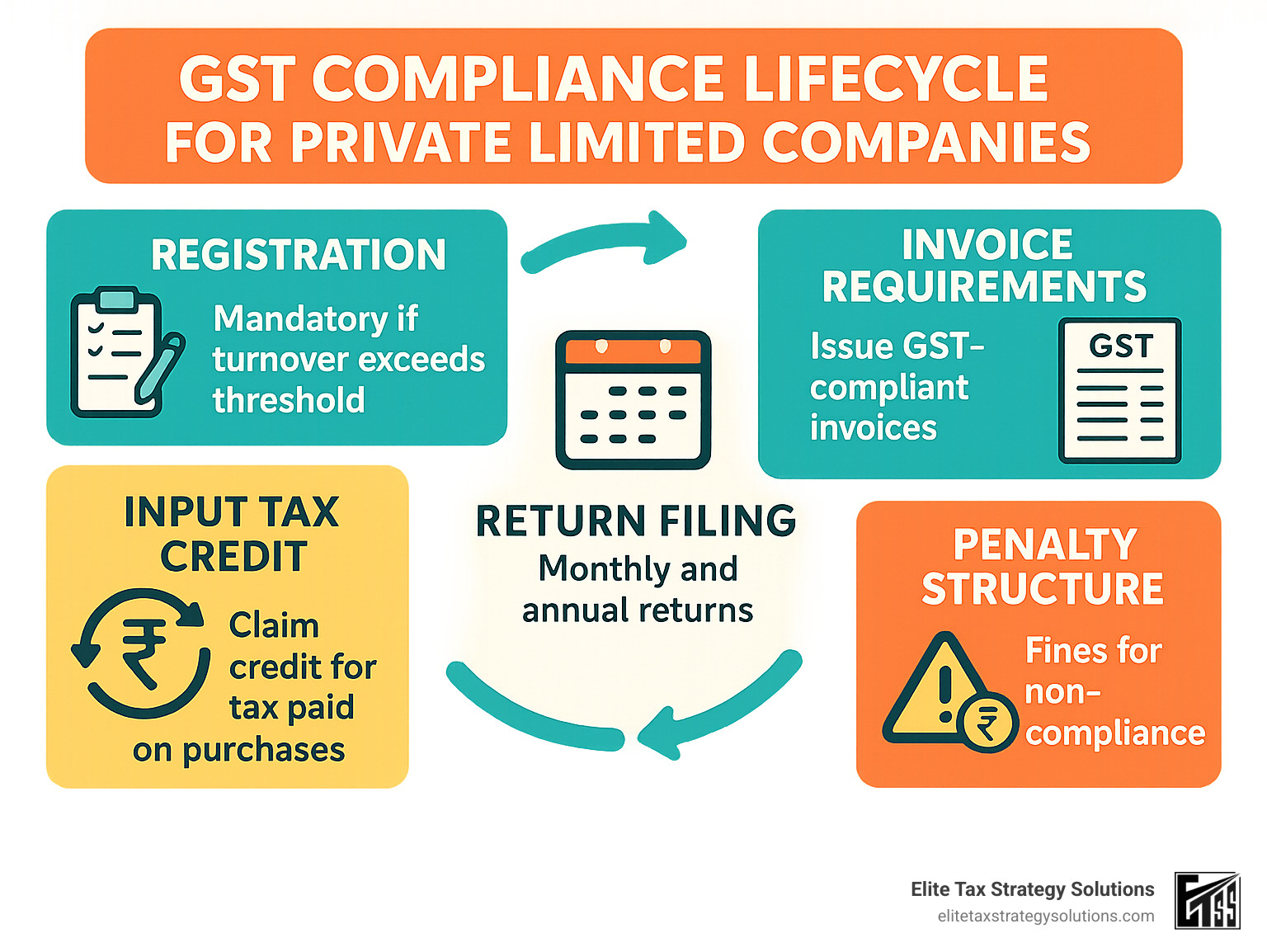
GST compliance for private limited company is a critical legal requirement that ensures your business remains in good standing with tax authorities while maximizing financial benefits. Here’s what you need to know:
Key GST Compliance Requirements:
1. Registration: Mandatory if annual turnover exceeds ₹40 lakh for goods or ₹20 lakh for services
2. Return Filing: Monthly GSTR-1 (sales) by 11th and GSTR-3B (summary) by 20th of the following month
3. Annual Returns: GSTR-9 by December 31st and GSTR-9C (if turnover > ₹5 crore)
4. Record Keeping: Maintain all GST documents for minimum 8 years
5. Invoicing: Issue GST-compliant invoices with GSTIN, HSN codes, and tax breakup
The Goods and Services Tax (GST), introduced in July 2017, revolutionized India’s tax system by consolidating multiple indirect taxes into a single framework. For private limited companies, navigating GST compliance isn’t just about avoiding penalties—it’s about enhancing business credibility, accessing input tax credits, and improving cash flow management.
Non-compliance can result in serious consequences, including penalties of ₹100 per day per Act for late filing, up to 10% of tax dues for non-registration, and potential imprisonment in cases of serious tax evasion.
I’m David Fritch, with over 40 years of experience helping small business owners steer complex tax regulations through Elite Tax Strategy Solutions, where we specialize in creating custom tax strategies for high-income earners and business owners.
Gst compliance for private limited company terms to remember:
– tax compliance for companies
– gst return compliance
– accounting and tax compliance
Understanding GST Compliance for Private Limited Companies
Understanding GST compliance for private limited company requirements means following all the rules set out in the GST Act – registering when required, issuing proper invoices, paying taxes on time, and filing returns regularly.
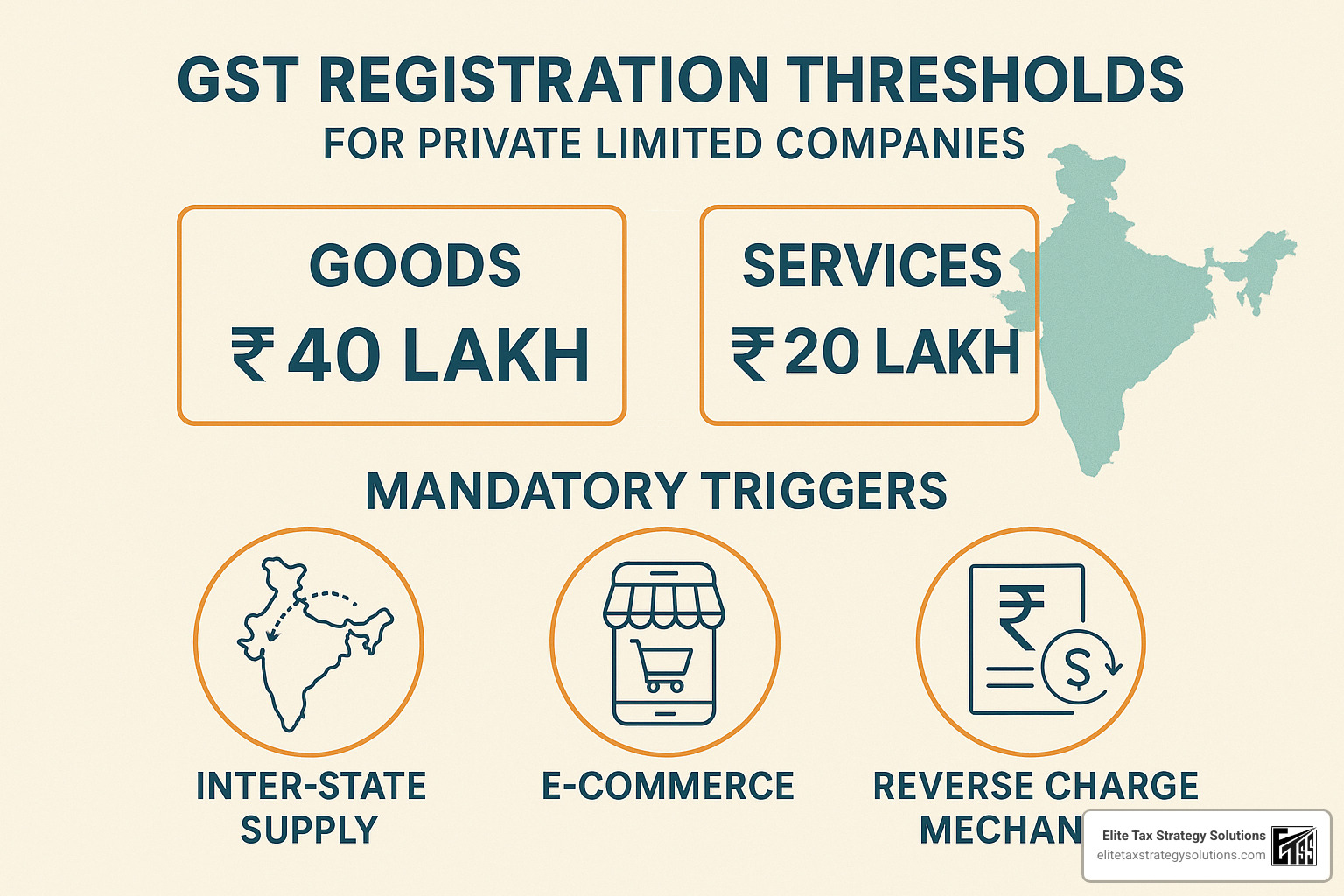
The law sets clear turnover thresholds that trigger mandatory registration:
– ₹40 lakh for businesses primarily selling goods (reduced to ₹20 lakh in North-Eastern and special category states)
– ₹20 lakh for service providers (₹10 lakh in North-Eastern and special category states)
These thresholds don’t apply if your company conducts interstate sales, sells through e-commerce platforms, operates as an e-commerce platform itself, deals with reverse charge transactions, or was previously registered under the old tax regime.
The government has also developed a GST Compliance Rating system under Section 149 of the GST Act. This 1-10 rating scale will assess how well you’ve maintained your GST obligations, bringing benefits like faster refunds and reduced scrutiny for high-scoring businesses.
Why GST compliance matters to a Pvt Ltd
Cash flow management improves with proper GST compliance as you can claim input tax credits when due, directly enhancing your working capital position.
Input tax credits allow you to offset taxes paid on purchases against tax collected on sales, reducing your effective tax burden.
Business opportunities expand with good compliance. Many larger companies and government bodies check GST compliance before awarding contracts.
Investor confidence gets a significant boost when your GST house is in order, improving both company valuation and access to financing.
A competitive edge emerges when you maintain strong compliance, especially when bidding for tenders that require good GST standing.
Key legal triggers for mandatory registration
Even if your turnover hasn’t hit the thresholds, certain activities automatically trigger GST registration:
Interstate supply requires GST registration regardless of turnover. If you sell goods or services across state lines, you must register.
When calculating your aggregate turnover, include all taxable supplies, exempt supplies, exports, and interstate supplies made under your PAN across India.
E-commerce participation automatically requires GST registration, regardless of turnover.
The Reverse Charge Mechanism (RCM) shifts tax payment responsibility to the buyer for certain transactions, requiring registration to comply with these requirements.
Casual taxable person status applies when you temporarily conduct business in a state where you don’t have a fixed location, requiring registration.
For more detailed information about GST laws and provisions, you can refer to the official GST Act reference published by the government.
GST Registration: Step-by-Step Blueprint
Getting your GST compliance for private limited company journey started begins with proper registration.
Step 1: Visit the GST Portal
Head over to gst.gov.in and steer to “Services” > “Registration” > “New Registration.”
Step 2: Create an Account
Enter your business email and phone number, verify both through OTP authentication, and select “Taxpayer” as your user type.
Step 3: Fill GST Registration Form (GST REG-01)
Select “Private Limited Company” from the business constitution dropdown, enter your company’s PAN details, and provide your business name. Specify the state and district where your main business operations happen.
Step 4: Upload Documents
Submit all required documents, ensuring each file is clear, legible, and follows format requirements – typically PDFs under 1MB each.
Step 5: Submit for Verification
Review everything carefully, then sign the application using a valid Digital Signature Certificate (DSC) of an authorized company signatory. You’ll receive an Application Reference Number (ARN) for tracking.
Step 6: GSTIN Generation
Track your application status using the ARN, and respond quickly to any queries from GST officers. When approved, download your GST Registration Certificate (Form GST REG-06).
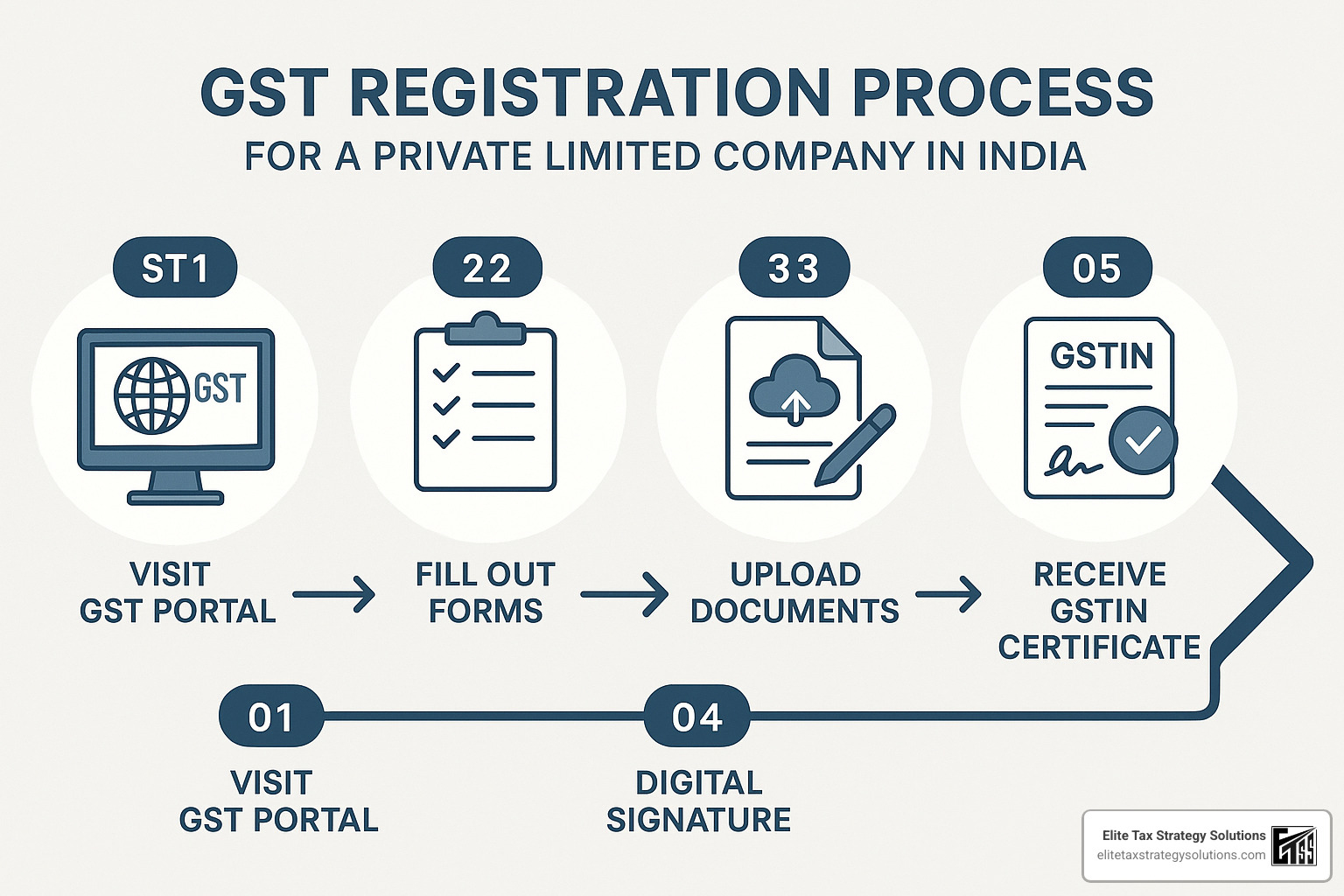
The process typically takes 7-10 working days. Your 15-digit GSTIN will follow this pattern: State Code (2 digits) + PAN (10 digits) + Entity Number (1 digit) + Check Digit (1 digit) + Blank (1 character).
Applications are often rejected due to document-application detail mismatches, blurry documents, failed address verification, missed verification query deadlines, or signatory verification problems.
Document checklist for a flawless application
Mandatory Documents:
– Company PAN Card
– Certificate of Incorporation
– Memorandum and Articles of Association (MOA/AOA)
– Board Resolution authorizing the GST signatory
– Business location proof (electricity bill, property tax receipt, ownership document, or rent/lease agreement)
– Bank Account Statement or Canceled Cheque (less than 2 months old)
– Digital Signature Certificate (DSC) of authorized signatory
For directors and authorized signatories:
– PAN Cards
– Aadhaar Cards
– Passport-sized photographs
– Address proof (if different from Aadhaar)
Create a dedicated digital folder with clear naming conventions for these documents to streamline both registration and future compliance needs.
How long does it take & how to avoid delays
While the standard timeline is 7-10 working days, flawless applications can be processed in 5 days, while problematic ones may take 3-4 weeks.
To avoid delays:
– Ensure your authorized signatory is available for GST verification calls
– Prepare for potential physical site inspections by keeping your office accessible
– Select correct HSN/SAC codes for your business activities
– Respond promptly to ARN responses requesting clarification (within 7 days)
– Ensure all addresses match perfectly across documents
– Submit high-resolution photographs of your business premises
– Track your application status daily on the GST portal
Keep the GST helpdesk number (1800-103-4786) handy for proactive follow-ups.
Post-Registration “gst compliance for private limited company” Calendar
After registration, your GST compliance for private limited company schedule becomes critical for avoiding penalties.
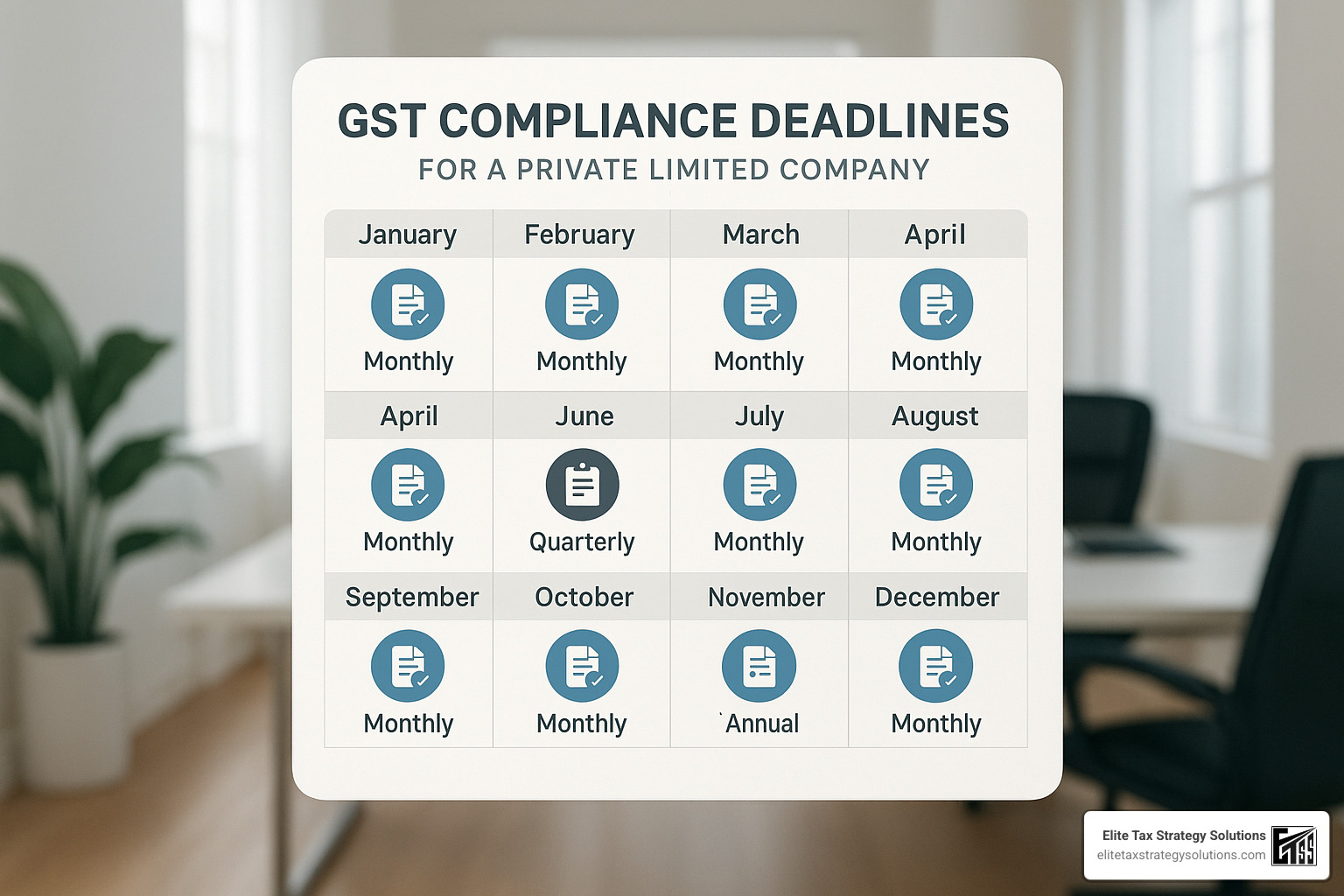
Every month, file your GSTR-1 by the 11th, detailing all sales and outward supplies. By the 20th, submit your GSTR-3B, a summary return covering both sales and purchases, along with tax payments.
For goods valued over ₹50,000, generate E-way Bills valid for one day per 100 km traveled, up to 15 days maximum.
If your turnover is below ₹5 crore, you can opt for the Quarterly Return Monthly Payment (QRMP) scheme. This allows quarterly GSTR-1 filing (by the 13th after quarter-end) with monthly tax payments by the 25th for the first two months of each quarter. Quarterly GSTR-3B is due by the 22nd or 24th of the month following the quarter.
Annually, file GSTR-9 by December 31st. Companies with turnover exceeding ₹5 crore must also file GSTR-9C, a reconciliation statement certified by a chartered accountant.
| Return Type | Frequency | Due Date | Late Filing Penalty |
|---|---|---|---|
| GSTR-1 | Monthly | 11th of next month | ₹100 per day per Act (max ₹5,000) |
| GSTR-3B | Monthly | 20th of next month | ₹100 per day per Act (max ₹5,000) |
| GSTR-1 (QRMP) | Quarterly | 13th of month after quarter | ₹100 per day per Act (max ₹5,000) |
| GSTR-3B (QRMP) | Quarterly | 22nd/24th of month after quarter | ₹100 per day per Act (max ₹5,000) |
| GSTR-9 | Annual | 31st December | ₹100 per day per Act (max ₹5,000) |
| GSTR-9C | Annual | 31st December | ₹100 per day per Act (max ₹5,000) |
Keep all records for at least 8 years, including tax invoices, debit/credit notes, bills of supply, delivery challans, e-way bills, payment records, and electronic ledgers.
Filing returns under the QRMP scheme
For companies with turnover under ₹5 crore, the QRMP scheme offers simplified compliance. To qualify, your aggregate turnover must be up to ₹5 crore in the previous financial year, and you must have filed your GSTR-3B for the last quarter.
For monthly payments under QRMP, choose either the Fixed Sum Method (35% of previous quarter’s tax) or the Self-Assessment Method (actual liability), paying by the 25th of each month.
The optional Invoice Furnishing Facility (IFF) allows uploading B2B invoices for the first two months of the quarter (up to ₹50 lakh value per month) by the 13th of the following month, helping customers claim ITC without waiting for your quarterly return.
For more guidance on optimizing your return filing strategy, visit our GST Return Compliance page.
Issuing GST-compliant invoices & claiming ITC
Proper invoicing is essential for GST compliance for private limited company.
A GST-compliant invoice needs:
– Unique sequential invoice number
– Issue date
– Your company’s name, address, and GSTIN
– Recipient details (for B2B transactions)
– HSN/SAC code for each item
– Description with quantity and value
– Taxable value with applicable GST rates
– Place of supply
– Delivery address
– Authorized signature
Special situations require specific mentions, such as “Tax payable on reverse charge basis” for reverse charge scenarios.
Input Tax Credit (ITC) allows you to offset tax paid on purchases against tax collected on sales. To claim ITC, you need a tax invoice from your supplier, proof of receiving goods/services, confirmation that your supplier paid the tax, and you must have filed your GSTR-3B.
Claim ITC by the due date of your GSTR-3B for September of the following financial year or by your annual return date, whichever comes first. Pay your supplier within 180 days of the invoice date to avoid ITC reversal.
Not all expenses qualify for ITC, including personal consumption items, food and beverages, health services, employee vacation benefits, and certain construction services.
Penalties & GST Compliance Rating impact
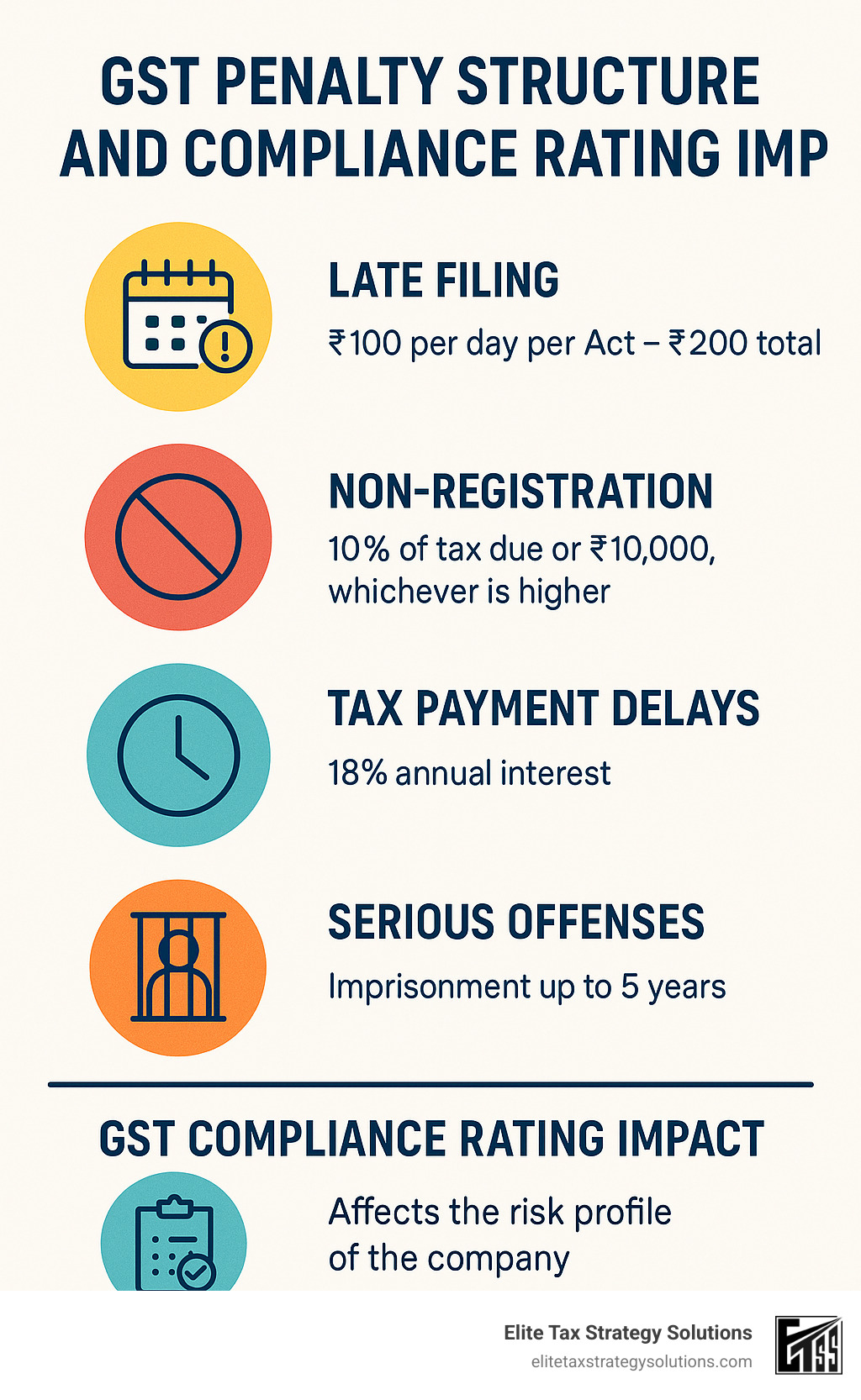
Late filing of GSTR-1 or GSTR-3B incurs penalties of ₹100 per day per Act (effectively ₹200 per day), up to ₹5,000 per return. Nil returns have reduced penalties of ₹20 per day (₹10 under each Act).
Not registering for GST when required costs 10% of the tax amount due or ₹10,000, whichever is higher. Willful tax evasion can increase this to 100% of the tax amount.
Late tax payments incur 18% annual interest, calculated daily with no ceiling.
Serious offenses like tax evasion exceeding ₹5 crore or issuing invoices without actual supply can result in imprisonment for up to 5 years plus fines.
The upcoming GST Compliance Rating system will rate taxpayers from 1-10 based on filing history, payment timeliness, declaration accuracy, and ITC claim reconciliation. High ratings (8-10) will bring benefits like preferred vendor status, faster refunds, and reduced scrutiny, while low ratings (1-4) will result in increased scrutiny, delayed refunds, and limited business opportunities.
Tackling Common Challenges in “gst compliance for private limited company”
Staying on top of GST compliance for private limited company requirements can be challenging. Here are practical solutions to common roadblocks:
1. Data Reconciliation Challenges
Discrepancies between your reports and what vendors/customers report can cause headaches. Establish a weekly reconciliation routine to compare your records with GSTR-2B data, giving you time to contact suppliers before filing deadlines.
Create a “supplier compliance scorecard” to track which vendors consistently cause problems. Often, a friendly conversation with problematic suppliers can resolve issues they may not realize are impacting your business.
2. Supplier Non-Compliance Issues
Your ITC claims depend on your suppliers’ compliance. Make GST compliance verification part of your vendor onboarding process and regularly check supplier GSTIN status, especially before large payments.
Consider adding compliance clauses in contracts that allow withholding partial payment until proper GST documentation is provided.
3. GST Portal Technical Glitches
Avoid the rush by filing 3-5 days early. Keep offline backups of all return data and document portal errors with screenshots, which can help when requesting penalty waivers for late filing caused by technical issues.
4. Inter-Branch Transfer Complexities
For companies with multiple state locations, implement standardized transfer pricing policies and documentation templates. Consider whether an Input Service Distributor (ISD) registration might benefit your company by streamlining credit distribution across locations.
5. Audit Readiness Concerns
Maintain a dedicated “GST audit file” with monthly reconciliations, classification decisions, and supporting documentation. This creates a clear trail showing your compliance journey, making audits less stressful and often leading to faster completion.
For more detailed guidance, visit our Compliance of GST resource page.
Tech and professional solutions
The right technology can transform GST compliance for private limited company from a monthly challenge into a manageable process.
GST-compliant accounting software like Tally, QuickBooks, and Zoho Books offer GST modules that automatically validate invoice formats and HSN codes, catching errors before they reach the GST portal.
For companies exceeding ₹5 crore turnover, e-invoicing tools become essential. One retail client saw reconciliation issues drop by 85% after implementing e-invoicing, as it eliminated manual data entry errors.
Document management deserves special attention given the 8-year retention requirement. Cloud-based systems with proper backup protocols have saved many businesses during GST audits.
Regular internal audits provide crucial checks and balances. Quarterly reviews focusing on different aspects of compliance can catch issues early when they’re still easily fixable.
For more insights on optimizing your overall tax approach, visit our Business Tax Compliance page.
Special scenarios: e-commerce, exports, multi-state operations
Specialized sectors face unique GST compliance requirements:
E-commerce businesses face mandatory registration regardless of turnover. Marketplace platforms must collect Tax at Source (TCS) at 1% and file monthly GSTR-8 returns. Implementing a specialized reconciliation tool can significantly reduce the time spent matching platform reports with GSTR-2B data.
Export businesses benefit from GST’s zero-rated supply provisions. Most exporters prefer using a Letter of Undertaking (LUT) to avoid tying up working capital. LUTs must be renewed annually by filing Form GST RFD-11. Ensure invoices are clearly marked with the correct export treatment to avoid confusion during refund processing.
Companies operating across multiple states must maintain separate registrations for each state. Consider an Input Service Distributor (ISD) registration to efficiently distribute input credits from your head office to branches. Develop standardized templates for inter-state branch transfers, which are treated as taxable supplies even without consideration.
Frequently Asked Questions about GST Compliance for Private Limited Companies
What happens if a private limited company crosses the turnover threshold mid-year?
When your company exceeds the registration threshold during the financial year, you have a 30-day window to complete GST registration. The clock starts from the day your aggregate turnover crosses the threshold.
Start monitoring your monthly turnover when you reach about 80% of the threshold to prepare documentation in advance. Missing this window can be costly – late registration penalties include ₹100 per day per Act (effectively ₹200 daily) plus 10% of the tax due from when you became liable until registration. During this period, you can’t collect GST from customers but must still pay it to the government.
Can a company below ₹40 lakh voluntarily register and claim ITC?
Yes! Voluntary GST registration offers several advantages even when your turnover is below threshold:
- Access to input tax credit allows you to recover GST paid on business purchases
- Early registration establishes your GST compliance history before you need it
- GST-registered businesses prefer suppliers who provide proper GST invoices
- GST registration signals business credibility and professionalism
Once registered, you’re committed to all compliance requirements for at least one full financial year before you can cancel registration.
How is the GST Compliance Rating calculated and why does it matter?
While not fully implemented yet, the GST Compliance Rating system will work on a scale of 1-10 (10 being best) based on several factors:
- Return filing timeliness
- Payment promptness
- Data accuracy in filed returns
- ITC matching with supplier reports
- Audit outcomes
This rating will impact your business in multiple ways:
- Determining business opportunities with large corporations and government entities
- Affecting priority processing for refunds and approvals
- Influencing the level of scrutiny you face
- Potential financial benefits from banks and lenders
- Serving as a public trust indicator in the marketplace
For comprehensive guidance on maintaining excellent GST compliance for private limited company operations, visit our tax support and compliance resources.
Conclusion
Keeping up with GST compliance for private limited company requirements can be challenging, but with the right approach, it transforms from a headache into a business advantage.
Start with timely registration when you hit those crucial thresholds—₹40 lakh for goods or ₹20 lakh for services—or when engaged in activities requiring registration regardless of turnover.
Issue GST-compliant invoices that help your customers claim input tax credits while creating an important audit trail. File returns on schedule—GSTR-1 by the 11th and GSTR-3B by the 20th each month (or quarterly if eligible for QRMP)—to avoid penalties and build your compliance rating.
Maintain organized records for the required 8-year period, conduct regular reconciliation between your records and GSTR-2B, and leverage appropriate technology to automate routine tasks.
At Elite Tax Strategy Solutions, we help private limited companies turn GST compliance from a worry into a well-oiled machine. Our team creates custom tax strategies that keep you penalty-free while maximizing legitimate tax benefits.
GST compliance for private limited company isn’t just about avoiding penalties—it’s about building business credibility, improving cash flow through timely ITC claims, and creating a competitive edge in your market.
Ready to transform your company’s approach to GST compliance? Visit our Tax Support and Compliance page or reach out to our office in Jasper, Indiana. We’d love to show you how a personalized compliance strategy can make all the difference for your business.