GST return compliance is crucial for any business operating in India to ensure they remain aligned with tax authorities and optimize tax efficiency. This process involves timely and accurate filing of GST returns, maintaining proper records, and adhering to tax invoice requirements. It can prevent penalties and foster smooth business operations. As businesses increasingly digitalize, GST compliance has become more seamless, allowing companies to streamline their processes and reduce manual errors.
Digitalization in tax compliance has transformed the way businesses handle their GST obligations. With cloud-based solutions and API integrations, businesses can now automate several aspects of their GST return filing. This not only ensures accuracy but also saves significant time and resources, enabling businesses to focus on growth rather than administrative tasks.
I’m David Fritch. With over 40 years of experience in tax strategy and compliance, I specialize in helping small business owners and high-income earners steer the complexities of gst return compliance. My expertise lies in ensuring that you remain compliant while optimizing your tax strategy for maximum efficiency. Let’s dig deeper into understanding GST compliance and its integral components.
Gst return compliance terminology:
– vat tax compliance
– foreign tax compliance
– international tax compliance
Understanding GST Return Compliance
Filing GST returns is a fundamental responsibility for businesses in India. It ensures that you accurately report your sales, purchases, and tax liabilities. This isn’t just a formality—it’s a legal requirement aimed at maintaining transparency and fairness in the tax system.
Compliance Responsibilities
Every business that is registered under GST must adhere to specific compliance responsibilities. This includes:
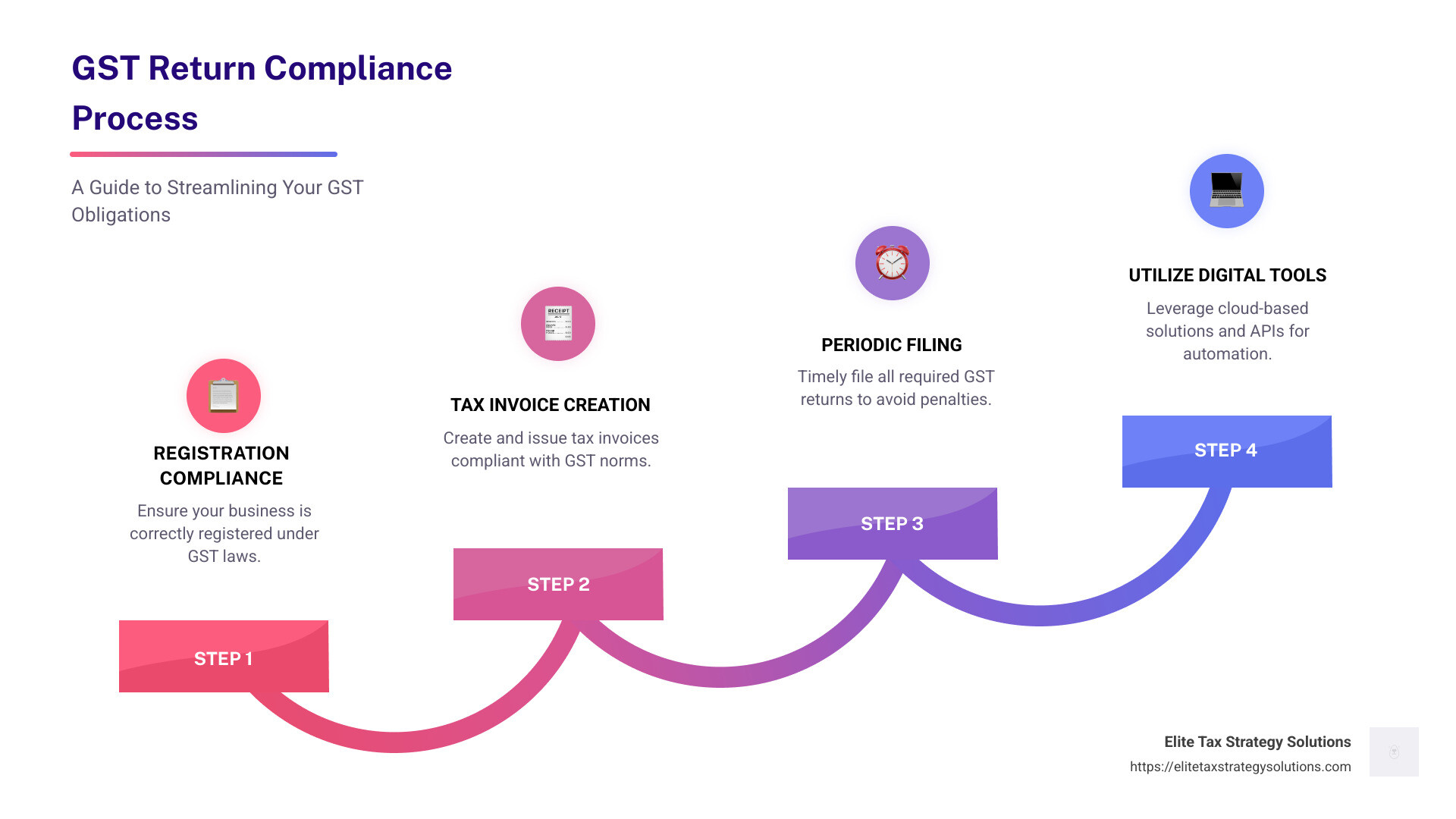
- Timely Filing: Businesses must file their GST returns on time. Late submissions can lead to penalties and interest charges.
- Accurate Reporting: Ensure that all sales and purchase data is correctly reported. This includes the correct calculation of tax liability and the input tax credit (ITC) availed.
- Maintaining Records: Keep detailed records of all financial transactions. This is not only essential for GST compliance but also critical if the tax authorities request an audit.
Tax Liability
Understanding your tax liability under GST is crucial. Your liability is the amount of GST you owe to the government after accounting for the ITC. Here’s a simple way to look at it:
- Output Tax: This is the GST you collect from your customers on sales.
- Input Tax Credit: This is the GST you pay on your purchases. You can claim this as a credit to reduce your overall tax liability.
The difference between the output tax and the input tax credit is your net tax liability. It’s important to calculate this accurately to avoid underpayment or overpayment.
GST Return Filing Process
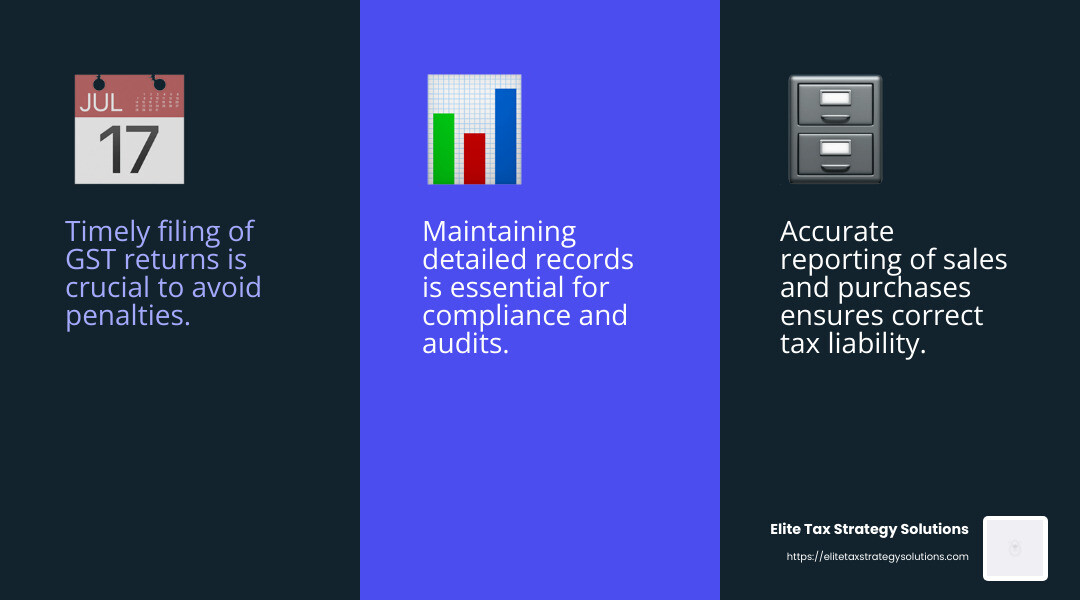
The process of filing GST returns involves several steps:
- Gather Data: Collect all your sales and purchase invoices.
- Calculate Tax: Determine your output tax and input tax credit.
- File Returns: Use the GST portal to file your returns. This can be done monthly, quarterly, or annually, depending on your business type.
- Pay Tax: Ensure any net tax liability is paid before filing.
By understanding and adhering to these compliance responsibilities, you can ensure that your business remains on the right side of the law. This not only helps in avoiding penalties but also improves your business’s credibility and compliance rating.
With the advent of digital tools and platforms, managing your GST return compliance has become more straightforward. Automation can significantly reduce the burden of manual calculations and data entry, allowing you to focus on what matters most—growing your business.
Key Components of GST Return Compliance
To successfully steer GST return compliance, businesses must focus on three key components: registration compliance, tax invoice compliance, and record-keeping. These elements are crucial for maintaining transparency and ensuring your business operates smoothly within the legal framework.
Registration Compliance
Getting your GST registration right is the first step in staying compliant. If your business’s annual turnover exceeds the threshold set by the government, you must register for GST. This process is straightforward and can be completed online at www.gst.gov.in.
Failure to register can lead to severe penalties. The Central Board of Indirect Taxes and Customs (CBIC) enforces strict rules for non-compliance, so ensure your business is registered if required.
Tax Invoice Compliance
Once registered, businesses must comply with tax invoice regulations. Every sale of goods or services requires a GST-compliant invoice. These invoices must include:
- Supplier and recipient GSTIN
- HSN/SAC codes for the goods/services
- Tax rates and taxable value
- Sequential invoice numbering
Failing to issue proper invoices can result in penalties up to ₹10,000 or 100% of the tax amount due, whichever is higher. Accurate invoicing is not just about avoiding penalties; it’s also about ensuring that you and your customers can claim the correct Input Tax Credit (ITC).
Record-Keeping
Maintaining accurate records is the backbone of GST compliance. Businesses must keep detailed documentation, including:
- Tax invoices and receipts
- Bills of entry for imports
- Records of all financial transactions
These records should be kept for at least six years from the date of filing the annual return. Proper record-keeping is critical not only for compliance but also for defending your tax positions in case of an audit.
Regularly reconciling your records with your GST returns ensures accuracy and helps prevent discrepancies. For instance, matching your purchase records with the GSTR-2A (auto-generated based on suppliers’ GSTR-1) can help verify your ITC claims.
By focusing on these key components, businesses can streamline their GST return compliance process, reduce the risk of errors, and avoid costly penalties. This foundation paves the way for more efficient tax management and positions your business for success in a digital tax environment.
Types of GST Returns and Their Importance
Understanding the different types of GST returns is crucial for efficient tax management. Let’s break down the key returns: GSTR-1, GSTR-3B, and GSTR-9.
GSTR-1: Reporting Outward Supplies
GSTR-1 is all about detailing your outward supplies. In simple terms, it’s where you report all your sales. This return includes invoices and debit-credit notes for a tax period.
-
Who files it? All regular taxpayers, including casual taxable persons, need to file GSTR-1. If your business’s annual turnover is over ₹5 crore, you must file it monthly by the 11th of the following month. For businesses in the QRMP scheme, the deadline is the 13th of the month following each quarter.
-
Why is it important? Filing GSTR-1 accurately ensures that your buyers can claim their Input Tax Credit (ITC) without issues. It’s also a way to maintain transparency and keep your tax records straight.
GSTR-3B: Summary of Sales, Purchases, and Tax Payment
GSTR-3B is a monthly summary return. It captures the total sales and purchases, tax liability, and ITC availed.
-
Who files it? This is mandatory for all regular taxpayers and is due by the 20th of the following month.
-
Why is it important? GSTR-3B is critical because it involves the actual payment of tax. Accuracy here is non-negotiable, as errors can lead to discrepancies and potential penalties.
GSTR-9: The Annual Return
GSTR-9 is the annual return that consolidates all the monthly or quarterly returns filed throughout the financial year.
-
Who files it? All taxpayers registered under GST must file an annual return by December 31st of the succeeding financial year. If your turnover exceeds ₹50 million, you’ll also need to submit a GST Audit Report.
-
Why is it important? This return provides a comprehensive overview of your GST obligations for the year. It helps identify any discrepancies or errors in the monthly/quarterly returns and ensures that your tax records are complete and accurate.
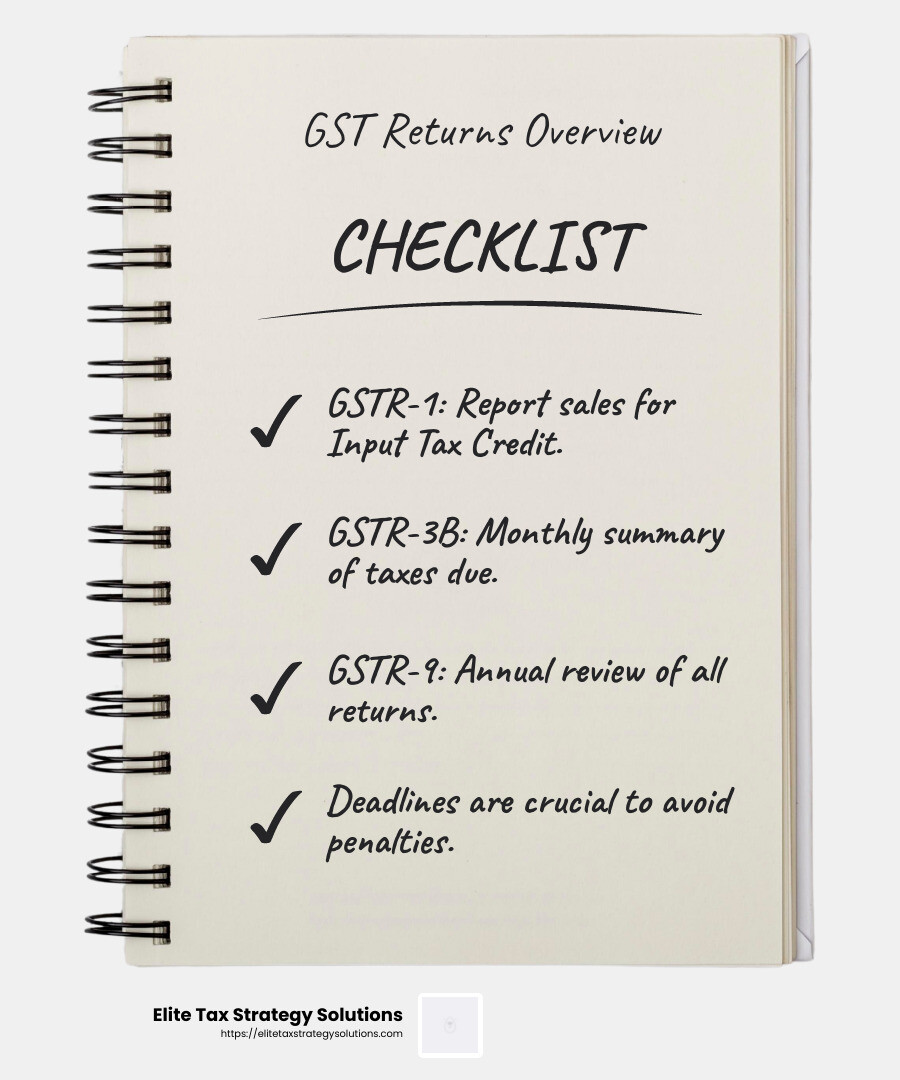
By understanding and correctly filing these returns, businesses can maintain compliance, optimize tax efficiency, and avoid unnecessary penalties. Accurate GST return filing is not just a legal requirement; it’s a best practice for healthy financial management.
Automating GST Return Compliance
Automation in GST return compliance is a game-changer for businesses. Imagine a world where your tax returns are filed with minimal manual effort, reducing errors and saving time. Let’s see how automation through cloud platforms and API integration makes this possible.
Cloud Platform: Your Digital Tax Assistant
A cloud platform acts like your digital filing cabinet. It stores all your GST return forms in one place—from old forms like GSTR-1 to new ones like RET-1. This makes it easy to access historical records whenever you need them.
- Why use a cloud platform? It keeps your data secure and accessible from anywhere. Plus, it automatically updates with the latest GST rules and deadlines, so you’re always compliant.
API Integration: Seamless Data Flow
API integration is like having a direct pipeline from your invoicing system to the GST portal. It allows your systems to “talk” to each other, pulling invoice data directly into your GST returns.
- Benefits of API integration: It speeds up the filing process and reduces errors. No more manual data entry means fewer mistakes and a smoother filing experience.
Automation Benefits: More Than Just Time-Saving
Automating your GST returns offers a host of benefits beyond just saving time.
-
Accuracy: Automated systems validate data, flagging errors before you file. This reduces the risk of inaccuracies and potential penalties.
-
Efficiency: With automation, you can handle multi-state GST returns across different business units and clients from a single account. This simplifies compliance and makes managing multiple GSTINs a breeze.
-
Focus on Growth: By automating routine tasks, you free up time to focus on growing your business, rather than getting bogged down by compliance paperwork.
Incorporating automation into your GST return process not only improves compliance but also boosts your overall business efficiency. It’s a smart move for any business looking to thrive in today’s digital tax landscape.
Frequently Asked Questions about GST Return Compliance
What is the GST return?
A GST return is like a report card for your business’s tax activities. It details your sales, purchases, and the taxes you’ve collected and paid. Think of it as a snapshot of your tax obligations and credits, all neatly wrapped up in a digital form.
-
Sales Details: This includes all the goods and services you’ve sold. It’s crucial to report these accurately to ensure your tax liability is correctly calculated.
-
Purchases: These are the goods and services you’ve bought. Reporting them helps determine the Input Tax Credit (ITC) you can claim, reducing your overall tax burden.
-
Tax Collected: This is the GST you’ve collected from your customers. It’s essential to report this accurately to avoid underpayment or overpayment of taxes.
Which GST return is mandatory?
The must-do form for businesses is Form GSTR-1. This form is all about outward supplies, which means detailing the sales you’ve made. Filing this form ensures that your sales data is up-to-date and helps in reconciling with your buyers’ records.
-
Due Date: Typically, GSTR-1 is due by the 11th of the following month. However, businesses with an annual turnover of up to Rs. 5 crore can opt for quarterly filing.
-
Importance: Timely and accurate filing of GSTR-1 is crucial. It affects your compliance rating and helps maintain a smooth flow of Input Tax Credit for your buyers.
What is the GST annual return rule?
The GST annual return is like an end-of-year review for your business’s tax activities. It consolidates all the monthly or quarterly returns filed throughout the financial year.
-
Who files it? All registered taxpayers are required to file an annual return. However, the complexity and additional requirements depend on your turnover.
-
Due Date: The annual return is due by 31st December following the end of the financial year. For businesses with a turnover above a specified limit, filing GSTR-9C, a reconciliation statement, is also mandatory.
-
Purpose: This return ensures that all your tax transactions for the year are accounted for. It’s a way to double-check your compliance and make any necessary adjustments before closing the books for the year.
Understanding these aspects of GST return compliance is key to staying on the right side of tax laws. It helps avoid penalties and ensures a smooth, hassle-free tax experience.
Conclusion
At Elite Tax Strategy Solutions, we believe in a proactive approach to tax compliance. Our goal is to not just help you meet your GST obligations, but to optimize your tax position for better financial health. By understanding the nuances of GST return compliance, we ensure that your business is always in line with the latest regulations, avoiding penalties and maximizing your tax efficiency.
We know that GST compliance can seem daunting, but with the right strategies and tools, it becomes manageable. Our team offers personalized tax planning services that are custom to your unique needs. Whether you’re a high-income earner or a small business owner, we focus on maximizing your tax savings while ensuring financial stability.
Our approach is thorough and proactive. We keep up with the ever-changing tax laws and help you adjust your strategies accordingly. This way, you can focus on what you do best—growing your business—while we handle the complexities of GST compliance.
By choosing Elite Tax Strategy Solutions, you’re not just getting a service provider; you’re getting a partner in your financial journey. We are here to guide you through the maze of GST regulations, ensuring that your tax return process is not just a compliance task, but a step towards financial optimization.
Ready to take control of your GST compliance and optimize your taxes? Explore our tax support and compliance services to learn more about how we can help you achieve your financial goals.