
Foreign tax compliance is essential for high-income earners and business owners seeking financial stability in a global economy. In today’s interconnected world, understanding international tax laws is not just about following rules—it’s crucial to prevent tax evasion and safeguard financial interests. Here’s what you need to know:
- Foreign tax compliance ensures all worldwide income is reported and taxes owed are paid.
- The IRS uses FATCA to track foreign assets of U.S. citizens and residents.
- Non-compliance can lead to hefty penalties.
- The 2010 HIRE Act reinforced transparency in global financial services to prevent tax avoidance.
I’m David Fritch, with decades of experience managing foreign tax compliance for individuals and businesses. Let’s dig into the key concepts and strategies to keep your business on the right side of the law.
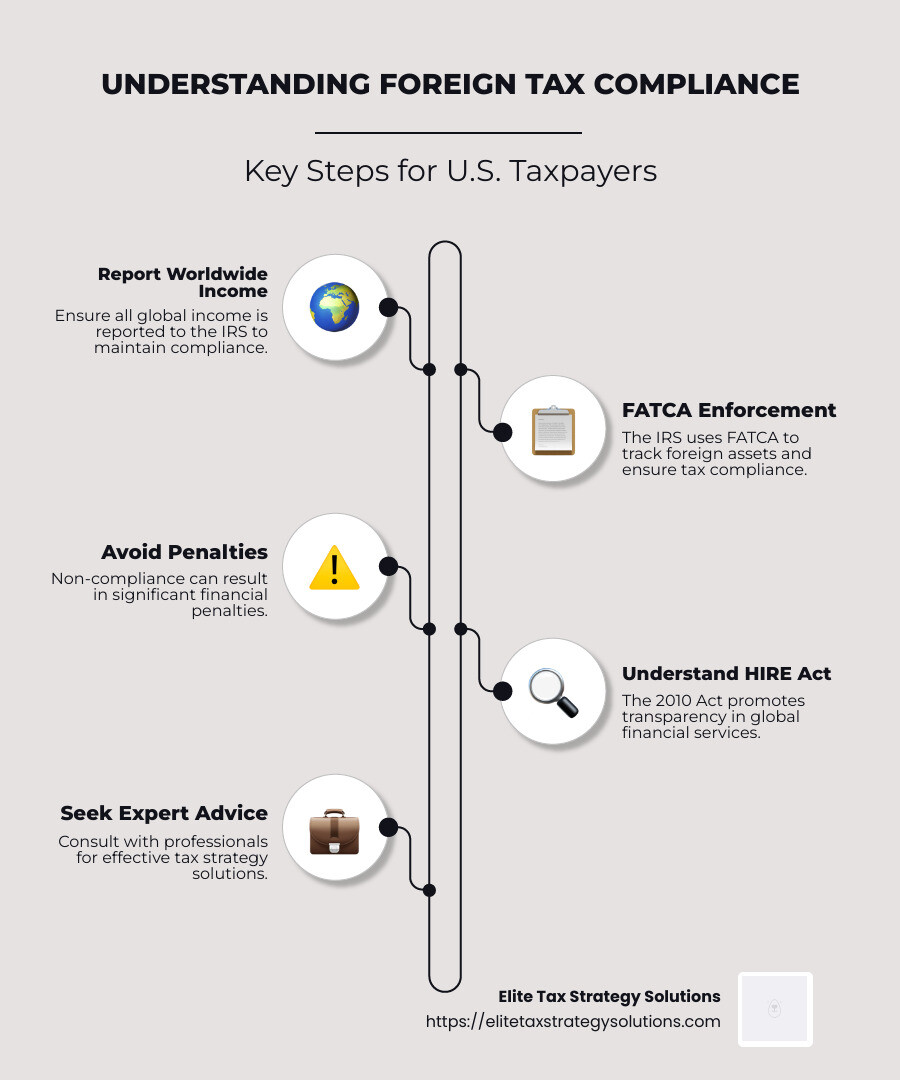
Foreign tax compliance word roundup:
– international tax compliance
– tax compliance for companies
– vat compliance services
Understanding Foreign Tax Compliance
What is Foreign Tax Compliance?
Foreign tax compliance is about making sure U.S. taxpayers follow international tax laws. This involves reporting foreign income and assets to the IRS. The goal? To prevent tax evasion and maintain transparency in global finance.
A key player here is the Foreign Account Tax Compliance Act (FATCA). This law requires foreign financial institutions to report the assets held by U.S. account holders. It ensures that U.S. taxpayers pay taxes on their global income, not just what they earn domestically.
Here’s how it works:
- FATCA mandates that U.S. taxpayers report foreign financial assets if they exceed certain thresholds.
- Foreign banks must disclose accounts held by U.S. citizens or face penalties.
- This law applies to individual taxpayers, businesses, and even non-resident aliens with U.S. ties.
The IRS uses this information to keep track of U.S. assets abroad and collect any taxes owed.
Key Regulations and Acts
The HIRE Act of 2010 was a game-changer. It introduced FATCA to improve transparency and combat tax evasion. But FATCA is just one part of the puzzle. Here’s a quick look at the regulations and acts involved:
- FATCA: Requires reporting of foreign financial assets by U.S. taxpayers and foreign banks.
- IRS Compliance: U.S. taxpayers must file reports like Form 8938 for foreign assets.
- International Tax Laws: These laws ensure that foreign financial institutions comply with U.S. regulations.
Compliance requirements are strict. If foreign financial institutions don’t comply, they face a 30% withholding tax on U.S. sourced payments. This is a strong incentive for them to cooperate.
The takeaway? Foreign tax compliance is vital for U.S. taxpayers and foreign institutions alike. It ensures transparency and fairness in the global economy. By understanding these regulations, businesses and individuals can avoid penalties and operate smoothly across borders.

Next, let’s explore the specific reporting requirements for U.S. taxpayers, including the differences between Form 8938 and FBAR.
Reporting Requirements for U.S. Taxpayers
When it comes to foreign tax compliance, U.S. taxpayers have some specific reporting requirements. Two key forms in this process are Form 8938 and the FBAR (FinCEN Form 114). While both forms deal with foreign financial assets, they serve different purposes and have distinct requirements.
Form 8938 vs. FBAR
Form 8938 is part of the IRS’s efforts to track foreign financial assets under the Foreign Account Tax Compliance Act (FATCA). U.S. taxpayers must file this form with their annual tax return if their foreign financial assets exceed certain thresholds. These thresholds vary depending on whether you live in the U.S. or abroad and whether you’re filing jointly or individually.
On the other hand, the FBAR is filed separately with the Financial Crimes Enforcement Network (FinCEN) and focuses on foreign bank accounts. You must file an FBAR if the total value of your foreign accounts exceeds $10,000 at any point during the year, regardless of where you live.
Here’s a quick comparison:
- Form 8938 is attached to your tax return and reports a broader range of foreign financial assets, including non-account assets like foreign stocks.
- FBAR is filed independently and focuses solely on foreign bank accounts.
Both forms are crucial for ensuring foreign tax compliance and avoiding hefty penalties. Failure to file either can result in significant fines, starting at $10,000 for Form 8938.
Specified Foreign Financial Assets
The IRS defines specified foreign financial assets as certain foreign financial accounts and non-account assets held for investment. Examples include:
- Foreign financial accounts: Bank accounts, investment accounts, and certain retirement accounts held in foreign institutions.
- Foreign non-account assets: Stocks, securities, and interests in foreign entities.
There are exceptions. For instance, financial accounts maintained by a U.S. payor, like a U.S. branch of a foreign bank, are not considered specified foreign financial assets. Similarly, interests in foreign social security systems or similar programs are exempt from reporting.
Understanding these distinctions is essential for U.S. taxpayers to remain compliant. By accurately reporting specified foreign financial assets, taxpayers can avoid penalties and ensure they meet their foreign tax compliance obligations.
Next, we’ll dive into the compliance requirements for foreign financial institutions and their role in the FATCA framework.
Compliance for Foreign Financial Institutions
Navigating foreign tax compliance can be complex for foreign financial institutions. The Foreign Account Tax Compliance Act (FATCA) sets clear expectations for these entities, primarily around reporting obligations and withholding tax.
FATCA Compliance Steps
Foreign financial institutions must follow several steps to comply with FATCA:
-
FATCA Registration: Institutions need to register with the IRS to receive a Global Intermediary Identification Number (GIIN). This number is crucial for reporting purposes and helps avoid the hefty withholding tax.
-
Identify U.S. Account Holders: Institutions must identify accounts held by U.S. taxpayers or entities. This involves checking for FATCA indicia, such as a U.S. place of birth or U.S. mailing address.
-
Report to the IRS: Once U.S. account holders are identified, institutions must report their financial information to the IRS. This includes account balances, income, and any withdrawals or transfers.
-
Withholding Tax: If an institution fails to comply, a 30% withholding tax is imposed on certain U.S.-sourced payments. This is a crucial incentive for institutions to meet their reporting obligations.
Penalties for Non-Compliance
Non-compliance with FATCA can be costly. The IRS imposes strict penalties on institutions that fail to meet the reporting requirements:
-
Failure to File: Institutions that do not file the required reports face significant fines. These penalties can escalate quickly, starting at $10,000 and increasing with continued non-compliance.
-
Withholding Tax: As mentioned, non-compliant institutions face a 30% withholding tax on U.S.-sourced income. This can severely impact an institution’s financial standing, making compliance a financial imperative.
-
Reputational Damage: Beyond financial penalties, non-compliance can damage an institution’s reputation. Trust is vital in the financial industry, and failing to comply with FATCA can erode client confidence.
Ensuring compliance with FATCA is not just about avoiding penalties. It’s about maintaining credibility and ensuring smooth operations in the global financial market. Next, we’ll answer some frequently asked questions about foreign tax compliance to help clarify common concerns and misunderstandings.
Frequently Asked Questions about Foreign Tax Compliance
What is foreign tax compliance?
Foreign tax compliance involves adhering to international tax laws, like the Foreign Account Tax Compliance Act (FATCA), which requires U.S. taxpayers and foreign financial institutions to report foreign assets and accounts. The goal is to prevent tax evasion by ensuring transparency in foreign financial dealings.
FATCA mandates that U.S. taxpayers report specified foreign financial assets exceeding certain thresholds to the IRS. This includes bank accounts, stocks, and other financial instruments. Foreign financial institutions, on the other hand, must identify and report accounts held by U.S. citizens to avoid penalties.
Who needs to fill the FATCA form?
U.S. taxpayers with foreign financial assets over a specified threshold must file Form 8938 under FATCA. This includes:
- Individuals: U.S. citizens and residents with foreign assets exceeding $50,000.
- Entities: Domestic partnerships, corporations, and trusts with U.S. beneficiaries.
Foreign financial institutions are also required to disclose information about U.S. account holders to the IRS. Failure to comply can result in a 30% withholding tax on U.S.-sourced payments.
Am I exempt from the Foreign Tax Compliance Act?
While FATCA has broad applicability, there are specific exemptions:
- Certain Financial Institutions: Some foreign institutions, like governmental entities and international organizations, might be exempt.
- Specific Assets: Assets held in a foreign branch of a U.S. institution or a U.S. branch of a foreign institution may not need to be reported.
- Thresholds: If your foreign financial assets are below the reporting threshold, you are exempt from filing Form 8938.
It’s crucial to understand these exemptions to determine your obligations accurately. However, always consult with a tax professional to ensure compliance with FATCA and avoid potential penalties.
By understanding these frequently asked questions, you can better steer the complexities of foreign tax compliance. In the next section, we will conclude our discussion by summarizing the key points and emphasizing the importance of staying compliant with international tax laws.
Conclusion
Navigating foreign tax compliance can seem daunting, but it’s essential for U.S. taxpayers and foreign financial institutions to stay on the right side of the law. The Foreign Account Tax Compliance Act (FATCA) is a critical piece of legislation aimed at curbing tax evasion by ensuring transparency in global financial transactions.
FATCA requires U.S. taxpayers to report their foreign financial assets to the IRS, using Form 8938 for assets over $50,000. This includes bank accounts, stocks, and other investments. Likewise, foreign financial institutions must report accounts held by U.S. citizens or face significant penalties, such as a 30% withholding tax on U.S.-sourced payments.
While compliance can be complex, the penalties for non-compliance are steep. Individuals who fail to file necessary forms may face fines starting at $10,000, with additional penalties if the failure continues. For institutions, non-compliance can mean exclusion from the U.S. market.
At Elite Tax Strategy Solutions, we understand the intricacies of foreign tax compliance. Our proactive approach ensures that you meet all compliance requirements, helping you avoid costly penalties. We offer custom tax planning services to high earners and closely held businesses, focusing on maximizing your tax savings while maintaining financial stability.
For more information on how we can assist with your tax compliance needs, visit our Tax Support and Compliance Services page.
By staying informed and compliant, you can focus on what truly matters — growing your business and securing your financial future. Compliance isn’t just about avoiding penalties; it’s about ensuring your business operates smoothly and transparently in the global financial landscape.