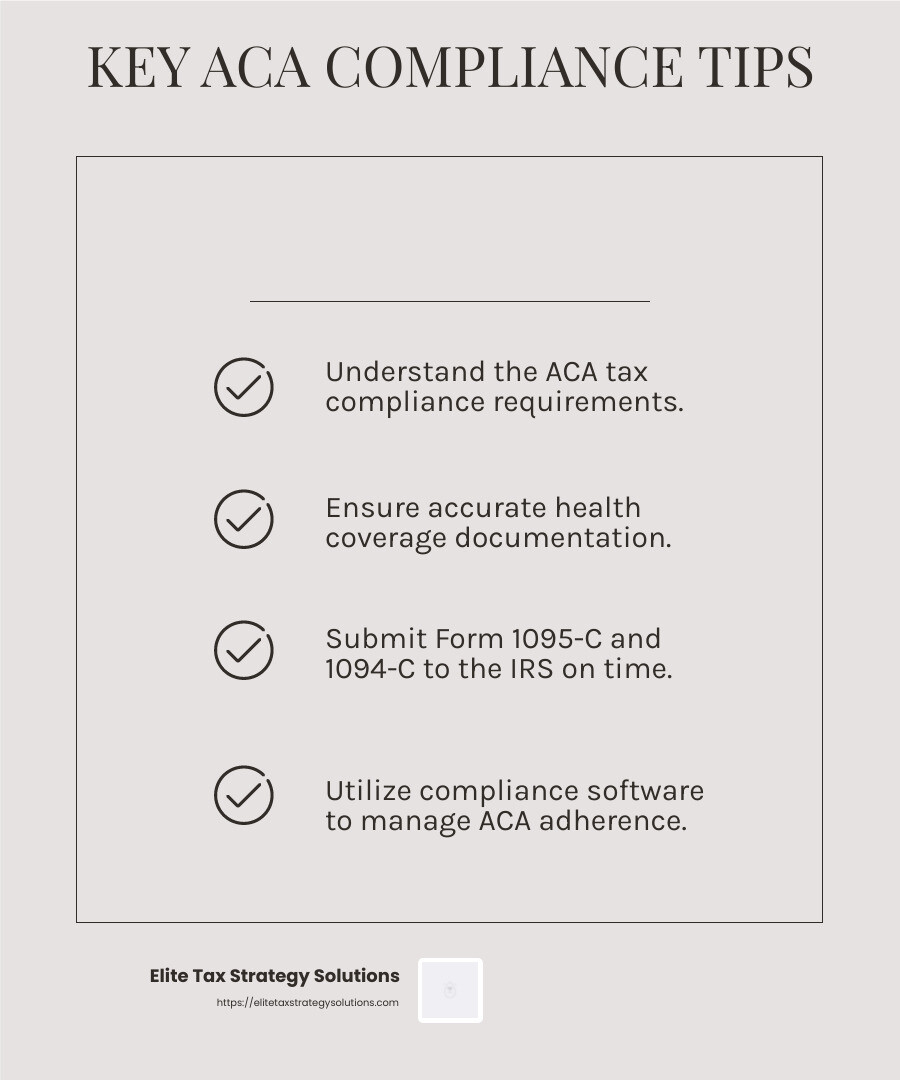
To steer the complexities of aca tax compliance successfully, one must understand its core components and significance. In simple terms, aca tax compliance involves adhering to the healthcare regulations set forth by the Affordable Care Act (ACA), ensuring both individuals and businesses meet health insurance reporting and coverage obligations. Here’s what you need to know:
- Health Coverage Requirements: The ACA mandates that individuals must have health insurance and certain employers must provide it.
- Reporting Obligations: Employers classified as Applicable Large Employers (ALEs) need to report coverage and employee details to the IRS using specific forms like 1095-C.
- Penalties for Non-Compliance: Lack of compliance can lead to significant financial penalties, so stay informed and prepared.
At Elite Tax Strategy Solutions, we focus on helping high-income earners and small business owners steer these demands effectively, offering custom strategies to ensure compliance and optimize financial outcomes.
I’m David Fritch, with over four decades of experience in tax compliance, including the intricate aspects of aca tax compliance. My background includes running a CPA practice and helping businesses like yours manage and grow their profits while staying ahead of tax obligations.
Aca tax compliance terms simplified:
– tax compliance for companies
– tax compliance services
– 1099 tax compliance
Understanding ACA Tax Compliance
Navigating ACA tax compliance is crucial for both individuals and businesses to avoid penalties and ensure proper health insurance coverage. Let’s break it down step by step.
What is ACA Compliance?
ACA compliance refers to adhering to the rules set by the Affordable Care Act. For businesses, this means providing health insurance that meets minimum standards to employees. Specifically, businesses classified as Applicable Large Employers (ALEs) must offer coverage to at least 95% of full-time employees. If they don’t, they face penalties.
-
Employer Requirements: ALEs are businesses with 50 or more full-time equivalent employees. They must ensure the health plans they offer are affordable and provide essential health benefits.
-
Minimum Standards: The ACA requires that health plans cover a comprehensive set of services, including preventive care, hospitalization, and prescription drugs.
ACA Tax Mandate
The ACA also includes an individual mandate, which requires most Americans to have health insurance. If they don’t, they may face a penalty, unless they qualify for an exemption.
-
Penalties: Individuals without coverage may incur a penalty during tax filing. This penalty was designed to encourage people to obtain insurance and avoid unexpected medical costs.
-
Exemptions: Some individuals may qualify for exemptions due to financial hardship, membership in certain groups, or other specific conditions.
Reporting Requirements
Employers need to report on the health coverage they provide using specific IRS forms. This is crucial to demonstrate compliance with the ACA.
-
Form 1095-C: This form is used by ALEs to report information about health insurance coverage offered to employees. It includes details like the type of coverage and who was covered.
-
Form 1094-C: This is a transmittal form that accompanies Form 1095-C when submitted to the IRS. It summarizes the information provided in all the 1095-C forms for the employer.
-
IRS Submission: These forms must be submitted annually to the IRS. Failure to do so can result in penalties for the employer.
Understanding these components of ACA tax compliance is essential for avoiding penalties and ensuring that both individuals and businesses meet their health insurance obligations. Next, we’ll dive into the key tax provisions under the ACA, providing insight into how they impact individuals, families, and businesses.
Key Tax Provisions Under the ACA
The Affordable Care Act (ACA) introduced several key tax provisions that affect individuals, families, and businesses. Understanding these provisions is crucial for maintaining compliance and avoiding penalties.
Individual Shared Responsibility Provision
Under the ACA, most individuals are required to have health insurance coverage or face a penalty, unless they qualify for an exemption. This is known as the Individual Shared Responsibility Provision.
-
Healthcare Coverage: Individuals must ensure they have minimum essential coverage, which can be obtained through employer-sponsored plans, government programs, or the Health Insurance Marketplace.
-
Exemptions: Some individuals may be exempt from this requirement due to factors like financial hardship or membership in certain groups. It’s essential to know if you qualify for an exemption to avoid unnecessary penalties.
-
Penalties: If you fail to obtain coverage and do not qualify for an exemption, you may incur a penalty during tax filing. This penalty is calculated based on a percentage of your household income or a flat fee, whichever is higher.
Premium Tax Credit
The Premium Tax Credit is designed to help individuals and families afford health insurance purchased through the Health Insurance Marketplace.
-
Eligibility: To qualify for this credit, your household income must be between 100% and 400% of the federal poverty level. Additionally, you cannot be eligible for other affordable coverage, such as Medicaid.
-
Health Insurance Marketplace: You must purchase your health insurance through the Marketplace to qualify for the Premium Tax Credit. This ensures that your plan meets ACA standards.
-
Tax Filing: When filing taxes, you must reconcile the credit you received with your actual income. This is done using IRS Form 8962. If there’s a discrepancy, you may need to repay some or all of the credit.
Employer Shared Responsibility Provisions
Businesses, especially those classified as Applicable Large Employers (ALEs), have specific responsibilities under the ACA, known as the Employer Shared Responsibility Provisions.
-
Workforce Size: ALEs are defined as businesses with 50 or more full-time equivalent employees. They must offer health insurance to at least 95% of full-time employees to avoid penalties.
-
Health Coverage Requirements: The insurance offered must be affordable and provide minimum essential coverage. Failure to meet these requirements can result in significant penalties.
-
Reporting Obligations: Employers must report the health coverage they provide using IRS Forms 1095-C and 1094-C. Accurate and timely reporting is essential to demonstrate compliance and avoid penalties.
By understanding these key tax provisions, individuals and businesses can steer ACA tax compliance more effectively. Keeping informed about eligibility, coverage requirements, and reporting obligations will help avoid penalties and ensure proper health insurance coverage.
Best Practices for ACA Tax Compliance
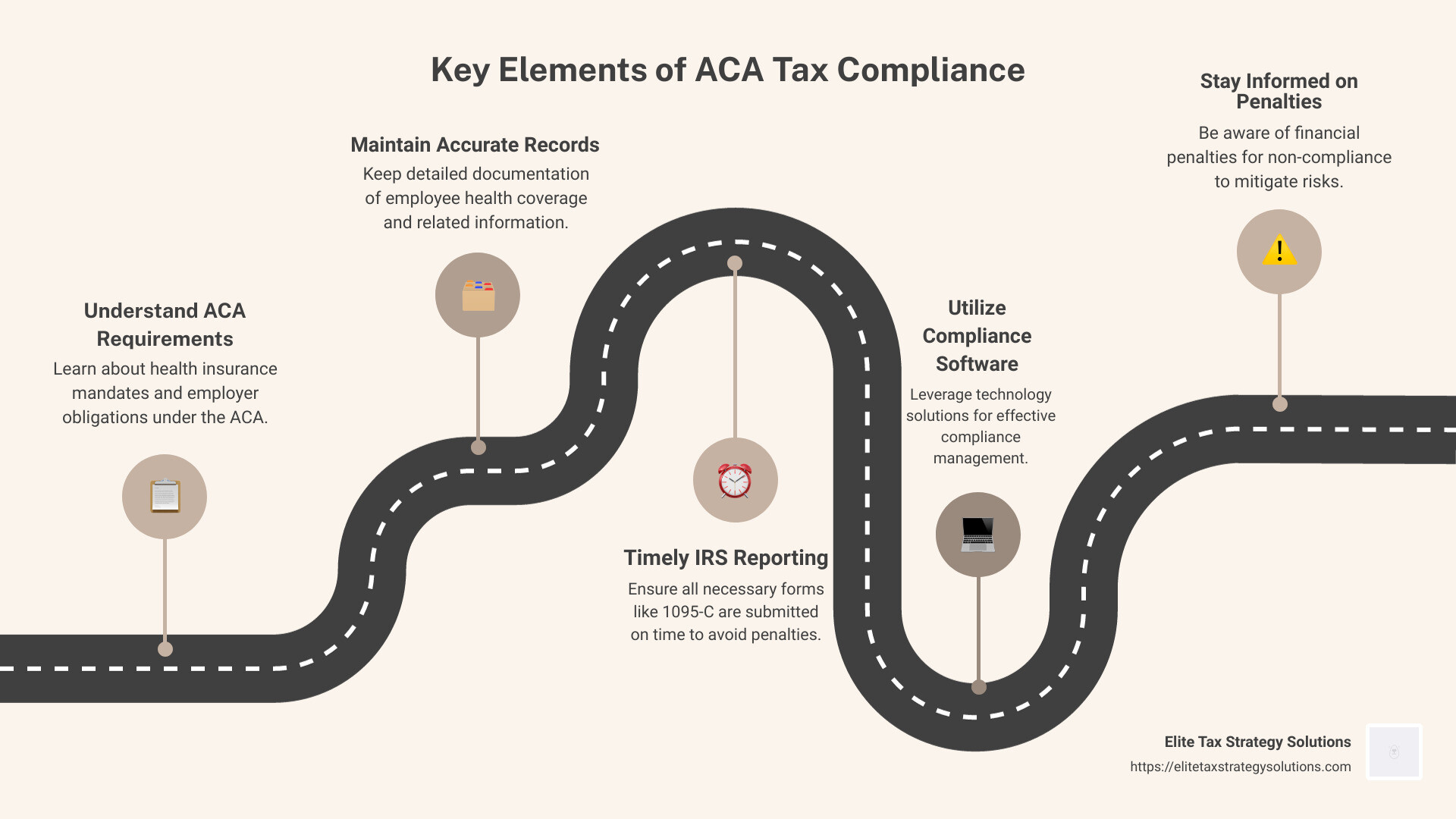
Navigating ACA tax compliance can be daunting, but following some best practices can simplify the process and help avoid penalties. Let’s explore three essential areas: accurate record-keeping, timely reporting, and utilizing compliance software.
Accurate Record-Keeping
Keeping precise records is the backbone of ACA compliance. Here’s what you need to focus on:
-
Employee Records: Maintain up-to-date records of all employees, including their employment status and hours worked. This is crucial for determining full-time equivalents and ensuring compliance with the ACA’s coverage requirements.
-
Health Coverage Details: Document the health insurance coverage offered to employees, including plan types and coverage dates. This ensures you have the necessary information when filing IRS forms.
-
Documentation: Store all relevant documents securely and ensure they are easily accessible. This includes employee waivers, coverage offers, and any correspondence related to health insurance.
Timely Reporting
Meeting reporting deadlines is critical to avoid penalties. Follow these tips to stay on track:
-
Deadlines: Familiarize yourself with important deadlines for filing IRS forms. For instance, Forms 1095-C and 1094-C must be submitted annually to report employee health coverage.
-
IRS Forms: Complete the required IRS forms accurately. Form 1095-C provides details about the health coverage offered to employees, while Form 1094-C serves as a transmittal summary.
-
Submission Process: Use electronic filing to submit forms to the IRS. It is faster and reduces the risk of errors compared to paper submissions.
Utilizing Compliance Software
Leveraging technology can streamline the compliance process. Consider these benefits of using compliance software:
-
ONESOURCE ACA Solutions: This software provides a centralized hub for managing ACA reporting. It helps streamline the preparation and distribution of forms and can assist in penalty abatement.
-
Centralized Hub: A centralized system ensures all your data is in one place, making it easier to access and manage. This reduces the risk of errors and ensures consistency across reports.
-
Penalty Abatement: The software can help identify potential issues before they become penalties. By proactively managing compliance, you can address concerns early and avoid costly mistakes.
By implementing these best practices, businesses can steer ACA tax compliance more efficiently and effectively. Accurate records, timely reporting, and the right software tools are key to staying compliant and avoiding penalties.
Frequently Asked Questions about ACA Tax Compliance
What is ACA compliance?
ACA compliance refers to adhering to the requirements set by the Affordable Care Act, ensuring that individuals and businesses meet health coverage standards. For employers, this means providing minimum essential coverage to full-time employees and reporting this information to the IRS. Compliance also involves understanding the rules around health insurance marketplaces and premium tax credits for individuals and families.
What is the ACA explanation on taxes?
The ACA impacts taxes in several ways. It introduced the Premium Tax Credit, which helps lower the cost of health insurance for eligible individuals and families purchasing through the Health Insurance Marketplace. Employers must report health coverage information to the IRS using Forms 1095-C and 1094-C. Non-compliance can result in penalties, so understanding these tax implications is crucial for both individuals and businesses.
How can I avoid the ACA tax penalty?
To avoid penalties, ensure you meet all ACA requirements:
-
For Individuals: Maintain health insurance coverage that qualifies as minimum essential coverage. If you qualify for exemptions, apply for them to avoid penalties.
-
For Employers: Provide health insurance that meets ACA standards to full-time employees. Submit accurate and timely Forms 1095-C and 1094-C to the IRS.
Utilizing comprehensive compliance solutions can help manage these processes efficiently, reducing the risk of penalties by ensuring accurate reporting and record-keeping.
Conclusion
Navigating the complex landscape of ACA tax compliance is crucial for individuals and businesses alike. The Affordable Care Act has introduced significant changes to how health insurance and taxes intersect, making compliance not just a legal obligation but a financial necessity.
For individuals, maintaining the right health coverage can prevent unexpected tax penalties. For businesses, especially those with larger workforces, understanding and adhering to reporting requirements is essential. This includes providing the right coverage and submitting necessary forms like the 1095-C and 1094-C to the IRS.
At Elite Tax Strategy Solutions, we specialize in helping our clients stay compliant while maximizing their financial efficiency. Our proactive approach ensures that you not only meet all ACA requirements but also optimize your tax strategies to benefit your bottom line. We manage everything from accurate tax preparation to ongoing compliance monitoring, providing peace of mind and allowing you to focus on what you do best.
To learn more about how we can assist you with ACA compliance and other tax-related needs, visit our Tax Support and Compliance page. Our team is ready to support you every step of the way, ensuring that you remain compliant and financially sound in today’s ever-changing tax landscape.