Why Business Tax Audits Strike Fear (But Shouldn’t)
A business tax audit is a formal IRS review of your company’s financial records to verify that your tax return is accurate. While the thought can be intimidating, the reality is far less dramatic.
Key Facts About Business Tax Audits:
- Audit rates are extremely low: Only 1% of Schedule C filers and 0.1% of S-Corps get audited.
- Most audits are by mail: Nearly 74% are correspondence audits handled without in-person meetings.
- An audit is verification, not accusation: Being selected doesn’t mean you did anything wrong.
- You have rights: This includes professional representation and the right to appeal.
The reality is that with a US tax gap estimated at $625 billion, the IRS conducts audits as a routine verification process. While noncompliant businesses are less likely to survive after an audit, compliant businesses face minimal long-term impact.
The key to navigating an audit is preparation. When you know what to expect and have your records organized, an audit becomes a manageable business process rather than a crisis.
I’m David Fritch, and with 40 years of experience as a CPA, I’ve helped countless business owners steer business tax audits with confidence. Through Elite Tax Strategy Solutions, I specialize in proactive tax planning that not only minimizes audit risk but ensures you’re prepared if one occurs.
What is a Business Tax Audit and Why Was I Chosen?
A business tax audit is the IRS’s process for verifying that your company’s income, deductions, and credits are accurately reported according to tax laws. It’s a fact-checking process, not an accusation of wrongdoing. Many business owners panic when they receive an audit letter, but the selection is often systematic or random.
The IRS uses computer programs to screen returns, comparing them to others in similar industries. If your return stands out, it might get flagged. Sometimes, selection is random or related to an audit of a business partner or investor. For more information, you can explore our resources on IRS compliance.
Common Triggers for Business Tax Audits
While some audits are random, many are triggered by specific red flags:
- Large cash transactions: Businesses that handle lots of cash (restaurants, salons) are watched closely because it’s easier to underreport income.
- Disproportionate expenses: Deductions that seem unusually high compared to your reported income will be flagged by IRS computers.
- Claiming business losses for multiple years: The IRS expects businesses to eventually be profitable. Consistent losses may trigger a review under the Hobby Loss Rule.
- Misclassifying employees: Incorrectly labeling employees as independent contractors to avoid payroll taxes is a major issue for the IRS.
- Significant changes from prior years: A sudden 50% drop in income or a doubling of deductions will attract attention.
- Unreported income from 1099 mismatches: The IRS automatically compares 1099 forms to your return. If the numbers don’t match, an audit is likely.
- Excessive deductions: High claims for home office, meals, or auto expenses are frequently audited due to common errors.
The Odds of Being Audited
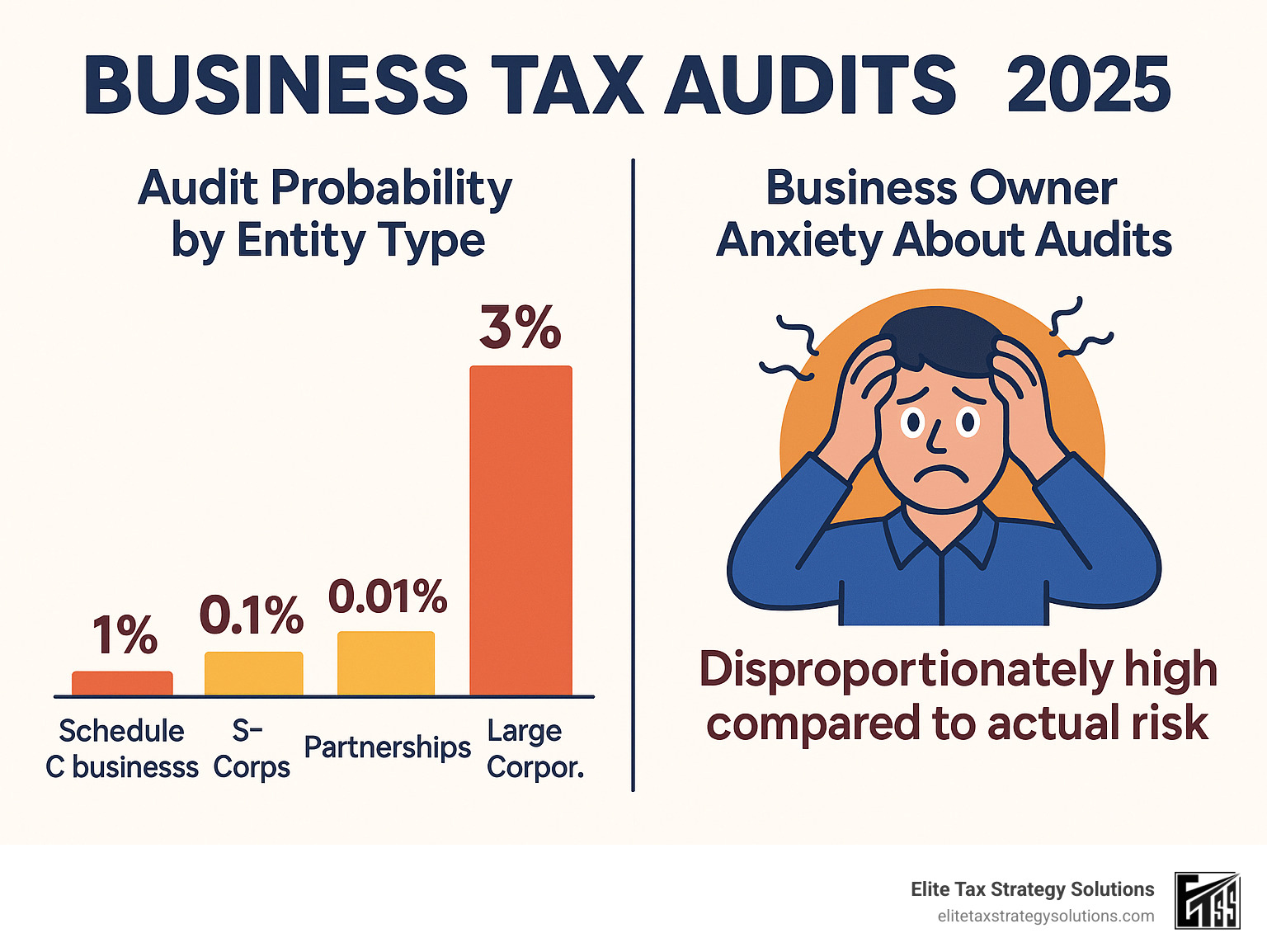
Here’s the good news: your actual chances of facing a business tax audit are remarkably low. Audit rates have been declining for years.
- Schedule C filers (sole proprietors): 1% audit rate
- S-Corporations: 0.1% audit rate
- Partnerships: 0.01% audit rate
- Large corporations: ~3% audit rate
For most small and medium-sized businesses, the odds are heavily in your favor. The anxiety business owners experience is completely disproportionate to the actual risk. Your energy is better spent on proper record-keeping than on worrying about an audit that probably won’t happen.

The Audit Playbook: Types, Timelines, and Processes
The IRS will always notify you of an audit by mail. If someone calls claiming to be from the IRS about an audit, it’s a scam. Once you receive that official letter, the process begins. Understanding tax compliance is crucial at this stage.
The timeline for business tax audits varies. A simple correspondence audit might take a few weeks, while a complex field audit can last a year or more. The IRS generally has three years from when you filed to audit your return. However, this extends to six years if you underreported income by more than 25%. For suspected fraud, there is no time limit.
The Different Types of IRS Business Audits
The IRS conducts business tax audits in three main ways:
| Audit Type | How It’s Conducted | Scope & Focus | Frequency (2018) |
|---|---|---|---|
| Correspondence Audit | By mail; IRS requests specific documentation. | Specific items (e.g., a single deduction); least intrusive. | 73.7% |
| Office Audit | At an IRS office; in-person interview. | Broader scope; covers specific schedules or related items. | Less common |
| Field Audit | At your business or accountant’s office. | Most comprehensive; can involve a full review of your return. | 26.3% |
Correspondence audits are the most common and least intrusive. Office audits are more involved, requiring a meeting at an IRS office. Field audits are the most comprehensive, with an IRS agent visiting your place of business.
What to Expect During the Audit Process
Every business tax audit follows a predictable pattern:
- Initial Contact: You’ll receive a letter stating which tax years and items are being examined.
- Document Request: The IRS will ask for specific records. A crucial tip: only provide what they ask for. Volunteering extra information can expand the audit’s scope.
- Examiner Review: The agent reviews your documents and may ask follow-up questions.
- Closing Conference: The examiner discusses their findings and any proposed changes to your return.
Throughout the process, remember you have the right to representation. A qualified tax professional (CPA, enrolled agent, or attorney) can communicate with the IRS on your behalf, ensuring your rights are protected. Being prepared makes all the difference, which is why we offer resources for tax audit preparation.
Your Audit Survival Kit: Required Documents and Taxpayer Rights
Facing a business tax audit is much smoother with an organized survival kit. The IRS will only ask for documents you already used to prepare your tax return. The golden rule is: Always send copies, never originals.
Good recordkeeping is the foundation of smart business management and makes audit preparation easier. We help businesses maintain excellent accounting and tax compliance to stay prepared.
Generally, keep records for three years from your filing date. However, there are exceptions:
- Keep records for six years if you underreported income by more than 25%.
- Keep records for seven years for losses from worthless securities or bad debt.
- Keep records indefinitely if you filed a fraudulent return or never filed.
- Keep employment tax records for at least four years.
The IRS provides detailed guidance on how long to keep records on its website.
Key Documents and Records to Prepare

Have these documents organized and accessible:
- Receipts and bills: Proof for every business expense, showing date, amount, and purpose.
- Canceled checks and bank statements: Proof of payment and a record of money flowing in and out of your business.
- Loan agreements: Details for any deducted interest payments.
- Travel and mileage logs: Records of dates, destinations, business purpose, and mileage.
- Legal and employment documents: Papers related to deductions for legal fees, uniforms, or education.
- Electronic accounting records: General ledgers and journals from your accounting software.
- Schedule K-1s: If you are a partner in a partnership or a shareholder in an S-corporation.
- Business meal records: Documentation of date, cost, location, business purpose, and attendees.
Understanding Your Rights as a Business Owner
You have significant rights outlined in the Taxpayer Bill of Rights (IRS Publication 1). Key rights include:
- The Right to Be Informed: To know why the IRS is asking for information.
- The Right to Quality Service: To be treated professionally and courteously.
- The Right to Challenge the IRS’s Position and Be Heard: To provide evidence and have it considered.
- The Right to Appeal: To take your case to an independent appeals office if you disagree with the findings.
- The Right to Finality: To know the maximum time for the audit process.
- The Right to Privacy and Confidentiality: To have your tax information protected.
- The Right to Retain Representation: To hire an authorized professional, like a CPA or attorney, to represent you.
At Elite Tax Strategy Solutions, we are committed to protecting these rights for our clients, ensuring you are treated fairly throughout any business tax audit.
From Defense to Offense: Managing Outcomes and Future Risk
After a business tax audit, the effects can be significant. Research shows that noncompliant businesses are 2.7 to 12.6 percentage points less likely to survive after an audit. The administrative burden and operational costs can drain resources, even for compliant businesses. You can read more about this in this research paper.
However, an audit can be a wake-up call, prompting businesses to improve their recordkeeping and tax strategies. The key is to turn this experience into a catalyst for improvement through proactive tax risk management. We specialize in tax risk management strategies that help businesses stay ahead of potential issues.
The Three Potential Outcomes of Business Tax Audits
Every business tax audit ends in one of three ways:
- No Change: The ideal outcome. The IRS finds everything in order and accepts your return as filed.
- Agreed: The IRS proposes changes, and you accept them. This may result in additional tax, penalties, and interest. You’ll sign an examination report to close the case.
- Disagreed: You believe the IRS’s proposed changes are incorrect. You have several options:
- Request a conference with the auditor’s manager.
- File an appeal with the independent IRS Office of Appeals. The IRS provides guidance on filing an appeal.
- Use mediation to reach a solution with a neutral third party.
- Take your case to U.S. Tax Court, which requires legal representation.
How to Effectively Manage and Minimize Future Audit Risk
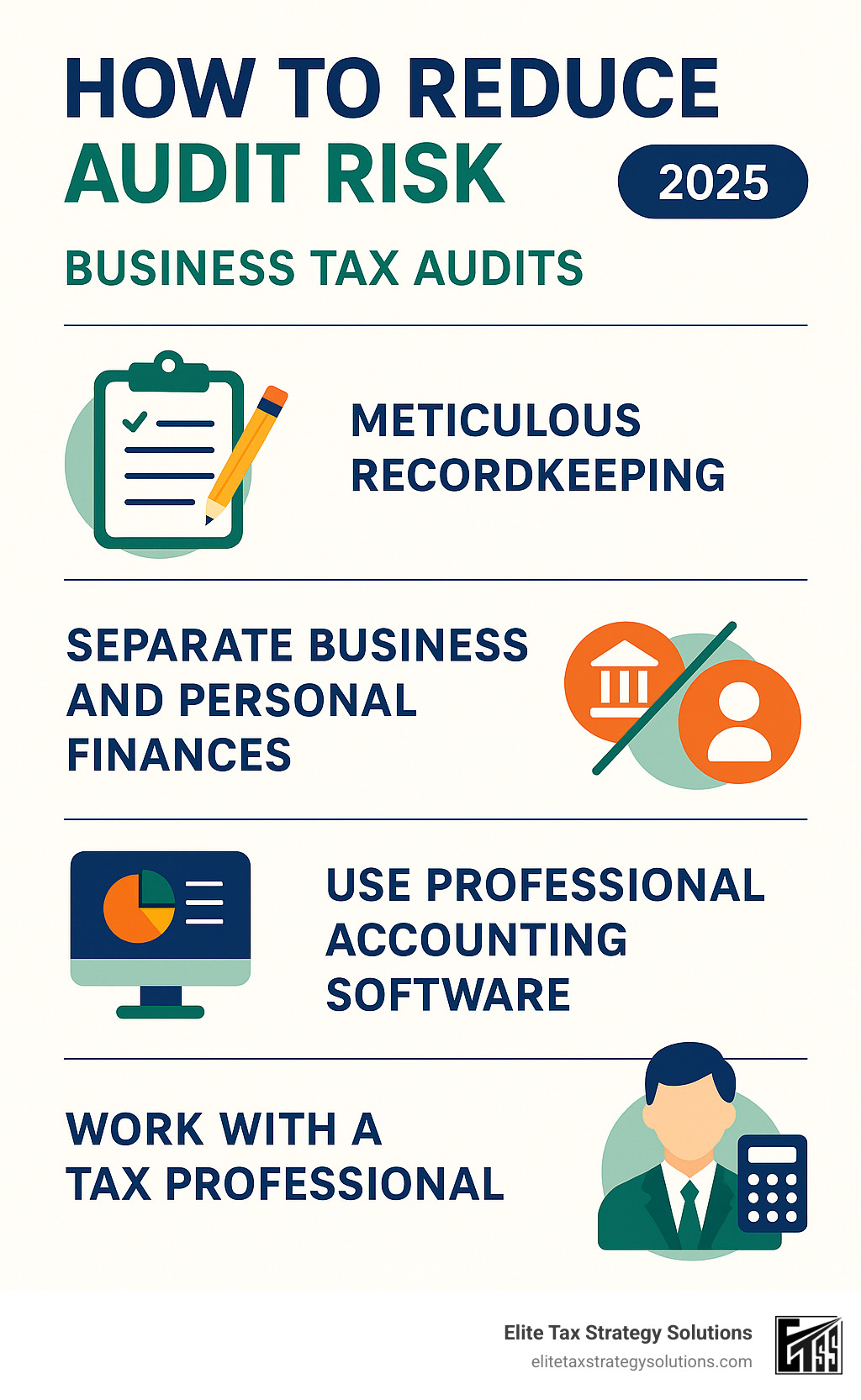
The best approach is to prevent audits through proactive strategies:
- Meticulous Recordkeeping: Keep detailed, organized records for every transaction. This is your best defense.
- Separate Business and Personal Finances: Use dedicated business bank accounts and credit cards to avoid red flags.
- Use Professional Accounting Software: Tools like QuickBooks or Xero automate tracking and simplify reporting.
- Understand Legitimate Business Expenses: Only deduct expenses that are “ordinary and necessary.” When in doubt, consult the IRS guidelines on legitimate business expenses.
- Conduct Mid-Year Tax Reviews: A check-in with a professional can identify and correct issues before they become audit triggers.
- Properly Classify Workers: Follow strict IRS guidelines for distinguishing between employees and independent contractors.
- Report All Income: The IRS’s automated systems easily detect mismatches with 1099s.
- Work with a Qualified Tax Professional: This is your most valuable investment in audit protection and proactive tax planning.
These strategies build a more financially stable and compliant business. Our expertise in business tax compliance helps owners implement these best practices with confidence.
Frequently Asked Questions about Business Tax Audits
Here are answers to the questions I hear most often from business owners facing an audit.
How long does a business tax audit take?
There’s no standard timeline. A simple correspondence audit handled by mail might take a few weeks, while a complex field audit can last a year or more. The duration depends on four key factors:
- The type of audit (correspondence, office, or field).
- The complexity of your tax return.
- The organization and availability of your records.
- Your level of agreement with the auditor’s findings.
How far back can the IRS audit my business?
Typically, the IRS can audit returns from the last three years. This statute of limitations extends to six years if the IRS finds you’ve underreported your gross income by more than 25%. In cases of fraud or failure to file a return, there is no time limit at all. Most audits focus on returns filed within the past two years, but you should be prepared for the three-year lookback.
What are the biggest costs of an audit for a small business?
The financial impact extends beyond just the tax bill. The primary costs include:
- Back Taxes, Penalties, and Interest: If the audit finds an underpayment, you’ll owe the additional tax plus penalties (often 20% or more) and interest.
- Professional Representation Fees: Hiring a CPA or tax attorney is a worthwhile investment that can save money in the long run, but it is an upfront cost.
- Time and Productivity Loss: This is a significant hidden cost. The time you and your staff spend gathering documents and dealing with the audit is time not spent running your business.
- Stress and Emotional Toll: The anxiety of an audit can affect your decision-making, well-being, and business operations.
Proper preparation and professional guidance can significantly reduce all these costs, turning a potential crisis into a manageable process.
Take Control of Your Tax Strategy
The journey through understanding business tax audits reveals an important truth: while the fear is real, the threat is manageable with the right approach. You now know that audit rates are low, the process is predictable, and you have clear rights as a taxpayer.
Confidence in the face of an audit rests on three pillars:
- Preparation: Organized records and properly documented expenses turn a crisis into a routine interaction.
- Understanding: Knowing the process, from audit types to your rights, transforms anxiety into action.
- Proactive Planning: Smart business owners work with tax professionals to build strategies that minimize risk and maximize savings.
An audit is a verification process, not a catastrophe for a prepared business. Instead of letting audit anxiety drive your decisions, channel that energy into building a tax strategy so solid that audits become non-events.
At Elite Tax Strategy Solutions, we specialize in proactive tax optimization for high earners and closely held businesses. Our approach is to build a compliant, robust strategy that minimizes risk and positions you for long-term financial success.
Don’t wait for an audit notice to get serious about your tax strategy. Develop a proactive strategy with our small business tax planning services and transform potential worry into genuine confidence.