Why Tax Planning for S-Corps Is Your Key to Maximum Savings
Tax planning for S-Corps lets owners benefit from the liability protection of a corporation while being taxed once—on their personal return. Because profits pass through rather than being hit by a corporate tax first, well-designed strategies can slash both income and payroll taxes.
Key S-Corp tax-saving moves:
- Salary Optimization – Pay yourself a reasonable W-2 wage and take the rest as distributions that escape self-employment tax
- Maximize Deductions – Home office, business meals, vehicle costs and professional fees all reduce taxable income
- Leverage Retirement Plans – Fund a Solo 401(k) or SEP-IRA with up to 25 % of wages
- Use Fringe Benefits – Deduct health-insurance premiums and other employee perks
- Claim the 20 % QBI Deduction – Section 199A can eliminate tax on one-fifth of qualified profits
- Strategic Family Employment – Pay children for real work done to move income into lower brackets
Even a mid-sized owner can trim payroll taxes by several thousand dollars each year just by dialing-in salary versus distributions, while the QBI deduction can shelter up to 20 % of remaining income.
Simple Tax planning for S-Corps glossary:
Understanding S-Corp Taxation: The Foundation of Your Strategy
Think of an S-Corporation as the best of both worlds – you get the liability protection of a corporation with the tax simplicity of a partnership. This unique structure is what makes tax planning for S-Corps so powerful for business owners who want to minimize their tax burden.
Here’s what makes S-Corps special: they’re pass-through entities, which means your business doesn’t pay federal income tax at the corporate level. Instead, all the income, losses, deductions, and credits flow directly through to you and other shareholders on your personal tax returns.
This creates incredible opportunities for tax savings, but it’s not a complete free pass. Your S-Corp might still face some entity-level taxes, like the built-in gains tax on certain appreciated assets or the passive income tax if you have too much passive income. These are the exceptions, not the rule.
Understanding these fundamentals is your first step toward implementing effective Tax Strategies for Small Business Owners that can save you thousands of dollars each year. The primary tax advantages of an S-Corp become even more valuable when you know how to use them strategically.
How S-Corp Pass-Through Taxation Works
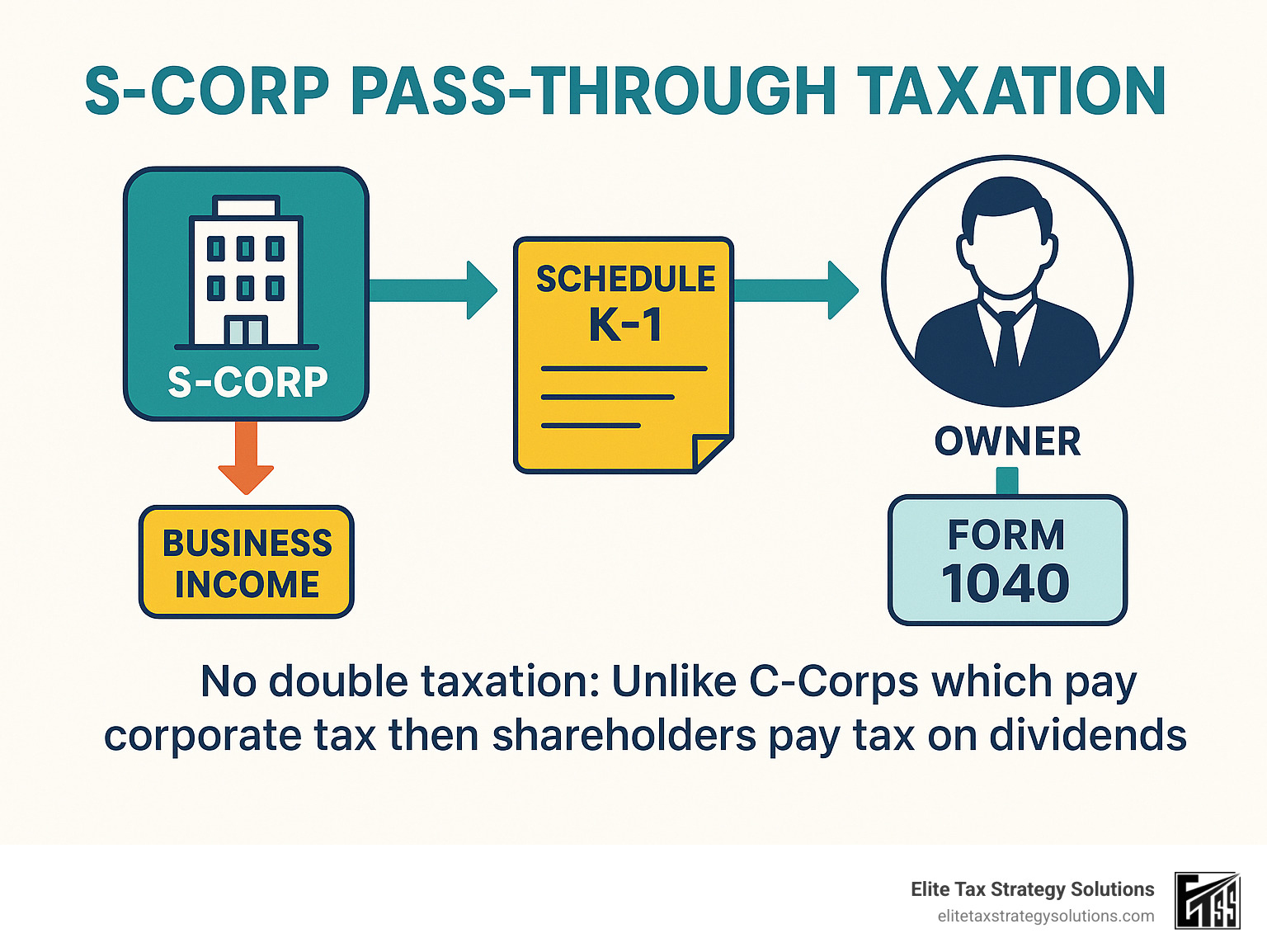
Here’s where the magic happens. When your S-Corp makes money, that corporate income doesn’t get trapped at the business level and taxed twice. Instead, it flows straight through to your personal Form 1040 via Schedule K-1, and you’ll report it on Schedule E.
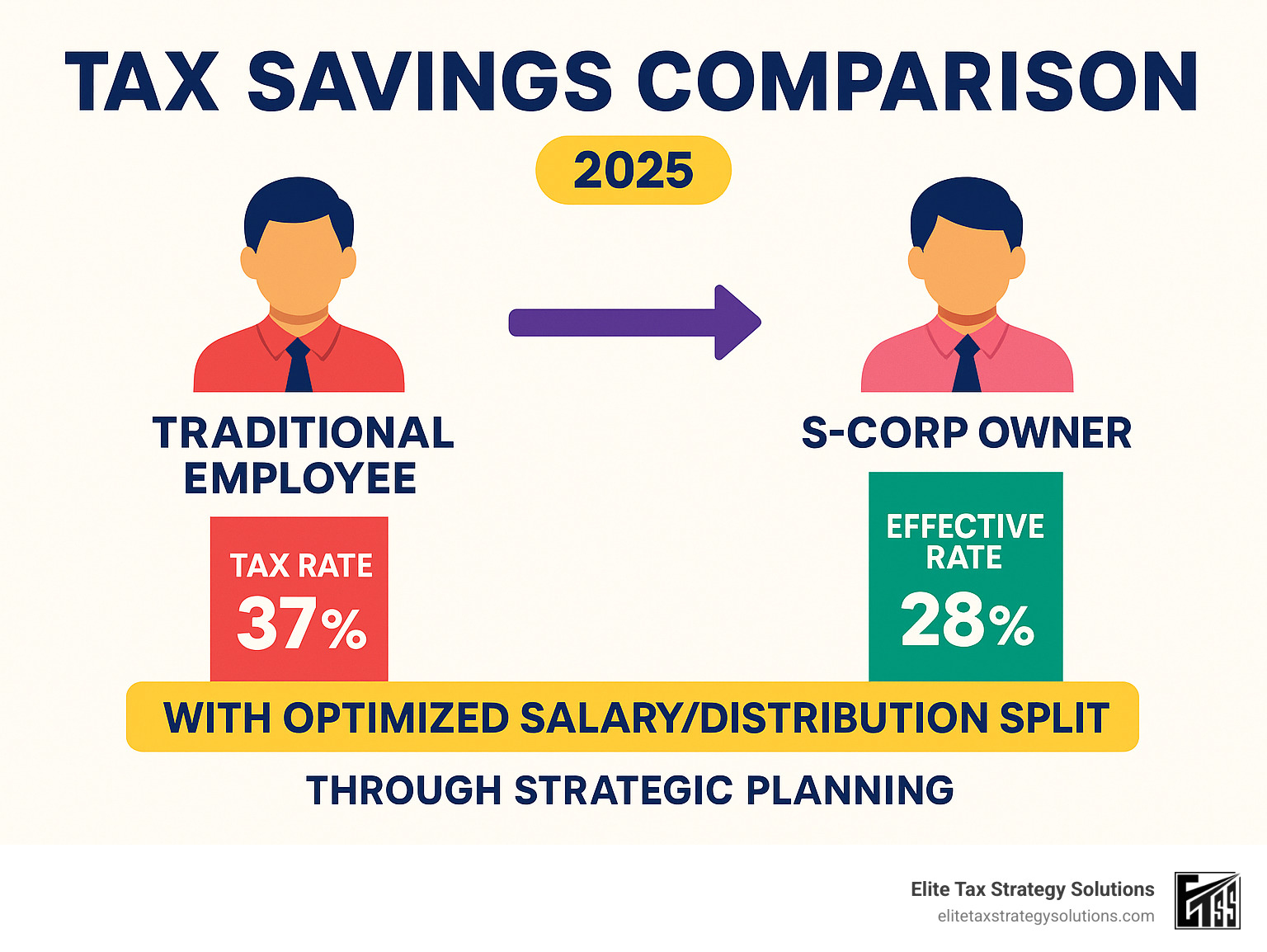
Your individual tax rates of 10% to 37% apply to this income, which is typically much more favorable than the combined corporate and personal tax rates that C-Corp owners face.
This pass-through system works for everything your business generates. Business losses can actually help you by offsetting other income on your personal return. Deductions reduce your taxable income dollar-for-dollar, and tax credits directly cut your tax liability.
The beauty of this approach is avoiding double taxation completely. C-Corporation owners get hit twice – once when the corporation pays tax, then again when they receive dividends. S-Corp owners skip that first tax entirely.
Key Advantages Over Other Structures
When you’re evaluating business structures, S-Corps offer some compelling advantages that make them particularly attractive for growing businesses and high-income earners.
The biggest advantage is self-employment tax relief. If you’re an LLC owner, you pay self-employment tax on all your business income – that’s 15.3% right off the top. S-Corp owners only pay FICA tax savings on their W-2 salary, not on distributions. This alone can save thousands of dollars annually.
Asset protection is another major benefit. Your S-Corp provides corporate liability protection, creating a legal barrier between your business debts and your personal assets. This peace of mind is invaluable for business owners in any industry.
You’ll also qualify for the Qualified Business Income (QBI) deduction under Section 199A. This can potentially reduce your tax liability by up to 20% on your business income, which is a massive advantage that wasn’t available to business owners just a few years ago.
Finally, S-Corps give you flexible characterization of income. You can strategically split your total compensation between salary (which is subject to payroll taxes) and distributions (which aren’t subject to self-employment tax). This flexibility is the cornerstone of effective tax planning for S-Corps.
The Cornerstone of S-Corp Savings: Optimizing Salary and Distributions
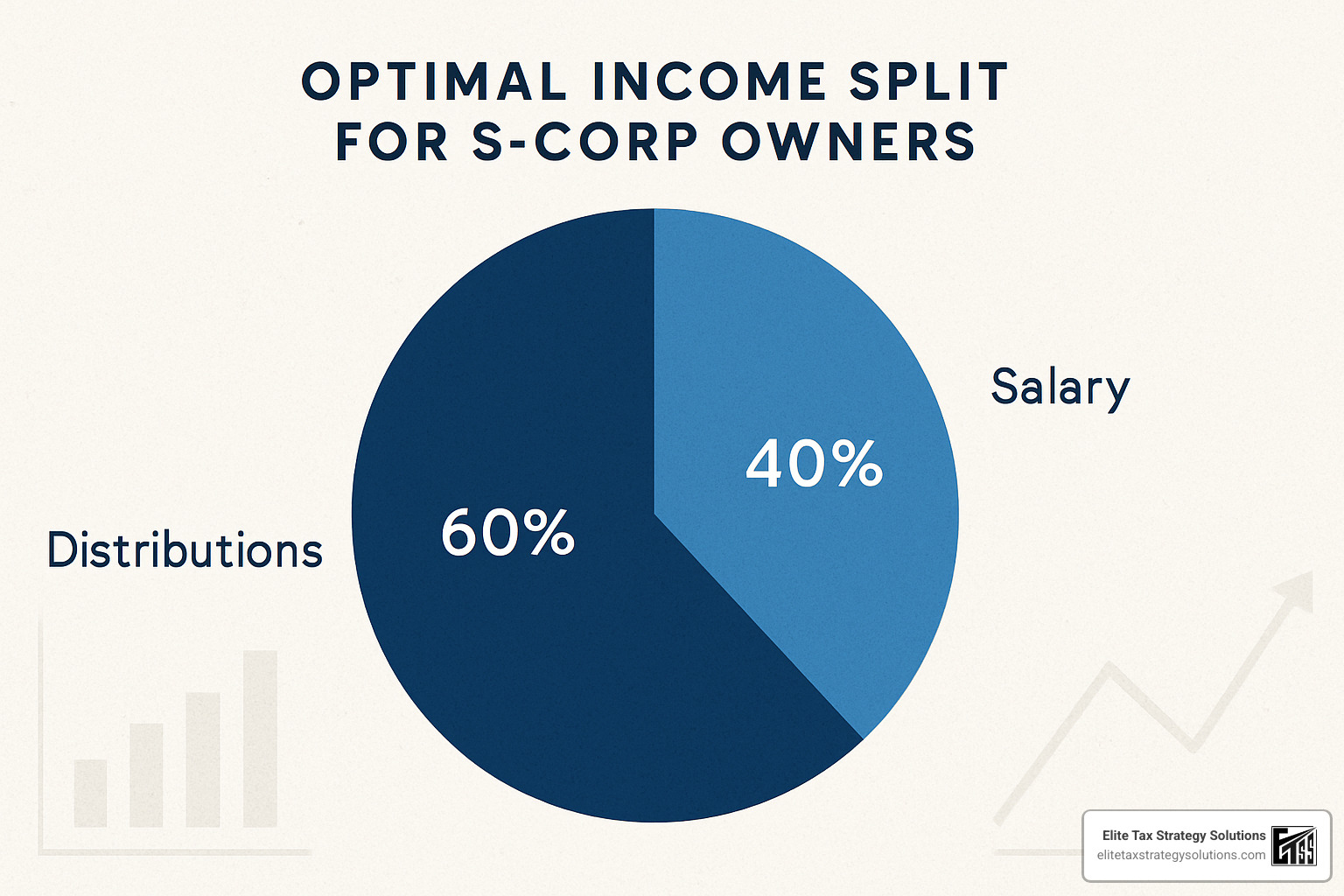
Your biggest win often comes from how you divide total compensation between W-2 salary (subject to the full 15.3 % FICA tax) and shareholder distributions (which are not). The IRS demands a “reasonable” salary first, but every dollar that legally shifts to a distribution avoids both the 12.4 % Social Security and 2.9 % Medicare taxes.
A client earning $100,000 who takes a $60,000 salary and $40,000 distribution saves roughly $6,100 in payroll taxes compared with taking the whole amount as wages. Multiply that benefit as profits grow.
Determining Reasonable Compensation
The IRS uses a simple question: “What would you pay someone else to do this job?” Answer it by documenting:
- Industry pay surveys
- Specific duties you perform
- Your credentials and years of experience
- Hours you actually work and the company’s profitability
If pay is set too low, the Service can reclassify distributions as wages, assess back payroll taxes, penalties and interest. Protect yourself by keeping a short file—salary studies, job description, board minutes—supporting the number.
Finding the Sweet Spot
Practitioners often start with a 60/40 wage/distribution mix, but the ideal ratio shifts with:
- Total income (higher profits generally support a larger salary)
- Industry norms (a consultant versus a retailer)
- Desire to maximize the Section 199A deduction, which may benefit from higher W-2 wages
Combine the salary strategy with Deduction Optimization to stack savings on both payroll and income taxes.
Maximizing Deductions: A Core Component of Tax Planning for S-Corps
Every ordinary and necessary business expense you document cuts taxable income dollar-for-dollar, yet many owners forfeit deductions because records are thin. Start by reviewing these high-impact categories and tracking them in real time.
Common Operational Expense Deductions
- Salaries and wages (including your reasonable compensation)
- Marketing, advertising and software subscriptions
- Professional fees: legal, accounting, consulting
- Office supplies and rent or utilities
- Travel and business meals (50 % deductible)
- Insurance premiums for liability, property or E&O
Asset-Based and Owner-Specific Deductions

- Home office – Space used exclusively and regularly for the business qualifies for the simplified method ($5 per sq. ft., max $1,500) or actual-expense method
- Vehicle – Choose either the 67-cent mileage rate (2024) or actual costs; maintain a mileage log
- Section 179 & Bonus Depreciation – Expense up to $1.22 million of 2024 equipment purchases; 60 % bonus depreciation still available this year
- Augusta Rule – Rent your home to the S-Corp for up to 14 business days annually; the corporation deducts the rent while you receive it tax-free
- Accountable Plan – Reimburse yourself and staff for out-of-pocket costs; the company deducts the payment and the employee receives it tax-free
Solid digital records and clear business purpose notes are your best defense if the IRS asks questions.
Advanced Tax Strategies and Employee Benefits

Advanced tax planning for S-Corps goes beyond basic deductions to include sophisticated strategies involving retirement plans, fringe benefits, and family employment. These strategies can provide substantial tax savings while building long-term wealth and providing valuable benefits to you and your employees.
Our approach to Corporate Tax Planning incorporates these advanced strategies to maximize both current tax savings and future financial security for our clients.
Leveraging Retirement Plans for Massive Savings
Retirement plans offer some of the most powerful tax savings available to S-Corp owners. The key is understanding how different plans work and which ones provide the best benefits for your situation.
SEP-IRA Plans: A Simplified Employee Pension plan allows you to contribute up to 25% of your W-2 wages, with a maximum of $69,000 for 2024. This is particularly attractive because contributions are tax-deductible for the business and tax-deferred for you personally.
Solo 401(k) Plans: If you have no employees other than your spouse, a Solo 401(k) offers maximum flexibility. For 2024, you can contribute up to $23,000 in elective deferrals ($30,500 if you’re 50 or older), plus up to 25% of your compensation as an employer contribution.
Defined Benefit Plans: For high-income S-Corp owners, defined benefit plans can allow contributions of hundreds of thousands of dollars annually. These plans are complex but can provide massive tax deductions for the right situation.
The research shows that S-Corp owners can contribute up to $61,000 towards retirement through an S-Corp plan for 2023, with limits increasing for 2024. The Retirement Plan Startup Costs Tax Credit can also provide additional tax benefits when establishing a new plan.
Strategic Use of Fringe Benefits and Family Employment
Health Insurance Strategy: S-Corps can pay health insurance premiums for shareholder-employees who own more than 2% of the company. The premiums are deductible for the business and included in your W-2 wages, but you can typically take a self-employed health insurance deduction on your personal return.
Hiring Your Children: One of the most effective strategies is employing your children in legitimate business roles. Each child can earn up to $12,950 in 2022 without paying federal income taxes. This shifts income from your higher tax bracket to their lower (or zero) bracket while providing them with earned income.
Accountable Plans: Establish formal accountable plans to reimburse employees (including yourself) for business expenses. This creates tax-free fringe benefits for employees while providing business deductions.
Education Assistance: S-Corps can provide up to $5,250 annually in tax-free educational assistance to employees, including courses that aren’t job-related.
State-Specific Elections and Federal Deductions
Section 199A QBI Deduction: The Qualified Business Income deduction allows eligible S-Corp owners to deduct up to 20% of their qualified business income. This deduction is subject to income limitations and W-2 wage requirements for high earners. Our guide on Maximizing Your Qualified Business Income (QBI) Deduction Before It Expires provides detailed strategies for optimization.
SALT Cap Workaround: The $10,000 limit on state and local tax deductions affects many S-Corp owners. However, 33 states have passed Pass-Through Entity Tax (PTET) elections that allow the S-Corp to pay state income taxes at the entity level, creating a federal deduction while providing a state tax credit to owners.
Research and Development Credits: S-Corps engaged in developing new products, improving processes, or enhancing technology may qualify for R&D tax credits. These credits directly reduce your tax liability dollar-for-dollar.
Staying Compliant: Record-Keeping and IRS Requirements
Let’s be honest – nobody gets excited about paperwork and compliance. But when it comes to tax planning for S-Corps, staying on the IRS’s good side is absolutely crucial for protecting your tax savings and avoiding costly penalties.
The IRS pays closer attention to S-Corp returns than many other business structures, especially when it comes to reasonable compensation and related-party transactions. Think of compliance as insurance for your tax strategies – it’s not glamorous, but it protects everything you’ve worked to build.
Our Business Tax Compliance services help ensure our clients meet all requirements while maximizing their tax savings. The key is establishing systems that make compliance automatic rather than burdensome.
Key IRS Forms and Deadlines for S-Corps
Your S-Corp has specific filing requirements that are different from other business structures. Missing these deadlines or filing incorrectly can trigger audits and penalties that wipe out your tax savings.
Form 1120-S is your primary tax return, due on March 15 for calendar year filers. This form reports your corporation’s income, deductions, and other tax items. Unlike your personal return, there’s no automatic extension – you must request one.
Each shareholder receives a Schedule K-1 showing their share of the corporation’s income, deductions, credits, and other items. Your shareholders need these K-1s to complete their personal tax returns, so delays in filing your corporate return create problems for everyone.
If you need more time, you can file Form 7004 for an automatic six-month extension. However, this only extends the filing deadline, not the payment deadline. Any taxes owed are still due by the original deadline.
Estimated tax payments are typically required since your S-Corp doesn’t withhold taxes on distributions. These quarterly payments are due on April 15, June 15, September 15, and January 15. Missing these can result in penalties even if you file your return on time.
Starting in 2024, S-Corporations that file 10 or more returns in a calendar year must e-file their Forms 1120-S. This mandate reflects the IRS’s push toward digital processing and faster return processing.
Best Practices for Bulletproof Record-Keeping
Good record-keeping isn’t just about compliance – it’s about protecting your deductions and making tax preparation easier. I’ve seen too many business owners lose valuable deductions simply because they couldn’t document them properly.
Separate your business and personal finances completely. This means separate bank accounts, credit cards, and expense tracking. Mixing personal and business expenses creates compliance nightmares and weakens your liability protection. The IRS views commingled funds as a red flag for audits.
Use professional accounting software to automatically categorize expenses, track mileage, and generate the reports you need for tax preparation. Modern software reduces errors and saves hours during tax season. The small monthly cost pays for itself in time savings and better organization.
Document the business purpose for every expense. For each transaction, record the business purpose, date, amount, and parties involved. This is especially important for meals, entertainment, and travel expenses that the IRS scrutinizes closely.
Keep digital records with cloud backup. Scan and store receipts digitally so they’re searchable and accessible. The IRS accepts digital records as long as they’re legible and properly stored. This also protects you from losing important documents.
Maintain corporate minutes and document major business decisions, shareholder meetings, and board resolutions. These records support your corporate structure and help justify reasonable compensation decisions if questioned by the IRS.
The goal isn’t just to survive an audit – it’s to have such good records that the IRS finds nothing to question. When your documentation is thorough and professional, it demonstrates that you’re serious about compliance and legitimately entitled to your deductions.
Frequently Asked Questions about Tax Planning for S-Corps
Getting started with tax planning for S-Corps often raises questions about elections, benefits, and compliance. These are the most common concerns we hear from business owners considering or already using S-Corp status.
How do I elect S-Corp status for my business?
Making the S-Corp election is straightforward, but timing matters. You’ll need to file Form 2553, Election by a Small Business Corporation, which must be signed by all shareholders. The critical deadline is the 15th day of the third month of the tax year you want the election to take effect.
For calendar year businesses, this means filing by March 15. If you’re starting a new business, you have 75 days from incorporation to file the election. Miss this deadline, and you’ll have to wait until the following tax year – unless you qualify for late election relief.
The IRS does provide procedures for curing defective S-Corp elections if you have a valid reason for missing the deadline. However, it’s much easier and more reliable to file on time. We always recommend getting this form submitted well before the deadline to avoid any complications.
Can my S-Corp pay for my health insurance?
This is one of the most valuable benefits of S-Corp status. Yes, your S-Corp can pay health insurance premiums for shareholder-employees who own more than 2% of the company. Here’s how it works in practice:
The S-Corp pays the premiums directly to the insurance company and deducts them as a business expense. These premiums must be included as wages on your W-2, but you can typically take a self-employed health insurance deduction on your personal tax return.
This creates a win-win situation: the S-Corp gets a business deduction for the premiums, and you get a personal deduction that reduces your adjusted gross income. The premiums aren’t subject to payroll taxes either, providing additional savings beyond the income tax benefits.
What happens if the IRS decides my salary is too low?
This is probably the biggest compliance risk S-Corp owners face. If the IRS determines your salary is unreasonably low, they can reclassify a portion of your distributions as wages. This triggers several expensive consequences:
You and the corporation will owe back payroll taxes (Social Security and Medicare) on the reclassified amount. The IRS will also assess penalties and interest on the unpaid taxes, which can add up quickly. In severe cases, they might even challenge your S-Corp election entirely.
To avoid this nightmare scenario, we help our clients establish reasonable compensation based on industry standards, job responsibilities, and company performance. Documenting your compensation decision with market research and detailed job descriptions provides important protection if the IRS ever questions your salary level.
The key is being proactive rather than reactive. It’s much easier to justify your compensation upfront than to defend it during an audit. We regularly review our clients’ compensation levels to ensure they remain reasonable as their businesses grow and change.
Conclusion: Proactive Planning is Your Most Valuable Asset
Tax planning for S-Corps isn’t just about filing returns – it’s about building a comprehensive strategy that saves you thousands of dollars year after year. The strategies we’ve explored work together like pieces of a puzzle, creating a complete picture of tax optimization that goes far beyond basic compliance.
Think about it this way: salary optimization alone can save you over $6,000 annually on a $100,000 income. Add in maximizing deductions, leveraging retirement plans, and implementing advanced strategies like the QBI deduction, and you’re looking at substantial savings that compound over time.
The challenge is that tax laws are constantly evolving. The Section 199A deduction that could save you 20% on your business income? It’s scheduled to expire after 2025. Bonus depreciation that lets you immediately write off equipment purchases? It’s declining by 20% each year until it disappears after 2026.
This shifting landscape makes proactive planning absolutely essential. Reactive tax preparation – where you hand over a box of receipts each April – leaves money on the table. Proactive tax planning positions you to take advantage of opportunities before they disappear and helps you steer changes before they impact your bottom line.
At Elite Tax Strategy Solutions, we’ve spent 40 years helping high earners and closely held businesses in Jasper, Indiana and suburban areas near major cities maximize their S-Corp tax strategies. Our clients don’t just get their taxes filed – they get a comprehensive roadmap that evolves with their business and the changing tax landscape.
The difference between business owners who implement sophisticated S-Corp strategies and those who don’t can be staggering. With five million small businesses operating as S-Corps, those who take a strategic approach will always have a competitive advantage.
Your S-Corp structure is already giving you advantages over other business types. The question is: are you maximizing those advantages? Are you capturing every deduction, optimizing your salary-distribution split, and positioning yourself for future changes in tax law?
Take control of your S-Corp’s financial future with expert tax planning for small businesses and find exactly how much you could be saving with the right strategy. Because when it comes to taxes, proactive planning isn’t just valuable – it’s your most valuable asset.