Why Every Small Business Owner Needs to Know About IRS Publication 334
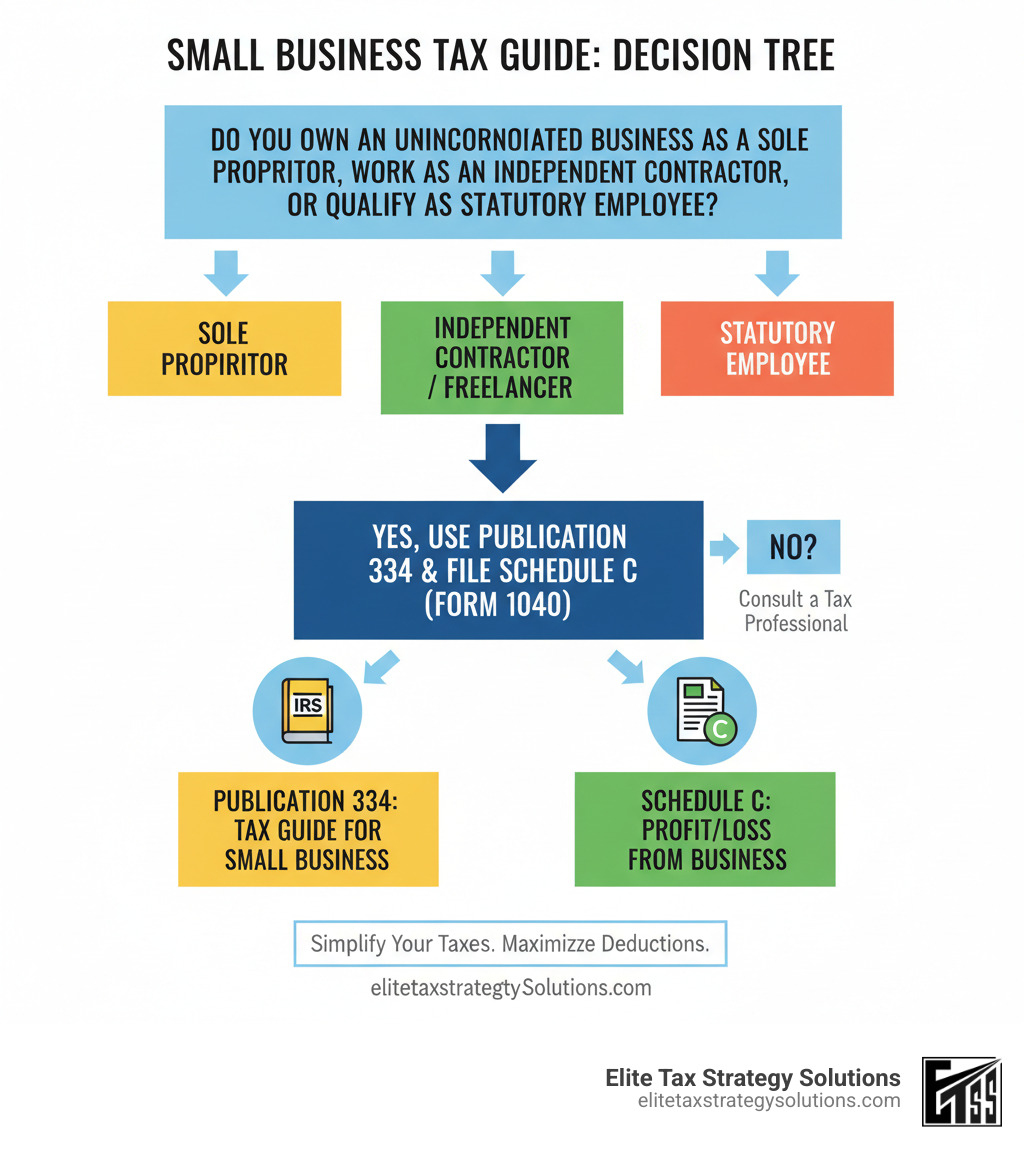
Publication 334 is the IRS Tax Guide for Small Business for people reporting business income and expenses on Schedule C (Form 1040).
Who Should Use Publication 334:
- Sole proprietors
- Independent contractors and freelancers
- Statutory employees
- Anyone filing Schedule C to report business profit or loss
What It Covers:
- Business income reporting and expense deductions
- Accounting methods (cash vs. accrual)
- Self-employment tax
- Business credits and depreciation
- Record-keeping requirements
- Disposition of business property
Key Updates for 2024-2025:
- Standard mileage rate: 67 cents per mile (2024), 70 cents per mile (2025)
- Business meal deduction: 50% (reverted from temporary 100%)
- Bonus depreciation: 60% for 2024 (phasing out)
If you’re a small business owner, Publication 334 is a practical starting point—with examples for cost of goods sold, gross profit, and operating expenses—and guidance on forms, accounting methods, and handling a sale or closure.
As David Fritch, I’ve spent 40 years helping small business owners steer Publication 334 and Schedule C, uncovering tax-saving opportunities they often miss.
Know your publication 334 terms:
Decoding IRS Publication 334: Reporting Income and Expenses
If you’re a sole proprietor or independent contractor, Publication 334 is your guide to completing Schedule C: Profit or Loss From Business, which attaches to your Form 1040. It explains what to report, where to report it, and why it matters—so your return is accurate and you capture all allowable deductions.
It covers income reporting, cost of goods sold, recordkeeping, and what to do if you sell or close your business. For small businesses in places like Jasper, Indiana, or those juggling multiple income streams, it helps simplify a complex process.
Choosing Your Accounting Framework
Your accounting period is typically the calendar year; a fiscal year is allowed but changing later generally requires IRS approval.
Your accounting method determines when you recognize income and expenses:
- Cash method: report income when received; deduct expenses when paid.
- Accrual method: report income when earned; deduct expenses when incurred.
If you keep inventory, you generally use accrual for purchases and sales; however, small business taxpayers with average annual gross receipts of $30 million or less may not need to keep inventory or use accrual for those items, per Publication 334. You set your method with your first return; changing it later usually requires Form 3115 (Application for Change in Accounting Method).
Calculating Your Business’s Profitability
Start with gross receipts (cash, checks, card payments—and the fair market value of bartered goods/services). Subtract returns and allowances to get net receipts.
For product-based businesses, calculate Cost of Goods Sold (COGS) using Publication 334’s formula:
Beginning Inventory + Purchases + Cost of Labor + Materials & Supplies + Other Costs – Ending Inventory = Cost of Goods Sold
Gross profit = Net receipts − COGS. Then consider other income (for example, interest earned). These figures flow through Schedule C and determine taxable business income.
Opening up Savings: Business Deductions and Tax Credits
Ordinary and necessary expenses—common in your trade and helpful for your business—are deductible. Two big ones for many Schedule C filers are the home office and vehicle deductions. If you use a specific area of your home regularly and exclusively for business, you may deduct a share of mortgage interest, property taxes, utilities, insurance, and depreciation. For vehicles, you can use the standard mileage rate—67 cents per mile (2024) and 70 cents per mile (2025)—or actual expenses. Pick the method that yields the larger deduction and keep solid records.
Proper documentation is essential for both deductions. For the home office, maintain records showing exclusive business use, while for vehicles, keep a detailed mileage log noting dates, destinations, and business purposes.

Common Business Deductions Detailed in Publication 334
Over decades of advising small business owners, we’ve seen money left on the table simply from missed deductions. Review these common items:
- Travel away from home (transportation, lodging, and 50% of meals)
- Office supplies, small equipment, software
- Advertising and marketing
- Professional fees (accounting, legal, consulting)
- Rent and utilities
- Business insurance (including self-employed health insurance when eligible)
- One-half of self-employment tax (deducted on Schedule 1)
- Depreciation, Section 179 expensing, and bonus depreciation (60% for 2024, phasing out)
- Employees’ pay; pension/profit-sharing contributions; business interest and taxes
Leveraging Business Tax Credits
Credits reduce tax dollar-for-dollar, making them more valuable than deductions. Many fall under the General Business Credit (summarized on Form 3800). Key examples in Publication 334:
- Work Opportunity Credit (Form 5884)
- Disabled Access Credit (Form 8826)
- Credit for Small Employer Health Insurance Premiums (Form 8941)
At Elite Tax Strategy Solutions, we proactively identify deductions and credits to maximize tax savings while keeping you compliant.
Navigating Key Concepts and Special Situations
Publication 334 helps you handle less common but important situations.
- Disposing of business property: Compare the amount realized to your adjusted basis (cost minus depreciation) to find gain or loss, then report on Form 4797 as directed in the publication.
- Not-for-profit (hobby) rules: If there’s no genuine profit motive, losses can be limited. Publication 334 lists factors the IRS considers (businesslike records, expertise, profit history, and more).
- Self-employment tax: If net self-employment earnings are $400 or more, you generally owe SE tax—15.3% up to the Social Security wage base, plus the additional 0.9% Medicare tax for higher incomes. You can deduct one-half of SE tax on Schedule 1.
Sole Proprietor vs. Statutory Employee
Both typically use Schedule C for expenses, but treatment differs:
- Sole proprietor: No W-2, pays self-employment tax, usually makes quarterly estimated payments.
- Statutory employee: Receives a W-2 with box 13 checked; Social Security/Medicare are withheld by the company; still deducts business expenses on Schedule C.
Beyond the IRS: Support from the SBA and Other Resources
The Small Business Administration (SBA) offers contracting help, capital, and management assistance. See its Contracting Assistance Programs. The Taxpayer Advocate Service (TAS) can help resolve IRS issues that normal channels haven’t fixed. Elite Tax Strategy Solutions connects clients with these resources as part of a proactive tax and business strategy.
Decoding IRS Publication 334: Reporting Income and Expenses
In brief: Publication 334 explains how Schedule C works, what income must be reported, how to track expenses, and what to do if you sell assets or close your business. If you file Schedule C: Profit or Loss From Business, use this guide to choose your accounting period and method, understand cost of goods sold, and organize records so you report accurately and minimize errors.
Open uping Savings: Business Deductions and Tax Credits
Quick reference for savings highlighted in Publication 334:
- Deduct ordinary and necessary expenses (home office, car, supplies, marketing, professional fees, rent, utilities, insurance, depreciation, and more).
- Business meal deduction is 50%; mileage rates are 67¢ (2024) and 70¢ (2025).
- Explore credits within the General Business Credit framework, including the Work Opportunity Credit (Form 5884) and the Credit for Small Employer Health Insurance Premiums (Form 8941).
Navigating Key Concepts and Special Situations
Snapshot guidance from Publication 334:
- Property sales and trade-ins: compute gain/loss vs. adjusted basis; report on Form 4797 as applicable.
- Not-for-profit (hobby) rules: demonstrate a profit motive to avoid loss limitations.
- Self-employment tax: applies at $400+ in net earnings; one-half is deductible on Schedule 1.
Beyond the IRS: The SBA provides loans, mentoring, and federal contracting help via its Contracting Assistance Programs. TAS can assist when IRS issues persist despite normal channels.
Decoding IRS Publication 334: Reporting Income and Expenses
Use Publication 334 as your concise guide to reporting business income/expenses on Schedule C: Profit or Loss From Business, choosing cash vs. accrual, and calculating cost of goods sold and gross profit.
Opening up Savings: Business Deductions and Tax Credits
Keep records to support deductions (home office, vehicle, supplies, advertising, professional fees, rent, utilities, insurance, depreciation) and evaluate credits that reduce tax dollar-for-dollar:
- Work Opportunity Credit (Form 5884)
- Disabled Access Credit (Form 8826)
- Credit for Small Employer Health Insurance Premiums (Form 8941)
Many credits roll into the General Business Credit (summarized on Form 3800).
Navigating Key Concepts and Special Situations
When edge cases arise—property dispositions, hobby-loss concerns, or self-employment tax—Publication 334 provides the framework to get it right. For growth and support beyond taxes, explore the SBA’s Contracting Assistance Programs and consider the Taxpayer Advocate Service (TAS) if IRS issues remain unresolved.