
Optimizing tax deductions is a vital step in tax planning that can save you significantly on your tax bill and improve financial stability. Simply put, effective tax planning involves managing your finances while keeping tax implications in mind. Tax optimization tailors strategies to your specific financial situation, focusing on maximizing deductions, utilizing credits, and aligning with your financial goals. Here’s what you can do to optimize your tax deductions:
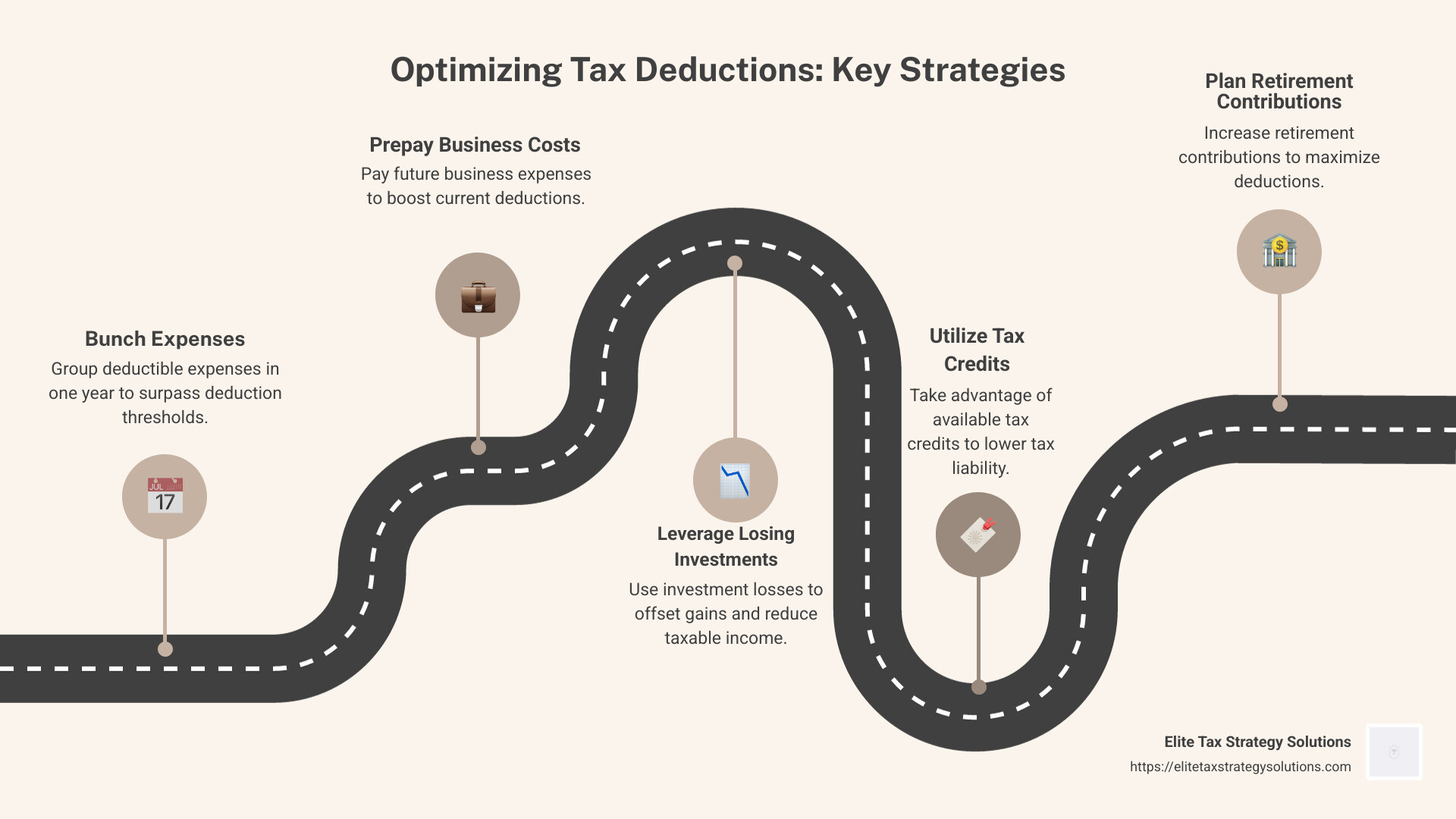
- Bunch expenses: Group your deductible expenses in one year to surpass deduction thresholds.
- Prepay business costs: Boost deductions by paying future business expenses now.
- Leverage losing investments: Use investment losses to offset gains and lower taxable income.
These strategies reduce taxable income, resulting in lower taxes owed and retained earnings for future growth.
I’m David Fritch. With 40 years of experience as both a CPA and a tax strategy expert, I specialize in optimizing tax deductions for high-income earners and small business owners. My focus is on leveraging the complexities of the tax code to maximize savings and ensure compliance.
Optimizing tax deductions definitions:
– tax audit preparation
– tax liability reduction
– tax planning for businesses
Understanding Tax Deductions
Tax deductions are like hidden treasures in the tax code that can help you keep more of your hard-earned money. There are two main types of deductions you need to know about: itemized deductions and the standard deduction.
Itemized Deductions vs. Standard Deduction
Itemized deductions allow you to list specific expenses on your tax return that the IRS considers deductible. These can include medical expenses, mortgage interest, and charitable contributions. The goal is to add up these expenses and see if they exceed the standard deduction amount. If they do, you can subtract them from your income, lowering your taxable income.
The standard deduction, on the other hand, is a fixed amount set by the IRS that you can deduct from your income if you choose not to itemize. It’s simpler and quicker, but it might not save you as much money if your itemizable expenses are high.
Here’s a quick comparison of the standard deduction for the tax years 2024 and 2025:
| Filing Status | 2024 Standard Deduction | 2025 Standard Deduction |
|---|---|---|
| Single | $14,600 | $15,000 |
| Married Filing Separately | $14,600 | $15,000 |
| Head of Household | $21,900 | $22,500 |
| Married Filing Jointly | $29,200 | $30,000 |
That if you’re 65 or older, you get an extra deduction.
IRS-Approved Categories
To make the most of itemizing, you need to understand the IRS-approved categories for deductions. Some common categories include:
- Medical and Dental Expenses: Deductible if they exceed 7.5% of your adjusted gross income (AGI).
- Mortgage Interest and Points: Homeowners can deduct interest paid on their mortgage.
- Charitable Contributions: You can usually deduct up to 60% of your AGI for donations to qualified organizations.
- State and Local Taxes: Known as SALT, these are deductible up to $10,000.

Optimizing tax deductions requires careful planning. You might need to decide each year whether to take the standard deduction or itemize, depending on which gives you the bigger tax break. Keep track of all your deductible expenses throughout the year. This way, you can make an informed decision when tax time rolls around.
Next, we’ll explore strategies to help you maximize your tax benefits.
Optimizing Tax Deductions
Optimizing tax deductions can seem tricky, but with a few smart strategies, you can make the most of your deductible expenses. Let’s explore some practical tips like bunching deductions, spending strategies, and using a checklist to keep everything organized.
Bunching Deductions
Bunching deductions is a clever way to maximize your tax savings. This strategy involves concentrating your deductible expenses into one tax year to surpass the standard deduction threshold.
For instance, if you have medical expenses that usually hover around 7% of your adjusted gross income (AGI), you might not qualify to deduct them. But if you can shift some of these expenses to the next year, you might exceed the 7.5% AGI limit in one year, allowing you to deduct a portion of those expenses.
Spending Strategies
When planning to itemize, consider timing your expenses strategically. If you’ve been postponing certain deductible purchases or expenses, such as medical treatments or home repairs, it might be wise to incur these costs in a year you plan to itemize. This way, you increase your deductions and potentially lower your taxable income.
Example: If you’re close to the threshold for medical deductions, scheduling a planned surgery or dental work within the same year can help you surpass the deduction limit, saving you money on taxes.
The Power of a Checklist
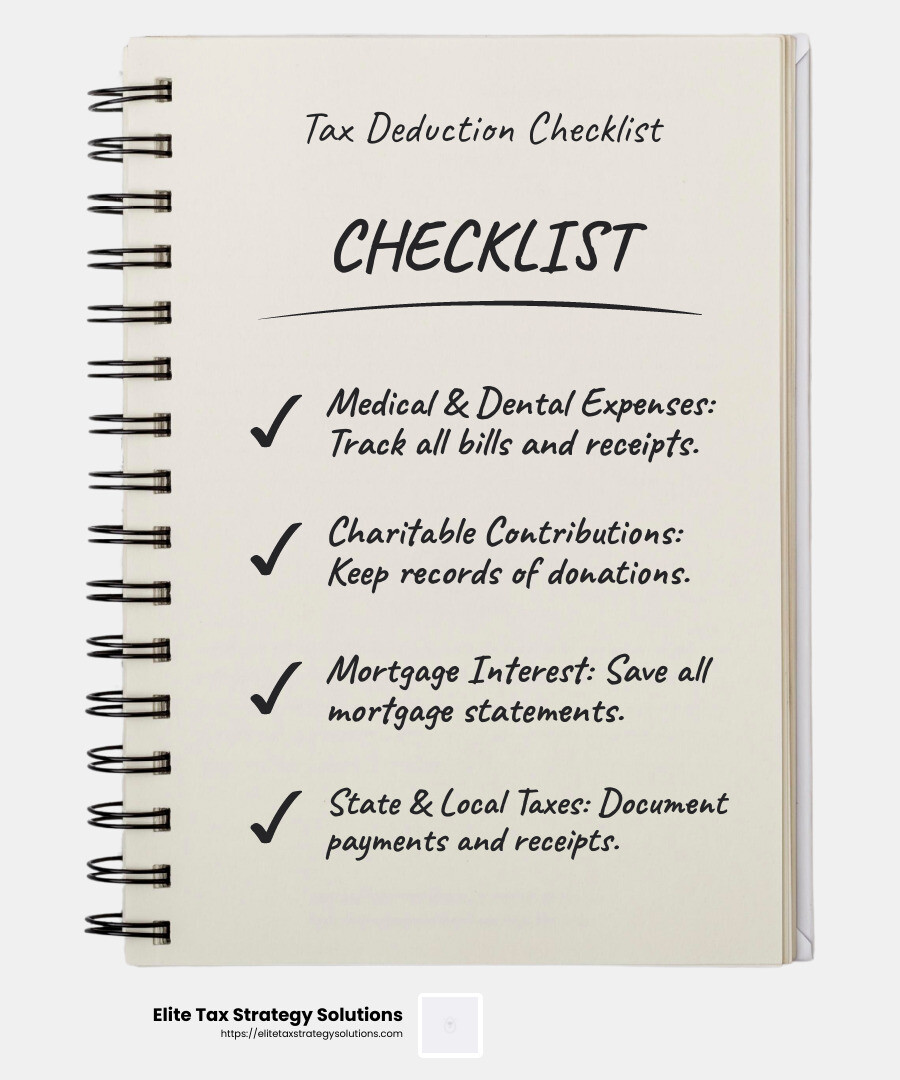
Keeping a checklist of potential deductions is essential. This tool helps ensure you don’t overlook any deductible expenses. Here’s a simple checklist to get you started:
- Medical and Dental Expenses: Track all bills and receipts.
- Charitable Contributions: Keep records of donations and acknowledgments from charities.
- Mortgage Interest and Points: Save all mortgage statements.
- State and Local Taxes: Document payments and receipts.
- Home Office and Business Expenses: Maintain detailed records if you work from home or own a business.
By using these strategies, you can effectively optimize your tax deductions and potentially save a significant amount on your tax bill. The key is to plan ahead and keep detailed records throughout the year.
Up next, we’ll dig into the top strategies for maximizing tax benefits, including retirement contributions and charitable donations.
Top Strategies for Maximizing Tax Benefits
When it comes to maximizing your tax benefits, a few key strategies can make a significant difference. Let’s explore how retirement contributions, charitable donations, and tax credits can help you save money and optimize your tax situation.
Retirement Contributions
Contributing to retirement accounts is a powerful way to reduce your taxable income. By putting money into accounts like a 401(k), IRA, or Roth IRA, you not only save for the future but also enjoy immediate tax benefits.
-
401(k) Contributions: Contributions are made with pretax dollars, reducing your current taxable income. For 2024, the contribution limit is $23,000 if you’re under 50, and $30,500 if you’re 50 or older, thanks to catch-up contributions.
-
IRA Contributions: Depending on your income and filing status, contributions to a traditional IRA may be tax-deductible. For 2024, the contribution limit is $7,000, or $8,000 if you’re 50 or older.
Pro Tip: If you’re self-employed, consider a SEP or SIMPLE IRA. These plans allow for higher contribution limits, offering more room for tax savings.
Charitable Donations
Charitable donations not only support causes you care about but can also provide valuable tax deductions. To maximize your benefits:
-
Donate Appreciated Assets: Instead of cash, consider donating stocks or other appreciated assets. You’ll avoid capital gains taxes and can deduct the fair market value of the asset.
-
Bunching Donations: Similar to bunching deductions, concentrate your donations in a single year to surpass the standard deduction threshold, allowing you to itemize and gain a larger deduction.
Example: If you usually donate $1,000 annually, consider donating $3,000 every three years. This strategy can help you itemize and potentially save more on taxes.
Tax Credits
Tax credits are even more valuable than deductions because they reduce your tax bill dollar-for-dollar. Here are a few credits to consider:
-
Earned Income Tax Credit (EITC): Designed for low to moderate-income workers, the EITC can provide significant savings. The amount varies based on income, filing status, and number of children.
-
Child Tax Credit: Families with qualifying children under 17 can claim this credit. For 2024, the credit is up to $2,000 per child, with up to $1,500 refundable.
-
Education Credits: If you’re paying for education, look into the American Opportunity Credit and the Lifetime Learning Credit. These credits can help offset costs for tuition and other educational expenses.
Quote: “Maximizing your tax return is like giving yourself a bonus at the end of the year,” says Lee Reams Sr., co-founder of TaxBuzz. This mindset highlights the importance of leveraging every available credit to keep more of your hard-earned money.
By focusing on these strategies, you can significantly maximize your tax benefits and keep more money in your pocket. Next, we’ll explore some often overlooked deductions that can further improve your tax savings.
Exploring Overlooked Deductions
When it comes to optimizing tax deductions, some potential savings often slip through the cracks. Let’s explore a few overlooked areas that could boost your tax return.
Gambling Losses
Did you know you can deduct gambling losses? If you’ve had a lucky streak, you can offset your winnings by deducting your losses up to the amount of your winnings. For example, if you won $500 but lost $300, you can deduct the $300. You must itemize your deductions and keep detailed records, like receipts or statements, to support your claims.
Small Business Expenses
Running a small business or being self-employed comes with its own set of tax benefits. Beyond the obvious deductions like office supplies and utilities, there are more nuanced areas to consider:
-
Home Office Deduction: If you use part of your home exclusively for business, you can deduct a portion of your mortgage interest, rent, and utilities. This deduction can be a game-changer for freelancers and remote workers.
-
Vehicle Use: If you drive for work, track your mileage. You can deduct either the standard mileage rate (65.5 cents per mile for 2024) or actual expenses like gas and maintenance.
-
Education Expenses: If you take courses to improve your business skills, those costs might be deductible. This includes tuition, books, and even some travel costs.
Tip: Keep detailed records and receipts to substantiate these deductions. A small habit of diligent recordkeeping can lead to significant tax savings.
Above-Line Deductions
Above-line deductions are special because they reduce your adjusted gross income (AGI), which can qualify you for other tax benefits. You can claim these deductions even if you don’t itemize:
-
Student Loan Interest: You can deduct up to $2,500 of interest paid on student loans. However, the deduction phases out at higher income levels.
-
Educator Expenses: Teachers can deduct up to $300 for classroom supplies. This deduction is above the line, so you don’t need to itemize.
-
Health Savings Account (HSA) Contributions: Contributions to an HSA are tax-deductible, and withdrawals for medical expenses are tax-free. It’s a triple tax advantage if used wisely.
Fact: Above-line deductions are often overlooked because they don’t require itemizing. Yet, they can significantly lower your taxable income, making them valuable tools in your tax strategy.
By exploring these overlooked deductions, you can open up additional tax savings and ensure you’re not leaving money on the table. Next, we’ll answer some frequently asked questions about tax deductions to further clarify this complex topic.
Frequently Asked Questions about Tax Deductions
What expenses are 100% tax deductible?
When it comes to running a business, some expenses are fully deductible. Office equipment is one such category. This includes computers, printers, and furniture that are used exclusively for business. Similarly, business travel expenses like airfare, hotel stays, and meals can be 100% deductible if they are directly related to your business activities. However, it’s crucial to keep detailed records and receipts to justify these expenses during tax filing.
Is tax optimization legal?
Yes, tax optimization is legal. It involves strategic tax planning to minimize your tax liability while staying within the boundaries of the law. Compliance is key. The IRS sets clear rules and guidelines, and as long as you follow them, you can legally reduce your tax bill. For instance, by utilizing available deductions and credits, such as those for charitable contributions or medical expenses, you can optimize your tax situation without crossing any legal lines.
What is the most overlooked tax deduction?
One of the most overlooked tax deductions involves charitable contributions. Many taxpayers forget that even small donations can add up and be deducted. You can also deduct expenses related to volunteer work, such as mileage driven to and from the charity. Another commonly missed deduction is for medical expenses. While these need to exceed 7.5% of your adjusted gross income to be deductible, larger families or those with unexpected medical needs might find this deduction beneficial. Keeping thorough records of all these expenses can help ensure you don’t miss out on these valuable deductions.
These FAQs address common concerns and misconceptions around tax deductions. By understanding these elements, you can better steer the complexities of tax season and make informed decisions. Now, let’s dig into the top strategies for maximizing tax benefits.
Conclusion
At Elite Tax Strategy Solutions, we understand that navigating tax deductions can be daunting. But remember, it’s not just about saving on your taxes today—it’s about achieving long-term financial stability through personalized tax planning.
Our approach is simple yet effective. We work closely with high earners and closely held businesses to identify every possible deduction and credit that applies to your unique financial situation. This means we don’t just look at the obvious; we dig deep to uncover overlooked deductions that others might miss.
For instance, while many focus solely on standard deductions, we encourage exploring itemized deductions if they can offer greater benefits. This might include deductions for charitable contributions, medical expenses, or even small business expenses. We also emphasize the importance of timing your income and expenses strategically to maximize your deductions.
Personalized tax planning is at the heart of what we do. By aligning your tax strategy with your overall financial goals, we help you not only save money but also achieve financial stability. Our proactive approach ensures you are always in compliance with the latest tax laws, giving you peace of mind and more control over your financial future.
If you’re ready to optimize your tax deductions and secure your financial future, consider partnering with us. Learn more about our high-income individual tax planning services and find how we can tailor a tax strategy that works for you.
In the ever-changing landscape of tax laws, having a trusted partner by your side can make all the difference. Let us help you turn the complexities of tax planning into opportunities for growth and stability.