Why Payroll Tax Compliance Matters for Canadian Businesses
Payroll tax compliance is the process of correctly calculating, withholding, and remitting employment taxes to government authorities while meeting all reporting deadlines. For Canadian employers—and for U.S.-based companies that hire employees in Canada—this means navigating a complex landscape of federal and provincial requirements.
For Elite Tax Strategy Solutions clients in Jasper, Indiana and suburban areas near major cities, cross-border hiring into Canada comes up often. This guide equips both Canadian employers and U.S. businesses expanding or hiring in Canada with the steps to stay compliant.
Quick Answer: Key Steps to Steer Payroll Tax Compliance
- Register for a Business Number (BN) and payroll account with the CRA
- Deduct the correct amounts for CPP, EI, and income tax from employee wages
- Match employer contributions for CPP and pay 1.4x employee EI premiums
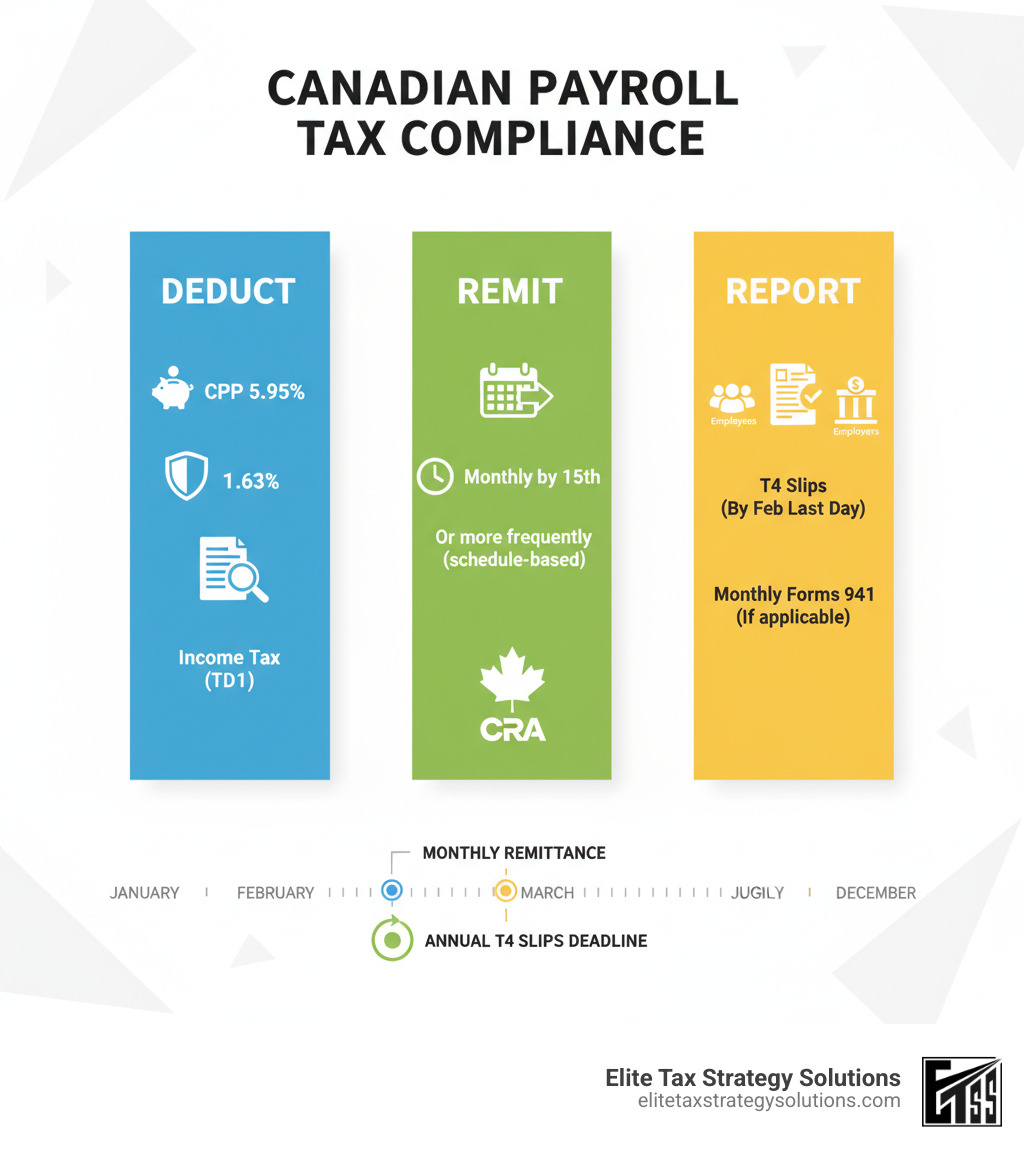
- Remit deductions by the 15th of the following month (or more frequently based on your schedule)
- Report annually via T4 slips and summaries by the last day of February
- Keep accurate records for at least six years
The stakes are high. Employers are responsible for deducting taxes, calculating their own share, depositing payments, and filing returns on time. The CRA can review your records for up to five years, and incorrect reporting can lead to significant payroll tax liabilities, penalties, and interest.
This complexity multiplies when you consider provincial differences. Quebec has its own pension plan (QPP), while Ontario has an Employer Health Tax (EHT). Every province manages its own workers’ compensation system. A single misstep can trigger costly audits.
As a CPA with 40 years of experience, I’ve seen how proactive planning prevents costly mistakes. This guide will walk you through each step of maintaining payroll tax compliance in Canada.
Key terms for payroll tax compliance:
Understanding Your Core Payroll Tax Obligations in Canada
When you hire an employee in Canada, you and your employee both contribute to programs that protect workers. The federal government sets the baseline rules, while provinces add their own requirements for healthcare and workplace safety. Contribution rates and rules change annually and vary by province, making payroll tax compliance a moving target.
Let’s break down what you need to pay, starting with the federal programs.
Federal Payroll Taxes (Canada-wide, excluding Quebec)
These three federal deductions form the backbone of payroll in Canada. You calculate them from each employee’s paycheque and add your own employer contributions.
Canada Pension Plan (CPP) funds retirement, disability, and survivor benefits. For 2025, both you and your employee contribute 5.95% of pensionable earnings, up to a maximum of $4,034.10 per year each. You match your employee’s contribution dollar for dollar. You can check the latest CPP contribution rates and maximums for current figures.
Employment Insurance (EI) provides temporary income for job loss or certain leaves. For 2025, employees contribute 1.63% of insurable earnings (capped at $1,123.07 annually). As the employer, you pay 1.4 times the employee’s contribution, which is 2.28% of insurable earnings (capped at $1,572.30 annually).
Federal income tax withholding varies based on employee earnings and the tax credits they claim on their federal and provincial TD1 forms. The federal tax brackets for 2025 start at 14.5% and increase with income. Payroll software or the CRA’s calculator handles this complex calculation.
The Quebec Difference: QPP, QPIP, and More
If you employ people in Quebec, you’ll use provincial programs instead of some federal ones.
- Quebec Pension Plan (QPP): This replaces CPP. For 2025, the rate is 10.8% of pensionable earnings, split equally between employer and employee (5.4% each). Contribution maximums differ from CPP.
- Quebec Parental Insurance Plan (QPIP): This replaces EI for parental benefits. For 2025, employers contribute 0.692% of insurable earnings, and employees pay 0.494%. Find more details on the Québec Parental Insurance Plan on their site.
- Health Services Fund: Most employers pay into this fund, with rates varying based on total payroll size.
- Contributions Related to Labour Standards: Employers pay 0.06% on the first $98,000 of each employee’s earnings to fund workplace protections.
- CNESST: This is Quebec’s workers’ compensation board, which also handles workplace health, safety, and pay equity.
Provincial & Territorial Payroll Taxes
Beyond federal or Quebec obligations, you must account for provincial and territorial requirements, which primarily fund healthcare and workers’ compensation.
Employer Health Tax (EHT) exists in several provinces. Ontario’s EHT has a $1 million payroll exemption for 2025. British Columbia’s EHT rates range from 1.95% to 2.925%, depending on payroll size.
Workers’ compensation is mandatory nationwide but managed provincially (e.g., WSIB in Ontario, WorkSafeBC in British Columbia). You must register within 10 calendar days of hiring your first employee. Premiums are based on your industry’s risk level.
Other notable taxes include Manitoba’s Health and Post Secondary Education Tax Levy and a flat 2% payroll tax in the Northwest Territories and Nunavut.
| Province/Territory | Provincial Income Tax | Employer Health Tax (EHT) | Workers’ Compensation Body | Other Unique Contributions |
|---|---|---|---|---|
| Ontario | Yes | Yes (2025 exemption $1M) | WSIB | |
| British Columbia | Yes | Yes (rates vary) | WorkSafeBC | |
| Alberta | Yes | No | WCB – Alberta | |
| Quebec | Yes | No (covered by Health Services Fund) | CNESST | QPIP, Health Services Fund, Contributions Related to Labour Standards |
| Manitoba | Yes | No | WCB – Manitoba | Health and Post Secondary Education Tax Levy |
| NWT & Nunavut | Yes | No | WSCC | 2% Payroll Tax |
Location significantly impacts your payroll costs. Know your provincial requirements before hiring.
A Step-by-Step Guide to Canadian Payroll Tax Compliance
Let’s walk through the practical steps for ensuring your payroll tax compliance. A solid foundation is crucial to avoid future problems.
Step 1: Setting Up Your Payroll System
Getting started correctly is essential. This involves registering with the necessary authorities and gathering key employee information.
First, you need a Business Number (BN) from the Canada Revenue Agency (CRA). If you don’t have one, register online. With your BN, you must then open a specific payroll account with the CRA. You can register for a payroll account online. New employers are typically “regular remitters,” with payments due by the 15th of the following month.
Before paying anyone, collect their Social Insurance Number (SIN)—this is mandatory. Also, have every new employee complete a federal TD1 form and, if they claim more than the basic personal amount, a provincial TD1 form. These forms determine how much income tax to withhold and must be kept on file.
Step 2: Classifying Workers Correctly
One of the most costly mistakes in payroll tax compliance is misclassifying an employee as an independent contractor. This distinction has significant legal and tax implications.
- Employees: You control what work is done and how. You must deduct CPP, EI, and income tax, and pay the employer’s share of CPP and EI.
- Independent Contractors: They control their work, use their own tools, and are responsible for their own taxes. You do not deduct taxes from their payments.
The CRA considers several factors to determine status: control, who provides tools and equipment, the chance of profit or risk of loss, and integration into the business. Misclassifying an employee as a contractor can lead to severe penalties, including liability for all unremitted CPP, EI (both employer and employee portions), and income tax, plus interest.

Step 3: Calculating and Remitting Payroll Deductions
This is the core of ongoing compliance. Start by determining gross pay, which includes all wages, commissions, bonuses, and taxable benefits.
Next, calculate the statutory deductions: CPP, EI, and income tax. The CRA’s online payroll deductions calculator is an invaluable tool that eliminates guesswork. Simply enter the pay details, and it provides the exact deduction amounts.
Your remittance schedule depends on your average monthly withholding amount. Most new employers are regular remitters, paying by the 15th of the following month. Larger employers may become accelerated remitters with more frequent deadlines. After making deductions, pay your employees their net earnings and provide a detailed payslip.
Step 4: Managing Basic Employment Standards
Compliance extends beyond taxes to employment standards, which govern pay and time off. These rules vary by jurisdiction.
- Payroll Cycle: Most businesses use a consistent biweekly, semi-monthly, or monthly cycle.
- Minimum Wage: You must pay at least the federal or provincial minimum wage, whichever is applicable. For 2025, the federal rate is $17.75/hour, while provincial rates vary (e.g., Ontario’s is $17.60/hour as of October 1, 2025).
- Overtime: Rules differ by province. Federally, it’s 1.5 times the regular rate for hours over 8 per day or 40 per week. In Ontario, it’s typically after 44 hours per week.
- Vacation Pay: This is a percentage of gross earnings (e.g., 4-6% in Ontario, depending on service length).
- Termination & Severance Pay: When employment ends, you must provide notice or pay in lieu, following provincial minimums. Severance pay may also apply to long-term employees.
- Statutory Holidays: Employees are entitled to paid days off for holidays mandated by federal or provincial law.
Navigating CRA Enforcement and Mitigating Compliance Risks
Even with careful planning, mistakes can happen. Understanding how the Canada Revenue Agency (CRA) enforces payroll tax compliance is key to managing risk.
The Role of the Canada Revenue Agency (CRA)
The CRA’s mandate is to ensure employers withhold, remit, and report payroll taxes correctly. They use several programs to verify compliance:
- Trust Accounts Examinations: Comprehensive reviews of payroll and GST/HST accounts.
- Pensionable and Insurable Earnings Review (PIER): Audits that specifically check for correct CPP and EI deductions.
- PD4R Discrepancy Notices: Automated notices sent when your annual T4 summary doesn’t match the remittances you made throughout the year.
Contact from the CRA usually begins with a letter or phone call. Organized records are your best defense in any review.

Common Payroll Errors and How to Avoid Them
Most payroll errors are preventable. Here are the top five mistakes to avoid:
- Misclassifying Employees: Labeling an employee as a contractor to avoid taxes is a major red flag for the CRA and carries severe financial penalties.
- Incorrect CPP/EI Calculations: These errors often result from using outdated rates or forgetting the 1.4x employer multiplier for EI. Always use the latest CPP contribution rates and maximums.
- Failing to Report Taxable Benefits: Benefits like personal use of a company car or non-cash gifts over a certain value are part of an employee’s income and are subject to deductions.
- Late Remittances or Filings: Missing deadlines for remittances or T4s triggers automatic penalties and interest, and can lead to further scrutiny.
- Inaccurate T4s: Errors on T4 slips cause problems for your employees and signal poor compliance to the CRA. Reconcile your records before filing.
Understanding Key Deadlines and Reporting for payroll tax compliance
Meeting deadlines is non-negotiable. Mark these dates on your calendar:
- Monthly Remittance: For most regular remitters, all CPP, EI, and income tax deducted in the previous month is due by the 15th of the current month.
- Annual Reporting: By the last day of February, you must provide T4 slips to all employees and file a T4 Summary with the CRA, reconciling your annual totals.
- Record of Employment (ROE): When an employee leaves, you must issue an ROE to Service Canada within five calendar days.
Behind all this is the requirement for accurate record-keeping. The CRA requires you to keep all payroll records for at least six years from the end of the last tax year they relate to. This includes payroll registers, TD1 forms, T4 copies, and remittance confirmations. Good records are your best defense in an audit.
Advanced & International Payroll Considerations
As your business grows, payroll tax compliance can become more complex, especially when hiring across Canada or internationally.
Payroll Options for Canadian Employers
Deciding how to manage payroll operations is a key strategic choice.
- In-House Payroll: Handling payroll yourself provides maximum control but carries a high compliance burden and risk, especially as your team grows. Keeping up with changing regulations becomes a significant time drain.
- Local Payroll Outsourcing: A Canadian payroll provider takes over calculations, remittances, and filings. This transfers the technical burden to experts, reduces risk, and frees you to focus on your business.
- Global Payroll Outsourcing: For businesses in multiple countries, these services manage payroll across all jurisdictions through a single platform, ensuring compliance everywhere.

Key Considerations for Global Employers Hiring in Canada
For international companies, hiring in Canada traditionally requires establishing a local legal entity—a costly and time-consuming process.
Employer of Record (EOR) services offer a streamlined alternative. An EOR acts as the legal employer for tax and compliance purposes, allowing you to hire Canadian talent without setting up a Canadian company. The EOR manages all aspects of payroll tax compliance, including CRA registration, deductions, remittances, and reporting.
This model dramatically reduces risk and administrative burden, allowing you to onboard Canadian employees in days instead of months. It’s an effective way to test the Canadian market or build a remote team with minimal upfront investment.
A Comparative Look: US Payroll Tax Deposit Rules
Understanding cross-border differences is crucial for businesses operating in both Canada and the US.
The US IRS uses a different system for tax deposits. Instead of a fixed monthly schedule, the deposit frequency (monthly or semiweekly) is determined by a lookback period that assesses your past tax liability. If your liability was over $50,000 in that period, you must deposit semiweekly.
Furthermore, a $100,000 next-day deposit rule requires any employer who accumulates $100,000 in tax liability on a single day to deposit it by the next business day. All deposits are made via the Electronic Federal Tax Payment System (EFTPS), and employers report activity quarterly on Form 941. For details, the IRS provides Notice 931 (Rev. September 2025) Deposit Requirements for Employment Taxes.
These differences highlight why international payroll requires specialized knowledge.
Frequently Asked Questions about Payroll Tax Compliance
Here are answers to some of the most common questions about managing payroll tax compliance in Canada.
What happens if I make a mistake on my payroll remittance?
Don’t panic, but act quickly. If you find an error, correct it as soon as possible. For under-remittances, pay the difference immediately to minimize penalties and interest. For over-remittances or misallocated payments, contact the CRA to have the funds applied to a future remittance or refunded.
Being proactive and reporting the error yourself demonstrates good faith and often leads to a smoother resolution. However, be aware of the penalties for late or insufficient remittances:
- 1-3 days late: 3% penalty
- 4-5 days late: 5% penalty
- 6-7 days late: 7% penalty
- More than 7 days late: 10% penalty
Interest also accrues on all overdue amounts. If the error affects filed T4s, you will need to amend them.
How long do I need to keep payroll records in Canada?
The CRA requires you to keep all payroll-related books and records for at least six years from the end of the last tax year they relate to. For example, records for the 2025 tax year must be kept until the end of 2031.
“Payroll records” include:
- Employee information (SINs, start/end dates)
- Payroll registers for every pay period
- Employee TD1 forms (federal and provincial)
- Copies of all T4 slips and the T4 Summary
- Remittance receipts and confirmations
- Records of Employment (ROEs)
- Details of any taxable benefits provided
Good record-keeping is not just a rule—it’s your best defense in a CRA review or audit.
Can I pay an employee as a contractor to avoid payroll taxes?
This is a common question with a clear answer: no. If a worker functions as an employee, you cannot classify them as a contractor simply to avoid payroll taxes. The CRA looks at the reality of the working relationship—not the label in your contract—to determine a worker’s status.
The risks of misclassification are severe. If the CRA reclassifies a worker from contractor to employee during an audit, you will be held liable for all unremitted payroll deductions. This includes:
- Both the employer’s and the employee’s share of CPP contributions.
- Both the employer’s (1.4x) and the employee’s share of EI premiums.
- All income tax that should have been withheld.
On top of these back taxes, the CRA will assess significant penalties and interest, potentially going back several years. The short-term savings are not worth the long-term financial risk. If you are unsure of a worker’s status, request a ruling from the CRA before you hire them.
Conclusion
Managing payroll tax compliance in Canada is a critical business function. It requires a firm grasp of federal and provincial rules, from CPP and EI deductions to Quebec’s unique QPP system and various provincial health taxes.
We’ve covered the essential steps: registering with the CRA, correctly classifying workers, calculating and remitting deductions on time, and adhering to employment standards. Staying on top of deadlines and maintaining accurate records for at least six years are non-negotiable.
Getting compliance right isn’t just about avoiding penalties, interest, and stressful CRA audits. It’s about running your business with integrity, treating employees fairly, and building a solid foundation for growth. The risks of non-compliance—including costly reclassifications and back-tax assessments—are too high to ignore.
Based in Jasper, Indiana and serving clients in suburban areas near major U.S. cities, Elite Tax Strategy Solutions frequently supports U.S. businesses that hire employees in Canada. We coordinate Canadian payroll compliance alongside your broader tax strategy so you can expand confidently across borders.
At Elite Tax Strategy Solutions, we understand that you’d rather focus on growing your business than navigating complex tax regulations. That’s why we offer personalized tax planning and compliance services for high earners and closely held businesses. Our proactive approach ensures you meet all your obligations while optimizing your financial position.
Let us turn payroll compliance from a burden into a seamless part of your operations. With expert guidance, you can achieve the peace of mind that comes from knowing your taxes are handled correctly.
Navigate your tax compliance with expert support and get back to what you do best—running your business.