Why Multi-State Tax Planning Can Make or Break Your Business
Multi state tax planning is critical for businesses operating across state lines. It determines where you owe taxes, how much you pay, and whether you’re compliant with dozens of different state regulations. Without a solid plan, businesses risk unexpected tax bills, costly penalties, and aggressive state audits that can derail growth.
Key concepts in multi-state taxation include:
- Nexus: Your connection to a state (physical, economic, or through employees) that creates a tax obligation.
- Economic Nexus: Post-Wayfair rules mean you can owe taxes based on sales volume alone, with no physical presence.
- Apportionment: The formula used to divide your income among states where you have nexus.
- Compliance: Each state has its own unique rates, rules, and filing deadlines.
- Business Structure: Your entity type (C Corp, S Corp, LLC) significantly impacts your tax liabilities.
Operating in multiple states means more opportunities, but also more complex taxes. States are becoming more aggressive in seeking revenue, especially after the 2018 Supreme Court decision in South Dakota v. Wayfair allowed them to enforce tax collection based purely on economic activity. The rise of remote work has further complicated compliance, as telecommuting employees can create nexus across the country.
I’m David Fritch, and for over 40 years, I’ve helped business owners and high-income earners steer complex tax challenges through my firms Fritch Law Office and David P. Fritch CPA, PC. At Elite Tax Strategy Solutions, we develop customized strategies that help clients operating across state lines maximize savings while ensuring full compliance.
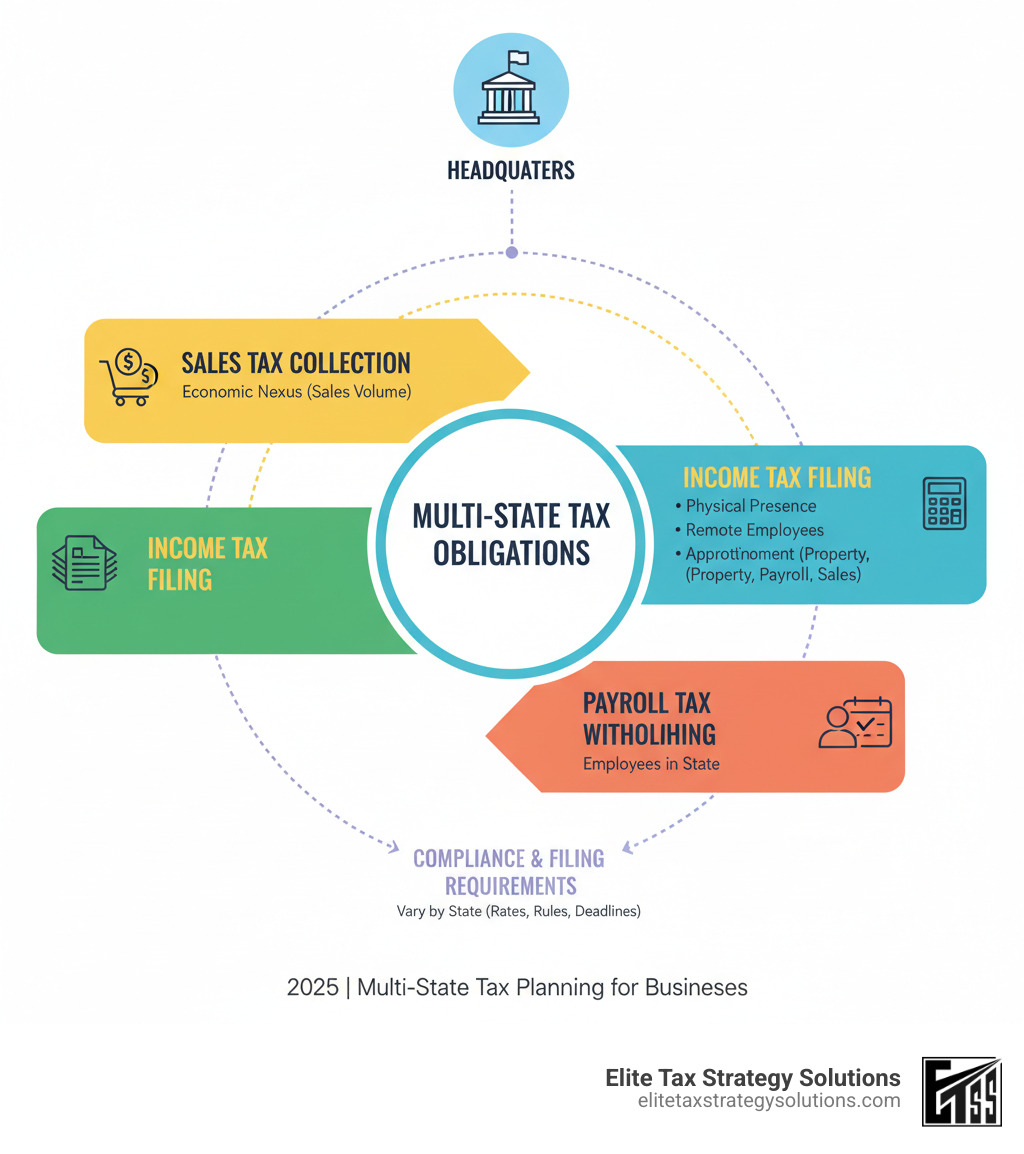
Key terms for Multi state tax planning:
Understanding Your Tax Footprint: Nexus and State Obligations
When your business expands beyond its home state, you must determine where you have “nexus.” Nexus is the legal connection that gives a state the right to tax your business. Understanding it is the foundation of effective multi state tax planning.
Traditionally, nexus was created through physical presence—an office, warehouse, or inventory in a state. However, even sending employees for installations, training, or trade shows can establish this connection. The rise of remote work has also changed the landscape; having even one remote employee in another state can establish physical nexus for income, sales, and payroll tax purposes.
For e-commerce businesses, storing products in third-party warehouses (like Amazon’s fulfillment centers) creates nexus in those states. Your digital presence can also be a factor, as interactive website features or sales of digital goods may trigger obligations. Then there’s economic nexus, which allows states to tax you based purely on sales volume, even without any physical presence.
Ignoring these connections is not an option. States are increasingly aggressive in pursuing businesses for unpaid taxes, and state audit risks are real. The first step in protecting your business is to understand exactly where you have nexus.
The Post-Wayfair World: Economic Nexus Explained

Before 2018, a business needed a physical presence in a state to be required to collect sales tax. The Supreme Court’s decision in South Dakota v. Wayfair changed everything, allowing states to tax businesses based purely on economic activity.
Now, if you meet a state’s revenue or transaction thresholds, you have economic nexus. The most common thresholds are $100,000 in annual sales or 200 transactions, but these vary by state. For any business selling online, this means you must constantly monitor sales into every state to know when you’ve triggered a new obligation to register, collect, and remit sales tax.
This ruling massively impacted e-commerce companies, which suddenly became responsible for complying with dozens of different state tax systems. Without a system to track economic nexus, you could easily miss an obligation and face penalties. This is where proactive multi state tax planning is essential.
Evolving Regulations and Their Impact
The multi-state tax landscape is constantly changing. For example, Public Law 86-272, a federal law from 1959, protects businesses from state income tax if their only activity in a state is the “solicitation of orders” for tangible goods. Historically, this protected companies with traveling salespeople.
However, states are now reinterpreting this law for the digital age, arguing that activities like website chatbots, online job applications, or certain types of digital customer support go beyond “mere solicitation.” This could strip away that protection and create income tax nexus where you thought you were safe.
Another evolving area is the taxation of digital goods. States are increasingly looking to tax software-as-a-service (SaaS), cloud computing, and streaming services. The rules are inconsistent and change frequently as states seek new revenue.
Staying current requires ongoing attention to legislative changes and court rulings. Organizations like the Multistate Tax Commission work to promote uniformity and provide guidance, but the responsibility ultimately falls on the business owner. Multi-state taxation is not a “set it and forget it” issue; it demands regular reviews of your tax footprint and proactive adjustments.
Dividing the Pie: Apportionment, Sourcing, and State-Specific Rules
Once you determine you have nexus in multiple states, the next question is: how much of your income does each state get to tax? The answer lies in apportionment, the process of dividing your total taxable income among the states where you do business.
Each state has its own apportionment formula, tax rates, and rules. Some have a corporate income tax, while others use a gross receipts tax or a franchise tax. Rates vary wildly, and many states require state tax addbacks, meaning you can’t deduct income taxes paid to other states, which increases your taxable income. Understanding these variations is critical, as the difference between a well-planned and a poorly planned multi-state operation can mean tens of thousands of dollars in unnecessary taxes. Proactive multi state tax planning is essential to protecting your profitability.
Key Factors in Multi-State Tax Planning: Apportionment and Sourcing
Historically, most states used a three-factor formula for apportionment, equally weighing a company’s property, payroll, and sales in a state. Today, many states have shifted to a single-sales factor formula, which apportions income based solely on where sales occur. This can significantly impact companies with a large sales footprint but limited physical presence.
To determine where sales occur, states use different sourcing rules. Market-based sourcing, the more modern approach, assigns revenue to the state where the customer receives the benefit of the service. The older method, cost-of-performance sourcing, assigns revenue to the state where the work was performed. The method a state uses can dramatically change which state gets to tax the income.
Finally, throwback and throwout rules prevent income from going untaxed. A throwback rule requires sales made into a state where you lack nexus to be “thrown back” and taxed in your home state. A throwout rule simply excludes those sales from the apportionment calculation. These complex rules require careful tracking and are a key component of strategic multi state tax planning.
How Business Structure Affects Tax Liabilities
Your business’s legal structure fundamentally shapes how it’s taxed across multiple states. Thoughtful multi state tax planning requires choosing the right entity.
-
A C Corporation is a separate legal entity that pays corporate income tax. It must file returns in every state where it has nexus. When profits are distributed as dividends, shareholders are taxed again personally, creating “double taxation.”
-
An S Corporation is a pass-through entity, meaning profits and losses flow to the owners’ personal tax returns, avoiding double taxation at the federal level. However, not all states recognize S Corp status, and some impose their own corporate-level taxes.
-
A Limited Liability Company (LLC) offers the most flexibility. It can be taxed as a pass-through entity (like a partnership) or elect to be taxed as a C Corp or S Corp. While states generally follow the federal classification, their own nexus rules still apply.
Recently, Pass-Through Entity-Level Taxes (PTETs) have become an important tool. These state-level elections allow the business to pay state income tax at the entity level, creating a federal deduction that helps owners bypass the $10,000 state and local tax (SALT) deduction cap. However, this adds another layer of analysis to determine if the election is beneficial in each state.
It’s also important to know that simply owning an interest in a pass-through entity doing business in other states can create personal tax filing obligations for you in those states. As your business grows, you should continually evaluate if your structure is still the most tax-efficient option, often with the help of professionals who understand both entity structuring and corporate tax reduction strategies.
Proactive Multi-State Tax Planning and Compliance
Operating across state lines introduces a new level of tax complexity, and the stakes are high. States have become more aggressive in collecting taxes, leading to increased audit risks. They use data to find inconsistencies, such as a business filing an income tax return but not a sales tax return in the same state.
The penalties for non-compliance can be severe, including retroactive tax bills, compounded interest, and late filing fees. These unexpected costs can drain resources that should be fueling growth. Furthermore, managing different filing deadlines for income, sales, and payroll taxes across multiple states is a significant logistical challenge.
Payroll tax complexity has also grown with the rise of remote work. Each remote employee can create nexus, requiring you to withhold the correct state income tax and handle unemployment insurance obligations in their home state. For more on this, see our guide to multi-state payroll tax compliance.
Strategic multi state tax planning is an opportunity to protect your business and optimize your tax position. The key is to be proactive and address these challenges before they become crises.
Essential Steps for Effective Compliance
Effective multi state tax planning is an ongoing process. Here are the essential steps to maintain your business’s tax health:
- Conduct a nexus study. Regularly analyze where you have physical, economic, or employee-driven tax obligations. Revisit this study after any significant business change.
- Register in nexus states. Once you identify nexus, register for the appropriate sales tax permits, employer accounts, and income tax authority. Skipping this step leads to bigger problems later.
- Implement tax collection systems. Use robust software to calculate, collect, and record the correct sales tax for every transaction. Managing this manually is prone to error.
- Track and maintain records. Keep detailed documentation of sales, employee locations, and taxes paid. These records are your defense in an audit.
- File returns and remit taxes accurately. Use a compliance calendar to track all filing deadlines across every jurisdiction to avoid penalties and audit triggers.
- Regularly review and update your strategy. State tax laws change constantly. Adapt your approach to ensure ongoing compliance and identify new tax-saving opportunities.
Strategic Multi-State Tax Planning to Mitigate Exposure
Beyond compliance, smart multi state tax planning involves actively reducing your tax exposure. This is where you move from defense to offense.

-
Entity structuring is a powerful tool. Organizing your business across one or more legal entities can significantly impact your state tax liabilities. The right structure is compliant and tax-efficient.
-
Tax credits and incentives are offered by many states to encourage job creation and investment. You must know about these programs and actively apply for them to benefit.
-
Voluntary Disclosure Agreements (VDAs) can be a lifesaver if you find past non-compliance. These programs allow you to come forward, report unpaid taxes, and in return, states typically waive or reduce penalties. It’s always better to volunteer before the state finds you.
-
Managing intercompany transactions is crucial for businesses with multiple related entities. States require these transactions to be priced at fair market value to prevent artificial income shifting to low-tax states. Proper documentation is essential.
Strategic multi state tax planning can reduce your tax burden and improve cash flow, turning a compliance challenge into a competitive advantage. For businesses dealing with sales tax specifically, learn more about sales tax compliance to understand the nuances of this area.
Frequently Asked Questions about Multi-State Tax Planning
We know that multi state tax planning can feel overwhelming. Here are answers to some of the most common questions business owners ask.
What is the difference between sales tax nexus and income tax nexus?
This is a critical distinction. The two types of nexus are separate and have different triggers.
-
Sales tax nexus creates an obligation to collect and remit sales tax from customers. Since the Wayfair decision, this is often triggered by economic nexus (exceeding a state’s sales or transaction threshold) even without a physical presence.
-
Income tax nexus creates an obligation to file a state income tax return and pay tax on the portion of your profits apportioned to that state. This is traditionally tied to physical presence, but states are increasingly adopting economic nexus standards for income tax as well.
The key takeaway is that meeting the threshold for one type of nexus does not automatically mean you have the other. A comprehensive multi state tax planning strategy must evaluate both.
Can having just one remote employee create nexus?
Yes, absolutely. This is one of the most common ways businesses unexpectedly create new tax obligations. In most states, having a single employee working remotely is enough to establish physical nexus. This can trigger requirements for:
- Income tax: You may need to file a corporate income tax return in the employee’s state.
- Sales tax: You may be required to collect sales tax in that state.
- Payroll tax: You must withhold state income tax from the employee’s pay and pay state unemployment taxes.
For any business embracing remote work, this makes proactive multi state tax planning essential. Before hiring across state lines, you should understand the tax implications.
What is the Multistate Tax Commission (MTC)?
The Multistate Tax Commission (MTC) is an intergovernmental agency created by states in 1967 to bring more uniformity to state tax systems. Its mission is to promote fairness and simplify tax compliance for businesses operating in multiple states.
The MTC develops model laws and regulations that states can choose to adopt. For example, it provides guidance on how to apply apportionment rules and steer complex issues like the taxation of digital services. The MTC also offers a voluntary disclosure program that can help businesses resolve past-due tax liabilities in multiple states at once.
While the MTC does not have direct authority to create law, it is an influential organization that plays a key role in multi state tax planning. Its resources can be valuable for businesses trying to stay compliant across the country.
Conclusion
Growing a business across state lines brings incredible opportunities, but multi state tax planning is one of the most complex challenges you’ll face. We’ve covered how nexus can be triggered by a single remote employee or an economic threshold, how states use apportionment formulas to claim a share of your profits, and why compliance means juggling dozens of different rules and deadlines.
The stakes are high, as states are more aggressive than ever in pursuing out-of-state businesses. However, these challenges don’t have to derail your growth. The key is to be proactive, not reactive. Waiting for an audit notice is not a strategy; by then, you’re already facing penalties and stress.
Effective multi state tax planning is about more than just avoiding problems—it’s about finding opportunities. The right entity structure, strategic use of tax credits, and smart operational decisions can significantly reduce your overall tax burden. A cookie-cutter approach won’t work; you need a customized strategy that fits your unique business footprint and goals.
At Elite Tax Strategy Solutions, we specialize in turning tax complexity into a competitive advantage. We help businesses in Jasper, Indiana, and beyond build sustainable growth with a tax strategy that aligns with their aspirations.
Your business deserves a tax plan that works as hard as you do. Develop your innovative tax plan with us and let’s turn these multi-state challenges into opportunities for growth and savings.