
Why Tax Planning Today Protects Your Wealth Tomorrow
Tax saving tips 2026 can help you keep thousands of dollars in your pocket instead of sending them to the IRS. With only weeks left in the year, now is the time to act on strategies that reduce your tax bill for the current year and set you up for success in the years to come.
Quick Answer: Top Tax Saving Tips for the Current Year
- Maximize retirement contributions – 401(k) limit is $23,000 ($30,500 if 50+)
- Harvest tax losses – Sell underperforming investments to offset gains
- Donate appreciated assets – Give stocks to charity to avoid capital gains
- Claim all credits – Child Tax Credit, education credits, and more
- Use tax-advantaged accounts – HSAs, 529 plans, and IRAs offer powerful benefits
- Time your income and deductions – Defer income or accelerate expenses strategically
Most Canadians only think about their taxes when they file in March or April, but by then, it is often too late to take advantage of the many tax-saving opportunities available. The same is true for American taxpayers. The difference between proactive tax planning and reactive tax filing can mean tens of thousands of dollars in savings.
For high-income earners and business owners, the stakes are even higher. Tax laws have grown increasingly complex, with new regulations, changing contribution limits, and shifting deduction rules that can overwhelm even the most diligent individuals. Without a strategic approach, you risk leaving substantial money on the table.
The good news? There are proven strategies to reduce your tax liability legally and effectively. From maxing out retirement accounts to harvesting investment losses, from strategic charitable giving to leveraging tax-advantaged savings accounts, the opportunities are substantial for those who plan ahead.
As we approach year-end, several critical deadlines loom. Most tax-saving moves must be completed by December 31 to count for the current tax year. That includes retirement contributions to employer plans, stock sales for tax-loss harvesting, and charitable donations. Only a few exceptions, like IRA and HSA contributions, can be made until the tax filing deadline of the following year (typically April 15).
Looking forward, significant tax law changes are on the horizon that could affect your planning strategy. The Tax Cuts and Jobs Act provisions are set to expire, potentially resulting in higher tax rates and reduced exemptions. Understanding these shifts is crucial for long-term financial planning.
I’m David Fritch, and over my 40 years of experience helping high-income earners and small business owners, I’ve seen how the right tax saving tips 2026 can transform financial outcomes. Through Elite Tax Strategy Solutions, I’ve helped clients save substantial amounts by implementing proactive, personalized strategies custom to their unique situations.
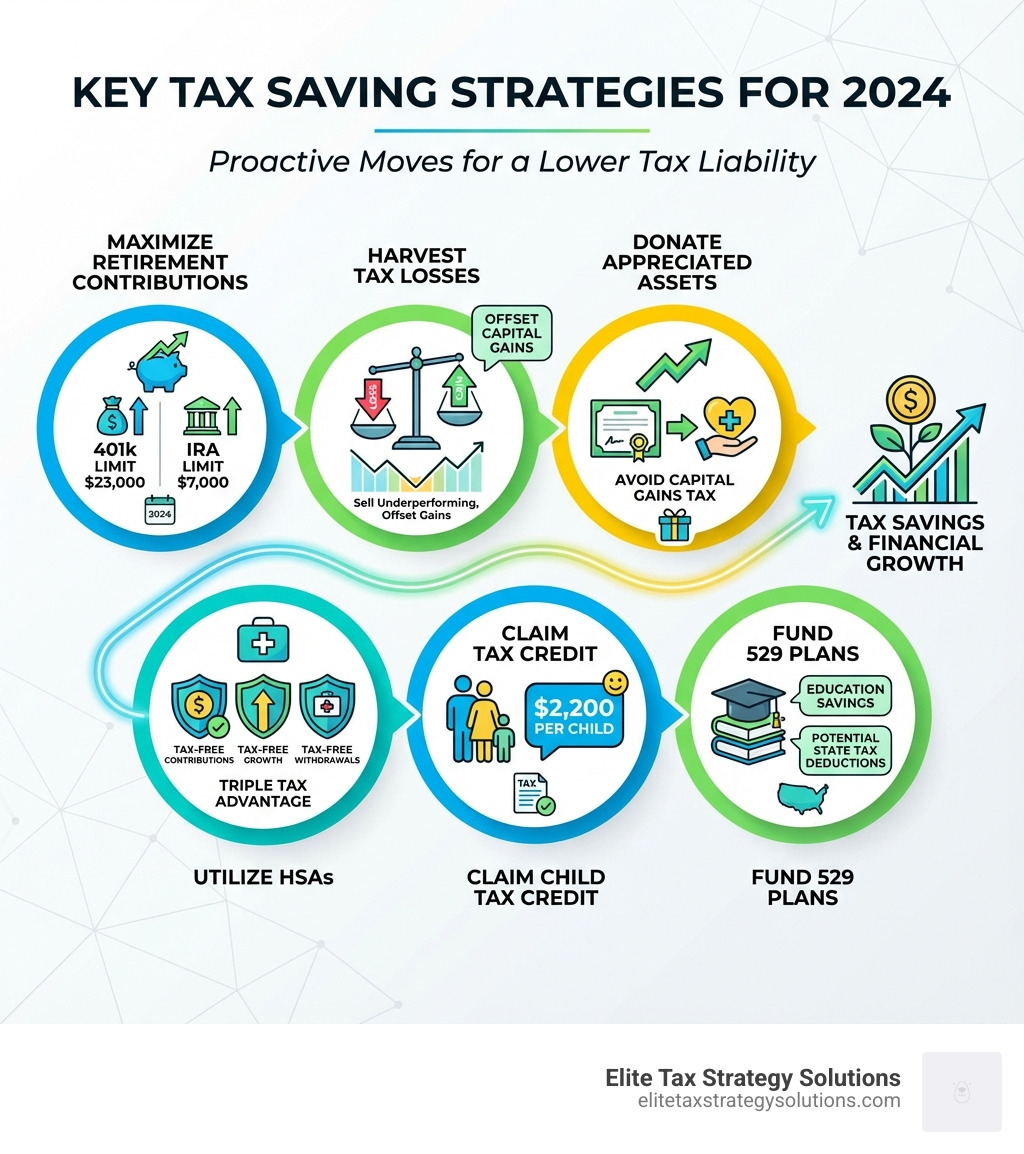
Tax saving tips 2026 terms you need:
Maximize Your Deductions and Credits
When it comes to lowering your tax bill, deductions and credits are your best friends. They both reduce your tax liability, but they work in fundamentally different ways. Deductions reduce your taxable income, meaning you pay tax on a smaller amount. Credits, on the other hand, directly reduce the amount of tax you owe, dollar for dollar. Understanding and maximizing both is a cornerstone of effective tax saving tips 2026.
Standard vs. Itemized Deductions: Which Path Saves You More?
For the current tax year, the IRS offers a choice: take the standard deduction or itemize your deductions. For many taxpayers, especially those in Jasper, Indiana, and suburban areas near major cities, the standard deduction has become the more attractive option since the Tax Cuts and Jobs Act (TCJA).
The standard deduction for the 2024 tax year is:
- $14,600 for single filers
- $29,200 for married filing jointly
If your total itemized deductions exceed these amounts, then itemizing is usually the way to go. Itemized deductions can include:
- State and Local Taxes (SALT): While capped at $10,000 per household, this can still be a significant deduction for property taxes and state income taxes.
- Mortgage Interest Deduction: If you own a home, the interest you pay on your mortgage (up to certain limits) can be deducted. This is often a major factor pushing taxpayers past the standard deduction threshold.
- Medical Expense Deduction: You can deduct medical expenses that exceed 7.5% of your Adjusted Gross Income (AGI). This can be particularly beneficial if you’ve had significant medical costs during the year.
- Charitable Contributions: We’ll dive deeper into this later, but cash contributions to qualified charities can be deducted if you itemize.
Our team at Elite Tax Strategy Solutions often helps high-income earners and business owners carefully track their expenses throughout the year. This proactive record-keeping ensures that come tax time, we can accurately compare itemized deductions against the standard deduction, ensuring you choose the path that yields the greatest tax savings.
Don’t Overlook These Valuable Tax Credits
Tax credits are pure gold because they directly reduce your tax bill. Unlike deductions, which lower your taxable income, a $1,000 credit means $1,000 less in taxes owed. Here are some key credits to consider for your tax saving tips 2026:
- Child Tax Credit (CTC): For the 2024 tax year, the Child Tax Credit is $2,000 per qualifying child. A portion of this credit, up to $1,600, can be refundable, meaning you could receive it as a refund even if you don’t owe any tax. This is a powerful benefit for families.
- Education Credits: If you, your spouse, or your dependents are pursuing higher education, you might qualify for credits like the American Opportunity Tax Credit (AOTC) or the Lifetime Learning Credit (LLC). These credits can help offset the cost of tuition, fees, and course materials.
- Home Loan Tax Benefits: While not a credit, it’s worth reiterating that interest paid on a home loan can be a significant deduction, reducing your overall taxable income.
- Student Loan Interest Deduction: You can deduct up to $2,500 in student loan interest paid during the year, reducing your taxable income.

Boost Your Savings with Tax-Advantaged Accounts
One of the most effective long-term tax saving tips 2026 is to leverage tax-advantaged accounts. These accounts offer incredible benefits, such as tax-deferred growth, tax-free withdrawals, or immediate tax deductions, helping your money grow faster and shielding it from the IRS.
Retirement Planning: 401(k)s and IRAs
When it comes to retirement, don’t leave free money on the table! Maximizing contributions to your 401(k) and IRA is one of the easiest and most impactful ways to reduce your current tax bill and build wealth for the future.
- 401(k) Contributions: For 2024, you can contribute up to $23,000 to your 401(k) (or 403(b), 457 plan). If you’re 50 or older, you can contribute an additional $7,500 as a catch-up contribution, bringing your total to $30,500. These contributions are typically pre-tax, meaning they reduce your taxable income dollar-for-dollar in the year you contribute. Many employers also offer a matching contribution – essentially free money! 401(k) contributions must be made by December 31 of the tax year.
- IRA Contributions: You can contribute up to $7,000 to an Individual Retirement Account (IRA) in 2024. If you’re 50 or older, you get an extra $1,000 catch-up contribution, for a total of $8,000. You have until the tax filing deadline (typically April 15 of the next year) to make IRA contributions for the 2024 tax year.
- Traditional IRA: Contributions may be tax-deductible, reducing your current taxable income. Earnings grow tax-deferred until retirement, when withdrawals are taxed as ordinary income.
- Roth IRA: Contributions are made with after-tax dollars, so there’s no immediate deduction. However, your earnings grow tax-free, and qualified withdrawals in retirement are also tax-free. This is a powerful option, especially if you expect to be in a higher tax bracket in retirement.
Education and Health Savings: 529 Plans and HSAs
Beyond retirement, other specialized accounts offer fantastic tax benefits for education and health expenses.
- 529 Plans: These state-sponsored plans are designed to help you save for qualified educational expenses. While contributions aren’t federally tax-deductible, your money grows tax-deferred, and withdrawals are tax-free when used for eligible costs like tuition, fees, and books. Some states, including Indiana, offer state tax deductions or credits for 529 contributions, providing an immediate tax benefit.
- Secure Act 2.0: A game-changer for 529 plans is the provision allowing unused 529 funds to be rolled over to a Roth IRA under specific conditions. Starting in 2024, up to $35,000 can be rolled over tax-free and penalty-free from a 529 plan to a Roth IRA for the beneficiary, provided the 529 has been open for at least 15 years. This adds incredible flexibility to these plans.
- Health Savings Accounts (HSAs): Often called the “triple-tax advantage” account, HSAs are a must-have for those with high-deductible health plans.
- Tax-deductible contributions: Money you contribute reduces your taxable income.
- Tax-free growth: Your investments grow without being taxed.
- Tax-free withdrawals: Withdrawals are tax-free when used for qualified medical expenses.
Even better, after age 65, you can withdraw funds for any purpose without penalty (though they’ll be taxed as ordinary income if not for medical expenses). This makes HSAs a stealth retirement savings vehicle.

Advanced Investment and Gifting tax saving tips 2026
For high-income earners and business owners, basic deductions and retirement accounts are just the starting point. Proactive tax optimization involves sophisticated strategies that integrate investment management and wealth transfer planning. Our team at Elite Tax Strategy Solutions specializes in these advanced tax saving tips 2026, helping clients in Jasper, Indiana, and suburban areas steer complex financial landscapes to maximize savings and ensure financial stability.
Master the Art of Tax-Loss Harvesting
Tax-loss harvesting is a smart strategy to turn investment losses into tax savings. We all hope our investments only go up, but sometimes, they don’t. When an investment loses value, you can sell it to “harvest” that loss.
Here’s how it works:
- Offsetting Capital Gains: Realized capital losses can directly offset any capital gains you’ve realized from selling profitable investments. For example, if you sold stock A for a $10,000 gain and stock B for a $5,000 loss, your net capital gain for tax purposes would be $5,000.
- Deducting Against Ordinary Income: If your capital losses exceed your capital gains, you can use up to $3,000 of those net losses to deduct against your ordinary income (like your salary) each year. This is a direct reduction of your taxable income.
- Carry Forward Unused Losses: Any remaining losses beyond the $3,000 can be carry forward unused losses to future years to offset future capital gains or ordinary income. This means a bad investment year can provide tax benefits for years to come.
- Long-Term Capital Gains Rates: For 2024, long-term capital gains tax rates are 0%, 15%, and 20%, depending on your taxable income and filing status. Harvesting losses can help you reduce the amount of gains subject to these rates.
- The Wash Sale Rule: A crucial rule to remember is the “wash sale” rule. You cannot sell a security at a loss and then buy substantially identical securities within 30 days before or after the sale. Violating this rule disallows the loss.
Tax-loss harvesting is a year-end strategy that must be completed by December 31st to count for the current tax year. It requires careful planning and understanding of market movements, making it an ideal strategy to discuss with a tax professional.
Strategic Charitable Giving for Maximum Impact
Charitable giving is not just about generosity; it can also be a powerful tool for tax savings, especially for high-income earners who itemize their deductions.
- Donating Appreciated Assets: Instead of giving cash, consider donating appreciated assets like stocks or bonds that you’ve held for more than a year. If you sell these assets, you’d owe capital gains tax on the profit. By donating them directly to a qualified charity, you avoid paying capital gains tax entirely, and you can typically deduct the fair market value of the asset (up to certain AGI limits) if you itemize. This is a win-win for you and the charity!
- Donor-Advised Funds (DAFs): A DAF is like a charitable investment account. You contribute assets (cash, stock, etc.) to the DAF, receive an immediate tax deduction, and then recommend grants to your favorite charities over time. This allows you to get the tax benefit now, even if you haven’t decided on all your recipient charities yet.
- Qualified Charitable Distributions (QCDs): If you’re 70½ or older and have an IRA, you can make a QCD directly from your IRA to a qualified charity. These distributions count towards your Required Minimum Distribution (RMD) but are not included in your taxable income, which can be a significant tax advantage.
- Itemizing Charitable Gifts: To deduct charitable contributions, you generally need to itemize your deductions. For 2024, if your itemized deductions (including charitable gifts) exceed the standard deduction ($14,600 for singles, $29,200 for married filing jointly), then this strategy can be highly beneficial.
Smart Gifting to Reduce Your Future Estate
Gifting strategies are key components of long-term estate planning, particularly for those with substantial wealth. By strategically giving away assets during your lifetime, you can reduce the size of your taxable estate, potentially saving your heirs significant estate taxes down the road.
- Annual Gift Tax Exclusion: For 2024, you can give up to $18,000 per recipient per year without incurring gift tax or using up any of your lifetime gift tax exemption. If you’re married, you and your spouse can jointly give $36,000 to each recipient annually. This is a powerful way to transfer wealth tax-free over time.
- Lifetime Gift Tax Exemption: Beyond the annual exclusion, you also have a lifetime gift tax exemption. For 2024, this exemption is $13.61 million per individual. This means you can give away assets up to this amount (minus any gifts made using your annual exclusion) during your lifetime or at death without incurring federal gift or estate taxes.
- Reducing Taxable Estate: Utilizing both the annual exclusion and, when appropriate, portions of your lifetime exemption, allows you to systematically transfer assets out of your estate. This proactive approach can significantly reduce the potential estate tax burden on your heirs, aligning with our goal of comprehensive wealth management for our clients in Jasper, Indiana, and surrounding suburban communities.
Looking Ahead: Tax Law Changes in 2025 and Beyond
Tax laws are never static. As we look beyond the current year, significant changes are on the horizon that will impact your tax planning for years to come. Staying informed and proactively adjusting your strategies is essential for effective tax saving tips 2026 and beyond.
The Sunsetting of the Tax Cuts and Jobs Act (TCJA)
The Tax Cuts and Jobs Act (TCJA) of 2017 brought about sweeping changes to the tax code, but many of the individual provisions were temporary. A significant portion of these are currently set to expire at the end of 2025. Unless Congress acts, this could mean:
- Higher Individual Tax Rates: Income tax rates are scheduled to revert to the higher, pre-TCJA levels.
- Smaller Standard Deduction: The nearly doubled standard deduction is set to be cut roughly in half (adjusted for inflation), which will require more taxpayers to consider itemizing.
- Reduced Estate Tax Exemption: The lifetime estate and gift tax exemption, currently at a historic high, is scheduled to revert to a much lower amount (around $5 million, adjusted for inflation).
- Other Key Changes: The $10,000 cap on state and local tax (SALT) deductions is also set to expire, along with current formulas for the Child Tax Credit and other provisions.
This looming expiration date highlights the critical importance of long-term planning. Our team at Elite Tax Strategy Solutions is already working with clients to model these potential changes and develop strategies to mitigate their impact, ensuring their financial stability remains intact.
Staying Informed on Future Tax Laws
While the TCJA sunset is the most significant change on the known horizon, tax laws are constantly evolving. Congress frequently proposes and passes new legislation that can create both new opportunities and new challenges for taxpayers. Changes to retirement account rules, tax credits, and deduction limitations can happen at any time.
Understanding these ongoing legislative shifts is crucial for sophisticated tax planning. We constantly monitor these developments to advise our clients effectively. Proactive planning, rather than reactive filing, is the key to navigating an uncertain tax landscape and protecting your wealth in the long term.
Frequently Asked Questions about tax saving tips 2026
We know tax planning can bring up a lot of questions. Here are some of the most common inquiries we receive about tax saving tips 2026 and beyond.
What are the most effective tax-saving strategies for 2024?
The most effective tax saving tips 2026 involve a combination of strategies custom to your individual circumstances. Our top recommendations include:
- Maximizing contributions to tax-advantaged retirement accounts like 401(k)s and IRAs.
- Utilizing Health Savings Accounts (HSAs) for their triple-tax benefits.
- Implementing tax-loss harvesting to offset capital gains and reduce ordinary income.
- Strategically bunching or donating appreciated assets for charitable contributions.
- Claiming all eligible tax credits, such as the Child Tax Credit or education credits.
- Proactively planning for upcoming changes to tax laws.
What is the deadline for most 2024 tax-saving moves?
For most tax saving tips 2026, the deadline is December 31 of the tax year in question. This includes:
- Contributions to employer-sponsored retirement plans (like 401(k)s).
- Stock sales for tax-loss harvesting.
- Making charitable donations (cash or appreciated assets).
However, there are a few key exceptions: - Contributions to Traditional and Roth IRAs for a given tax year can generally be made up until the tax filing deadline, typically April 15 of the following year.
- Contributions to Health Savings Accounts (HSAs) for a given tax year can also typically be made up until the tax filing deadline, usually April 15 of the following year.
Should I take the standard deduction or itemize?
The decision to take the standard deduction or itemize depends on which option results in a lower taxable income for you. You should itemize your deductions if your total eligible itemized deductions exceed the standard deduction amount for your filing status. For 2024, these amounts are $14,600 for single filers and $29,200 for married filing jointly. Common itemized deductions include mortgage interest, state and local taxes (up to the $10,000 SALT cap), significant medical expenses, and charitable contributions. For high-income earners and those with substantial expenses, itemizing often provides greater tax savings. We recommend carefully tracking all potential deductions throughout the year to make an informed decision.
Conclusion: Take Control of Your Tax Strategy
As we’ve explored, effective tax planning is far more than just filling out forms in April. It’s a year-round, proactive process that can significantly impact your financial well-being. From maximizing contributions to tax-advantaged accounts to strategically managing investments and charitable giving, the tax saving tips 2026 we’ve discussed offer powerful avenues to reduce your tax liability.
For high earners and business owners in Jasper, Indiana, and suburban areas near major cities, the complexity of tax laws, coupled with upcoming legislative changes, makes personalized and proactive tax optimization an absolute necessity. Leaving money on the table isn’t an option when strategic planning can lead to substantial savings.
At Elite Tax Strategy Solutions, we pride ourselves on a thorough, proactive approach to tax optimization and compliance. We don’t just react to tax season; we help you plan for it, anticipating changes and identifying opportunities to maximize your tax savings and improve your financial stability.
Don’t let the intricacies of the tax code overwhelm you. Take control of your tax strategy today. We invite you to take the next step with our innovative tax planning services. Let us help you steer the complexities and secure a more prosperous financial future.