
The Economic Impact of Family Planning on Your Financial Future
Positive effects of family planning in financial stability are numerous and well-documented. If you’re looking for how family planning contributes to your financial well-being, here’s what research has conclusively shown:
| Key Financial Benefits of Family Planning |
|---|
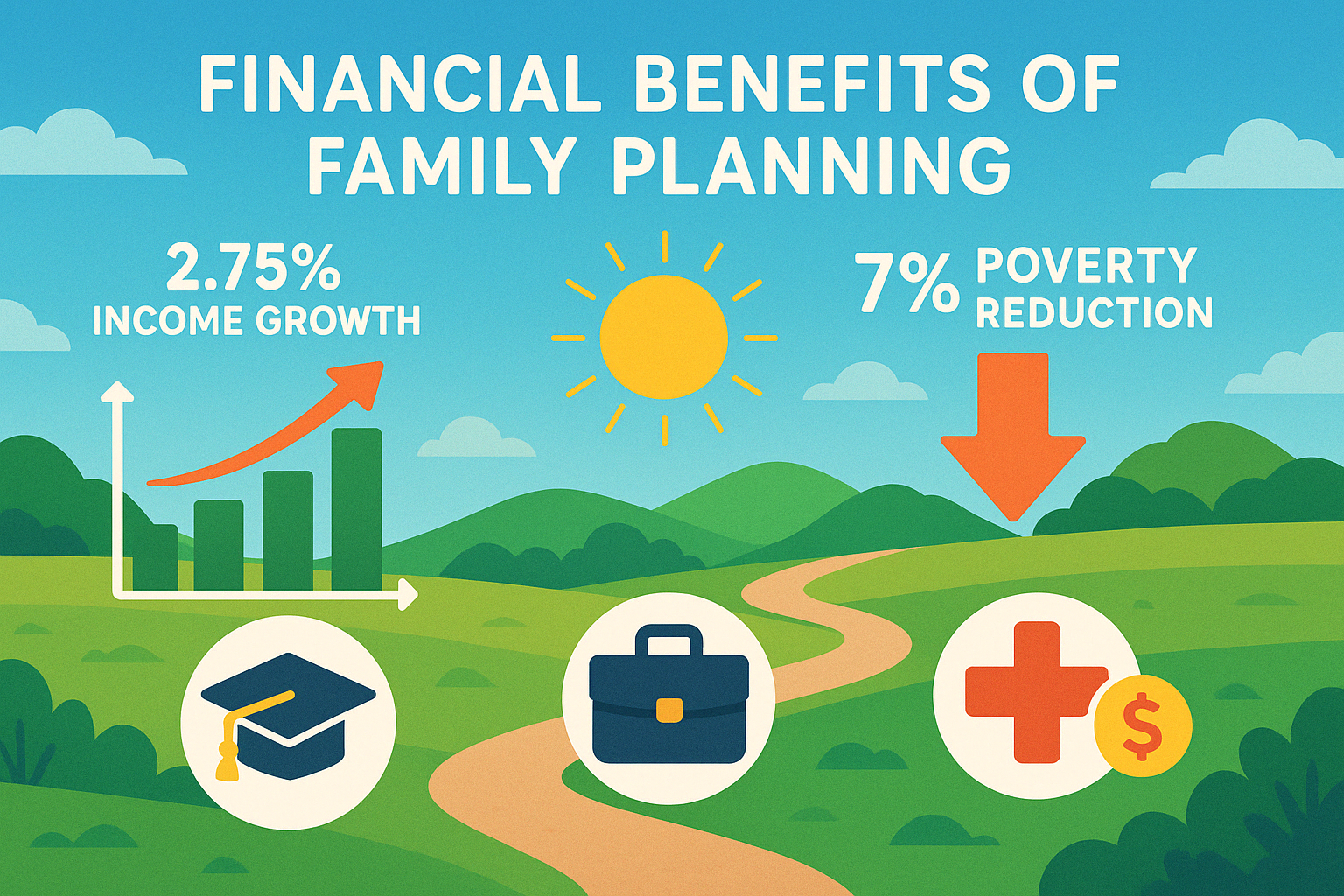
| ???? 2.75% higher household incomes for children born after family planning programs |
| ???? 7% reduction in poverty rates for families with access to family planning |
| ???? Increased educational attainment leading to higher lifetime earnings |
| ???? Improved career opportunities for women, with up to 8% wage premium by age 50 |
| ???? Significant savings in healthcare costs ($2.20 saved for every $1 invested) |
Family planning represents far more than just deciding when to have children. It’s a powerful economic strategy that enables families to invest more resources per child, build wealth over time, and create generational financial stability.
Studies from programs like the Family Planning and Maternal Child Health (FPMCH) initiative in Bangladesh demonstrate that families with access to comprehensive family planning experienced larger incomes, greater wealth accumulation, and higher levels of education compared to those without such access.
The ability to plan pregnancies allows parents—particularly women—to pursue education, develop careers, and increase earning potential. This translates directly into improved household finances, reduced reliance on public assistance, and better long-term economic outcomes for both parents and children.
For women specifically, access to reliable contraception has been linked to approximately one-third of the wage gains women have made since the 1960s. Early access to birth control is associated with an 8% hourly wage premium by age 50, demonstrating the profound economic impact of reproductive autonomy.
I’m David Fritch, a tax strategist with four decades of experience helping clients achieve financial stability through comprehensive planning, and I’ve witnessed the positive effects of family planning in financial stability as clients make informed decisions about family size and timing that directly impact their long-term economic prosperity.
Basic positive effects of family planning in financial stability vocab:
– financial stability planning
– financial stability of any pension plan
– ways to improve your personal and financial stability and planning
Understanding the Connection Between Family Planning and Financial Stability
Have you ever wondered how the timing of your family’s growth affects your bank account? It’s a connection that’s more powerful than most people realize.
Family planning, as defined by the World Health Organization, is the ability of individuals and couples to anticipate and attain their desired number of children and the spacing and timing of their births. While this definition sounds clinical, the real-world impact on your financial life can be tremendous.
When my clients at Elite Tax Strategy Solutions sit down to discuss their financial futures, family planning decisions often emerge as a critical factor in their overall financial picture. I’ve seen how the ability to choose when and how many children to have creates a foundation for financial success that ripples through every aspect of a family’s economic life.
Think about it this way: when you can plan your family’s growth, you gain remarkable control over your financial destiny. Resource allocation becomes more strategic and intentional—you can save for a home down payment before welcoming a child, for example, rather than trying to juggle both simultaneously. Career development opportunities, especially for mothers, can be pursued with greater confidence when pregnancies are planned around professional milestones.
The benefits extend to long-term planning as well. Families who know their expected size can more accurately forecast future expenses for everything from college savings to retirement needs. And let’s not overlook the very real benefit of reduced financial stress that comes with planned rather than unexpected additions to your family.
Research from the Guttmacher Institute confirms what we see in practice—unplanned pregnancies can significantly disrupt even the most carefully crafted financial plans. By contrast, access to comprehensive family planning services allows families to make reproductive choices that align beautifully with their financial goals and capabilities.
I’ve noticed an interesting pattern in my 40+ years of tax and financial planning: clients who thoughtfully approach family planning tend to demonstrate the same discipline and foresight in other areas of their financial lives. This holistic approach to planning—both family and financial—creates a powerful foundation for long-term prosperity.
The positive effects of family planning in financial stability aren’t limited to individual households either. Economists have identified what they call a “demographic dividend”—a period of accelerated economic growth that occurs when a country’s working-age population grows larger relative to the dependent population. This pattern shows how family planning decisions, when multiplied across millions of households, can transform entire economies.
At its heart, the connection between family planning and financial stability is about empowerment. It’s about having the freedom to shape your family’s future according to your values, dreams, and financial realities—rather than having those decisions made for you by circumstance.
The Positive Effects of Family Planning in Financial Stability
When we talk about the positive effects of family planning in financial stability, we’re not just discussing theoretical benefits—we’re looking at real-world outcomes backed by compelling research and everyday experiences.
Family planning empowers people to make thoughtful choices about when and how many children to have, creating ripple effects that strengthen financial foundations for generations. The evidence is both fascinating and convincing.
Take the Family Planning and Maternal Child Health (FPMCH) program in Bangladesh, for example. This program didn’t just improve health outcomes—it transformed economic realities. Families with access to these services saw their incomes grow significantly compared to those without access. Even more impressive, household assets in program areas exceeded those in comparison groups by up to 43%, depending on how assets were measured.
For women, the educational benefits translated directly to earnings—women in program areas earned an additional 450 taka per year of schooling, roughly equivalent to six months of typical salary. That’s life-changing money for many families.
These benefits aren’t limited to developing economies either. Looking closer to home, research on U.S. family planning programs from the 1960s and 1970s found that children born after these programs began had 2.8% higher household incomes and were 7% less likely to experience poverty. The impact was especially meaningful for vulnerable communities.
As researchers Bailey, Malkova, and McLaren noted in their comprehensive study, “The introduction of family planning programs corresponds to a notable trend break in household income.” In plain English: when family planning becomes available, financial situations improve.
Why does this happen? Several powerful mechanisms are at work:
When families have fewer children, they can invest more in each child’s education and development. Women can participate more fully in the workforce when they can plan pregnancies. Smaller families mean fewer dependents relative to working adults. And planned pregnancies tend to have better health outcomes, reducing healthcare costs for everyone.
Here at Elite Tax Strategy Solutions, we see these principles in action with our Jasper, Indiana clients. Those who thoughtfully plan their families often have greater capacity for retirement saving, can better fund education expenses, and build wealth more effectively over time.
Positive Effects of Family Planning on Household Income
The financial benefits of family planning are perhaps most visible in household income. Multiple studies have shown a direct connection between family planning access and increased earnings.
Researchers at the University of Michigan found that children born after federal family planning programs were introduced had household incomes approximately 2.75% higher than those born before such programs existed. That translates to about $1,840 in additional annual household income (in 2025 dollars) per child—money that can cover several months of groceries, help with mortgage payments, or build college savings.
| Household Economic Indicators | Without Family Planning Access | With Family Planning Access | Improvement |
|---|---|---|---|
| Average Household Income | Baseline | +2.75% | $1,840/year |
| Poverty Rate | Baseline | -7% | Significant reduction |
| Public Assistance Reliance | Baseline | -12% | Less dependency |
| Single-Parent Household Likelihood | Baseline | -4% | More stable family structure |
How exactly does family planning boost income? In several important ways.
Improved maternal education and career advancement happens when women can control pregnancy timing, allowing them to complete higher education and establish careers before having children. Each additional year of education typically increases earnings by 8-10%.
Increased labor force participation becomes possible when women can plan their families. Historical data shows that access to oral contraceptives contributed to roughly one-third of women’s wage gains since the 1960s.
Better job stability and advancement opportunities emerge when parenthood is planned, allowing both parents to maintain steadier employment and pursue career growth.
Reduced income disruptions occur when pregnancies are planned rather than unexpected, particularly for women who might otherwise need extended time away from work.
In our practice at Elite Tax Strategy Solutions, we’ve noticed that clients who approach family planning intentionally often have more predictable income trajectories. This predictability makes long-term financial planning more effective and allows for more strategic tax planning and investment decisions.
As researchers from the Guttmacher Institute have noted, “Access to oral contraceptives is responsible for roughly one-third of the total wage gains women have made since the 1960s.” That’s not just a statistic—it represents millions of women who’ve been able to build stronger financial futures for themselves and their families.
Positive Effects of Family Planning on Children’s Financial Future
The positive effects of family planning in financial stability don’t stop with parents—they extend powerfully to the next generation, creating a foundation for lifelong financial wellness.

Children born into families with access to family planning services experience significant advantages that follow them throughout life. The FPMCH program in Bangladesh showed that children in areas with family planning programs had higher educational attainment, completing more years of schooling on average. They also had better nutritional status, making them less likely to be undernourished—a factor that contributes to better cognitive development and long-term earning potential.
Perhaps most importantly, these children had greater access to parental resources. With fewer siblings competing for attention and support, each child received more parental investment in their development—more time reading together, more guidance with homework, more opportunities for enrichment activities.
These early advantages snowball into substantial economic benefits throughout life. Studies in the United States have found that early access to family planning is associated with higher college enrollment and completion rates, with some estimates suggesting a 12-20% increase in college enrollment correlated with early access to contraception.
The financial benefits continue as these children grow up. Children born after the introduction of U.S. family planning programs were 7% less likely to live in poverty as adults and 12% less likely to live in households receiving public assistance. They were also more likely to complete higher education and secure better-paying jobs.
Economists call this the “quality-quantity trade-off.” When families can choose to have fewer children, they can invest more resources—financial, emotional, and time—in each child. This increased investment yields better outcomes in health, education, and eventual economic success.
At Elite Tax Strategy Solutions, we emphasize this intergenerational aspect of financial planning with our clients. The family planning decisions you make today can significantly impact not only your own financial stability but also that of your children and even grandchildren. When we help clients build financial plans, we’re not just thinking about the next few years—we’re helping them build lasting financial legacies that can strengthen their families for generations to come.
Economic Benefits of Family Planning for Communities and Nations
Beyond individual and family benefits, family planning generates substantial economic advantages for communities and entire nations. These broader economic impacts make family planning a key component of sustainable development strategies worldwide.
One of the most significant economic benefits is the “demographic dividend” that occurs when a country’s fertility rate declines. This demographic shift creates a population structure with more working-age adults relative to dependent children and elderly people. It’s quite remarkable – economic models indicate that this demographic dividend could raise average incomes by up to 56% in regions with high fertility rates.
The cost savings for governments are equally impressive. For every dollar invested in reproductive health services, $2.20 is saved in pregnancy-related healthcare costs. That’s a return on investment that any financial advisor would be thrilled to offer a client! Family planning programs have been shown to reduce child poverty rates at approximately half the cost of the Earned Income Tax Credit and one-quarter the cost of Temporary Assistance for Needy Families. In Kenya, the return is even higher – every dollar spent on family planning returns an estimated $3.79 in savings across sectors including education, healthcare, and social services.

These savings don’t just appear in one area – they ripple across multiple sectors of society. Healthcare costs decrease as reduced unintended pregnancies lead to fewer complications and lower maternal and infant healthcare expenses. Education budgets stretch further since fewer children per family means lower public education expenditures per taxpayer. Social service demands decline as reduced poverty rates lead to less reliance on public assistance programs. Even infrastructure planning improves because more manageable population growth allows for better provision of public roads, utilities, and services.
“Without universal access to family planning and reproductive health, the impact and effectiveness of other interventions will be less, will cost more, and will take longer to achieve,” notes a comprehensive review in the Global Health: Science and Practice journal. This statement captures the multiplier effect that family planning has on other development initiatives.
At Elite Tax Strategy Solutions, we recognize that these broader economic trends ultimately affect our clients’ financial well-being through taxation, public services, and economic opportunities. When communities thrive economically, our clients have more opportunities to build and preserve wealth. A stable, growing economy provides the foundation for individual financial success, which is why we support policies that promote both personal responsibility and community prosperity.
Family Planning’s Role in National Economic Development
Family planning plays a crucial role in national economic development through several interconnected pathways. Countries that have successfully integrated family planning into their development strategies have often experienced accelerated economic growth and improved living standards.
The most dramatic example is what economists call the “East Asian Miracle,” where countries like South Korea, Taiwan, and Thailand experienced rapid economic growth partly attributed to declining fertility rates and the resulting demographic dividend. As fertility rates fell, these countries saw remarkable changes in their economies.
Women’s workforce participation skyrocketed as family sizes decreased, effectively doubling the productive workforce in many sectors. Household savings rates climbed significantly as families had fewer dependents to support, creating capital for investment. Human capital development accelerated through greater investment in education and skills development per child. And workforce productivity increased dramatically due to better education and health outcomes.
These factors combined to produce unprecedented economic growth rates and dramatic improvements in living standards. The change of these East Asian economies from poverty to prosperity within a single generation demonstrates the powerful link between family planning and national development.
Similarly, research from Egypt showed that as their family planning program reduced the total fertility rate from 5.6 to 3.1 children per woman, the country experienced significant savings in public expenditures on healthcare and education. These savings allowed for more productive investments in infrastructure and economic development.
Family planning also contributes to sustainable development in ways that might not be immediately obvious. Natural resources face less pressure when population growth is more manageable. Food security improves when agricultural capacity and population growth remain in balance. Political stability increases when there’s less competition for limited resources. And foreign investment becomes more attractive in countries with stable, predictable economic growth.
“Family planning enables women to be healthier and have more equal opportunities to pursue an education, a career, and financial security,” notes the Population Reference Bureau, highlighting how individual benefits aggregate to create national economic advantages.
At Elite Tax Strategy Solutions, we help our clients steer the economic environment shaped by these national trends. Understanding the broader economic context allows us to provide more effective tax and financial planning advice, particularly for business owners and high-income professionals whose financial success is closely tied to overall economic conditions.
The positive effects of family planning in financial stability extend far beyond individual households to strengthen entire communities and nations, creating the stable economic foundation that allows for long-term prosperity for all.
Empowering Women Through Family Planning
When we talk about the positive effects of family planning in financial stability, we simply can’t overlook how it transforms women’s lives. At its heart, family planning gives women something invaluable – control over their own futures.
I’ve seen this with many of our clients at Elite Tax Strategy Solutions. Women who have access to reliable contraception can make thoughtful choices about when (or if) to start families. This control creates a ripple effect throughout their financial lives.
The numbers tell a compelling story. Women with access to family planning typically complete more years of education, participate more actively in the workforce, earn higher wages, build stronger retirement savings, and experience less poverty throughout their lives. It’s not just a small difference either – research links early access to birth control with an 8% higher hourly wage by age 50. That percentage might seem modest, but it compounds dramatically over a career spanning decades.
Think about the timing of major life events. When a woman can delay having children until she’s established professionally, she creates a stronger financial foundation for herself and her future family. Each additional year of education increases her earning potential by roughly 8-10%. Those early career years without interruptions lead to stronger long-term trajectories. She can accumulate savings before taking on the expenses of children. And perhaps most importantly, more education and experience open doors to better jobs with higher pay and comprehensive benefits.
As the Brookings Institution research notes, “Having legal access to the birth control pill by age 20 significantly reduces the probability that a woman is subsequently in poverty.” This finding reflects what we see with our clients in Jasper, Indiana and surrounding communities – family planning provides genuine economic protection that lasts a lifetime.
Enhancing Women’s Educational and Career Opportunities
The change in women’s educational and professional achievements over the past several decades is nothing short of remarkable – and family planning has played a crucial role in this evolution.
Remember when women made up less than 5% of first-year law school classes back in the 1960s? Fast forward to today, and women represent over half of law school students. This shift didn’t happen by accident. When Ruth Bader Ginsburg attended Harvard Law School in 1957, she was just one of nine women in a class with over 500 men. The landscape has changed dramatically, largely because women gained greater control over their reproductive lives.
The economic benefits of this educational advancement are substantial and lasting. A college-educated woman typically earns about 65% more over her lifetime than someone with only a high school diploma. Professional positions usually come with better health insurance, retirement benefits, and paid leave policies. Higher education correlates strongly with lower unemployment rates, particularly during economic downturns. And professional careers offer more pathways for advancement and income growth over time.
Family planning makes these educational journeys possible by allowing women to delay childbearing until after completing their studies. Research suggests a 12-20% increase in college enrollment correlates with early access to contraception – a powerful testament to how reproductive autonomy opens educational doors.
Beyond the classroom, family planning improves women’s career trajectories in numerous ways. Women can strategically time career interruptions, maintain geographic mobility for professional opportunities, create more predictable career paths, and avoid the penalties that often come with unplanned absences.
At Elite Tax Strategy Solutions, we work with many professional women who have benefited from these expanded opportunities. We help them maximize retirement contributions, manage investment income effectively, and optimize tax deductions related to their professional development. These strategies build on the financial foundation that family planning helped establish, creating even greater financial security and prosperity.
The positive effects of family planning in financial stability for women aren’t just personal victories – they strengthen families, communities, and our entire economy. When women have the tools to chart their own financial futures, everyone benefits.
Overcoming Barriers to Accessing Family Planning Services
We’ve seen the incredible positive effects of family planning in financial stability, but the truth is that many families still struggle to access these life-changing services. This gap between what’s possible and what’s accessible creates real challenges for families trying to build financial security.
Globally, about 214 million women who want to prevent pregnancy can’t access modern contraception. Even here in the United States, nearly one-third of women face barriers when trying to get contraception. Perhaps most concerning, around 19 million American women live in what experts call “contraceptive deserts” – areas where finding a full range of birth control options is nearly impossible.
The obstacles families face are both frustrating and complex. For many of our clients in and around Jasper, Indiana, cost remains a significant hurdle. Some contraceptive methods – especially the most effective long-acting options – can come with hefty upfront costs that strain already tight budgets.
Distance creates another challenge, particularly in rural communities like those surrounding our area. When the nearest provider is an hour’s drive away, accessing regular care becomes a luxury many can’t afford. Add in the challenge of taking time off work, arranging childcare, and covering transportation costs, and you can see why many families simply go without.
Misinformation compounds these problems. I’ve spoken with clients who avoided certain contraceptive methods because they heard inaccurate information about side effects or effectiveness. Cultural and religious factors also play a significant role in many families’ decisions, sometimes creating tension between personal health choices and community expectations.
The institutional barriers can be just as formidable – restrictive policies, providers with limited training, clinics with inconvenient hours, and complicated insurance coverage all create roadblocks for families seeking care.
These aren’t just inconveniences – they have real economic consequences. When someone can’t access family planning services, unplanned pregnancies can derail education plans, interrupt promising careers, and strain already limited financial resources. The ripple effects can impact financial stability for years or even generations.
At Elite Tax Strategy Solutions, we see how family planning and financial planning intertwine. That’s why we take a holistic approach to advising our clients, acknowledging the very real challenges they face in both areas of life.
Strategies to Improve Access and Overcome Obstacles
The good news is that we know what works to improve access to family planning services. With thoughtful strategies at individual, community, and policy levels, we can ensure more families experience the positive effects of family planning in financial stability.

On the policy front, expanding insurance coverage makes a tremendous difference. When the Affordable Care Act reduced out-of-pocket costs for contraceptives, women saved approximately $1.4 billion on birth control pills in just the first year. Imagine what extending Medicaid family planning eligibility or requiring coverage of over-the-counter contraceptives without prescriptions could do for families struggling to make ends meet.
Healthcare delivery innovations are creating new pathways to care. Telehealth has been a game-changer, especially in rural areas, allowing women to consult with providers without lengthy travel. Broadening pharmacists’ ability to prescribe certain contraceptives has shown promising results in states that have implemented these policies. Even simple changes like extending quantity limits on contraceptives can reduce the burden of monthly refills.
Education remains powerful in overcoming barriers. Comprehensive, medically accurate sex education helps young people make informed choices. Community-based campaigns can address myths and misconceptions that prevent people from seeking care. Even entertainment media can play a role in shifting attitudes toward family planning when created with cultural sensitivity.
Financial support programs make perhaps the biggest difference of all. Increased funding for Title X and other family planning programs helps ensure services reach those who need them most. Sliding-scale fees based on income make care affordable for everyone. And offering free or subsidized long-acting contraceptive methods can remove cost barriers to the most effective options.
As researchers at the Guttmacher Institute have found, “Every additional dollar spent on contraceptive services can reduce the cost of pregnancy-related care by $2.22.” This isn’t just good healthcare policy – it’s smart economics.
At Elite Tax Strategy Solutions, we support policies that improve financial stability for our clients. We’ve seen how access to family planning services becomes an essential component of overall financial well-being, particularly for families in our community who may face geographic or economic barriers to healthcare access.
By addressing these barriers systematically, we can help ensure that the financial benefits of family planning reach everyone – not just those with the resources to overcome obstacles on their own.
For more information on barriers to family planning access and potential solutions, visit the United Nations Population Fund (UNFPA) resource center, which provides comprehensive data and policy recommendations to improve reproductive health access worldwide.
Frequently Asked Questions about Family Planning and Financial Stability
How does family planning affect household income?
When it comes to your family’s bottom line, family planning packs a powerful financial punch. Think about it this way – when couples can choose when to start their family, they’re essentially investing in their financial future.
For women especially, the ability to delay having children until after completing education and establishing a career foundation is like giving yourself a lifetime raise. Research shows that women who had early access to birth control earned about 8% more per hour by age 50 compared to those who didn’t. That’s not just pocket change – it adds up to tens of thousands of dollars over a lifetime!
I’ve seen this with many of our clients at Elite Tax Strategy Solutions. Those who thoughtfully timed their families often maintained more stable employment with fewer career interruptions. This stability translated into more promotions, better retirement savings, and greater overall financial security.
The numbers back this up too. Studies from the U.S. found that children born after family planning programs were introduced had household incomes about 2.75% higher than children born before these programs existed. While that might not sound huge, it represents nearly $1,840 in additional annual household income (in today’s dollars) per family.
Perhaps most importantly, planned pregnancies allow couples to welcome children during periods of financial stability rather than vulnerability. Having a baby during a career upswing versus during unemployment or financial hardship can make an enormous difference to a family’s long-term economic trajectory.
What are the long-term financial benefits of family planning for children?
The positive effects of family planning in financial stability extend powerfully to the next generation. Children born into families that planned for their arrival often enjoy substantial financial advantages throughout their lives.
Research paints a clear picture of these benefits. Children from families with access to family planning services are 7% less likely to live in poverty as adults and 12% less likely to rely on public assistance. They’re also significantly more likely to complete higher education, which opens doors to better-paying careers and greater financial security.
Economists call this the “quality-quantity trade-off,” and while it sounds a bit clinical, the concept is simple: when families can choose to have fewer children, they typically invest more in each child. These investments – in education, healthcare, extracurricular activities, and more – yield tremendous long-term benefits.
I remember working with a family in Jasper who carefully planned their two children four years apart. This spacing allowed them to fully fund both children’s college education – something that would have been impossible with three or four children closer together. Both children graduated debt-free and started their careers with financial advantages that will compound throughout their lives.
Additionally, children from smaller families often receive larger inheritances and more substantial financial support for education and first homes. At Elite Tax Strategy Solutions, we help clients maximize these intergenerational benefits through strategic estate planning and education funding approaches that make the most of tax-advantaged options.
How can family planning contribute to poverty reduction?
Family planning is one of the most powerful – – tools for breaking cycles of poverty. The connection between planned families and economic well-being runs deep, affecting everything from household finances to national economies.
When women can control their fertility, they’re more likely to complete their education and participate fully in the workforce. This increased participation directly boosts household income and reduces poverty risk. I’ve watched clients transform their financial situations simply by having the ability to time their pregnancies around educational and career milestones.
Education is another critical pathway. Family planning enables both parents and children to achieve higher levels of education, which strongly correlates with reduced poverty rates. Each additional year of education typically increases earning potential by 8-10% – a substantial return on investment.
For families with limited resources, having fewer children allows for better allocation of those resources. Instead of stretching meager finances across many children, parents can invest more in each child’s development, helping break intergenerational cycles of poverty. This might mean better nutrition, more books in the home, or the ability to pay for enrichment activities that develop valuable skills.
At the household level, a lower dependency ratio (fewer dependents relative to working adults) allows for greater savings and investment. This financial breathing room helps families build emergency funds and invest in assets that appreciate over time.
What’s particularly striking is how cost-effective family planning is as an anti-poverty strategy. Research indicates that family planning programs can reduce child poverty rates at approximately half the cost of the Earned Income Tax Credit and one-quarter the cost of Temporary Assistance for Needy Families. That’s an incredible return on investment.
At Elite Tax Strategy Solutions, we believe that poverty prevention is an essential component of long-term financial stability. Our personalized tax planning services help clients maximize their resources while building sustainable financial futures for their families, regardless of their starting point.
Conclusion
The positive effects of family planning in financial stability truly transform lives in ways both immediate and long-lasting. Throughout this article, we’ve explored how thoughtful family planning creates ripples of prosperity that extend from individual households to entire nations.
When families can make reproductive choices aligned with their financial goals, magic happens. Parents invest more in each child’s future. Women complete their education and build rewarding careers. Households accumulate wealth rather than struggling with unexpected expenses. Children grow up with more resources and opportunities, breaking cycles of poverty that might otherwise persist for generations.
The numbers tell a compelling story: children born after family planning programs show 2.75% higher household incomes and are 7% less likely to experience poverty. Women with early access to contraception earn wages 8% higher by age 50. Nations save $2.20 in healthcare costs for every dollar invested in family planning services.
But beyond these statistics are real human stories—stories of dreams fulfilled, stress reduced, and futures secured.
As the United Nations Population Fund (UNFPA) beautifully puts it: “Investing in family planning is investing in the prosperity of our future generations.”
Here at Elite Tax Strategy Solutions, we see the connection between family planning and financial wellbeing every day. Our clients who thoughtfully plan their families often demonstrate greater capacity for retirement saving, education funding, and wealth building. This intentional approach to family formation creates the foundation upon which our tax optimization strategies can build even greater prosperity.
For families in Jasper, Indiana and surrounding communities, we understand that financial stability isn’t just about tax codes and investment returns—it’s about making life choices that support your long-term vision for yourself and your loved ones. Family planning represents one of the most powerful tools available for creating that stability.
When you can choose when and how many children to have, you gain control over your financial destiny. You create space for education and career growth. You ensure that each child receives the resources they need to thrive. You build a legacy of prosperity that can endure for generations.
The evidence is clear: family planning and financial stability go hand in hand, creating brighter futures for individuals, families, and communities. By embracing both thoughtful family planning and strategic financial management, you open up potential for prosperity that might otherwise remain just beyond reach.