
Understanding How to Delay Paying Taxes
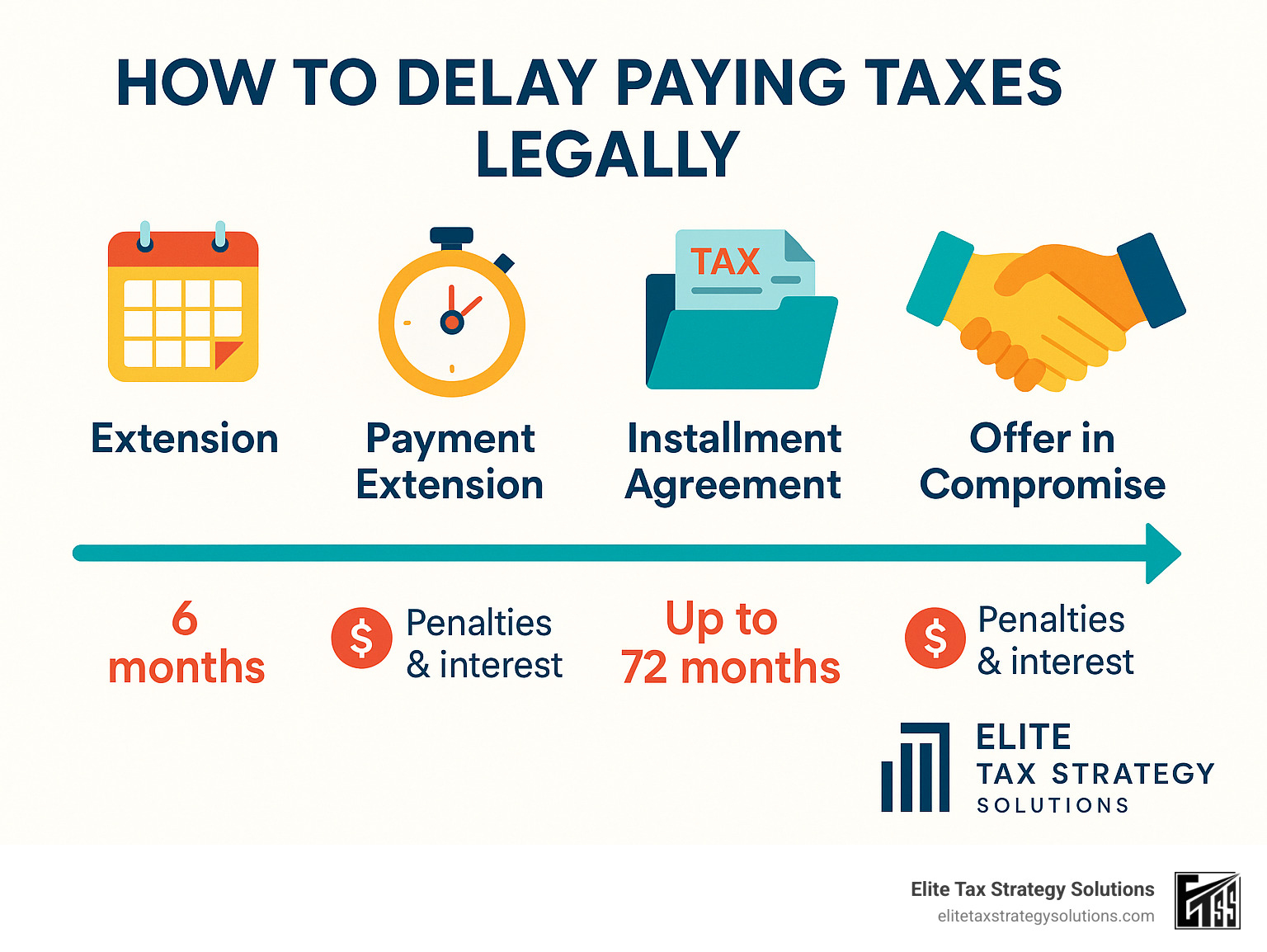
How to delay paying taxes legally comes down to a few key strategies:
- File an extension (Form 4868) – Gives you until October 15 to file your return
- Request a 180-day payment extension – No setup fee, but penalties and interest still apply
- Set up an installment agreement – Spread payments over up to 72 months
- Apply for an Offer in Compromise – Settle for less than you owe if you qualify
- Request “Currently Not Collectible” status – Temporary pause if you can prove financial hardship
It’s that dreaded time of year when the tax deadline looms large, and your bank account seems to shrink in anticipation. If you’re facing a tax bill that you simply can’t pay right now, you’re not alone. While the IRS expects payment by the filing deadline (typically April 15), there are legitimate ways to buy yourself more time.
First, understand this crucial distinction: delaying filing your tax return is different from delaying payment of taxes owed. Filing late without an extension triggers steep penalties of 5% per month (up to 25%), while late payment penalties are just 0.5% monthly (also capped at 25%). The IRS also charges interest, currently around 7% annually, which compounds daily.
The good news? The IRS offers several programs designed specifically for taxpayers who need more time to pay. These range from short-term extensions to long-term payment plans, and in some cases, even settlement options for those facing genuine financial hardship.
I’m David Fritch, a CPA with over 40 years of experience helping clients understand how to delay paying taxes legally while minimizing penalties and interest through my firm Elite Tax Strategy Solutions, where we specialize in creating customized tax strategies for high-income earners and business owners seeking to optimize their tax positions.
Must-know how to delay paying taxes terms:
– tax planning process
– tax optimization strategies
– proactive tax planning opportunities
How to Delay Paying Taxes Legally: The Ground Rules
Let’s talk about what you really need to know before exploring ways to delay your tax payments. Think of the IRS like that friend who’s happy to be flexible—but only if you follow their rules first!
The IRS operates on a “pay-as-you-go” system, which means taxes are technically due throughout the year as you earn income, not just when you file. This is why you have withholding from your paychecks or make quarterly estimated payments if you’re self-employed.
When April rolls around and you’re feeling the pinch, it’s important to understand what options actually buy you time. Form 4868 (that’s your automatic extension form) gives you until October 15 to file your paperwork—a full six months of breathing room. But here’s the catch that trips up so many of my clients: this extension only gives you more time to file the forms, not more time to pay what you owe.
For those of you living or working abroad, there’s a nice little bonus—an automatic two-month extension until June 15 without filing any special forms. And if you’ve been affected by a natural disaster (and trust me, the IRS does have a heart), you might qualify for extended deadlines through FEMA disaster declarations.
Now for the part nobody likes talking about—what happens when you don’t pay on time? The IRS will charge a failure-to-pay penalty of 0.5% per month (capped at 25%) plus interest on your unpaid balance at the federal short-term rate plus 3% (currently around 7% annually). That interest compounds daily, which can add up faster than you might expect.
If you’re considering your options, the IRS Free File extension guide walks you through requesting that filing extension electronically without spending a dime.
Does a Filing Extension Delay Paying Taxes? – how to delay paying taxes
I can’t tell you how many times I’ve had this conversation with worried clients who come into our Jasper office thinking they’ve bought themselves more time to pay by filing an extension. Let me be crystal clear: a filing extension does not extend the time to pay your taxes.
This misconception is so common that I sometimes wish the IRS would rename Form 4868 to “Application for Extension of Time to File Only—You Still Need to Pay!”
Even with that extension safely filed, you still need to estimate what you owe and pay as much as possible by the original April 15 deadline to avoid those penalties and interest I mentioned. The extension only gives you more time to gather documents, organize receipts, and complete the paperwork.
Here’s what we typically help our clients do:
– Estimate their tax liability using last year’s return as a starting point
– Factor in any major life changes (new job, house purchase, etc.)
– Pay as much as they possibly can by the deadline
– Even partial payments help reduce penalties
One bright spot in all this—making even a partial payment by the deadline can significantly reduce what you’ll owe in penalties later, since those penalties are calculated on the unpaid amount.
Penalties and Interest 101
Understanding what delaying your tax payment will actually cost you is crucial for making smart financial decisions. Think of it as the “price tag” for buying more time.
The IRS has two main penalties that can apply:
-
Failure-to-file penalty: This is the big one at 5% of unpaid taxes per month, up to 25%. This is why filing, even if you can’t pay, is so important.
-
Failure-to-pay penalty: This is much smaller at 0.5% of unpaid taxes per month, also capped at 25%.
If both penalties hit you in the same month, the IRS caps the combined penalty at 5%. On top of these penalties, interest compounds daily at the federal short-term rate plus 3% (currently about 7% annually).
To put this in real dollars, let’s look at what happens with a $10,000 tax bill:
| Scenario | 3 Months Late | 6 Months Late | 12 Months Late |
|---|---|---|---|
| Late filing, late payment | $1,550 | $3,175 | $6,675 |
| On-time filing, late payment | $150 | $300 | $600 + interest |
The difference is dramatic! Filing on time but paying late costs a fraction of what you’d pay by missing the filing deadline altogether. This is why I always tell my clients: “File your return even if you have to send it with an IOU.”
The bottom line? Understanding these ground rules helps you make strategic decisions about how to delay paying taxes while minimizing the extra costs. Even when you need more time to pay, following the proper procedures can save you thousands.
Short-Term Tactics: Extensions, 180-Day Plans & Beyond
Need a little breathing room with your tax bill? You’re not alone. When cash flow is tight but you expect to have funds available within a few months, these short-term strategies can be your financial lifeline.
I’ve seen clients panic when they realize they can’t pay their taxes by April 15th, but there’s good news – the IRS actually offers several reasonable options for temporary relief.
IRS Form 4868 & 180-Day Payment Extension – how to delay paying taxes
First things first – file something by the deadline! Whether it’s your completed return or Form 4868 for an extension, meeting the filing deadline helps you avoid that hefty 5% per month failure-to-file penalty.
The simplest way to request an extension is electronically:
“I remember helping a client last year who was frantically searching for missing documents the week before Tax Day,” says David Fritch, CPA. “We filed Form 4868 electronically through the IRS Free File program, which gave her until October to gather everything properly.”
When e-filing your extension, take advantage of the “pay online and check the box” option. This allows you to make even a partial payment (which reduces future penalties) while simultaneously requesting your extension. Be sure to save that electronic confirmation number – it’s your proof if questions arise later.
Once you’ve filed, you can request the little-known 180-day payment extension through the IRS Online Payment Agreement application. This gem doesn’t require a setup fee or financial disclosure, and approval is typically quick.
Just remember – how to delay paying taxes legally doesn’t mean avoiding interest and penalties completely. The 0.5% monthly late-payment penalty and roughly 7% annual interest will continue accruing until you’re paid up. But that’s still far better than the alternative of not filing at all!
You can learn more about tax deferral strategies on our website at How to Defer Taxes.
State & Disaster Extensions
While we’ve covered federal extensions, don’t forget about your state taxes! This is where things get a bit more complicated, as each state marches to its own drummer.
Most states will match the federal October 15th extension for filing, but their payment requirements are all over the map. Some generously extend both filing and payment deadlines, while others insist on full payment by the original due date regardless of filing extensions.
“I had a client move from Indiana to California last year,” notes Fritch. “She was surprised to learn that California required a separate extension form, while Indiana automatically aligned with her federal extension.”
If you’ve been affected by a federally declared disaster, there’s a silver lining. The IRS typically provides automatic extensions for both filing and payment deadlines in disaster areas. While interest still accrues on unpaid balances, penalties are usually waived during the extension period.
For those living abroad, the IRS automatically grants a two-month extension until June 15th without requiring Form 4868. If you need more time beyond that, you can request an extension until October 15th. Qualifying expatriates claiming the Foreign Earned Income Exclusion may file Form 2350 for an even longer extension to meet residency requirements.
At Elite Tax Strategy Solutions, we keep track of these changing rules so you don’t have to. After all, how to delay paying taxes properly means understanding not just federal rules, but also the specific requirements in your state and any special circumstances that might apply to you.
Long-Term Solutions: Installment Agreements, Offers & Hardship Status
When short-term extensions aren’t enough, the IRS offers several long-term payment options. These solutions are designed for taxpayers who need months or years to pay their tax debt.

Streamlined & Guaranteed Installment Agreements
Let’s face it – sometimes you need more than a few months to catch up on your tax debt. That’s where installment agreements come in, allowing you to make manageable monthly payments instead of one painful lump sum.
If you owe $10,000 or less, you may qualify for a Guaranteed Installment Agreement. This is exactly what it sounds like – the IRS must grant your request if you meet certain conditions. You’ll need to have filed all your returns for the past five years, be able to pay everything within three years, and not have had another installment plan recently.
For larger debts up to $50,000, the Streamlined Installment Agreement gives you up to 72 months (that’s six years!) to pay. The beauty of this option is the simplified application process with minimal financial documentation required. You can even apply online through the Online Payment Agreement application from the comfort of your home.
The setup fees vary based on how you apply and how you’ll make payments. The smartest move is to set up direct debit payments and apply online – you’ll pay just $31 to set up the plan. Other methods can cost up to $225. If you’re facing financial hardship, you might qualify for reduced fees or even have them waived entirely.
Here at Elite Tax Strategy Solutions, we’ve helped countless clients in Jasper, Indiana and beyond steer these options. We’ve seen how the right installment agreement can transform overwhelming tax debt into a manageable monthly expense.
Offer in Compromise Basics
When you’re truly unable to pay your full tax debt, an Offer in Compromise (OIC) might be your best option. This program allows you to settle your tax debt for less than the full amount – sometimes significantly less. Think of it as the IRS’s version of debt settlement.
How to delay paying taxes through an OIC isn’t easy – the IRS accepts only about one-third of applications. You’ll need to prove one of three things: you can’t pay the full amount before the collection statute expires (usually 10 years), you don’t actually owe the tax, or paying would create extreme economic hardship.
The application process involves completing Form 656, paying a $205 application fee (waived for qualifying low-income taxpayers), making an initial payment, and providing detailed financial information on Form 433-A (OIC). The IRS will then calculate your “reasonable collection potential” based on your assets, income, expenses, and future earning potential.
I’ve personally helped clients reduce six-figure tax debts to manageable settlements through the OIC program. While it’s not for everyone, when it works, it can provide tremendous financial relief and a fresh start.
Temporary Delay of Collection
Sometimes you just need breathing room while you get back on your feet. If you’re facing genuine financial hardship, the IRS may place your account in “Currently Not Collectible” (CNC) status. This doesn’t make your tax debt disappear, but it does temporarily pause collection activities.
To request CNC status, you’ll need to contact the IRS (the number should be on your bill or notice) and complete Form 433-A or 433-F to document your financial situation. You’ll need to show that paying your tax debt would prevent you from covering basic living expenses like housing, utilities, food, and healthcare.
While your account is in CNC status, the IRS will suspend aggressive collection actions like levies and wage garnishments. You’ll get some breathing room, but there are important caveats: penalties and interest continue to grow, the IRS will periodically review your financial situation, and the 10-year collection statute continues to run.
I recently worked with a client who lost his job and faced serious health issues. By documenting his hardship and securing CNC status, we gave him the time he needed to focus on recovery without the stress of IRS collection actions. When his situation improved, we helped him transition to an affordable installment agreement.
At Elite Tax Strategy Solutions, we specialize in matching clients with the right long-term solution for their unique circumstances. Whether it’s structuring an installment agreement with affordable payments, pursuing an Offer in Compromise for significant savings, or documenting hardship for temporary relief, we’re here to help you find the path forward.
Strategic Deferral Techniques for Individuals & Businesses
Beyond IRS payment programs, there are legitimate strategies to defer tax liabilities through timing of income and deductions. These approaches can be particularly valuable for business owners and self-employed individuals.

Defer Income & Accelerate Deductions
The timing of when you recognize income and take deductions can make a world of difference in your tax situation. It’s like having a time machine for your money—legally pushing income into next year while pulling deductions into this one.
If you’re a cash-basis taxpayer (as most individuals and small businesses are), you have some flexibility. Hold off on sending those December invoices until the last days of the month so payment arrives in January. I’ve had clients save thousands by simply waiting a week to bill their customers.
You can also prepay deductible expenses before the ball drops on New Year’s Eve. Need office supplies or equipment? Buy them in December instead of January. There’s even a little-known “mail-date rule” that lets you claim deductions in the year you mail a check, even if it’s not cashed until the following year. Just don’t drop those envelopes in the mail on December 31st—the postmark matters!
For those using accrual-basis accounting, the game changes slightly. You’ll want to delay events that trigger income recognition until the calendar flips, while ensuring both liability and economic performance for expenses are completed before year-end.
Section 179 expensing is another powerful tool in your belt. Instead of depreciating equipment purchases over years, you can deduct up to $1,220,000 in 2024 all at once. I’ve seen this transform tax situations for growing businesses in Jasper who invested in new equipment.
Want to dive deeper into income deferral strategies? Check out our detailed guide at How to Defer Income to Next Year.
Retirement & Investment Accounts for Tax Deferral
Retirement accounts aren’t just for retirement—they’re tax shelters hiding in plain sight. When you contribute to traditional retirement accounts, you’re essentially telling the IRS, “Not today, thanks!” on a portion of your income.
Traditional IRAs allow contributions up to $7,000 for 2025 ($8,000 if you’re 50+), while SEP-IRAs let self-employed folks contribute up to 25% of their net income, maxing out at a generous $69,000 for 2024.
For the self-employed superstars, a Solo 401(k) offers the best of both worlds—employee contributions up to $23,000 plus employer contributions to a combined total of $69,000. I recently helped a Jasper consultant slash her tax bill by $15,000 through maximizing her Solo 401(k).
Don’t overlook the triple-threat Health Savings Account (HSA). It’s the unicorn of tax accounts—contributions are tax-deductible, growth is tax-free, and withdrawals for medical expenses come out tax-free. That’s three layers of tax benefits in one account!
Beyond retirement accounts, annuities let earnings grow tax-deferred until withdrawal, while cash-value life insurance offers similar tax-deferred growth with tax-free death benefits. Executives might explore Non-Qualified Deferred Compensation (NQDC) Plans to push current income into future, potentially lower-tax years.
Curious about borrowing from your retirement plan? The IRS retirement topics page explains the rules without the confusing jargon.
Capital Gains Deferral Moves
When it comes to investments, patience pays—literally. Hold investments for more than a year to qualify for those sweet long-term capital gains rates (0%, 15%, or 20% depending on your income). For single taxpayers with taxable income below $47,025 in 2024, that rate drops to zero. Yes, zero!
Having a bad year in the market? Make lemonade from lemons by harvesting tax losses. Sell underwater investments to offset capital gains and up to $3,000 of ordinary income. I’ve seen clients turn market downturns into tax advantages that softened the blow considerably.
Real estate investors have special tools in their kit. The 1031 exchange lets you defer capital gains taxes by rolling proceeds from one investment property into another “like-kind” property. It’s like playing Monopoly with the tax code, trading properties without the tax hit.
If you’re selling a business or property, consider an installment sale to spread the gain—and the tax bill—over multiple years. This strategy works particularly well when you’re nearing retirement and expect lower income in future years.
The 2017 Tax Cuts and Jobs Act introduced Opportunity Zone investments, allowing investors to defer and potentially reduce capital gains taxes by putting money into designated economically distressed communities. It’s a chance to do good while doing well on your taxes.
For philanthropically-minded folks, charitable remainder trusts offer a way to transfer appreciated assets, receive income for life, and defer capital gains taxes while supporting your favorite causes.
At Elite Tax Strategy Solutions, we help our high-net-worth clients steer these capital gains deferral strategies as part of a comprehensive tax plan. After all, it’s not just about how to delay paying taxes—it’s about strategically timing when and how you pay them to keep more of what you’ve earned.
Communication & Risk Management with the IRS
Effectively managing your relationship with the IRS is crucial when delaying tax payments. Proactive communication and thorough documentation can help you avoid additional complications.

Best Practices for Contact & Documentation
Let’s face it—nobody looks forward to talking with the IRS. But when you’re delaying tax payments, reaching out before they reach for you can make all the difference.
I always tell my clients at Elite Tax Strategy Solutions that proactive communication is your best defense. Don’t wait for those intimidating notices to start arriving in your mailbox. Instead, call the IRS at 800-829-1040 to discuss your situation before it escalates. The person on the other end of the line is human too, and they’re often more helpful when you take the initiative.
Documentation is your lifeline when navigating IRS waters. After any phone conversation, jot down the date, time, the name of the representative, and what was discussed. Those confirmation numbers they provide? Write them down immediately—they’re worth their weight in gold if questions arise later.
When sending anything important to the IRS, certified mail with return receipt is your friend. Yes, it costs a few dollars more, but the peace of mind is priceless. I’ve seen too many clients face unnecessary stress because they couldn’t prove the IRS received their documents.
If you’ve set up a direct debit installment plan (which I highly recommend for the reduced fees), mark those payment dates on your calendar and ensure your bank account has sufficient funds. A missed payment can default your entire agreement, sending you back to square one.
For many taxpayers, especially those with complex situations, professional representation makes sense. Form 2848 (Power of Attorney) allows us to speak directly with the IRS on your behalf, saving you time and potential headaches. Think of it as having a translator who speaks fluent “IRS.”
Don’t forget about the Taxpayer Advocate Service—they’re the unsung heroes within the IRS who can help when standard procedures aren’t working or if you’re experiencing genuine financial hardship. They’re independent and focused solely on resolving your problems.
Audit Risk & Cash-Flow Considerations
When implementing strategies on how to delay paying taxes, it’s important to balance immediate relief with long-term risk management.
Certain behaviors can raise red flags that increase your audit risk. Excessive deductions relative to your income level might seem tempting, but they can invite unwanted scrutiny. Similarly, inconsistencies between your tax return and information returns (like W-2s or 1099s) practically send an invitation for the IRS to take a closer look.
I’ve helped clients steer some challenging situations, but I always steer them away from abusive tax shelters or listed transactions. The short-term benefit isn’t worth the long-term pain—these schemes are actively monitored by the IRS and can lead to substantial penalties.
Smart cash-flow planning is essential when delaying tax payments. Beyond the original tax liability, budget for penalties and interest that will continue to accrue. At current rates, that’s about 0.5% per month in penalties plus 7% annual interest compounded daily—costs that can add up quickly.
That the IRS generally has 10 years from the date of assessment to collect tax debt—what’s known as the collection statute expiration date (CSED). However, certain actions like filing bankruptcy or submitting an Offer in Compromise can pause this clock, extending the time the IRS has to collect.
One often-overlooked strategy is to reassess your W-4 withholding to prevent future payment issues. Adjusting your withholding now can help ensure you’re not in the same position next tax season.
Tax laws change frequently, sometimes dramatically. What works as a deferral strategy today might not be available tomorrow. At Elite Tax Strategy Solutions, we keep our finger on the pulse of tax legislation to help clients adapt their strategies accordingly.
The goal isn’t just to delay taxes—it’s to create a sustainable plan that addresses your current constraints while building toward long-term financial stability. With careful planning and open communication with the IRS, you can steer tax payment challenges while minimizing penalties and stress.
Frequently Asked Questions about Delaying Tax Payments
What happens if I file but can’t pay?
We hear this question all the time at our office in Jasper. The good news? Filing your return on time—even without full payment—is absolutely the right move. When you file but can’t pay, the IRS simply sends you a bill for the balance due.
You’ll face the failure-to-pay penalty (0.5% monthly) and interest (around 7% annually), but you’ll avoid the much steeper failure-to-file penalty of 5% per month. Think of it this way: filing without paying costs roughly one-tenth what not filing costs!
To minimize the financial impact, I always recommend these steps to my clients:
First, pay whatever you can when filing—even a partial payment reduces the base amount subject to penalties. Second, consider requesting that 180-day payment extension we discussed earlier (it’s quick and has no setup fee). Third, compare the combined IRS interest and penalties (roughly 13% annually) against your other borrowing options like personal loans or credit cards—sometimes those alternatives are actually cheaper.
The IRS would rather have you file and make arrangements than disappear off their radar. They’re surprisingly reasonable when you’re proactive.
How do I qualify for an Offer in Compromise?
An Offer in Compromise (OIC) is like the holy grail of tax resolution—settling your tax debt for less than you owe. But I’ll be straight with you: the IRS doesn’t approve these easily. Only about one-third of applications succeed.
To have a realistic shot at approval, you need to meet several baseline requirements. You must have filed all required tax returns and made all required estimated tax payments for the current year. Business owners with employees must be current on federal tax deposits. And you can’t be in an open bankruptcy proceeding.
Beyond these basics, you’ll need to demonstrate one of three conditions:
Doubt as to Collectibility – You simply cannot pay the full amount before the collection statute expires. This is the most common qualification route.
Doubt as to Liability – You have legitimate reason to believe you don’t actually owe the tax. This is relatively rare.
Effective Tax Administration – You could technically pay the full amount, but doing so would create severe economic hardship or would be fundamentally unfair due to exceptional circumstances.
The IRS evaluates your “reasonable collection potential” by looking at your assets (with quick-sale discounts applied) and your future income after allowing for necessary living expenses. They consider how much time remains on the 10-year collection statute.
I’ve helped many clients successfully steer the OIC process over my 40 years in practice. Having professional representation significantly boosts your approval chances because we understand exactly how to present your financial situation in the most favorable light while remaining completely truthful.
Are payment plans available for state taxes?
Yes, absolutely. While we’ve focused primarily on IRS strategies in this article, most states offer payment plans similar to federal installment agreements. However—and this is important—the terms vary significantly from state to state.
Here in Indiana, our state Department of Revenue offers several payment plan options, but the terms are generally less flexible than federal plans. Other states have their own unique requirements regarding:
Application methods (some states require paper forms while others have online portals), maximum repayment periods (typically shorter than the IRS’s 72-month maximum), interest rates (often higher than federal rates), financial disclosure requirements, and down payment thresholds.
One thing I always emphasize to clients at Elite Tax Strategy Solutions: if you owe both federal and state taxes, you’ll need separate payment arrangements with each taxing authority. Some states actually require proof of your federal payment plan before they’ll approve a state installment agreement.
The good news is that most states are motivated to work with taxpayers rather than push them into financial hardship. At our firm, we help clients create comprehensive strategies that address both federal and state tax obligations, ensuring all bases are covered while preserving cash flow and minimizing penalties.
Don’t hesitate to reach out if you’re facing state tax issues—we’ve helped clients with tax authorities in Indiana and numerous other states find manageable solutions to seemingly overwhelming tax problems.
Conclusion
How to delay paying taxes legally isn’t about avoiding your obligations – it’s about finding breathing room when you need it while staying on the right side of the law. Throughout this guide, we’ve walked through various strategies that can help you manage your tax burden when cash is tight.
The foundation of any tax delay strategy is filing your return on time, even if you can’t pay a dime. This simple step saves you from the harsh 5% monthly failure-to-file penalty, which can quickly snowball into serious debt.
For immediate relief, the IRS’s 180-day extension gives you six months of breathing room with no setup fee. If you need longer, installment agreements let you spread payments over up to 72 months, making your tax bill more manageable with predictable monthly payments.
For those facing genuine financial hardship, an Offer in Compromise might allow you to settle for less than you owe. While approval isn’t guaranteed, it can be life-changing for those who qualify. Similarly, strategic tax deferral techniques like timing your income and deductions can significantly reduce your current-year tax burden.
Don’t overlook retirement accounts as tax deferral vehicles. Beyond building your nest egg, contributions to traditional IRAs, 401(k)s, and similar accounts reduce your taxable income today while helping secure your future.
While these approaches can provide valuable flexibility, they’re not “get out of jail free” cards. Most still involve penalties and interest until your balance is paid. The key is finding the right balance between short-term relief and long-term financial health.
Here at Elite Tax Strategy Solutions in Jasper, Indiana, we specialize in creating personalized tax strategies for high-income earners and business owners. We don’t just react to tax problems – we help prevent them through proactive planning custom to your specific situation.
Tax challenges can feel overwhelming, but you don’t have to face them alone. Our team brings decades of experience helping clients steer complex tax situations while maintaining their financial stability and peace of mind.
Ready to take control of your tax situation? Visit our page on Innovative Tax Planning to learn more about how we can help you develop a tax strategy that works for your unique circumstances.
