
Strategic Tax Planning for High-Net-Worth Individuals
Advanced tax planning strategies are essential for high-net-worth individuals seeking to reduce their tax liabilities and protect their wealth. By leveraging specific techniques, you can help preserve more of your earnings and ensure a seamless transfer of wealth to future generations.
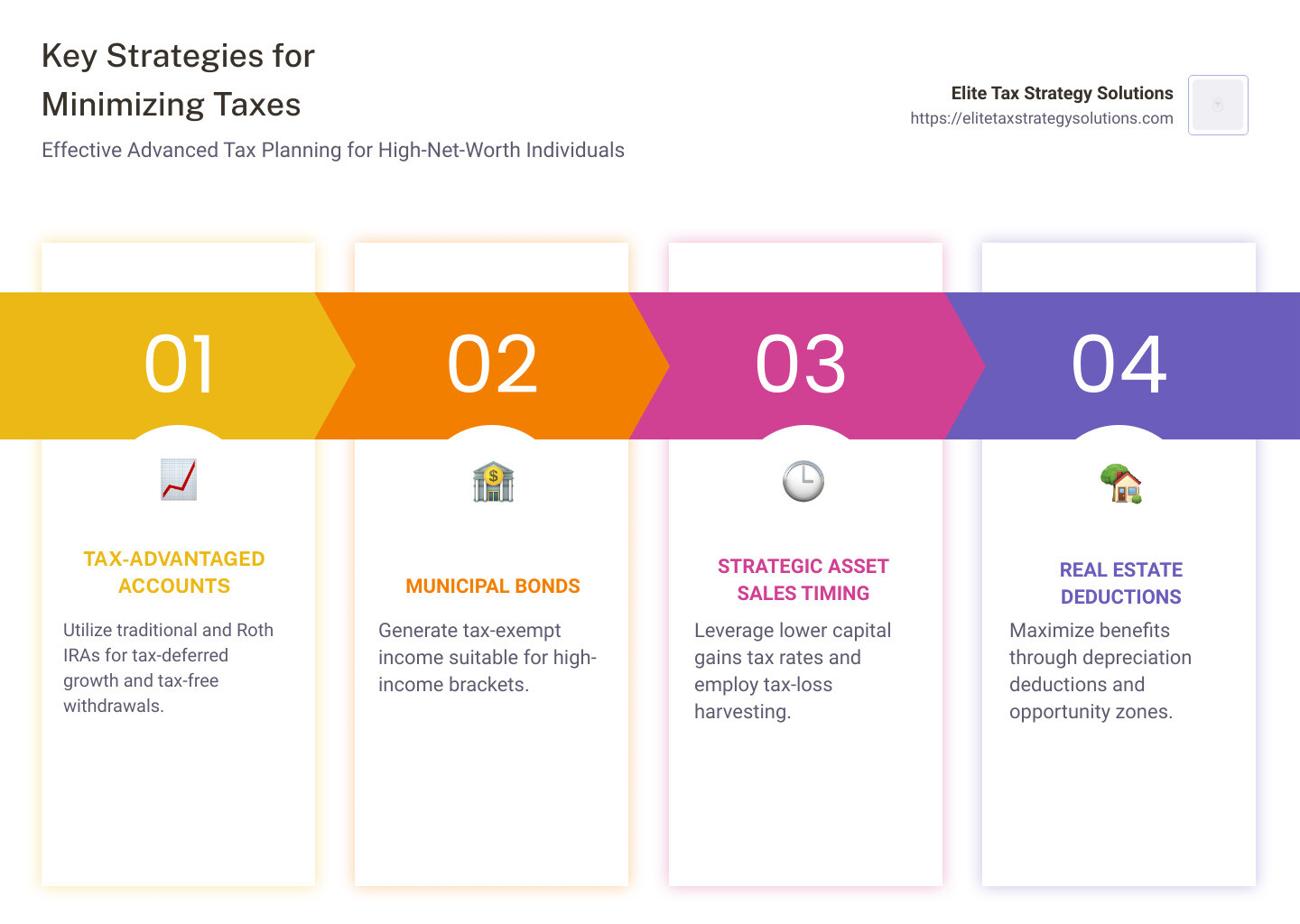
Key Strategies for Minimizing Taxes:
- Tax-advantaged accounts: Use traditional and Roth IRAs for tax-deferred growth and tax-free withdrawals.
- Municipal bonds: Generate tax-exempt income suitable for high-income brackets.
- Strategic asset sales timing: Leverage lower capital gains tax rates and employ tax-loss harvesting.
- Real estate deductions: Maximize benefits through depreciation deductions and opportunity zones.
I’m David Fritch, an expert in advanced tax planning strategies with over 40 years of experience in tax and law. I’m dedicated to helping high-income earners and small business owners achieve financial stability and optimize their tax savings.
Easy advanced tax planning strategies glossary:
– high net worth tax strategies
– retirement tax strategies for high income earners
– tax advice for high earners
Deciphering the Tax Landscape
Navigating the intricate world of tax laws can be challenging, especially for high-net-worth individuals. Understanding the evolving tax landscape is crucial for effective tax planning. Let’s break down the key elements you need to know.
Evolving Federal Legislation
Federal tax laws are constantly changing, and staying updated is essential. Recent adjustments in income tax brackets can significantly impact your near-term tax liabilities. For instance, shifts in federal income tax brackets can either increase or decrease the amount of tax you owe each year.
Another critical area is capital gains tax. Proposed changes to long-term capital gains tax rates and income thresholds could influence your investment strategies. For example, if the rates increase, you might want to reconsider the timing of your asset sales.
The federal gift and estate tax exemption is another area to watch. Currently, the exemption is over $13 million per individual. However, there’s ongoing uncertainty about its future, making legacy and philanthropic transfer planning more complex.
Global Taxation
For those with multinational investments or business activities, global taxation adds another layer of complexity. Laws like FATCA (Foreign Account Tax Compliance Act) require detailed reporting of foreign assets to the IRS. Non-compliance can result in severe penalties.
Double taxation agreements (DTAs) between countries are designed to prevent the same income from being taxed twice. Leveraging DTAs effectively requires a deep understanding of treaty specifics and careful structuring of your assets and accounts.
Example:
Imagine you have investments in both the U.S. and Germany. Without a DTA, you could end up paying tax on the same income in both countries. However, by understanding the DTA between the U.S. and Germany, you can significantly reduce your tax burden.
Key Areas Affected by Tax Legislation:
- Income Tax Brackets: Changes can increase or decrease your annual tax bill.
- Capital Gains Tax: Timing of asset sales can be crucial.
- Gift and Estate Tax Exemption: Plan for potential changes to maximize benefits.
Multinational Investments and IRS Reporting
If you hold investments across multiple countries, you’re subject to different tax laws and reporting requirements. FATCA has intensified these reporting demands, making it essential to stay compliant to avoid penalties.
Double Taxation Agreements (DTAs) can help mitigate the risk of being taxed twice on the same income. By understanding and leveraging these agreements, you can optimize your global tax strategy.
Case Study:
A client with significant investments in both the U.S. and Canada was able to use the DTA between the two countries to avoid double taxation. This saved them thousands of dollars annually.
By understanding the evolving federal legislation and the complexities of global taxation, you can make informed decisions to minimize your tax liabilities and protect your wealth.
Next, we’ll explore advanced tax planning strategies to further optimize your financial situation.
Advanced Tax Planning Strategies
Tax-Advantaged Accounts
Tax-advantaged accounts are a cornerstone of advanced tax planning strategies. They offer powerful ways to grow your wealth while minimizing tax liabilities. Let’s break down two key types: Traditional IRAs and Roth IRAs.
Traditional IRAs allow for tax-deferred growth. This means you don’t pay taxes on your investment gains each year. You only owe taxes when you withdraw the money, ideally when you’re in a lower tax bracket during retirement. For example, if you contribute $6,000 annually to a Traditional IRA, that amount grows tax-free until you take it out.
Roth IRAs, on the other hand, are funded with after-tax dollars. The significant advantage here is that both the growth and withdrawals are tax-free, provided certain conditions are met. This creates a source of tax-free income in retirement. Imagine contributing $6,000 to a Roth IRA every year for 20 years. The growth on these contributions can be substantial, and you won’t pay any taxes on the withdrawals.
Municipal Bonds
Municipal bonds, or “munis,” are another excellent tool for high-net-worth individuals looking to minimize taxes. The interest you earn from municipal bonds is generally exempt from federal income tax and, in some cases, state and local taxes as well.

For those in higher income brackets, this tax-exempt status can make a big difference. However, it’s important to note that municipal bonds often offer lower nominal yields compared to taxable bonds. The trade-off is the tax savings, which can make the overall return more attractive.
Strategic Timing of Asset Sales
Timing is everything when it comes to selling appreciated assets. Capital gains tax can significantly impact your investment returns. By selling assets in years when you expect to be in a lower tax bracket, you can take advantage of lower long-term capital gains tax rates.
Another tactic is tax-loss harvesting. This involves selling investments at a loss to offset gains from other investments, reducing your overall tax liability. However, be mindful of the IRS wash sale rules, which disallow claiming a loss if you buy the same or a substantially identical security within 30 days before or after the sale.
Real Estate Deductions and Credits
Real estate offers numerous opportunities for tax deductions and credits. For instance, you can take advantage of depreciation deductions on rental properties. This allows you to deduct the cost of the property over its useful life, reducing your taxable income.
Investing in opportunity zones is another strategy. These are designated areas where investments can qualify for significant tax incentives, including deferrals and exclusions of capital gains.
Finally, consider energy efficiency credits. If you make energy-efficient improvements to your property, you may qualify for various federal and state tax credits. This not only reduces your tax bill but also increases the value of your property.
By leveraging these advanced tax planning strategies, you can significantly minimize your tax liabilities and optimize your financial situation. Next, we’ll dig into transferring wealth and how to strategically plan for your legacy.
Transferring Wealth
Transferring wealth efficiently is crucial for high-net-worth individuals. Proper planning can minimize taxes and ensure a smooth transition of assets to future generations. Here are some advanced strategies to consider.
Strategic Trusts
Trusts are powerful tools for wealth transfer. They come in various forms, each with unique benefits.
Irrevocable Life Insurance Trusts (ILITs) are a popular choice. Once set up, they cannot be altered, but they keep high-value life insurance policies out of the taxable estate. For example, premium payments made to the ILIT escape gift and estate taxes, allowing heirs to receive substantial tax-free payouts. This makes ILITs a smart move for reducing estate taxes.
Grantor Retained Annuity Trusts (GRATs) allow the grantor to retain some income while transferring the future appreciation of assets to beneficiaries, bypassing estate taxes. This is ideal for assets expected to appreciate significantly.
Gifting
Gifting is another effective strategy. The annual gift tax exclusion allows individuals to gift up to $18,000 per person per year without triggering gift taxes. This can add up quickly if you have multiple recipients.
Additionally, you can leverage the lifetime gift tax exemption, which is currently $13.61 million per individual. This allows for significant wealth transfer without incurring gift taxes, making it a cornerstone of many advanced tax planning strategies.
Life Insurance
Life insurance policies like whole life and universal life can also minimize taxes. These policies offer tax-deferred growth and tax-free death benefits. By integrating life insurance into your overall wealth management plan, you can achieve significant tax savings.
Charitable Strategies
Charitable giving not only supports causes you care about but also offers substantial tax benefits.
DAFs vs. Foundations
Donor-Advised Funds (DAFs) provide immediate tax deductions and flexible granting options without administrative burdens. This makes them a convenient choice for many donors.
In contrast, private foundations offer greater control over charitable activities but come with higher costs and stricter deduction limits. Both options have their merits, depending on your philanthropic goals.
Charitable Trusts
Charitable Remainder Trusts (CRTs) provide income to the donor with the remainder going to charity. This setup can increase your tax deductions and savings.
Charitable Lead Trusts (CLTs), on the other hand, donate upfront and pass the remaining assets to heirs, reducing estate taxes. Both types of trusts integrate charitable giving into your tax planning strategy effectively.
By combining these advanced strategies, you can transfer wealth efficiently while minimizing tax liabilities. Next, we’ll explore advanced tax reduction approaches that can further optimize your financial situation.
Advanced Tax Reduction Approaches
When it comes to reducing taxes, high-net-worth individuals have several advanced tax planning strategies at their disposal. Let’s explore some key methods that can significantly lower your tax burden.
Captive Insurance
Creating a captive insurance company can be a game-changer for those with substantial business risks. Essentially, you set up your own insurance company to cover risks unique to your business. This approach offers several benefits:
- Tax Deductions: Premiums paid to the captive insurance company are typically tax-deductible, reducing your overall taxable income.
- Self-Insurance: You have more control over the insurance policies, tailoring them to meet specific needs.
- Asset Protection: Funds within the captive are protected from creditors, adding an extra layer of security.
For example, one of our clients, an online marketing expert, established a captive insurance policy to protect against litigation risks. This not only provided peace of mind but also resulted in significant tax savings.
Conservation Easements
For those with significant land holdings, conservation easements offer a unique way to achieve both philanthropic and financial goals. By donating a perpetual conservation easement, you restrict future development rights while preserving the land’s ecological or historical characteristics.
- Income Tax Deductions: Properly structured easement contributions can generate substantial one-time income tax deductions.
- Ecological Preservation: You contribute to the preservation of valuable natural resources, which can also improve your legacy.
A high-net-worth landowner who donated a conservation easement on their 500-acre property not only protected the land for future generations but also received a significant tax deduction, aligning with their philanthropic goals.
QSBS Exclusions
Investing in Qualified Small Business Stock (QSBS) can offer substantial tax benefits under Section 1202 of the U.S. tax code. If you hold the stock for more than five years, you may be eligible to exclude up to 100% of the capital gains from taxable income.
- Capital Gains Tax Treatment: This provision incentivizes investment in startups and young companies, presenting an attractive tax planning option.
- Significant Savings: For example, a corporate client leveraged Section 1202 and saved approximately $400,000 in taxes on a $900,000 gain.
Incorporating QSBS into your investment strategy can be a powerful tool for both supporting innovation and minimizing tax liabilities.
By understanding and utilizing these advanced tax reduction approaches, you can significantly improve your financial well-being. Next, we’ll address some frequently asked questions about these strategies to provide further clarity.
Frequently Asked Questions about Advanced Tax Planning Strategies
What are the tax strategies for ultra high net worth individuals?
Ultra high net worth individuals often face complex tax challenges. Here are some key strategies to consider:
-
Annual Gift Tax Exclusion: You can give up to $17,000 per person per year without incurring any gift tax. This allows you to reduce your estate’s value while providing financial support to loved ones.
-
Lifetime Gift Tax Exemption: The IRS allows a lifetime exemption of over $13 million per individual. This means you can gift significant amounts without paying gift tax, although it will reduce your estate tax exemption.
-
Charitable Giving: Donating to charities can provide substantial income tax deductions. Strategies include donor-advised funds and charitable trusts, which offer immediate tax benefits and greater control over how your donations are used.
-
Trusts: Establishing various types of trusts, such as irrevocable life insurance trusts (ILITs) and grantor retained annuity trusts (GRATs), can help manage and transfer wealth while minimizing tax liabilities.
What is a qualified tax planning strategy?
A qualified tax planning strategy is one that is both prudent and feasible. It should comply with tax laws and regulations while effectively achieving your financial goals. Here are some key elements:
-
ASC 740-10-55-39: This accounting standard guides the recognition and measurement of tax positions. It ensures that tax benefits are recorded only when they are more likely than not to be sustained upon examination by tax authorities.
-
Management Implementation: Effective tax planning requires active management. This involves regular reviews and updates to your tax strategy to adapt to changes in tax laws and your financial situation.
How do high income earners reduce taxes?
High income earners have several options to reduce their tax burden. Here are some effective strategies:
-
Retirement Plan Contributions: Contributing to retirement accounts like 401(k), 403(b), and 457 plans can reduce your taxable income. These contributions are often tax-deferred, meaning you won’t pay taxes until you withdraw the funds in retirement.
-
Traditional and Roth IRAs: Contributions to traditional IRAs are tax-deductible, while Roth IRAs offer tax-free withdrawals in retirement. Both options provide significant tax advantages.
-
Tax-Advantaged Accounts: Utilizing health savings accounts (HSAs) and flexible spending accounts (FSAs) can offer tax benefits for medical expenses.
By leveraging these advanced tax planning strategies, high-income earners and ultra high net worth individuals can significantly reduce their tax liabilities and improve their financial stability.
Next, we’ll dig into more specific strategies for transferring wealth effectively.
Conclusion
At Elite Tax Strategy Solutions, we understand that advanced tax planning is more than just an annual task—it’s a continuous, personalized journey towards maximizing tax savings and ensuring financial stability.
Personalized Tax Planning
Every client’s situation is unique. That’s why we offer personalized tax planning services custom to your specific financial goals and circumstances. Our approach involves a thorough analysis of your financial landscape, ensuring we leverage every available tax-saving opportunity.
Maximizing Tax Savings
Our goal is simple: to help you keep more of what you earn. We employ a wide array of advanced tax planning strategies, from utilizing tax-advantaged accounts like IRAs and HSAs to implementing complex structures such as trusts and captive insurance companies. For instance, a client who set up a defined benefit plan saved around $80,000 in taxes while securing their retirement.
Ensuring Financial Stability
Tax planning is not just about reducing your tax bill today; it’s about securing your financial future. By integrating tax planning with your broader financial strategy, we help you achieve long-term objectives like retirement planning, wealth transfer, and charitable giving.
Contact Us Today
Ready to take control of your tax situation? Contact us today to schedule a consultation and find how our advanced tax planning strategies can benefit you and your family. Let’s build your enduring legacy together.
By working with Elite Tax Strategy Solutions, you can confidently steer the complexities of tax planning, knowing your strategy is designed to safeguard and improve your wealth. Our proactive, personalized approach ensures you are always ahead of the curve.