
Tax advice for high earners is crucial for anyone looking to maximize their financial stability and minimize their tax burdens. High-income individuals face unique challenges and opportunities when it comes to tax planning. To get you started, here are three key strategies to consider immediately:
- Maximize Retirement Contributions: Contributing to retirement accounts like 401(k)s and IRAs can significantly reduce your taxable income.
- Take Advantage of Tax-Efficient Investments: Investments like municipal bonds and index funds can help you grow your wealth with lower tax liabilities.
- Charitable Donations: Donating to charities not only supports good causes but also provides valuable tax deductions.
As a high earner, proactive tax planning is essential to ensure your long-term financial health. “This year should be a year of preparation,” advises Joe Goldman, a wealth planner at City National Bank. With potential legislative changes on the horizon, it’s more important than ever to have a strategic plan in place.
My name is David Fritch, and for over 40 years, I have been helping high-income earners steer the complex world of tax planning. With my experience as a CPA and investment advisor, I can provide you with custom, effective strategies to optimize your tax situation.
Tax advice for high earners word list:
– financial planning for high income earners
– extra medicare tax for high earners
– high net worth tax strategies
Understanding High-Income Tax Brackets
High-income earners face unique challenges and opportunities when it comes to taxes. Understanding federal tax brackets and marginal tax rates is crucial for effective tax planning.
Federal Tax Brackets
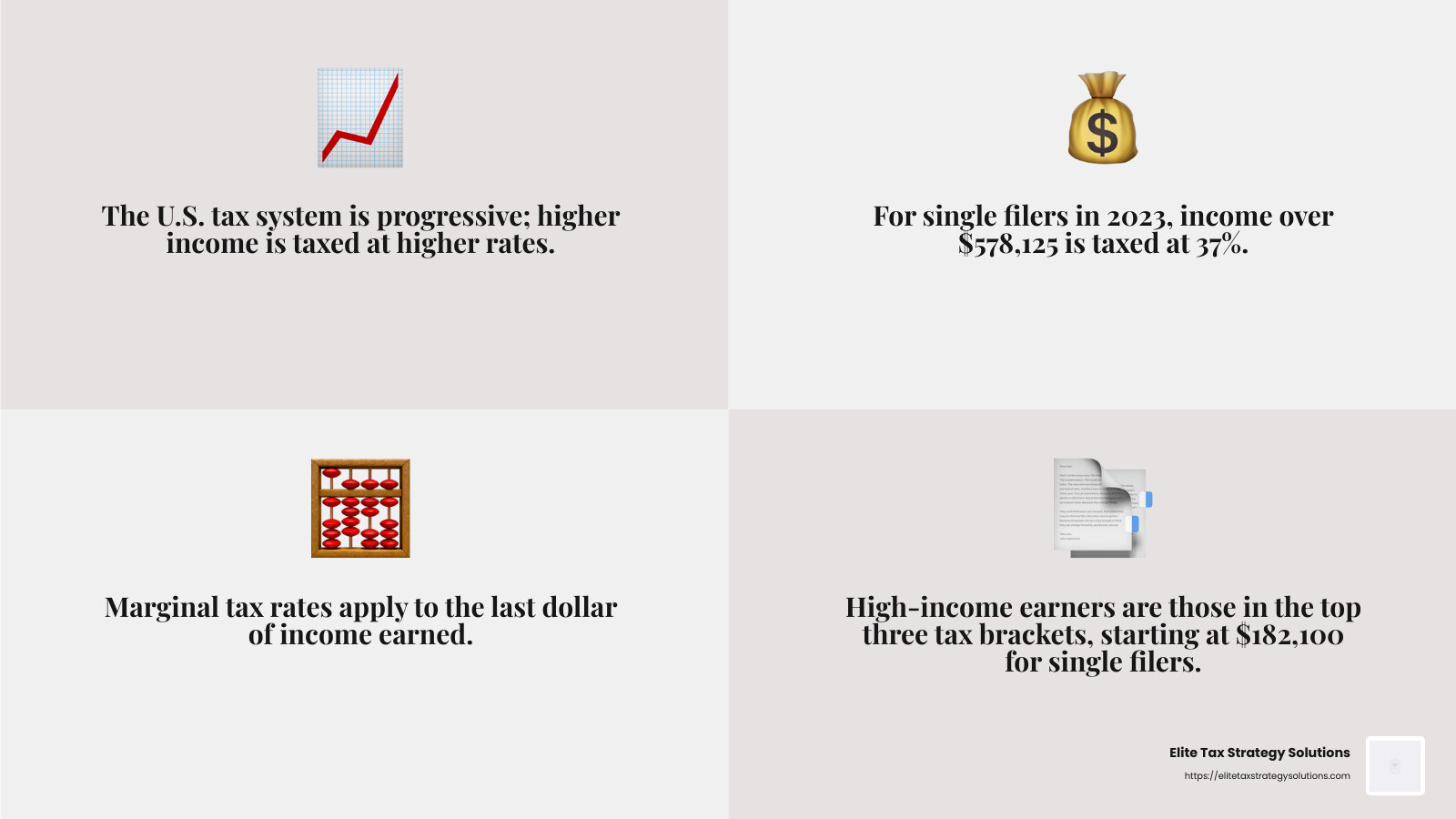
The U.S. tax system is progressive, meaning that higher income is taxed at higher rates. For 2023, here are the federal tax brackets for single filers:
| Taxable Income Range (USD) | Tax Rate (%) |
|---|---|
| 0 to 11,000 | 10% |
| 11,001 to 44,725 | 12% |
| 44,726 to 95,375 | 22% |
| 95,376 to 182,100 | 24% |
| 182,101 to 231,250 | 32% |
| 231,251 to 578,125 | 35% |
| 578,126+ | 37% |
Married couples filing jointly and heads of household have different brackets, but the principle is the same: higher income, higher rates.
Marginal Tax Rates
Your marginal tax rate is the rate you pay on your last dollar of income. For example, if you are a single filer with a taxable income of $200,000, your marginal tax rate is 32%. This doesn’t mean all your income is taxed at 32%. Instead, your income is divided across the brackets, with each portion taxed at its respective rate.
IRS Definitions
The IRS defines high-income earners as those who fall into the top three tax brackets. For single filers, this means earning more than $182,100. For married couples filing jointly, the threshold is $364,201.
Why It Matters
Understanding these brackets helps you plan better. For high earners, the goal is often to reduce taxable income to fall into a lower bracket. This can be achieved through various strategies like maximizing retirement contributions, charitable donations, and tax-efficient investments.
For example, Joe Goldman, a wealth planner at City National Bank, advises, “This year should be a year of preparation.” With potential legislative changes on the horizon, it’s more important than ever to have a strategic plan in place.
Next, let’s dive into some top tax strategies for high earners to help you steer these complex waters.
Top Tax Strategies for High Earners
Maximize Retirement Contributions
Contributing to retirement accounts is one of the most effective ways to reduce taxable income. 401(k) plans, Roth IRAs, SEP-IRAs, and Solo 401(k)s offer significant tax advantages.
-
401(k) Plans: Contributions are made with pre-tax dollars, which reduces your taxable income. For 2024, the maximum 401(k) contribution is $23,000. If you’re over 50, you can add an extra $7,500 in catch-up contributions.
-
Roth IRA: Contributions are made with post-tax dollars, but withdrawals during retirement are tax-free. This is great for tax diversification and planning for tax-free income in retirement.
-
SEP-IRA and Solo 401(k): These are excellent options for self-employed individuals. They allow for higher contribution limits, offering more opportunities to reduce taxable income.
Charitable Contributions
Charitable giving is another powerful tool for high earners to reduce their tax burden.
-
Donor-Advised Funds: These funds allow you to make a charitable contribution, receive an immediate tax deduction, and then recommend grants from the fund over time. This is particularly useful for bundling several years’ worth of donations into one tax year to maximize deductions.
-
Appreciated Assets: Donating appreciated stocks or other assets can help you avoid paying capital gains tax on the appreciation while still getting a charitable deduction for the full market value of the asset.
-
Charitable Trusts: Setting up a charitable remainder trust or a charitable lead trust can provide both income and estate tax benefits while supporting your favorite causes.
Roth IRA Conversions
Converting a traditional IRA to a Roth IRA can be a smart move, especially if you expect to be in a higher tax bracket in the future.
-
Tax-Free Withdrawals: Once the funds are in a Roth IRA, they grow tax-free, and withdrawals during retirement are also tax-free.
-
Backdoor Roth IRA: High earners can use this strategy to contribute to a Roth IRA even if their income exceeds the direct contribution limits. This involves contributing to a traditional IRA and then converting it to a Roth IRA.
-
Mega Backdoor Roth IRA: This is an even more powerful strategy for those with access to a 401(k) that allows after-tax contributions. You can contribute up to the total 401(k) limit and then convert those after-tax contributions to a Roth IRA.
Tax-Efficient Investments
Investing in a tax-efficient manner can significantly reduce your tax liability.
-
Index Funds and ETFs: These investment vehicles typically generate fewer taxable events compared to actively managed funds, making them more tax-efficient.
-
Municipal Bonds: The interest earned from municipal bonds is usually exempt from federal, state, and local taxes, making them an attractive option for high-income earners.
-
Asset Location: Placing income-generating assets in tax-advantaged accounts (like IRAs) and growth assets in taxable accounts can optimize your tax situation.
Business Ownership Deductions
Owning a business opens up numerous tax deduction opportunities.
-
Home Office: If you use part of your home exclusively for business, you can deduct a portion of your mortgage interest, utilities, and other expenses.
-
Business Expenses: Deducting ordinary and necessary business expenses like travel, supplies, and salaries can significantly reduce taxable income.
-
Restructuring Entities: Consider changing your business entity structure to a corporation or an LLC, which may offer more tax benefits depending on your specific situation.
By leveraging these strategies, high earners can significantly reduce their tax burden and keep more of their hard-earned money. Next, let’s dive into some advanced tax planning techniques that can further optimize your tax situation.
Advanced Tax Planning Techniques
When you’re a high earner, basic tax strategies might not be enough to keep your tax bill low. That’s where advanced tax planning techniques come in. These strategies can help you maximize your savings and manage your tax liabilities more effectively. Let’s explore some of the most effective methods: tax-loss harvesting, income deferral, Qualified Small Business Stock (QSBS), and investing in Opportunity Zones.
Tax-Loss Harvesting
Tax-loss harvesting is a strategy that helps you reduce your taxable income by selling investments at a loss to offset gains from other investments.
-
Capital Gains: When you sell an asset for more than you paid for it, you incur a capital gain, which is taxable. By selling other assets at a loss, you can offset these gains and reduce your overall tax liability.
-
Wash-Sale Rules: Be careful of the wash-sale rule, which prohibits you from buying the same or a substantially identical security within 30 days before or after the sale. Violating this rule means you can’t claim the tax loss.
Income Deferral
Timing is everything when it comes to taxes, and income deferral can help you manage when you recognize income, potentially reducing your tax liability.
-
Deferred Compensation: This allows you to defer a portion of your salary into a tax-advantaged account, reducing your current taxable income. You won’t pay taxes on this income until you withdraw it, ideally when you’re in a lower tax bracket.
-
Stock Options: If you have stock options, you can choose when to exercise them. By doing so strategically, you can control when you recognize the income, potentially deferring it to a more tax-efficient year.
-
Year-End Bonuses: If you expect a high-income year, consider deferring any bonuses or additional income to the following year. This can help smooth out your taxable income over multiple years and reduce your overall tax rate.
Qualified Small Business Stock (QSBS)
Investing in Qualified Small Business Stock can offer significant tax benefits, including partial or complete exclusion of capital gains.
-
Partial Exclusion: Under certain conditions, you can exclude up to 50% of the gain from the sale of QSBS, provided you hold the stock for more than five years.
-
Complete Exclusion: In some cases, you may be able to exclude 100% of the gain. This is a powerful incentive for investing in small businesses and can lead to substantial tax savings.
Investing in Opportunity Zones
Opportunity Zones are designated low-income areas where investments can qualify for special tax incentives.
-
Capital Gains Deferral: You can defer capital gains tax by investing in an Opportunity Zone Fund. The deferred gain won’t be recognized until the earlier of the date you sell your investment or December 31, 2026.
-
Long-Term Benefits: If you hold the investment for at least 10 years, you can potentially exclude any additional gains from the investment. This makes Opportunity Zones a compelling option for long-term investors looking to reduce their tax liabilities.
By leveraging these advanced tax planning techniques, high earners can significantly optimize their tax situation. Next, let’s answer some frequently asked questions about tax advice for high earners.
Frequently Asked Questions about Tax Advice for High Earners
What is the best way to reduce taxable income?
Reducing taxable income is crucial for high earners. Here are some effective strategies:
-
Maximize Retirement Contributions: Contributing to retirement accounts like a 401(k), SEP-IRA, or Solo 401(k) can significantly lower your taxable income. For instance, in 2024, you can contribute up to $23,000 to your 401(k) if you’re over 50.
-
Charitable Contributions: Donating to charity not only benefits the community but also provides tax deductions. Consider using donor-advised funds or donating appreciated assets to maximize your tax benefits.
-
Roth IRA Conversions: While contributions to a Roth IRA are made with post-tax dollars, the withdrawals are tax-free in retirement. This can be particularly advantageous if you expect to be in a higher tax bracket later.
-
Health Savings Accounts (HSAs): Contributions to an HSA reduce your taxable income, and the funds grow tax-free. Withdrawals for qualified medical expenses are also tax-free, providing triple tax benefits.
How can high earners minimize capital gains taxes?
Minimizing capital gains taxes can save high earners a substantial amount. Here are some strategies:
-
Tax-Loss Harvesting: Offset capital gains by selling investments at a loss. This strategy allows you to reduce your taxable income by the amount of the loss.
-
Invest in Opportunity Zones: Deferring capital gains by investing in Opportunity Zones can be beneficial. If you hold the investment for at least 10 years, you can potentially exclude additional gains from your taxes.
-
Qualified Small Business Stock (QSBS): Investing in QSBS can offer partial or complete exclusion of gains from the sale of the stock, provided you meet certain conditions, such as holding the stock for more than five years.
-
Use Tax-Advantaged Accounts: Place investments in tax-advantaged accounts like Roth IRAs or HSAs, where they can grow tax-free.
What are the benefits of a Roth IRA conversion?
Converting to a Roth IRA offers several benefits for high earners:
-
Tax-Free Withdrawals: Roth IRAs allow for tax-free withdrawals in retirement, which can be a significant advantage if you expect to be in a higher tax bracket.
-
No Required Minimum Distributions (RMDs): Unlike traditional IRAs, Roth IRAs do not have RMDs during the account holder’s lifetime. This means you can let the money grow tax-free for as long as you want.
-
Estate Planning: Roth IRAs can be passed on to heirs tax-free, providing a tax-efficient way to transfer wealth.
-
Tax Diversification: Having both traditional and Roth retirement accounts gives you flexibility in managing your tax liabilities in retirement. You can choose the most tax-efficient account to withdraw from each year.
By understanding and leveraging these strategies, high earners can significantly reduce their tax liabilities and optimize their financial situation.
Conclusion
At Elite Tax Strategy Solutions, we understand that high earners face unique challenges when it comes to managing their tax liabilities. Our personalized tax planning services are designed to help you steer these complexities with ease and confidence.
Personalized Tax Planning
Our approach is not one-size-fits-all. We take the time to understand your specific financial situation, goals, and concerns. This allows us to craft a custom tax strategy that maximizes your savings and ensures compliance with ever-changing tax laws.
Proactive Approach
Staying ahead of tax changes is crucial. As Joe Goldman, a wealth planner, noted, “This year should be a year of preparation.” At Elite Tax Strategy Solutions, we adopt a proactive approach to tax planning. This means we continually monitor legislative changes and adjust your strategy as needed to keep you in the best possible financial position.
For instance, potential changes to the estate and gift tax exemptions could significantly impact your financial future. By planning ahead, we can help you mitigate these effects and protect your wealth.
Why Choose Us?
With over 100 custom tax-saving strategies, our team of seasoned professionals is dedicated to helping high earners like you achieve financial stability and maximize tax savings. Whether it’s through advanced techniques like tax-loss harvesting or optimizing your retirement contributions, we have the expertise to guide you.
Don’t let taxes get the best of you. Partner with us to ensure that your tax plan is not just a set of numbers, but a roadmap to financial success.
For more information on how we can help you with tax planning, visit our Innovative Tax Planning page.