The Importance of High Net Worth Tax Strategies
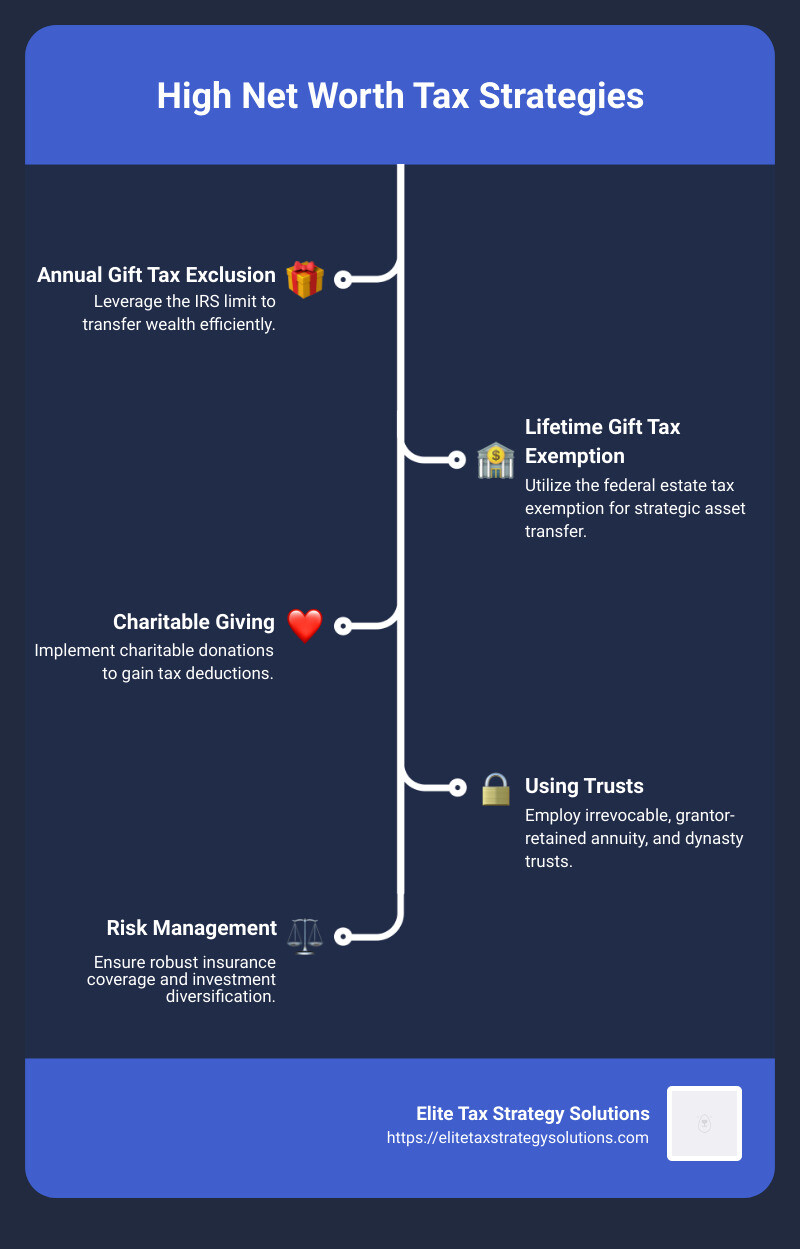
High net worth tax strategies are crucial for maintaining and growing your wealth. Here are some key strategies you might consider:
- Leveraging the annual gift tax exclusion
- Utilizing the lifetime gift tax exemption
- Implementing charitable giving
- Using various trusts
- Engaging in robust risk management
Tax planning isn’t only about reducing your taxes but also preserving and growing your wealth. For ultra-high-net-worth families, have a comprehensive plan that balances tax efficiency and long-term financial stability. This involves strategies like investment diversification, insurance coverage, and maintaining estate liquidity to manage potential tax liabilities.
Given the complexity of tax laws and the unique challenges faced by wealthy individuals, working with a seasoned financial advisor is paramount. A knowledgeable advisor can provide custom solutions that align with your financial goals while ensuring compliance with all tax regulations.
My name is David Fritch, and with over 40 years of experience in tax planning and wealth management, I specialize in helping high-income earners and business owners optimize their tax efficiency and secure financial stability.
Understanding High Net Worth Tax Challenges
High-net-worth individuals face unique tax challenges that can significantly impact their wealth if not managed properly. Let’s explore these challenges:
High Tax Rates
Ultra-high-net-worth individuals often find themselves in the highest tax brackets. This means a significant portion of their income goes to taxes. For instance, in the U.S., the top federal income tax rate is 37% for individuals earning over $539,900 and married couples earning over $647,850 as of 2023. This high tax rate can erode wealth quickly if not managed effectively.
Complex Tax Laws
The tax code is intricate and constantly changing. Navigating these complexities requires a deep understanding of current laws and regulations. For example, the Tax Cuts and Jobs Act (TCJA) introduced several changes that will sunset in 2025, potentially altering tax liabilities significantly. Staying informed and proactive is crucial to leveraging tax benefits and minimizing liabilities.
International Tax Issues
Many high-net-worth individuals have assets and interests in multiple countries. This global footprint introduces additional layers of complexity due to different tax laws and reporting requirements in each jurisdiction. For example, understanding how international tax treaties impact liability is essential to avoid double taxation and ensure compliance.
Diverse Income Streams
High-net-worth individuals typically have multiple income streams, including investments, businesses, and real estate holdings. Each source of income can be taxed differently, making it crucial to have a comprehensive tax plan. For instance, capital gains from investments are taxed differently than ordinary income, and rental income from real estate has its own set of rules and deductions.

Case Study: Managing Complex Tax Situations
Consider the hypothetical case of an ultra-high-net-worth individual with investments in the U.S., Europe, and Asia, along with multiple businesses and real estate holdings. This individual faced significant tax challenges due to varying international tax laws and diverse income streams. By working with a specialized financial advisor, they were able to develop a comprehensive tax plan that included:
- Utilizing international tax treaties to minimize double taxation
- Leveraging deductions and credits available for their business and real estate investments
- Implementing strategies to manage their high tax rate, such as charitable giving and trusts
By addressing these complex tax challenges, they were able to preserve and grow their wealth effectively.
Conclusion
Understanding and managing these tax challenges is crucial for high-net-worth individuals. With the right strategies and professional guidance, you can steer high tax rates, complex laws, international issues, and diverse income streams to optimize your tax efficiency and preserve your wealth.
Next, we’ll dig into key high net worth tax strategies to help you further optimize your tax efficiency.
Key High Net Worth Tax Strategies
Annual Gift Tax Exclusion
One effective tax strategy for high-net-worth individuals is leveraging the annual gift tax exclusion. This allows you to gift up to $18,000 per recipient annually without incurring gift taxes, starting in 2024. For married couples, this amount doubles to $36,000.
Example: If you gift $18,000 each to five grandchildren, you can transfer $90,000 tax-free annually. Over time, this can significantly reduce your taxable estate.
Lifetime Gift Tax Exemption
The lifetime gift tax exemption is another powerful tool. In 2024, the exemption is $13.61 million per individual and $27.22 million for married couples. Gifts exceeding the annual exclusion count against this lifetime limit.
Tip: Strategic use of this exemption can help transfer substantial assets to heirs while minimizing federal estate taxes.
Charitable Giving
Charitable donations not only benefit society but also offer substantial tax advantages. Donations to qualified charities can lower your taxable income. Establishing a donor-advised fund or a charitable foundation can facilitate long-term giving while optimizing tax benefits.
Case Study: The Gates Foundation, founded by Bill and Melinda Gates, is an example of using charitable foundations for philanthropy and tax efficiency. They have donated billions while enjoying significant tax deductions.
Using Trusts
Trusts are versatile tools for high-net-worth tax strategies. Here are a few key types:
- Irrevocable Life Insurance Trusts (ILITs): These can remove life insurance proceeds from your taxable estate.
- Grantor-Retained Annuity Trusts (GRATs): Allow you to transfer assets while retaining an annuity, potentially reducing estate taxes.
- Dynasty Trusts: Designed to last for multiple generations, helping to minimize estate taxes over a long period.
Tip: Trusts can also enable income splitting, distributing income among beneficiaries in lower tax brackets to reduce overall tax liability.
Risk Management
Effective risk management is crucial for preserving wealth. This includes:
- Insurance Coverage: Ensure you have adequate life, health, and property insurance to protect against unforeseen events.
- Investment Diversification: Spread investments across various asset classes to minimize risk.
- Estate Liquidity Planning: Maintain sufficient liquid assets to cover estate taxes and other expenses without forcing the sale of illiquid assets.
Example: Proper insurance coverage and a diversified investment portfolio can safeguard your wealth against market volatility and other risks.

These high net worth tax strategies can significantly improve your tax efficiency and wealth preservation. Next, we’ll explore advanced tax planning techniques to further optimize your financial strategy.
Advanced Tax Planning Techniques
Tax Lot Matching
Tax lot matching is a strategic way to manage capital gains on investments. Instead of using the IRS’ default first-in, first-out (FIFO) method, you can choose which specific shares to sell. This allows you to minimize taxable gains or even realize losses.
Example: If you own 100 shares of a stock bought at different prices, you can sell the shares with the highest purchase price first to reduce your taxable gain.
Roth Conversions
Converting a traditional IRA to a Roth IRA can offer significant tax benefits. While you pay taxes on the converted amount now, the future withdrawals are tax-free. This is particularly beneficial if you expect to be in a higher tax bracket in retirement.
Tip: Consider a Roth conversion during a year when your income is lower to minimize the tax impact. This strategy can also help with estate planning, as heirs can inherit Roth IRAs tax-free.
Tax Loss Harvesting
Tax loss harvesting involves selling investments at a loss to offset gains elsewhere in your portfolio. This can reduce your taxable income and improve your portfolio management.
Example: If you have a $10,000 gain on one stock and a $5,000 loss on another, selling the losing stock can reduce your taxable gain to $5,000.
1031 Exchanges
A 1031 exchange allows you to defer capital gains taxes on real estate transactions by reinvesting the proceeds into a similar property. This can help you grow your real estate portfolio without immediate tax consequences.
Case Study: A real estate investor sells a rental property and uses a 1031 exchange to buy a larger property within six months. This defers the capital gains tax, allowing the investor to use more capital for the new investment.
These advanced tax planning techniques can help you optimize your tax efficiency and improve your overall financial strategy. Next, we’ll explore estate planning for high net worth individuals to ensure your wealth is preserved for future generations.
Estate Planning for High Net Worth Individuals
Estate planning is crucial for high net worth individuals to ensure their wealth is preserved and passed on efficiently. Here are some key strategies to consider:
Estate Taxes
Estate taxes can significantly reduce the wealth you pass to your heirs. As of 2023, the federal estate tax exemption is $12.92 million per individual. Amounts above this are taxed at 40%. For married couples, this exemption doubles to $25.84 million.
Fact: The current exemption is set to sunset in 2026, potentially lowering the threshold and increasing tax liabilities.
Family Limited Partnerships (FLPs)
Family Limited Partnerships (FLPs) are powerful tools for managing and transferring wealth. They allow you to:
- Consolidate family assets: Pool assets into a partnership, simplifying management.
- Gift partnership interests: Transfer ownership to heirs while retaining control.
- Reduce taxable value: Discounts for lack of control and marketability can lower the taxable value of transferred interests.
Example: A family pools real estate assets into an FLP. Parents gift limited partnership shares to their children, reducing their taxable estate while maintaining control over the assets.
Family Limited Liability Companies (FLLCs)
Family Limited Liability Companies (FLLCs) offer similar benefits to FLPs but with added flexibility:
- Asset protection: Shield personal assets from business liabilities.
- Tax advantages: Pass-through taxation avoids double taxation.
- Control and management: Retain control while transferring ownership.
Case Study: A high net worth family uses an FLLC to manage a diverse portfolio, including real estate and investments. They gift membership interests to their children, reducing estate taxes while protecting assets from creditors.
Intergenerational Wealth Transfer
Efficient intergenerational wealth transfer ensures your legacy benefits future generations. Here are some strategies:
- Trusts: Use irrevocable trusts, like Dynasty Trusts, to pass assets tax-efficiently across generations.
- Gifting: Use the annual gift tax exclusion ($17,000 per recipient in 2023) and lifetime gift tax exemption to transfer wealth during your lifetime.
- Life insurance: Irrevocable Life Insurance Trusts (ILITs) can provide liquidity to pay estate taxes, ensuring your heirs receive their inheritance intact.
Example: A family sets up a Dynasty Trust, transferring $13.61 million to benefit children and grandchildren. This avoids estate taxes at each generational level, preserving wealth.
By implementing these estate planning strategies, high net worth individuals can optimize their tax efficiency and ensure their wealth is preserved for future generations.
Next, let’s address some frequently asked questions about high net worth tax strategies.
Frequently Asked Questions about High Net Worth Tax Strategies
How can high earners reduce taxable income?
Retirement Plans: Contributing to retirement plans like 401(k)s or IRAs can significantly reduce your taxable income. For small business owners, setting up a SEP IRA or Solo 401(k) can offer even more substantial tax benefits.
Deductible Expenses: High earners should maximize deductible expenses. This includes mortgage interest, medical expenses, and charitable donations.
Income Timing: Timing the receipt of income and the payment of expenses can also reduce tax liability. Deferring bonuses or accelerating deductions into the current year can be effective strategies.
What are the tax strategies for ultra-high-net-worth individuals?
Asset-Leveraged Loans: Ultra-high-net-worth individuals can take out loans using their assets as collateral. This allows them to access liquidity without selling the assets and triggering capital gains taxes.
Investment Diversification: Diversifying investments across different asset classes and geographical locations can optimize tax efficiency. This includes international investments that may benefit from favorable tax treaties.
Tax Deferral: Utilizing tax-deferred investment accounts, like certain annuities and retirement accounts, can delay tax payments. This allows wealth to grow tax-free until withdrawal.
How do high net worth individuals avoid taxes?
Tax-Advantaged Savings: Utilizing accounts like Roth IRAs and Health Savings Accounts (HSAs) can provide tax-free growth and withdrawals under certain conditions.
Charitable Donations: Charitable giving can provide significant tax deductions. Establishing a donor-advised fund allows high net worth individuals to make a large, tax-deductible donation while distributing the funds to charities over time.
Investment Loss Harvesting: Selling investments at a loss to offset gains from other investments can reduce taxable income. This strategy, known as tax loss harvesting, can be particularly effective in managing a diversified portfolio.
By implementing these high net worth tax strategies, individuals can optimize their tax efficiency, preserve their wealth, and ensure financial stability.
Conclusion
At Elite Tax Strategy Solutions, we understand that optimizing your tax efficiency is crucial for preserving wealth and achieving long-term financial stability. Our team of seasoned tax professionals is dedicated to providing proactive tax optimization strategies custom to the unique needs of high-income earners and small business owners.
Proactive Tax Optimization
Tax planning is not just about filing returns; it’s about being proactive. By staying ahead of tax law changes and implementing strategies like annual gift tax exclusion, lifetime gift tax exemption, and charitable giving, we help you minimize your tax liabilities effectively. We also specialize in advanced techniques such as tax lot matching, Roth conversions, and tax loss harvesting to further improve your tax efficiency.
Financial Stability
Our goal is to ensure your financial stability by integrating tax planning with your broader financial goals. Whether it’s retirement planning, education funding, or intergenerational wealth transfer, our comprehensive approach ensures that every aspect of your financial life is optimized for tax efficiency.
In conclusion, high net worth tax strategies are essential for anyone looking to preserve their wealth and achieve financial stability. At Elite Tax Strategy Solutions, we are committed to guiding you through this complex terrain with expertise and personalized service.
Ready to optimize your tax efficiency? Contact Elite Tax Strategy Solutions today and take the first step towards a financially secure future.